


Talk:Diffraction
 | This  level-4 vital article is rated B-class on Wikipedia's content assessment scale. level-4 vital article is rated B-class on Wikipedia's content assessment scale.It is of interest to the following WikiProjects: | |||||||||||||||||
| ||||||||||||||||||
.jpg?lang=en)


Diffractive Optics
[edit]"Diffractive Optics" redirects to this article. Diffractive Optics is a technique for making smaller and lighter lenses. It has nothing whatsover to do with the content of this article. 86.147.237.233 (talk) 12:40, 17 March 2012 (UTC)
- Actually, these lighter lenses you refer to work by the principles of diffraction described in this article. But if you'd like to start an article on diffractive optics, that would probably be OK, too. Dicklyon (talk) 18:46, 17 March 2012 (UTC)
- Are you sure about that? I was under the impression that "Diffractive Optics" was just a Canon marketing term for Fresnel lenses which don't actually work by diffraction. The DO lenses contain Fresnel lenses. Even so, the article doesn't mention the lens construction so my point stands. 86.147.237.233 (talk) 14:32, 22 March 2012 (UTC)
- I have seen reference to diffractive optics being a Canon marketing term in several reviews. Diffraction in a camera lens is a bad thing to be avoided where possible. Every camera lens suffers from the degrading effects of diffraction to some extent. The light travelling through a lens always diffracts around the aperture blades softening the image to some extent. As the aperture gets smaller, the diffracted light becomes a larger proportion of the total light throughput detracting from the sharpness of the image. In general, lenses usually give their sharpest image somewhere around f/8. When lenses are constructed out of Fresnel lenses, the steps between the lens segments introduces several further edges around which light diffracts, thus diffractive optic lenses have a lower optical performance. 109.145.22.224 (talk) 12:31, 5 April 2012 (UTC)
Propagation of a laser beam
[edit]In this section, it is mentioned "Hence, the smaller the output beam, the quicker it diverges". Here, does "smaller" mean a smaller size or something else? Hopefully someone can help me with this question, thanks! AlexHe34 (talk) 15:14, 30 March 2012 (UTC)
- When light is incident on an aperture, the angle into which it is diffracted is inversely proportional to the size of the aperture. One can view the output beam of a laser as being defined by the output aperture of the system. This is much smaller in a semiconductor laer than in, say a He-Ne laser, hence the semiconductor beam spreads out much more than a He-Ne one. It can, of course be collimated (converted into a beam which spreads only very slowly), as in a laser pointer, by using a lens.Epzcaw (talk) 20:50, 22 July 2012 (UTC)
I have fixed few other things here. Laser mirror is a resonator, not an aperture. And the laser beam is not always a fundamental mode (in fact, almost never). — Preceding unsigned comment added by Khrapkorr (talk • contribs) 20:30, 10 February 2015 (UTC)
Double-slit diffraction
[edit]You write: "Thomas Young performed a celebrated experiment in 1803 demonstrating interference from two closely spaced slits.[10]"
If you actually read the Bakerian lecture you reference [10] you will see that he does not discuss the celebrated double-slit experiment, nor is the diagram you print in that lecture. the only place Young mentions the experiments is in his popular lectures before Royal Institution (pub. 1807). The diagram is in fact from his lecture on hydraulics, not light, and although he describes a two-slit experiment, he never claims he actually did it. Furthermore the wavelengths he quotes for the wavelengths of light is from the Newton's rings experiment. There is no clear evidence that Young ever performed the experiment.
Tony Rothman
explain me the double slit diffraction (Radhika thakur (talk) 15:19, 21 April 2012 (UTC))
- See Double-slit experiment. Also see the comment in this (Diffraction) article about the difference between interference and diffraction. Epzcaw (talk) 07:52, 13 July 2012 (UTC)
Connection to the Heisenberg Uncertainty Principle?
[edit]I'm posting this here with the hope that a definitive answer could be included in an amended version of the main article. It was once explained to me in class when I was an undergraduate that single-slit diffraction could be understood in terms of the Heisenberg uncertainty principle. The argument goes as follows: Imagine an incident plane wave of light at wavelength "λ" approaching a 1-dimensional slit aperture from the left, which I will define as the "x" direction. The slit is of height "d" along the "y" direction, and for simplicity's sake is infinite along the z direction. Light must pass through the slit in the form of photons, and the Heisenberg uncertainty principle places limits on these photons' momenta. Specifically, we know that as a photon passes through the slit, its vertical position is known to within an uncertainty "d/2," so the vertical component of momentum, "p_y", is only defined to within a precision of hbar / d.
Now, because the incident light was coming in with wavelength λ, we know that each photon’s total momentum must be 2 π hbar / λ. We can combine the two relationships to give the following relation,

To within some factors of π and 2 that can probably be explained away by the specific geometry of the slit, this is exactly the width of the central peak in Fraunhofer diffraction.
My question is this: What happens when the slit becomes narrower than lambda / (2 pi)? That is to say, what happens when the slit becomes so narrow that a photon passing though it must acquire an uncertainty in transverse momentum which is greater than the photon’s total momentum was to begin with? Two possibilities come to mind:
- (a) When the slit gets that narrow, light simply cannot get through. This seems reasonable except for the fact that once you close down the slit even a single photon that sneaks through the slit would have to violate the uncertainty principle. Transmittance that is identically zero seems difficult to swallow.
- (b) When the slit becomes very narrow, it begins to resemble a cavity where photons can be up-converted to higher energy and momentum. Would this mean that forcing light to pass through a narrow slit changes its color?
Thanks in advance for any thoughts. Csmallw (talk) 04:57, 29 June 2013 (UTC)
Offering a MUCH better example of diffraction - Don Quixote's Windmill.
[edit]When you look at "point-like" lights through a rectangular grid, you see four diffraction spikes around each light. This is called a Don Quixote's Windmill, and that should be a heading that re-directs to this page. The best and most common example of this is looking at outside street lighting through an insect screened window or door at night time. Amazingly perceptive yet totally simple spectrographic analysis can be performed just from this phenomenon alone. For example, the difference between incandescent and metal-vapour emission lighting (such as sodium)is immediately obvious. Other examples are looking through lace or sheer curtains. I am happy to take and post some images and do a brief write-up of all of this, but someone else would have to do the redirect. 121.216.26.225 (talk) 09:54, 9 November 2014 (UTC)
- The phenomenon you describe is indeed a nice everyday example of diffraction, so images of that be welcome. As for its name, a quick search on Google Books didn't turn up a clear reference for "light diffraction Don Quixote". Fgnievinski (talk) 14:11, 9 November 2014 (UTC)
OK, then, will do. My WIkiactivity is very erratice so it will take some time. — Preceding unsigned comment added by 121.216.207.197 (talk) 10:52, 10 November 2014 (UTC)
- I am bewildered. Iam familiar with this effect but am new to the name. I came looking for an explanation of how a Bahtinov mask works. But Bahtinov masks and lace curtains do not have sizes that approach the wavelengths of the (generally) incoherent light affected, they are just repeating patterns - so how can diffraction occur with patterns at such macro scales? The article needs to explain this as it is a phenomenon the article suggests can't happen. Stub Mandrel (talk) 09:10, 19 May 2015 (UTC)
- I've removed it from the article for now, given the item you mention is a redlink, we don't have any cite to meet the verifiability policy for it, and considering the concern raised here that it seems to contradict the other cited content. DMacks (talk) 14:12, 19 May 2015 (UTC)
- I am bewildered. Iam familiar with this effect but am new to the name. I came looking for an explanation of how a Bahtinov mask works. But Bahtinov masks and lace curtains do not have sizes that approach the wavelengths of the (generally) incoherent light affected, they are just repeating patterns - so how can diffraction occur with patterns at such macro scales? The article needs to explain this as it is a phenomenon the article suggests can't happen. Stub Mandrel (talk) 09:10, 19 May 2015 (UTC)
"... Diffraction in the atmosphere by small particles can cause a bright ring to be visible around a bright light source like the sun or the moon. ...
[edit]Err, no these bright rings are caused by atmospheric REFRACTION. If you follow the link it even warns you not to confuse the two. 121.216.26.225 (talk) 09:58, 9 November 2014 (UTC)
- When the particles are small and, accordingly, the mechanism ambiguous, we really ought to use the word "scattering" rather than "diffraction", "refraction", or "reflection". In this case, if the particles are opaque then "refraction" is definitely not the right word for what is happening.2001:480:91:3304:0:0:0:658 (talk) 19:38, 25 June 2021 (UTC)
Diffraction Pattern of red Laser beam
[edit]This image on the front page is named as "Laser Interference" by the uploader. Could the author actually upload a interference pattern rather than diffraction pattern? As far as I know, it's possible to produce such pattern with Michelson and Morley setup. — Preceding unsigned comment added by Mywtfmp3 (talk • contribs) 07:04, 8 September 2015 (UTC)
External links modified
[edit]Hello fellow Wikipedians,
I have just added archive links to one external link on Diffraction. Please take a moment to review my edit. If necessary, add {{cbignore}} after the link to keep me from modifying it. Alternatively, you can add {{nobots|deny=InternetArchiveBot}} to keep me off the page altogether. I made the following changes:
- Added archive http://web.archive.org/web/20160101000520/http://scripts.mit.edu/~raskar/lightfields/index.php?title=An_Introduction_to_The_Wigner_Distribution_in_Geometric_Optics to http://scripts.mit.edu/~raskar/lightfields/index.php?title=An_Introduction_to_The_Wigner_Distribution_in_Geometric_Optics
When you have finished reviewing my changes, please set the checked parameter below to true to let others know.
This message was posted before February 2018. After February 2018, "External links modified" talk page sections are no longer generated or monitored by InternetArchiveBot. No special action is required regarding these talk page notices, other than regular verification using the archive tool instructions below. Editors have permission to delete these "External links modified" talk page sections if they want to de-clutter talk pages, but see the RfC before doing mass systematic removals. This message is updated dynamically through the template {{source check}} (last update: 5 June 2024).
- If you have discovered URLs which were erroneously considered dead by the bot, you can report them with this tool.
- If you found an error with any archives or the URLs themselves, you can fix them with this tool.
Cheers.—cyberbot IITalk to my owner:Online 08:53, 27 February 2016 (UTC)
Not really geometric shadow
[edit]@Johnjbarton, I think your addition of "geometric shadow" is not really correct. As one simple case, consider the focussing of an electron beam as it goes through a single atom (or a string). At least close to the atom you get increased probability. (John Cowley actually tried to get this to work for super-resolution before Cs-correction became possible.) I think there is a comparable effect for an aperature with any type of wave. Please change the lead back, bending is really more appropriate. Ldm1954 (talk) 21:16, 31 December 2024 (UTC)
- The previous lede was:
- Diffraction is the interference or bending of waves around the corners of an obstacle or through an aperture into the region of geometrical shadow of the obstacle/aperture.
- This sentence placed "interference" equivalent (or) to "bending of waves" which can't be right.
- My version:
- Maybe clearer would be
- So my edit did not add geometric shadow but I left it and it seems ok to me. My edit was based on Hecht's first paragraph on Diffraction:
- deviation of light from rectilinear propagation...the effect is a general characteristic of wave phenomena occurring whenever a portion of a wavefront, be it sound, a matter wave, or light, is obstructed in some way. This is similar to "bend" without using that word. "Bending of waves" sounds exactly like "refraction" to me.
- Having "geometrical shadow" in here makes sense to me in that the optics divides in to "geometrical optics" and "physical optics" when we arrive at interference and diffraction. So Hecht's first sentence in his diffraction chapter talks about "an intricate shadow made up of bright and dark regions quite unlike anything one might expect from the tenets of geometrical optics". Born and Wolf also start out with "the simple geometrical model of energy propagation was inadequate" when they begin diffraction.
- I'm unsure how focusing of an electron beam through an single atom relates but I would be happy to read more about that. At least as an optical analog at lower energies this would also be refraction as the electron wave encounters a gradation in the medium. To be sure, diffraction and refraction are naming effects at sharp classical boundaries and they don't apply crisply to continuous changes.
- Diffraction in crystals of say plane waves surely creates waves at angles to the original direction and one could say the the overall effect is to "bend" the wave. But is that the best word? In my mind, I bend a wire or my elbow: I have a hard time applying that as a metaphor for crystal diffraction with so many outgoing rays, but most especially since "bend" leaps out when one uses geometrical optics. Johnjbarton (talk) 23:47, 31 December 2024 (UTC)
- I did not notice that the "shadow" term was already there, mea culpa. That said, it remains inappropriate.
- If we go all the way back to the original electron (and x-ray) diffraction work, in neither case are there true apertures or obstacles. Electrons are "bent" by the electrostatic potential, x-rays by the charge density. With light you get diffraction due to variations in the refractive indices, e.g. opals. (I am sure that acoustic waves going through a variable medium will show similar effects, probably others as well.)
- I recognize that "bending" is not a great scientific term, but I think it is adequate. How about, which is also consistent with the last paragraph of the lead:
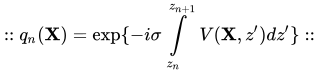
- To a first approximation you would use for a single atom the form from Multislice
- and you can change V(r) to charge density for x-rays, and similar for other cases. This form is called the Projected potential approximation (I need to write some pages on dynamical diffraction). N.B., the Multislice page needs a little repair, some good, some bad tweaks from when my students created it for a class in 2013. Ldm1954 (talk) 00:29, 1 January 2025 (UTC)
- Unfortunately we do not agree. The classical explanation of the original electron/xray diffraction work would use Huygens principle to demonstrate constructive interference due to a periodic pattern of scattering centers lit by the incoming wave. Simple point scattering centers would give the pattern, the details of the atoms is a higher order effect. The bending of sound waves in variable media and opalescence are generally considered refraction.
- So let me ask you: how would you describe refraction? To me it is "bending due to change in the medium", or as Hecht says it:
The fact that the incident rays are bent or "turned out of their way" as Newton put it, is called refraction.
Johnjbarton (talk) 01:41, 1 January 2025 (UTC)- Sorry, but you are wrong on this, it is not a disagreement issue. The first papers used geometry, but got a slightly wrong result. Hans Bethe gave the correct explanation by solving Schroedinger's equation, with the slight glitch that he did not use the relativistic wavelength. See references in Electron diffraction#Waves, diffraction and quantum mechanics.
- Your Huygens approach is an approximation of delta functions in the multislice formulation for the potential scattering; the propagator is the Greens function. A decent source is John Maxwell Cowley's book or more recently Peng, Dudarev & Whelan. Ichizuka's papers are decent as well, or the original Cowley-Moodie papers.
- Refraction is quite different. For electrons it is related to the average direction and how this changes due to the mean inner potential. It comes from the boundary conditions of equal probability current. That is also in Peng, Dudarev and Whelan and a few other places. Refraction is due to a discontinuous change, and the same form applies to photons, matter waves, brownies etc -- for photons use the Poynting vector.
- There are a stack of sources in Electron diffraction; I can send some papers tomorrow if needed.
- N.B., the multislice approach is a numerical solution that has also been used for x-rays, neutrons, light. It is similar to Pendry's method for LEED, but for high energies back scattering is negligable. Ldm1954 (talk) 02:31, 1 January 2025 (UTC)
- N.B. for refraction you match the derivatives across the boundary, for instance of a prism for light or a crystal for matter waves or xrays. More can be found in the sources cited at https://journals.jps.jp/doi/10.1143/JPSJ.18.1306 as one example, it is well documented. Ldm1954 (talk) 03:41, 1 January 2025 (UTC)
- In my opinion the introductory paragraph should describe the wave phenomena of diffraction and refraction in the way it is introduced in physics undergrad courses. Highly specialized content related to electron diffraction is already covered on that page. Johnjbarton (talk) 23:49, 1 January 2025 (UTC)
- Please check WP:LEAD, they are summaries. Independent of that "shadow" is just wrong for all waves, there is no need here for lies to children. This is not "specialized"content, it is diffraction physics 101, please check Cowleys book. I have spent 40 years teaching and researching diffraction, please recognise that I might know what I am saying. Ldm1954 (talk) 00:03, 2 January 2025 (UTC)
- I agree that this article can use additional work. Johnjbarton (talk) 00:21, 2 January 2025 (UTC)
- I will add it to my "to do" list. I have to finish a review which has climbed to 550 refs first. Ldm1954 (talk) 00:31, 2 January 2025 (UTC)
- I agree that this article can use additional work. Johnjbarton (talk) 00:21, 2 January 2025 (UTC)
- Please check WP:LEAD, they are summaries. Independent of that "shadow" is just wrong for all waves, there is no need here for lies to children. This is not "specialized"content, it is diffraction physics 101, please check Cowleys book. I have spent 40 years teaching and researching diffraction, please recognise that I might know what I am saying. Ldm1954 (talk) 00:03, 2 January 2025 (UTC)
- In my opinion the introductory paragraph should describe the wave phenomena of diffraction and refraction in the way it is introduced in physics undergrad courses. Highly specialized content related to electron diffraction is already covered on that page. Johnjbarton (talk) 23:49, 1 January 2025 (UTC)
- N.B. for refraction you match the derivatives across the boundary, for instance of a prism for light or a crystal for matter waves or xrays. More can be found in the sources cited at https://journals.jps.jp/doi/10.1143/JPSJ.18.1306 as one example, it is well documented. Ldm1954 (talk) 03:41, 1 January 2025 (UTC)
Section on single-slit diffraction should have a real-life picture
[edit]I noticed that the subsection on single-slit diffraction on this article lacked any photographic example of the effect in real life. This is a basic point for improvement, as common sense would suggest.
So I decided to use a photograph of mine of a blue laser beam's single slit diffraction pattern being projected on a wall, a completely valid example. Below is the photo itself in case anyone is curious:

But this got reverted, because:
This does not appear to add anything substantive and new to the already large collection of images making a mess of the layout here.
The whole argument makes no sense to me.
- "This does not appear to add anything substantive and new"
Really?
I'd reckon it's pretty substantive considering that there are no images of single-slit (non-circular aperture) light diffraction on the article, only diagrams (which are excellent, but do not suffice alone in completely informing readers of such an optical phenomenon) but no photos.
Additionally, how many pictures of blue laser diffraction do you come across? Not a lot, so I'd say the use of blue light as an example (which kinda infers such an effect occurs across the whole spectrum, not just the traditionally-used green and red laser beams) was also quite fair.
- " to the already large collection of images making a mess of the layout here."
I understand that cluttering and/or an overabundance of images on an article is not a good thing, but it wasn't like that at all (and, if anything, wouldn't simple reasoning argue that generally more images would mean more information and therefore improvement upon an article?). One may view the now-reverted version and they'll see that the image fits in just fine (not too small, not too large, not poking outside the subsection, its relevant to the content, etc).
Though, perhaps, it appears to mess up the layout a bit if viewed on a small screen device (e.g. a phone). Nonetheless, on a desktop screen like that of a PC, it's perfect. And the article's layout already looks terrible on phones anyways (likely no way to easily fix that without causing more problems).
I apologise if there is anything I have misjudged or if my tone is overly aggressive, I just feel as though what happened was really the wrong decision.
Anyone's thoughts or willingness for action on the matter would be much appreciated.
Kind regards, Xyqorophibian (talk) 03:57, 1 November 2025 (UTC)
- I somewhat agree with the reversion by DMacks. The page already has a lot of images, snd there is a small image above the single-slit line plot. More importantly, you have a bit of an arc in your image which will confuse non-experts as they won't know why it is there. I suspect your illumination is not fully centered on the slit, but that is just my intuitive guess. (You may also need to defocus your illumination.) Ldm1954 (talk) 05:52, 1 November 2025 (UTC)
- Thank you for your comment, @Ldm1954.
- That other image you are referring to does indeed accurately illustrate such single-slit diffraction, however, it is an animated simulation, not a real-life photograph (which is what I'm advocating for).
- I won't deny that there are a lot of images in the article, but I think that part of the reason as to why it feels like too many is the distribution of them (e.g. the intro to the "examples" section would be much nicer if the images were arranged differently, like, for example, if the images were arranged like those in the section "mechanism"). But, of course, there's also just personal preference and subjective opinion over the matter.
- About my photo and how the projected pattern has a bit of an "arc", I agree with you that this is a slight concern. I suspect its either (or perhaps both) due to poor photography equipment (the photo was taken using my phone, hence the mediocre sharpness) or slight misalignment from the gap's centre as the beam passed through (hence the projected pattern's asymmetrical illumination).
- If clarifying slight misalignment as a consequence of this effect is insufficient, then I'd be completely willing to redo the photograph. In fact, I've got an idea for a new photograph which involves comparing the diffraction patterns of different coloured lasers passing through similar apparatuses and being projected on the same surface at equal distances. This could, perhaps, be a good demonstration of diffraction pattern formulae (e.g. ym = mλL/a, namely for the case of single-slit diffraction [which is what the topic's in reference to]) and I think I'd be able to pull it off.
- Great discussion.
- Kind regards, Xyqorophibian (talk) 07:59, 1 November 2025 (UTC)
- If the goal is to illustate single-slit with an actual photograph, which I agree can be useful both to novice and advanced readers, in a way that our other images don't, then it needs to be a high quality photograph that does not have off-topic artifacts (confusing to novice, either distracting or potentially incorrect for advanced). How about File:Slit 20um 40um.jpg, which appears to be high quality, no distractions, and also adds the effect of slit-width. That makes it more directly "better than the animation", rather than "photo, but omits a detail". Or File:Diffraction sunlight - color channels.jpg, that instead adds the effect of wavelength.
- I'm not sure the best layout...maybe scrapping the animation in favor of side-by-side of the two photos I note (concept: "here are the effects of the two independent variables in the equation")? When I was using a wide screen, the newly added image appeared deep into the "Diffraction grating" section. DMacks (talk) 14:54, 1 November 2025 (UTC)
- Hello @DMacks, your response and collaborative approach is much appreciated. Let's go through this.
- The two images you have proposed are solid examples, especially File:Diffraction sunlight - color channels.jpg. I think the latter is the better option as it demonstrates how wavelength and fringe length are related (amongst other things, such as the polychromatic nature of solar radiation and how diffraction can [vaguely speaking] act as a decomposer of electromagnetic waves), it's definitely decent but I'm afraid I can't entirely agree that it is the best option in terms of image quality (as the sharpness is sufficient but not optimal, but its still far better than the former image in this respect).
- I think that replacing the animation with this image would probably be the best decision for layout if we really must avoid image cluttering in this case, but I'm still trying to determine whether the use of lasers would be a better choice than using sunlight (because with lasers, the diffraction patterns turn out sharper and also the other variable of distance between surface of projection and slit becomes more adjustable). Though at this point, I'm thinking that there's so much to be discussed with the special case of single-slit diffraction that perhaps a new article on it must be established rather than trying to condense (and, in doing so, trim other notable stuff) it all into a subsection of this article.
- If we'd really like to get an image that ticks all (or, at least most) relevant boxes, here's my new refined idea of using a "six in one" GIF:
- Separate into 6 equal component boxes.
- Insert videos of equal length and quality into each panel, and turn the resultant video into a GIF.
- Columns are based on laser colour (i.e. wavelengths for red, green and blue laser beams).
- Rows are associated with the other variables (i.e. slit size and distance from surface of projection).
- Synchronise all 6 GIFs, so as to convey the dependencies even more coherently (but also to reduce the potentially-distracting nature of the GIFs being unsynchronised).

Diagram for comparative laser diffraction idea - Admittedly, this sounds a bit ambitious, however, it'd display the relationships between diffraction patterns and these 3 variables in a manner that is not only photographically evident but visually active. If it's too much though, I guess we should probably just go with using File:Diffraction sunlight - color channels.jpg as a replacement (still, in the other option of going with the lasers, this sunlight diffraction image would be a good temporary substitute).
- Other than that, I'm surprised about your comment regarding the placement of my image as shown on your wide screen (that is, if I've understood you correctly). Strange.
- Sorry for replying so late, I've been busy the last few days but its not as if I've lost interest.
- Kind regards, Xyqorophibian (talk) 07:18, 4 November 2025 (UTC)

- Let me chime in in favor of the sunlight image over the proposed gif. Having an animation with 6 different frames to compare is quite challenging for the viewer to appreciate: the moment you move from one slot to another, it is already a different frame, etc. Then, there is already an animation in the article showing the dependence on both the distance and the width slit (in one frame). And finally, the dependence on the distance and the width would look essentially the same in the photos, so it will be overwhelming with variety that does not actually exist; if to go this route, I would propose changing a single parameter (width/distance). But I still think that a single still image would be better here. Maybe I'll try to take a photo through a slit of varying width to incorporate the width dependence?L3erdnik (talk) 13:55, 4 November 2025 (UTC)
- Thank you for chiming in, @L3erdnik.
- While I don't agree completely with your remarks, perhaps the 6 panel GIF idea was not a very pedagogically-accessible one.
- I think that just one photo (like the one I inserted before, except of higher quality) of single-slit diffraction would be the best route in this case, though your idea is surely interesting (and File:Diffraction sunlight - color channels.jpg is still a solid option too).
- I guess I'll see if I can make a better laser diffraction photo, if I do then I'll post in on Wikimedia Commons and in here. If not, we should probably go with one of the other two options.
- Kind regards, Xyqorophibian (talk) 05:13, 8 November 2025 (UTC)
- Let me chime in in favor of the sunlight image over the proposed gif. Having an animation with 6 different frames to compare is quite challenging for the viewer to appreciate: the moment you move from one slot to another, it is already a different frame, etc. Then, there is already an animation in the article showing the dependence on both the distance and the width slit (in one frame). And finally, the dependence on the distance and the width would look essentially the same in the photos, so it will be overwhelming with variety that does not actually exist; if to go this route, I would propose changing a single parameter (width/distance). But I still think that a single still image would be better here. Maybe I'll try to take a photo through a slit of varying width to incorporate the width dependence?L3erdnik (talk) 13:55, 4 November 2025 (UTC)
- Hi all,
- It’s been a while, but I suppose it’s never too late for potential improvement.
- The idea of including a photographic example of single‑slit laser diffraction came back to mind recently, and over the last two days I’ve tried to capture a cleaner photo. This is the best attempt I’ve managed so far. It avoids the arc/misalignment issues from the earlier version and shows the central maximum and side fringes clearly enough for a real‑world demonstration.

- I’d appreciate consensus on whether this would be considered adequate for the single-slit subsection, or if any adjustments would help it fit better (If consensus prefers, I’m happy to add a caption or explanatory note to clarify the setup and limitations).
- Kind regards, Xyqorophibian (talk) 10:03, 12 January 2026 (UTC)
- The quality of the image looks good. I'm surprised however by the lack of structure above and below the vertical axis. A tall vertical slit will show tall vertical fringes; a squarish slit will show diffraction along the vertical and horizontal axis. Perhaps you can add caption here? Johnjbarton (talk) 17:46, 12 January 2026 (UTC)
- Hi @Johnjbarton, thank you.
- There is some vertical structure — the fringes do taper in height with distance from the central maximum, though not dramatically. I agree that noting this in the caption or a footnote would add clarity and help readers interpret the geometry correctly.
- Kind regards, Xyqorophibian (talk) 21:49, 12 January 2026 (UTC)
- Maybe a picture of the slit? Johnjbarton (talk) 23:44, 12 January 2026 (UTC)
- Hi @Johnjbarton, thanks for the suggestion.
- The slit was made from two razor blades held together with clips, but I’ve already disassembled the setup and didn’t take photos of it at the time. I could reassemble it, but photographing both the slit and the projected pattern in a single shot would force the projection to be captured from too far away, reducing the clarity of the fringes and the pattern in general.
- Given that, I think the most useful contribution here is the diffraction pattern itself, provided the image quality is sufficient.
- Kind regards, Xyqorophibian (talk) 05:24, 13 January 2026 (UTC)
- I wasn't actually thinking of single shot, but any "two razor blades" clarifies enough for me. The beam must be effective precollimated vertically before the slit by the cavity and a tall thin slit then matches the pattern. I'm ok if you include the image and ok if some other image needs to go as a result. Johnjbarton (talk) 16:43, 13 January 2026 (UTC)
- Hi @Johnjbarton, thanks for the clarification.
- I’ve added a brief description of the slit setup on the Commons file page so the equipment is documented. I’ll also go ahead and add the diffraction pattern image to the single‑slit section, following WP:BE BOLD. If anyone feels adjustments are needed afterward, we can continue the discussion here.
- Kind regards, Xyqorophibian (talk) 12:22, 14 January 2026 (UTC)
- I wasn't actually thinking of single shot, but any "two razor blades" clarifies enough for me. The beam must be effective precollimated vertically before the slit by the cavity and a tall thin slit then matches the pattern. I'm ok if you include the image and ok if some other image needs to go as a result. Johnjbarton (talk) 16:43, 13 January 2026 (UTC)
- Maybe a picture of the slit? Johnjbarton (talk) 23:44, 12 January 2026 (UTC)
- The quality of the image looks good. I'm surprised however by the lack of structure above and below the vertical axis. A tall vertical slit will show tall vertical fringes; a squarish slit will show diffraction along the vertical and horizontal axis. Perhaps you can add caption here? Johnjbarton (talk) 17:46, 12 January 2026 (UTC)


Article Structure
[edit]The current structure of the article isn’t very clear and feels somewhat disorganised. I’d like to propose a refined structure. First, here are the main problems section by section.
The mechanism section covers the main models reasonably well, but it would benefit from being split into clearer subsections (e.g., classical, quantum, analytical, coherence, dimensionality). The four images at the end are useful, but the spiderweb photo would be better placed in the examples section, since it’s a real‑world manifestation of diffraction rather than part of the fundamental mechanism.
The examples section fails to distinguish between real-life manifestations (e.g. CD disks, atmospheric diffraction), engineered cases (e.g. Diffraction-limited imaging, Diffraction grating) and types/categories of diffraction (e.g. single slit, double slit, circular aperture). The layout of images is also visibly untidy (especially in the start of the section, but also as is visible in the circular aperture subsection having an image that buldges out into the general aperture subsection).
The patterns section is currently redundant, as it repeats concepts already covered under the mechanism section. It could justify its place if it were further developed into a more comprehensive overview of diffraction pattern characteristics.
The matter wave diffraction and Bragg diffraction sections are unnecessary, as I will demonstrate in my proposal. Even with the way that the article is currently organised, one could argue that these topics would more appropriately appear as subsections there rather than as standalone sections.
The coherence section should be a subsection of the mechanism section, since coherence is part of the mechanism that enables diffraction to occur.
The applications section is severely underdeveloped, and is missing several well-known applications of diffraction that belong there.
Now for the refined article structure:
The mechanism section would be clearer if reorganised into distinct subsections: (1) classical interference, (2) quantum‑mechanical description, (3) analytical models, (4) dimensionality, (5) Babinet’s principle, and (6) coherence requirements. Before these subsections, a short introductory paragraph could summarise the different modelling approaches to diffraction, followed by the images (except for the spider‑web example). This structure reflects the conceptual divisions already present in the text and would improve readability.
After that, a ‘Types’ section could group the standard aperture‑geometry cases of diffraction. This would include subsections for single‑slit diffraction, double‑slit diffraction, general‑aperture diffraction, and knife‑edge diffraction.
For the various real‑life manifestations of diffraction, a separate ‘Examples’ section would be appropriate. In addition to the existing real‑world cases (e.g. CDs, atmospheric diffraction, etc.), this section could also include the laser beam propagation subsection and the spider‑web image. The section can be divided into three subsections—Optical examples, Water‑wave diffraction, and Sound‑wave diffraction—to group the existing real‑world manifestations by wave type without over‑fragmenting the article.
The patterns section already gives several general qualitative observations about diffraction (scaling with aperture size, scale invariance, sharpening with periodicity), but it would become more substantive by adding a brief explanation of how diffraction patterns inherit the symmetry of the aperture, and how interference fringes relate to the broader diffraction envelope. These concepts could then be illustrated with a small gallery of representative patterns (single slit, double slit, circular aperture, gratings).
To deal with diffraction phenomena which are neither aperture‑geometry types nor real‑world manifestations, a "Forms & Effects" section would be appropriate. This would include forms of diffraction, such as Bragg diffraction, matter wave diffraction, speckle patterns, etc.
The diffraction-limited imaging and diffraction grating subsections can be moved to the applications section, since they describe engineered uses of diffraction rather than general forms or examples. This section could also be expanded with additional applications, such as a subsection on X‑ray crystallography.
For image sets that visually overflow their subsections, it may improve readability to centre them and place them immediately after the relevant paragraph. This tends to keep the layout cleaner, especially on narrower screens.
Below is a table visualising the structure for the article.
| Section | Subsection | Content (including additions/removals) |
|---|---|---|
| Mechanism | Intro paragraph | Overview of modelling approaches; images moved here (except spider‑web). |
| Classical interference | Existing classical wave explanation. | |
| Quantum‑mechanical description | Existing QM/path‑integral content. | |
| Analytical models | Fresnel/Fraunhofer models; reorganised from current text. | |
| Dimensionality | 1D vs 2D aperture treatment. | |
| Babinet’s principle | Existing subsection retained. | |
| Coherence requirements | Existing coherence content. | |
| Types | Single‑slit diffraction | Existing content moved here. |
| Double‑slit diffraction | Existing content moved here. | |
| General‑aperture diffraction | Existing general formulation. | |
| Knife‑edge diffraction | Existing content moved here. | |
| Patterns | Qualitative observations | Existing content: scaling, scale invariance, sharpening with periodicity. |
| Symmetry inheritance | New: patterns inherit aperture symmetry. | |
| Envelope vs fringes; representative gallery | New: envelope–fringe explanation + small gallery (single slit, double slit, circular aperture, gratings). | |
| Examples | Optical examples | CDs/DVDs, holograms, corona, glory, shadow fringes, diffraction spikes, deli‑meat iridescence, spider‑web diffraction. |
| Water‑wave diffraction | Ocean waves diffracting around jetties/obstacles. | |
| Sound‑wave diffraction | Sound bending around obstacles (e.g., hearing someone behind a tree). | |
| Forms & Effects | Bragg diffraction | Existing content moved here. |
| Matter‑wave diffraction | Existing content; fits as a general phenomenon. | |
| Speckle patterns | Existing content; statistical diffraction effect. | |
| Diffraction before destruction | Diffraction‑limited imaging | Existing content moved here. |
| Diffraction gratings | Existing content moved here. | |
| X‑ray crystallography | New: major application of diffraction. |
This is simply an alternative structure I’ve envisioned, and I think it would serve the article better than the present layout. I haven’t made any edits yet — this is only a proposal. If anyone sees issues, has suggestions, or thinks parts of the structure could be improved, I’d be very happy to discuss them. Looking forward to working together on this.
Kind regards, Xyqorophibian (talk) 07:03, 28 January 2026 (UTC)
- I certainly support some reorganisation, nit a trivial job. Some comments:
- I do not understand your separation of classical & QM here. Except technically for matter waves there is nothing discussed on this, and IMO this is not the place for duality except in a minor aside.
- In mechanism you only have single-scattering models. If you are reorganizing then something on multiple scattering is needed.
- The coherence section could do with much more rigor, particularly the statement about matter waves which is wrong (it is not the wavefunction, it is the probability density).
- I disagree with the whole "Diffraction before destruction" section. That is very specialised. Diffraction-limited imaging is off-topic, and imaging is much more complex than this. Diffraction gratings can perhaps go into examples combined with Bragg. X-ray crystallography is the wrong one to include, X-ray diffraction is relevant (but see later).
- I would relegate Speckle Patterns to see also, they are not a major use.
- I suggest the "Forms & Effects" is converted to "Uses to characterise materials" which includes mention of ED, XRY, ND etc and perhaps helium.
- Matter waves needs to go into Mechanisms, or a short section about waves.
- I have not checked everything, but sone more might be relegated to see also. Articles such as this tend to grow as people tack things on and are often not well curated.
- Ldm1954 (talk) 08:26, 28 January 2026 (UTC)
- Hi, feedback is interesting.
- 1. The current mechanism section already separates the different contexts into paragraphs, the second of which is explicitly about diffraction in quantum mechanics. That paragraph already contains a substantial QM explanation — photon wavefunctions, probability distributions, and Taylor’s low‑intensity double‑slit experiment. Since the article already mixes classical and quantum descriptions, the separation I proposed is simply an organisational improvement rather than an introduction of duality.
- Huh? I must be reading a different article! There is standard classical wave math, but no QM anywhere, at most a vague wave at de Broglie wavelength.
- 2. I agree that mentioning multiple‑scattering models could broaden the article’s coverage, but they also belong to a much more advanced level of scattering theory (radiative transfer, transport theory, etc.). A brief acknowledgement might be useful for completeness, but going into detail would pull the mechanism section into territory that’s probably too specialised for a general diffraction article.
- No, I disagree. No page on diffraction should exist that does not mention that single scattering is an approximation that in many cases is wrong,
- 3. You’re absolutely right about the matter‑wave phrasing — it should refer to the probability density rather than the wavefunction, and tightening that wording would definitely improve the section. Thanks for pointing that out. In terms of placement, I still think coherence fits naturally within the Mechanism section, since coherence is one of the conditions that allows diffraction to occur at all.
- Not really right, sorry. Diffraction occurs with finite partial spatial/temporal coherence.
- 4. I was also surprised that the current article includes a section on something so niche while omitting several much more widely known applications of diffraction. Whether that specialised topic should remain is probably a separate discussion, but for the purposes of restructuring I’m mainly concerned with placing the existing content in a clearer framework.
- In hindsight, I agree that diffraction‑limited imaging is off‑topic for this article and would fit better under a general “Forms & Effects” section rather than under Applications. However, I think diffraction gratings (as engineered devices) and Bragg diffraction (as a physical form of diffraction) both belong in their respective sections — I don’t see a strong reason to move them.
- Bragg diffraction is a limit for single scattering from large crystals that kindoff works for XRD & ND. It does not have any relevance otherwise.It is an approximation, not a physical form of diffraction, sorry I am picky!
- Regarding X‑ray crystallography: my thinking was that X‑ray diffraction is the physical phenomenon, whereas X‑ray crystallography is the application of that phenomenon to determine molecular structures. Since the Applications section is meant to cover engineered or practical uses of diffraction, crystallography seemed like the appropriate topic to include there.
- I do not like the concept of a "Forms and Effects" section. There are masses in both Electron diffraction and X-ray diffraction which should at least be mentioned so the interested reader can go there. Also X-ray crystallography is different, and this page is not somewhere for the details there
- 5. Perhaps, but considering how speckles are observed so commonly in diffraction experiments, I think it'd be worth keeping for the benefit of users who are aware of it but may not know exactly what it is.
- Maybe in optical experiments, less otherwise.
- 6. A "Uses to characterise materials" section would be redundant though, as material identification would be an application. It also wouldn't work out cleaner, as the current issue with muddling different categories would be reintroduced.
- You miss the point. As I said before XRD, ND, ED have masses of details that go far beyond applications. The reader should be guided to those pages for more details on more specialised diffraction.
- 7. Matter‑wave diffraction is an example of the phenomenon, not a mechanism behind it. So placing it under the mechanism section wouldn’t align with the section’s purpose.
- Nope, it is QM.
- 8. Unfortunately the article does show signs of long‑term accretion without much curation. At least we’re now in a position to tidy things up and give it a clearer structure, which is a step in the right direction.
- Thanks for pointing out the incorrect placement of the diff limited imaging subsection. Your comment about material characterisation made me realise that the Applications section could benefit from acknowledging those techniques, since they’re among the most common practical uses of diffraction.
- Here's my updated structure table:
| Section | Subsection | Content (including additions/removals) |
|---|---|---|
| Mechanism | Intro paragraph | Overview of modelling approaches; images moved here (except spider‑web). |
| Classical interference | Existing classical wave explanation. | |
| Quantum‑mechanical description | Existing QM/path‑integral content. | |
| Analytical models | Fresnel/Fraunhofer models; reorganised from current text. | |
| Dimensionality | 1D vs 2D aperture treatment. | |
| Babinet’s principle | Existing subsection retained. | |
| Coherence requirements | Existing coherence content. | |
| Types | Single‑slit diffraction | Existing content moved here. |
| Double‑slit diffraction | Existing content moved here. | |
| General‑aperture diffraction | Existing general formulation. | |
| Knife‑edge diffraction | Existing content moved here. | |
| Patterns | Qualitative observations | Existing content: scaling, scale invariance, sharpening with periodicity. |
| Symmetry inheritance | New: patterns inherit aperture symmetry. | |
| Envelope vs fringes; representative gallery | New: envelope–fringe explanation + small gallery (single slit, double slit, circular aperture, gratings). | |
| Examples | Optical examples | CDs/DVDs, holograms, corona, glory, shadow fringes, diffraction spikes, deli‑meat iridescence, spider‑web diffraction. |
| Water‑wave diffraction | Ocean waves diffracting around jetties/obstacles. | |
| Sound‑wave diffraction | Sound bending around obstacles (e.g., hearing someone behind a tree). | |
| Forms & Effects | Bragg diffraction | Existing content moved here. |
| Matter‑wave diffraction | Existing content; fits as a general phenomenon. | |
| Speckle patterns (probably) | Existing content; statistical diffraction effect. | |
| Diffraction‑limited imaging | Existing content moved here. | |
| Applications | Diffraction gratings | Existing content moved here. |
| X‑ray crystallography | New: major application of diffraction. | |
| Material‑characterisation techniques | New:Electron, neutron, X‑ray, and helium diffraction as practical tools for probing structure. |
- Kind regards, Xyqorophibian (talk) 11:58, 28 January 2026 (UTC)
- I inlined Ldm1954 (talk) 12:29, 28 January 2026 (UTC)
- Thanks for the follow‑up, Ldm1954. Since you inlined your replies into my earlier comment, I’m responding here in a single consolidated post so the discussion stays readable for everyone. I’ve separated each point and marked our respective comments clearly to avoid any confusion.
- Ldm1954:
- 1. I do not understand your separation of classical & QM here. Except technically for matter waves there is nothing discussed on this, and IMO this is not the place for duality except in a minor aside.
- I inlined Ldm1954 (talk) 12:29, 28 January 2026 (UTC)
- Kind regards, Xyqorophibian (talk) 11:58, 28 January 2026 (UTC)
- Xyqorophibian:
- 1. The current mechanism section already separates the different contexts into paragraphs, the second of which is explicitly about diffraction in quantum mechanics. That paragraph already contains a substantial QM explanation — photon wavefunctions, probability distributions, and Taylor’s low‑intensity double‑slit experiment. Since the article already mixes classical and quantum descriptions, the separation I proposed is simply an organisational improvement rather than an introduction of duality.
- Ldm1954: Huh? I must be reading a different article! There is standard classical wave math, but no QM anywhere, at most a vague wave at de Broglie wavelength.
- Xyqorophibian: The article does contain explicitly quantum‑mechanical material. In the lead, the sentence beginning “Furthermore, quantum mechanics also demonstrates…” introduces diffraction in the QM context. In the Mechanism section, the paragraph beginning “In quantum mechanics, diffraction is also described…” discusses wavefunctions, probability amplitudes, and detection probabilities. The following paragraph covers the Feynman path‑integral formulation, Schrödinger‑equation‑based matter‑wave propagation, and Bethe’s treatment of electron diffraction. Since the article already mixes classical and quantum descriptions, separating them more clearly is simply an organisational improvement (not an introduction of duality).
- Ldm1954:
- 2. In mechanism you only have single-scattering models. If you are reorganizing then something on multiple scattering is needed.
- Xyqorophibian:
- 2. I agree that mentioning multiple‑scattering models could broaden the article’s coverage, but they also belong to a much more advanced level of scattering theory (radiative transfer, transport theory, etc.). A brief acknowledgement might be useful for completeness, but going into detail would pull the mechanism section into territory that’s probably too specialised for a general diffraction article.
- Ldm1954: No, I disagree. No page on diffraction should exist that does not mention that single scattering is an approximation that in many cases is wrong,
- Xyqorophibian: You are correct that single‑scattering is an approximation and that multiple‑scattering effects are important in many real systems. The question here is how much of that belongs in a general‑audience overview. A concise statement noting that single‑scattering is an approximation, and that multiple‑scattering models exist for regimes where it breaks down, would be entirely appropriate. But an expansive treatment of radiative transfer, transport theory, or multiple‑scattering formalisms would push the Mechanism section into a level of technical depth that is better handled in the specialised subarticles. The aim is to acknowledge the limitation without overwhelming the general structure of the page.
- Ldm1954:
- 3. I do not see the point of separating mechanisms from forms. They are intertwined and separating them risks confusing readers.
- Xyqorophibian:
- 3. You’re absolutely right about the matter‑wave phrasing — it should refer to the probability density rather than the wavefunction, and tightening that wording would definitely improve the section. Thanks for pointing that out. In terms of placement, I still think coherence fits naturally within the Mechanism section, since coherence is one of the conditions that allows diffraction to occur at all.
- Ldm1954: Not really right, sorry. Diffraction occurs with finite partial spatial/temporal coherence.
- Xyqorophibian: You are correct that diffraction does not require perfect coherence; partial spatial and temporal coherence still produce observable diffraction patterns. The point I was making is simply that coherence — even if only partial — is one of the parameters that governs the visibility and structure of those patterns. Because of that, a brief discussion of coherence naturally belongs in the Mechanism section, where the basic conditions and dependencies of the mechanisms behind diffraction are outlined. The section can certainly be tightened to avoid overstating the requirement while still explaining its role.
- Ldm1954:
- 4. I disagree with the whole "Diffraction before destruction" section. That is very specialised. Diffraction-limited imaging is off-topic, and imaging is much more complex than this. Diffraction gratings can perhaps go into examples combined with Bragg. X-ray crystallography is the wrong one to include, X-ray diffraction is relevant (but see later).
- Xyqorophibian:
- 4. I was also surprised that the current article includes a section on something so niche while omitting several much more widely known applications of diffraction. Whether that specialised topic should remain is probably a separate discussion, but for the purposes of restructuring I’m mainly concerned with placing the existing content in a clearer framework. In hindsight, I agree that diffraction‑limited imaging is off‑topic for this article and would fit better under a general “Forms & Effects” section rather than under Applications. However, I think diffraction gratings (as engineered devices) and Bragg diffraction (as a physical form of diffraction) both belong in their respective sections — I don’t see a strong reason to move them.
- Regarding X‑ray crystallography: my thinking was that X‑ray diffraction is the physical phenomenon, whereas X‑ray crystallography is the application of that phenomenon to determine molecular structures. Since the Applications section is meant to cover engineered or practical uses of diffraction, crystallography seemed like the appropriate topic to include there.
- Ldm1954: Bragg diffraction is a limit for single scattering from large crystals that kind of works for XRD & ND. It does not have any relevance otherwise. It is an approximation, not a physical form of diffraction, sorry I am picky! I do not like the concept of a "Forms and Effects" section. There are masses in both Electron diffraction and X-ray diffraction which should at least be mentioned so the interested reader can go there. Also X-ray crystallography is different, and this page is not somewhere for the details there.
- Xyqorophibian: You are correct that Bragg diffraction is a single‑scattering approximation that applies primarily in the large‑crystal limit, and that it should not be presented as a universal “form” of diffraction. The point I was making is simply that Bragg’s law is one of the historically canonical geometries through which many readers first encounter diffraction, so giving it a brief, clearly contextualised mention helps orient newcomers before directing them to the dedicated subarticles. On structure, I agree that this article is not the place to reproduce the detailed content of the X‑ray, electron, or neutron diffraction pages. My aim with a “Forms & Effects”–style grouping is just to give readers a compact map of the main diffraction regimes and their typical uses, with clear links out to the specialised articles, rather than to expand those topics here.
- Ldm1954:
- 5. I would relegate Speckle Patterns to see also, they are not a major use.
- Xyqorophibian:
- 5. Perhaps, but considering how speckles are observed so commonly in diffraction experiments, I think it’d be worth keeping for the benefit of users who are aware of it but may not know exactly what it is.
- Ldm1954: Maybe in optical experiments, less otherwise.
- Xyqorophibian: While speckle is most prominently associated with optical setups, especially those involving coherent lasers, rough surfaces, or scattering media, the phenomenon does appear across a range of diffraction contexts, and many readers will have encountered it without necessarily understanding its origin. Keeping the subsection in the Forms & Effects section is simply meant to acknowledge a widely observed effect and provide a clear link to the dedicated article, rather than to expand the topic here. Retaining a concise subsection seems to strike the right balance between completeness and scope.
- Ldm1954:
- 6. I suggest the "Forms & Effects" is converted to "Uses to characterise materials" which includes mention of ED, XRY, ND etc and perhaps helium.
- Xyqorophibian:
- 6. A "Uses to characterise materials" section would be redundant though, as material identification would be an application. It also wouldn't work out cleaner, as the current issue with muddling different categories would be reintroduced.
- Ldm1954: You miss the point. As I said before XRD, ND, ED have masses of details that go far beyond applications. The reader should be guided to those pages for more details on more specialised diffraction.
- Xyqorophibian: XRD, ND, and ED do involve extensive material that goes well beyond simple applications, and readers should indeed be directed to those specialised pages for the full treatments. My concern is mainly structural: creating a separate “Uses to characterise materials” section would introduce an additional independent category that doesn’t add clarity and doesn’t need to be outside the Applications section. The overview article can still guide readers toward the major diffraction modalities without reproducing their detailed content, but keeping those pointers within a single, coherent Applications section avoids unnecessary redundancy in the article’s layout.
- Ldm1954:
- 7. Matter waves needs to go into Mechanisms, or a short section about waves.
- Xyqorophibian:
- 7. Matter‑wave diffraction is an example of the phenomenon, not a mechanism behind it. So placing it under the mechanism section wouldn’t align with the section’s purpose.
- Ldm1954: Nope, it is QM.
- Xyqorophibian: Matter‑wave diffraction is quantum‑mechanical, but that is precisely why it belongs in the Mechanism section: the mechanism behind diffraction in matter waves is the quantum‑mechanical wavefunction and its associated probability distribution. The section is meant to outline the underlying physical principles that give rise to diffraction across different systems, and for matter waves that principle is explicitly quantum. Presenting it there keeps the article’s structure parallel between classical and quantum cases while still directing readers to the dedicated subarticles for the full treatments.
- Happy to continue refining the structure as needed.
- Kind regards, Xyqorophibian (talk) 10:57, 29 January 2026 (UTC)
- Addendum. The coherence plays a major role in the intensity as well as (with gratings etc) the width of nominal point spots. This is not "coherence requirements", please recheck Born and Wolf chapter X or similar. Full details are not needed here, just enough of a sketch to point readers towards more complete analyses Ldm1954 (talk) 13:07, 28 January 2026 (UTC)
- Thanks for the clarification. You’re right that coherence influences not only the presence of fringes but also the intensity distribution and, in cases like gratings, the effective width of nominal point spots. My use of “coherence requirements” was only meant to group the basic conditions under which diffraction patterns form, not to imply a full treatment of coherence theory. A brief sketch pointing readers toward the fuller analyses in Born & Wolf makes sense in that context.
- Kind regards, Xyqorophibian (talk) 10:57, 29 January 2026 (UTC)
- Lets deal piecemeal: Mechanism.
- So long as you are leaving in my Bethe etc parts and Johnjbarton recent rewrite I am OK with what is there provided you add the de Broglie wavelength, cross ref to Electron diffraction#Core elements of electron diffraction for the relativistic case for ED, and Matter wave#De Broglie hypothesis section. I would skip the path integral since I do not think it is common. You could add Multislice. Ldm1954 (talk) 02:40, 30 January 2026 (UTC)
- Okay, let's look into this.
- I’ll maintain the mechanism section at a high conceptual level so that it stays true to its purpose and doesn’t duplicate material already covered in the dedicated subarticles or in other sections of the article.
- The conditions you mentioned — de Broglie wavelength, a pointer to the relativistic case, and possibly a brief mention of Multislice — can all be incorporated in a very compact way without expanding the section. This is just a prior agreement on scope and content; the actual implementation would happen once the overall structure of the article is finalised.
- Below is a rough draft of how this could look, just to illustrate the intended scope:
- Quantum mechanics
- Diffraction arises from the interference of probability amplitudes associated with the wavefunction. The relevant scale is the de Broglie wavelength, λ = h/p. In regimes where single‑scattering models are insufficient, multiple‑scattering approaches such as the Multislice method are used; see the dedicated article for details.
- For relativistic electrons, see Electron diffraction#Core elements of electron diffraction, and for broader background on matter‑wave behaviour see Matter-wave diffraction.
- This keeps the mechanism section focused on the underlying principles while directing readers to the more complete analyses in the specialised articles.
- Deal?
- Kind regards, Xyqorophibian (talk) 03:45, 30 January 2026 (UTC)
- Sorry I don't agree with this content at all. It is incomplete and unclear. Diffraction requires obstacles. The multiple scattering aspect is out of place in the base concept. QM and multiple scattering are not related.
- As far as the basic understanding of diffraction goes, QM not relevant. Diffraction is a wave phenomenon; QM is a wave theory. Thus, like all wave theories, it exhibits diffraction under the appropriate conditions (which is where de Broglie guides us). QM is an example, not a separate case.
- Multiple scattering is important in some applications of diffraction but it is not important to the basic concept of diffraction. If we could find appropriate sources, a nice way to present diffraction in a way that clarifies the role of multiple scattering would start with one obstacle, two, many. With one you have light inside the shadow. With two you have a broad structure. With many you have a diffraction pattern. Now rewind and consider the strength of the interaction: multiple scattering alters the pattern. Johnjbarton (talk) 17:02, 30 January 2026 (UTC)
- I second John's comments, what you have written is bad. Ldm1954 (talk) 17:10, 30 January 2026 (UTC)
- Addendum. The coherence plays a major role in the intensity as well as (with gratings etc) the width of nominal point spots. This is not "coherence requirements", please recheck Born and Wolf chapter X or similar. Full details are not needed here, just enough of a sketch to point readers towards more complete analyses Ldm1954 (talk) 13:07, 28 January 2026 (UTC)
- Thanks for taking up a complex and important topic!
- "Diffraction" is a complex topic that has different aspects depending on the nature of the wave medium and the obstacles. For example water-wave diffraction and low energy electron diffraction share almost no characteristics. In my opinion any attempt to provide a comprehensive discussion of the topic will fail for this reason, no matter what organization is adopted. I can see this already from your outline. Types does not include crystal, powder diffraction, atomic, or historical solid object diffraction. Examples similarly.
- Consequently I think this article should attempt to survey all topics related to diffraction but explain none of them here. Focus on trying to connect to every article in wikipedia related to the topic and let those articles do the lifting.
- I disagree with expanding the applications or even having an "Applications" section at all simply because the span is so large and the commonality so low. No coherent "Applications" section is possible because there is no logical relationship among the applications of diffraction in different media. Mention two or three applications in a single sentence in each subtype subsection instead. Johnjbarton (talk) 18:20, 28 January 2026 (UTC)
- Thanks for the comment — I agree the range of diffraction phenomena is broad, and that’s exactly why I’m trying to give the article a clearer high‑level structure. The idea isn’t to explain every subtype here, just to give readers a coherent overview and then point them to the specialised pages where the detailed treatments live.
- The outline is meant to separate the general principles from the common geometries, from the observed patterns, from the physical manifestations, and then from the practical uses. Each subsection would stay brief, with links out to things like crystal diffraction, powder diffraction, LEED, water‑wave diffraction, etc.
- On the Applications section: the goal isn’t to unify all applications conceptually, just to acknowledge the major practical contexts and provide the relevant links, which is pretty standard for broad physics overview articles.
- Overall I’m aiming for something navigable and pedagogically clear, while still relying on the subarticles for depth.
- Kind regards, Xyqorophibian (talk) 11:02, 29 January 2026 (UTC)
- Ok but I encourage you to pick a few key sources and follow them. Johnjbarton (talk) 17:03, 30 January 2026 (UTC)
- Having said this I thought about what sources would I pick. For clarity I would pick
- Insight into optics by Heavens, O. S
- Hecht, E. (2017). Optics. United Kingdom: Pearson Education, Incorporated.
- For depth, Born and Wolf or Jackson. But notice these all talk about (visible) optical diffraction. There are good sources on x-ray, electron, and matter-wave diffraction but these are not the same sources.
- Consequently I wonder if we are going about this wrong. Maybe we need Diffraction (optics) with the bulk of the material here and use this article as WP:Broad concept with only summaries. Johnjbarton (talk) 01:45, 31 January 2026 (UTC)
- Having said this I thought about what sources would I pick. For clarity I would pick
- Ok but I encourage you to pick a few key sources and follow them. Johnjbarton (talk) 17:03, 30 January 2026 (UTC)
Thanks for the feedback so far.
It looks like we’re not going to converge on the illustrative draft text I posted earlier — which is fine. That draft was only meant to show the intended scope of the mechanism section, not to propose final wording.
To keep things moving, I think the most productive next step is to settle the structure. Per WP:SUMMARYSTYLE, the mechanism section in a broad‑concept article needs to stay at a conceptual level, with the detailed analytical, numerical, and scattering models handled in the dedicated subarticles. That was the logic behind the outline I originally proposed, and I still think it’s the clearest and most policy‑aligned way to organise the article.
I’m going to proceed with that structure. Once the sections are in place, we can look at any wording adjustments in context, but the main goal here is to get the overall framework stable and coherent.
Below is the updated structural table reflecting that approach:
| Section | Subsection | Content (including additions/removals) |
|---|---|---|
| Mechanism | Intro paragraph | Overview of conceptual mechanisms; images moved here (except spider‑web). |
| Classical interference | Existing classical wave explanation. | |
| Quantum‑mechanical description | Existing QM/path‑integral content. | |
| Babinet’s principle | Existing subsection retained. | |
| Coherence requirements | Existing coherence content. | |
| Analytical methods | Analytical models | Fresnel/Fraunhofer models; reorganised from current text. |
| Dimensionality | 1D vs 2D aperture treatment. | |
| Scattering models | New: Brief overview of kinematic (single‑scattering) vs dynamical (multiple‑scattering) approaches; used mainly in X‑ray, electron, and neutron diffraction; details left to subarticles. | |
| Computer simulations | New: Numerical methods (FDTD, BPM, FEM, multislice) used when analytical solutions are impractical; evaluate the same wave equations; details in subarticles. | |
| Types | Single‑slit diffraction | Existing content moved here. |
| Double‑slit diffraction | Existing content moved here. | |
| General‑aperture diffraction | Existing general formulation. | |
| Knife‑edge diffraction | Existing content moved here. | |
| Patterns | Qualitative observations | Existing content: scaling, scale invariance, sharpening with periodicity. |
| Symmetry inheritance | New: patterns inherit aperture symmetry. | |
| Envelope vs fringes; representative gallery | New: envelope–fringe explanation + small gallery (single slit, double slit, circular aperture, gratings). | |
| Examples | Optical examples | CDs/DVDs, holograms, corona, glory, shadow fringes, diffraction spikes, spider‑web diffraction. |
| Water‑wave diffraction | Ocean waves diffracting around jetties/obstacles. | |
| Sound‑wave diffraction | Sound bending around obstacles (e.g., hearing someone behind a tree). | |
| Diffractive phenomena | Bragg diffraction | Existing content moved here. |
| Matter‑wave diffraction | Existing content; fits as a general phenomenon. | |
| Speckle patterns (probably) | Existing content; statistical diffraction effect. | |
| Diffraction‑limited imaging | Existing content moved here. | |
| Applications | Diffraction gratings | Existing content moved here. |
| X‑ray crystallography | New: major application of diffraction. | |
| Material‑characterisation techniques | New: Electron, neutron, X‑ray, and helium diffraction as practical tools for probing structure. |
Xyqorophibian (talk) 03:59, 31 January 2026 (UTC)
Without concensus it is inappropriate to proceed. I have revised your table, keeping parts that seem to be uncontraversial but changing others which are in line with my comments and (to some extent) John's. I will add some comments after this.
| Section | Subsection | Content (including additions/removals) |
|---|---|---|
| Mechanism | Intro paragraph | Overview of conceptual mechanisms; images moved here (except spider‑web). |
| Classical interference | Existing classical wave explanation. | |
| Mention of matter waves | de Broglie, relativistic wavelength | |
| Babinet’s principle | Existing subsection retained. | |
| Role of coherence | Existing coherence content, add partial coherence mention. | |
| Analytical methods | Analytical models | Fresnel/Fraunhofer models; reorganised from current text. |
| Dimensionality | 1D vs 2D aperture treatment. | |
| Scattering models | New: Brief overview of kinematic (single‑scattering) vs dynamical (multiple‑scattering) approaches; used mainly in X‑ray, electron, and neutron diffraction; details left to other articles. | |
| Computer simulations | New: Numerical methods (FDTD, BPM, FEM, multislice) used when analytical solutions are impractical; evaluate the same wave equations; details in other articles. | |
| Types | Single‑slit diffraction | Existing content moved here. |
| Double‑slit diffraction | Existing content moved here. | |
| General‑aperture diffraction | Existing general formulation. | |
| Knife‑edge diffraction | Existing content moved here. | |
| Patterns | Qualitative observations | Existing content: scaling, scale invariance, sharpening with periodicity. |
| Symmetry inheritance | New: patterns inherit aperture/sample symmetry. | |
| Envelope vs fringes; representative gallery | New: envelope–fringe explanation + small gallery (single slit, double slit, circular aperture, gratings). | |
| Examples | Optical examples | CDs/DVDs, holograms, corona, glory, shadow fringes, diffraction spikes, spider‑web diffraction. |
| Water‑wave diffraction | Ocean waves diffracting around jetties/obstacles. | |
| Sound‑wave diffraction | Sound bending around obstacles (e.g., hearing someone behind a tree). | |
| X-ray diffraction | Existing content moved here with Bragg, grating | |
| Matter‑wave diffraction | Existing content updated, perhaps a few more |
Ldm1954 (talk) 13:56, 31 January 2026 (UTC)
- Comments
- As a card carrying crystallographer, my expert opinion is that XRC does not belong here.
- I do not know of cases where Feynman line integrals play a useful role. There are a few papers, but other methods are much better.
- The last examples section does not need to be vast.
- I am dubious about speckle. If added it goes at the end and needs to include amorphous materials, phonons, disorder etc.
- Ldm1954 (talk) 14:01, 31 January 2026 (UTC)
- I suggest for both outlines: please consider moving "Analytical methods" later in the page. I think we should focus more on concepts because most readers seeking to learn more about analytical methods will be motivated to look in more specialized articles. Johnjbarton (talk) 17:20, 31 January 2026 (UTC)
- I agree with moving it, I suggest to before examples Ldm1954 (talk) 17:33, 31 January 2026 (UTC)
- I suggest for both outlines: please consider moving "Analytical methods" later in the page. I think we should focus more on concepts because most readers seeking to learn more about analytical methods will be motivated to look in more specialized articles. Johnjbarton (talk) 17:20, 31 January 2026 (UTC)
Thanks both for the detailed feedback — it’s very helpful to see where we’re converging.
A few points from my side after reviewing the comments:
- Analytical methods placement: I’m happy to move this section later in the article (just before Examples). That keeps the conceptual Mechanism section focused while giving readers a natural progression from concepts → phenomena → modelling → applications.
- Quantum‑mechanical description: I think it’s still important to retain a dedicated QM subsection rather than reducing it to a brief “mention of matter waves”. QM diffraction (electrons, neutrons, atoms, molecules) is a major part of the topic, and the existing conceptual explanation — including the path‑integral framing of how probability amplitudes interfere — is a recognised way of understanding why diffraction occurs in quantum mechanics. Here the path‑integral picture is used in its usual role as a mathematical‑conceptual framing of quantum interference, and it appears in the literature as a way of explaining why diffraction arises in QM, rather than as a computational method. More specific matter‑wave content (such as de Broglie wavelength, relativistic λ, and experimental details) fits better in the Matter‑wave diffraction subsection, since those are particular manifestations of QM diffraction rather than the core conceptual mechanism.
- Coherence: No objection to adding partial coherence — that’s a straightforward improvement.
- Diffractive phenomena: The removal of this entire section loses an important conceptual layer. Phenomena such as X‑ray/Bragg diffraction, speckle, and diffraction‑limited imaging are not “examples” in the same sense as CDs, water waves, or sound bending; they are distinct physical manifestations of diffraction. Keeping them grouped avoids mixing abstraction levels.
- Applications: Likewise, it’s clearer to retain a dedicated Applications section. Examples illustrate the phenomenon; applications use it. Most broad‑concept physics articles keep these separate, and techniques such as X‑ray crystallography, electron diffraction, and neutron diffraction fit naturally under Applications rather than Examples.
- Placement of X‑ray diffraction: X‑ray diffraction is neither an everyday manifestation nor an application; it is a form of diffraction occurring with electromagnetic waves in the X‑ray band. As such, it belongs with the other diffractive phenomena (e.g., Bragg diffraction, matter‑wave diffraction). The associated technique, X‑ray crystallography, belongs under Applications.
- X‑ray crystallography: I appreciate the crystallography perspective, but the structural distinction I’m making is between phenomena and techniques. X‑ray diffraction is a physical manifestation of diffraction (so it belongs with the other diffractive phenomena), whereas X‑ray crystallography is a technique that uses that phenomenon to determine structure. This is the same relationship as, for example, the Mössbauer effect (phenomenon) versus Mössbauer spectroscopy (technique). Keeping these categories separate follows the usual structure of broad‑concept physics articles and avoids mixing abstraction levels.
With those points incorporated, I’ve updated my outline below. I think this keeps the structure coherent, policy‑aligned, and easy to maintain while integrating the constructive suggestions raised so far.
| Section | Subsection | Content |
|---|---|---|
| Mechanism | Intro paragraph | Overview of conceptual mechanisms; images moved here (except spider‑web). |
| Classical interference | Existing classical wave explanation. | |
| Quantum‑mechanical description | Existing QM/path‑integral content; specific matter‑wave formulas (de Broglie, relativistic λ) and other less-conceptual content handled in the Matter‑wave diffraction subsection. | |
| Babinet’s principle | Existing subsection retained. | |
| Coherence requirements | Existing coherence content + partial coherence. | |
| Types | Single‑slit diffraction | Existing content moved here. |
| Double‑slit diffraction | Existing content moved here. | |
| General‑aperture diffraction | Existing general formulation. | |
| Knife‑edge diffraction | Existing content moved here. | |
| Patterns | Qualitative observations | Scaling, scale invariance, sharpening with periodicity. |
| Symmetry inheritance | New: patterns inherit aperture/sample symmetry. | |
| Envelope vs fringes; gallery | New: envelope–fringe explanation + small gallery. | |
| Diffractive phenomena | X‑ray diffraction and Bragg diffraction | Form of diffraction in the X‑ray band; Bragg diffraction (existing content moved here). |
| Matter‑wave diffraction | Existing content; general phenomenon. | |
| Speckle patterns | Optional/brief; statistical diffraction effect. | |
| Diffraction‑limited imaging | Existing content moved here. | |
| Analytical methods | Analytical models | Fresnel/Fraunhofer models. |
| Dimensionality | 1D vs 2D aperture treatment. | |
| Scattering models | New: Kinematic vs dynamical scattering; brief overview. | |
| Computer simulations | New: FDTD, BPM, FEM, multislice; brief overview. | |
| Examples | Optical examples | CDs/DVDs, holograms, corona, glory, spikes, spider‑web diffraction. |
| Water‑wave diffraction | Ocean waves around jetties. | |
| Sound‑wave diffraction | Hearing around obstacles. | |
| Applications | Diffraction gratings | Existing content moved here. |
| X‑ray crystallography | Major application of X‑ray diffraction for structure determination. | |
| Material‑characterisation techniques | Electron diffraction; neutron diffraction; helium diffraction; surface diffraction techniques. |
Xyqorophibian (talk) 03:33, 1 February 2026 (UTC)
- No.
- I do not see you making any attempt to reach concensus or even acknowledge the points made by others. For instance you continue to quote "Feynman Path Integral" for matter waves which, as I have already stated, is never used. It is not in Cowley's Diffraction Physics or any standard text that I know of. Please provide sources to back your claim.
- Similarly please provide sources to back your claim that x-ray crystallography is diffraction. For instance, the classic sigma-2 relationships and other without which modern crystallography would not exist are not diffraction.
- Currently I see no future to this discussion. Ldm1954 (talk) 13:12, 1 February 2026 (UTC)
- Sorry to hear your frustration, let's go through this civilly.
- I do not see you making any attempt to reach concensus or even acknowledge the points made by others.
- I did acknowledge others' points (in the above post, each one bulleted), and even incorporated them into the structure (e.g. repositioning the analytical methods section and adding partial coherence). In a thread involving only three participants, consensus naturally takes time to form.
- For instance you continue to quote "Feynman Path Integral" for matter waves which, as I have already stated, is never used. It is not in Cowley's Diffraction Physics or any standard text that I know of. Please provide sources to back your claim.
- QM, not matter waves. The sources listed below use the path‑integral picture to explain interference phenomena, including diffraction, at the conceptual level rather than claiming that path integrals are used as a computational method in matter‑wave diffraction — only that they are a recognised conceptual mechanism for explaining why QM diffraction occurs.
- Feynman & Hibbs, Quantum Mechanics and Path Integrals
- Griffiths & Schroeter, Introduction to Quantum Mechanics (conceptual path‑integral formulation)
- Shankar, Principles of Quantum Mechanics (path‑integral chapter)
- Schulman, Techniques and Applications of Path Integration
- Similarly please provide sources to back your claim that x-ray crystallography is diffraction. For instance, the classic sigma-2 relationships and other without which modern crystallography would not exist are not diffraction.
- X‑ray crystallography is a technique that uses X‑ray diffraction patterns to infer structure. Sources:
- Giacovazzo (Fundamentals of Crystallography)
- Als‑Nielsen & McMorrow (Elements of Modern X‑ray Physics)
- Warren (X‑ray Diffraction)
- The sigma‑2 relationships, structure‑factor refinement, and modern phasing methods are indeed beyond pure diffraction theory — which is exactly why crystallography belongs in Applications, while X‑ray diffraction (+ Bragg diffraction) itself belongs in Diffractive phenomena. This keeps the article’s abstraction levels clean and consistent with WP:SUMMARYSTYLE.
- Currently I see no future to this discussion.
- Admittedly it's difficult to carry on with a thread in which there is much disagreement, and if you prefer not to then that's fine. My goal here is simply to keep the structure coherent, neutral across subfields, and aligned with how broad‑concept physics articles are normally organised.
- I hope this clarifies my reasoning.
- Kind regards, Xyqorophibian (talk) 21:34, 1 February 2026 (UTC)
- OK, now some things are starting to become clearer.
- QM textbooks are not the right place to look for diffraction theory. Please read Bethe's original paper, and check the sources in Electron diffraction particularly Cowley's book. A simple path integral is equivalent to the 1st Born approximation and kinematical theory; the extended summation over paths (sum of the Born series) does not converge. Bethe solved the problem from Schroedinger's equation, which is what is always done using either matrix diagonalization, or numerical integrations.
- Giacovazzo covers crystallography (making it look complicated) and almost no diffraction. That is far from this topic.
- Please check my background, I have published and taught these topics for more than a month. Ldm1954 (talk) 23:15, 1 February 2026 (UTC)
- Thanks for the clarification.
- Your points about Bethe’s treatment, the Born series, and the limits of simple path‑integral pictures are of course correct in the context of diffraction modelling in condensed‑matter physics. Those sources are essential for anyone working on the computational side, and Cowley in particular is a standard reference.
- For this article, though, the quantum‑mechanical subsection is meant to give a high‑level explanation of why diffraction appears in QM at all — wavefunctions, probability amplitudes, and the qualitative path‑integral picture. In that context, standard QM textbooks are appropriate sources, not for diffraction modelling, but for the conceptual QM framework that this subsection is summarising. The more detailed theoretical treatments you mention fit naturally in the specialised subarticles (e.g. Electron diffraction, X‑ray diffraction), where they can be covered properly.
- A brief summary sentence acknowledging the more advanced treatments (e.g. multiple‑scattering, Bethe’s full Schrödinger‑equation solution, and related approaches beyond the first Born/kinematical approximation) you mentioned could be added at the end of the QM subsection, with links to the specialised subarticles.
- On Giacovazzo: agreed, it’s mainly crystallography. I only mentioned it as an example of how crystallography builds on diffraction, not as a source for the mechanism section.
- Your background in these areas is valuable, and I think it can help ensure the article stays accurate at the right level of detail.
- Kind regards, Xyqorophibian (talk) 00:16, 2 February 2026 (UTC)
- No. As I have already stated Bethe solved the Schroedinger equation, and that is how all ED is done. I am not budging on this one. John also disagreed with your XRC etc. We both are OK with most your others (I would not do them that way) subject to minor tweaks. Ldm1954 (talk) 00:22, 2 February 2026 (UTC)
- Understood. A brief mention of Bethe’s full Schrödinger‑equation treatment can go into the QM subsection as part of the summary sentence, with the more detailed modelling placed in the scattering‑models subsection where the kinematic/dynamical distinction naturally belongs. I’m happy to work on the minor tweaks you and John noted as the draft develops. Xyqorophibian (talk) 00:41, 2 February 2026 (UTC)
- You are reinventing matter diffraction. No. Ldm1954 (talk) 00:52, 2 February 2026 (UTC)
- I’m not proposing to redefine matter‑wave diffraction. The QM subsection would simply keep the usual conceptual summary, with a brief mention of Bethe’s full solution at the end. The detailed modelling remains in the scattering‑models subsection, where the kinematic/dynamical distinction is already covered. Xyqorophibian (talk) 00:59, 2 February 2026 (UTC)
- Let me put this another way. Wikipedia is based upon accepted science, not what you or I consider appropriate. You are pulling in science that is not an accepted part of the community understanding. I can understand this as you do not appear to have had a formal training in matter diffraction, but that does not permit you to introduce unconventional ideas and approaches into Wikipedia.
- Using Feynman path integrals to explain diffraction is wrong. Ldm1954 (talk) 00:56, 2 February 2026 (UTC)
- The intention isn’t to introduce unconventional science. The QM subsection would just summarise the standard conceptual explanation found in mainstream texts, and the detailed modelling remains in the scattering‑models subsection. This keeps the structure aligned with accepted treatments. Xyqorophibian (talk) 00:59, 2 February 2026 (UTC)
- No. I will not respond further, as you do not want to accept anything except your own opinion on what is "standard", ignoring the community. Ldm1954 (talk) 01:01, 2 February 2026 (UTC)
- A source for qualitative QM analysis of diffraction is
- Hecht, Eugene (2002). Optics (4th ed.). United States of America: Addison Wesley. ISBN 978-0-8053-8566-3.
- On page 435 he outlines Feynman path integral model of diffraction in two paragraphs, concluding in the third paragraph that the result is qualitatively similar to Huygens-Fresnel. Johnjbarton (talk) 01:47, 14 February 2026 (UTC)
- Of course it is the same, they are both solutions of the integral Greens function equation. But....they are not used in practice except to derive other models. Ldm1954 (talk) 02:11, 14 February 2026 (UTC)
- Hecht is just drawing a parallel between Huygens sources across an aperture and Feynman paths across the aperture. In both cases one adds phased values according to the optical path length. He just trying to get the concept across, not provide a computational approach. Johnjbarton (talk) 02:27, 14 February 2026 (UTC)
- I have to check, but it is probably in Hirsch et al and Cowley. The basic form is in Schiff and any QM text. In essence the integral form is used for a potential V, wavef Phi and Greens function G
- Phi(r )= Phi(0) + C Int G(r-r') V(r') Phi(r') dr'
- G is spherical wave, hence Huygens wavelets
- Take on the right Phi(r')= 1 gives kinematical theory.
- Have V(r') just in a plane, expands to Fraunhoffer in the far field and Fresnel in the near field.
- Integrate numerically, sequentually the multiplication by V and convolution by G is multislice.
- Change V to charge density is x-ray diffraction. Point scatterers for neutrons, and (I think) dielectric constant for light.
- Expand the integral as a series is either/both the Born series or Feyhman.
- Expand into a surface as a series for LEED/RHEED.
- Use the Fresnel (spherical wave) form for atom emitters and invert using the Barton transform in far field
- ..I have probably omitted a few. Ldm1954 (talk) 02:33, 14 February 2026 (UTC)
- N.B., the Born series does not converge for electron diffraction. I am not sure if it does for XRD etc. Ldm1954 (talk) 02:35, 14 February 2026 (UTC)
- Of course it is the same, they are both solutions of the integral Greens function equation. But....they are not used in practice except to derive other models. Ldm1954 (talk) 02:11, 14 February 2026 (UTC)
- The intention isn’t to introduce unconventional science. The QM subsection would just summarise the standard conceptual explanation found in mainstream texts, and the detailed modelling remains in the scattering‑models subsection. This keeps the structure aligned with accepted treatments. Xyqorophibian (talk) 00:59, 2 February 2026 (UTC)
- You are reinventing matter diffraction. No. Ldm1954 (talk) 00:52, 2 February 2026 (UTC)
- Understood. A brief mention of Bethe’s full Schrödinger‑equation treatment can go into the QM subsection as part of the summary sentence, with the more detailed modelling placed in the scattering‑models subsection where the kinematic/dynamical distinction naturally belongs. I’m happy to work on the minor tweaks you and John noted as the draft develops. Xyqorophibian (talk) 00:41, 2 February 2026 (UTC)
- No. As I have already stated Bethe solved the Schroedinger equation, and that is how all ED is done. I am not budging on this one. John also disagreed with your XRC etc. We both are OK with most your others (I would not do them that way) subject to minor tweaks. Ldm1954 (talk) 00:22, 2 February 2026 (UTC)
- OK, now some things are starting to become clearer.
Good to see the discussion active again.
I’ve looked over the edits made since the silence. Some were refinements; others were downgrades, but nonetheless, we’re getting somewhere and we can help make it better.
Thank you, Johnjbarton, for confirming the role of the Feynman path‑integral explanation — the source is solid, and the conceptual framing is consistent with how QM diffraction is presented in the literature (making it standard).
Ldm1954, the Green’s‑function / integral‑equation modelling material you’ve raised is valuable and should appear in the article, but it fits more naturally under Analytical methods → Scattering models, where the integral‑equation and computational approaches are grouped. The QM subsection (i.e. Mechanism → Quantum‑mechanical description) should ideally be kept purely conceptual.
If you still insist, Ldm1954, I’m fine keeping the brief mention of Bethe’s full Schrödinger‑equation treatment in the QM subsection, but the detailed modelling belongs in the Scattering models subsection.
Below is the revised structure table I propose we work from:
| Section | Subsection | Content |
|---|---|---|
| Mechanism | Intro paragraph | Overview of conceptual mechanisms; images moved here (except spider‑web). |
| Classical interference | Classical wave explanation. | |
| Quantum‑mechanical description | QM/path‑integral conceptual explanation only; specific matter‑wave formulas (de Broglie, relativistic λ) and other non‑conceptual details moved to the Matter‑wave diffraction subsection. A full Schrödinger‑equation treatment (e.g. Bethe’s) may be noted briefly but is summarised under Analytical methods → Scattering models. | |
| Babinet’s principle | Existing subsection retained. | |
| Coherence requirements | Existing coherence content + partial coherence. | |
| Types | Single‑slit diffraction | Existing content moved here. |
| Double‑slit diffraction | Existing content moved here. | |
| General‑aperture diffraction | Existing general formulation. | |
| Knife‑edge diffraction | Existing content moved here. | |
| Patterns | Qualitative observations | Scaling, scale invariance, sharpening with periodicity. |
| Symmetry inheritance | New: patterns inherit aperture/sample symmetry. | |
| Envelope vs fringes; gallery | New: envelope–fringe explanation + small gallery. | |
| Diffractive phenomena | X‑ray diffraction and Bragg diffraction | Form of diffraction in the X‑ray band; Bragg diffraction (existing content moved here). |
| Matter‑wave diffraction | General phenomenon; includes de Broglie wavelength, relativistic λ, and other specific matter‑wave details. | |
| Speckle patterns | Optional/brief; statistical diffraction effect. | |
| Diffraction‑limited imaging | Existing content moved here. | |
| Analytical methods | Analytical models | Fresnel/Fraunhofer models. |
| Dimensionality | 1D vs 2D aperture treatment. | |
| Scattering models | New: Kinematic vs dynamical scattering; Green‑function / integral‑equation formulations; brief overview; includes Bethe’s full Schrödinger‑equation treatment. | |
| Computer simulations | New: FDTD, BPM, FEM, multislice; brief overview. | |
| Examples | Optical examples | CDs/DVDs, holograms, corona, glory, spikes, spider‑web diffraction. |
| Water‑wave diffraction | Ocean waves around jetties. | |
| Sound‑wave diffraction | Hearing around obstacles. | |
| Applications | Diffraction gratings | Existing content moved here. |
| X‑ray crystallography | Major application of X‑ray diffraction for structure determination. | |
| Material‑characterisation techniques | Electron diffraction; neutron diffraction; helium diffraction; surface diffraction techniques. |
I’m optimistic we can reach a structure that works well for everyone.
Kind regards, Xyqorophibian (talk) 09:22, 14 February 2026 (UTC)
- @Xyqorophibian, sorry but as already stated I strongly disagree with your suggestions. Without concensus we do not make such large changes, so please abandon this proposal. Please also read WP:Bludgeon.
- N.B., I changed your tables (and my single one) to default collapsed. Ldm1954 (talk) 11:17, 14 February 2026 (UTC)
- Strongly disagree with my suggestions as you please, but what is objectively better is of more importance than one's preferences.
- My proposal is based on policy considerations such as WP:SUMMARYSTYLE, WP:STRUCTURE, and keeping conceptual material distinct from modelling content. From that perspective, I believe the framework I outlined is the more coherent and consistent way to organise the article.
- I have non-unilaterally been inviting cooperation, acknowledging others' points and engaging in discussion, if further consensus is desired, I'd be happy for this to be taken to WikiProject Physics.
- Regarding WP:Bludgeon, I’ve been consolidating replies into single posts to keep the thread readable and avoid an unnecessary amount of responses to individual comments. The reiteration of my points was simply to provide further clarity where needed.
- Also, remarks which are personal comments ("you do not appear to have had a formal training in matter diffraction"), false accusations ("You are reinventing matter diffraction."), dismissive reactions ("Nope, it is QM.") and boasting about credentials ("As a card carrying crystallographer,...") don't encourage actual progress and improvement.
- Thank you for collapsing the tables, they were taking up a lot of space.
- I’m happy to continue working on the article’s structure; however, I’m feeling uncertain about whether we’ll reach final convergence.
- Xyqorophibian (talk) 13:52, 14 February 2026 (UTC)
- In my opinion, combining content alterations with reorganization is derailing the reorganization discussion and making content alteration discussions overly complex. Address the content issues in separate Talk topics. Johnjbarton (talk) 18:59, 14 February 2026 (UTC)
Sources please
[edit]Xyqorophibian and Johnjbarton, I have added a decent number of sources, but more are still needed. A big gap is more gentle sources for many of the sections. Can you please add some, I have only kept advanced texts. Note that I am using {{Rp}} with books to indicate sections or pages. Ldm1954 (talk) 13:22, 13 February 2026 (UTC)
- Thanks for inviting me into this — I’ll take a look and add some gentler sources where they’d be helpful.
- Kind regards, Xyqorophibian (talk) 09:46, 14 February 2026 (UTC)