


User:Esquivalience/sandbox4
In mathematics, particularly numerical analysis, multiple methods to compute, either precisely or approximately, the principal square root of a nonnegative real number have been developed. The square root of a number is the number that, when squared, equals that number. In other words, the square root of a number , denoted by , is the number such that . Each positive number has two square roots, the positive or principal square root (), and the negative square root which is the negative of , (), as the square of a negative number is positive.[1]


Numerous methods with the sole purpose of computing the square root of a number, some of which rely on certain representations of numbers, such as IEEE floating point representation. However, the problem can also be solved with root-finding algorithms, methods that compute, for a function , at what does , which is its root. The square root problem of finding can be reduced to finding the root of the function . Square root-finding methods typically compute approximate results, but typically converge to the actual square root of a number as the number of iterations increase.


The square root of a negative number, which has a solution in the complex numbers, need not be computed by a dedicated method, as they can be computed by computing the square root of its absolute value , and then multiplying it by the imaginary unit , the square root of (so that ).


Methods
[edit]Root-finding
[edit]It is possible to reduce the square root problem of finding to computing the root (or zero) of the function , that is, finding such that .[2] Thus, root-finding algorithms can be used to approximate .
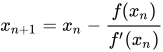
Newton's method is commonly used, the Babylonian method described below being a special case of Newton's; given an initial guess, it approximates the root of a function by using its derivative to generate a better estimate of the root. It can be applied successively to generate increasingly precise estimates. Newton's method can be described as follows, where is the estimate generated.


Babylonian method
[edit]The Babylonian method was among the first algorithms used to estimate square roots. The method generates a better estimate of from the initial guess or previous estimate by taking the arithmetic mean of and . The Babylonian method can be derived from Newton's method as follows.


References
[edit]- ^ Weisstein, Eric W. "Square Root". MathWorld.
- ^ Hardy 1908, pp. 322–323.
Works
[edit]- Hardy, Godfrey H. (1908). A Course of Pure Mathematics. Cambridge, UK: Cambridge University Press. ISBN 0521720559.
{{cite book}}: ISBN / Date incompatibility (help)