Telesp
 | |
| Company type | Sociedade Anônima |
|---|---|
| Industry | Telecommunications |
| Founded | April 12, 1973 |
| Defunct | July 29, 1998 |
| Headquarters | São Paulo, Brazil |
| Products | Fixed line |
| Subsidiaries | Telesp Celular (sold to Portugal Telecom in 1998) |
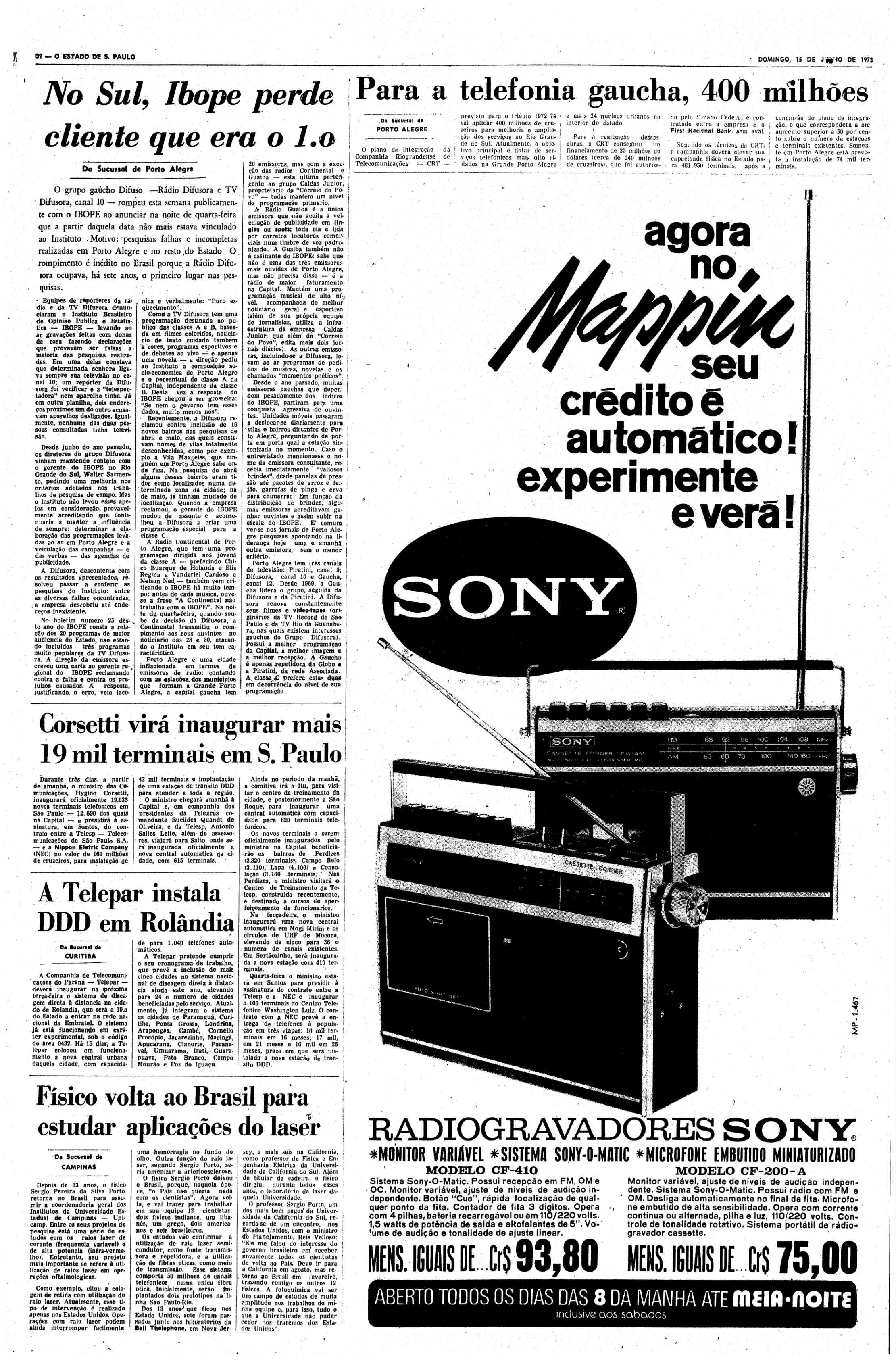
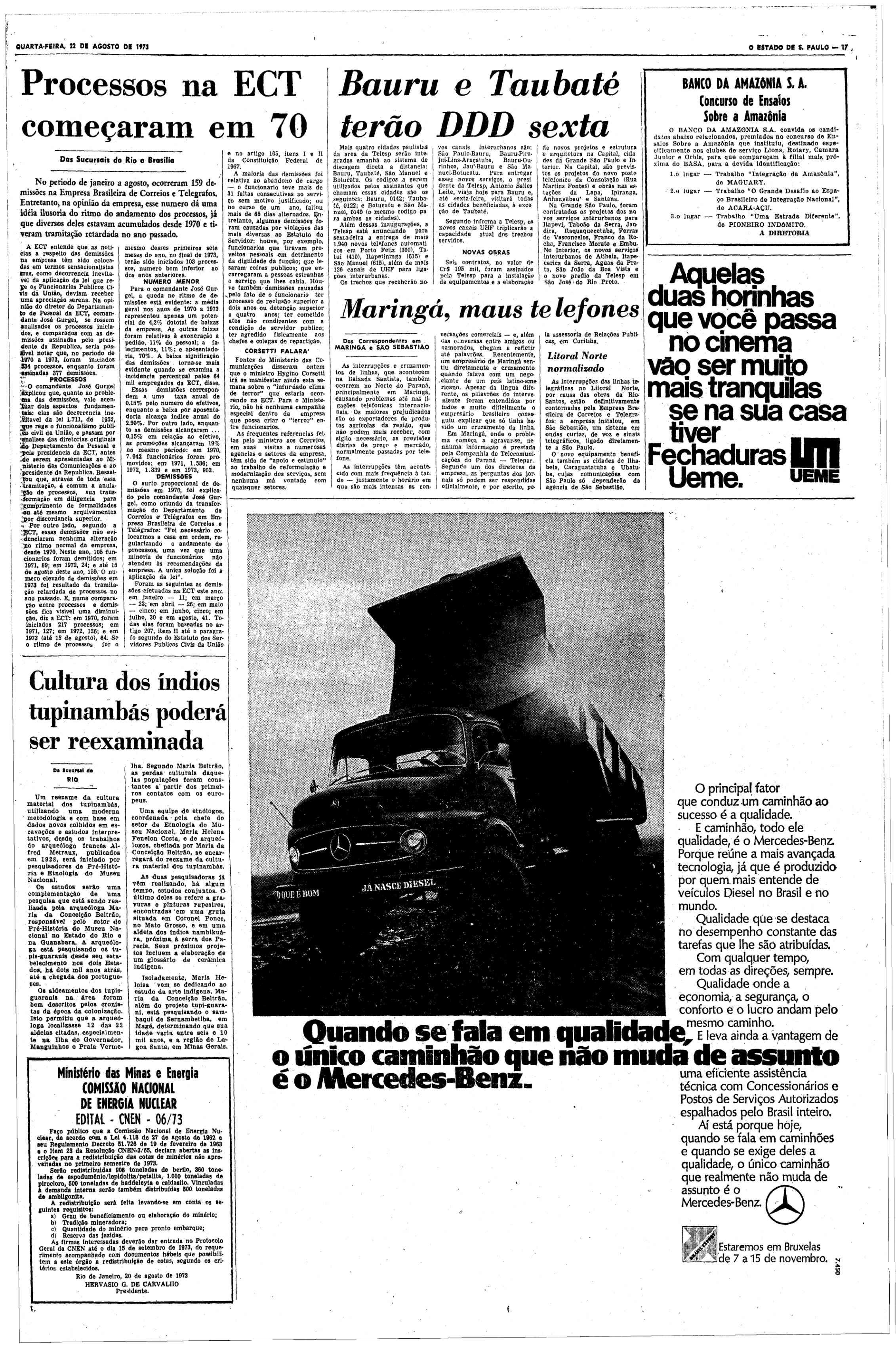
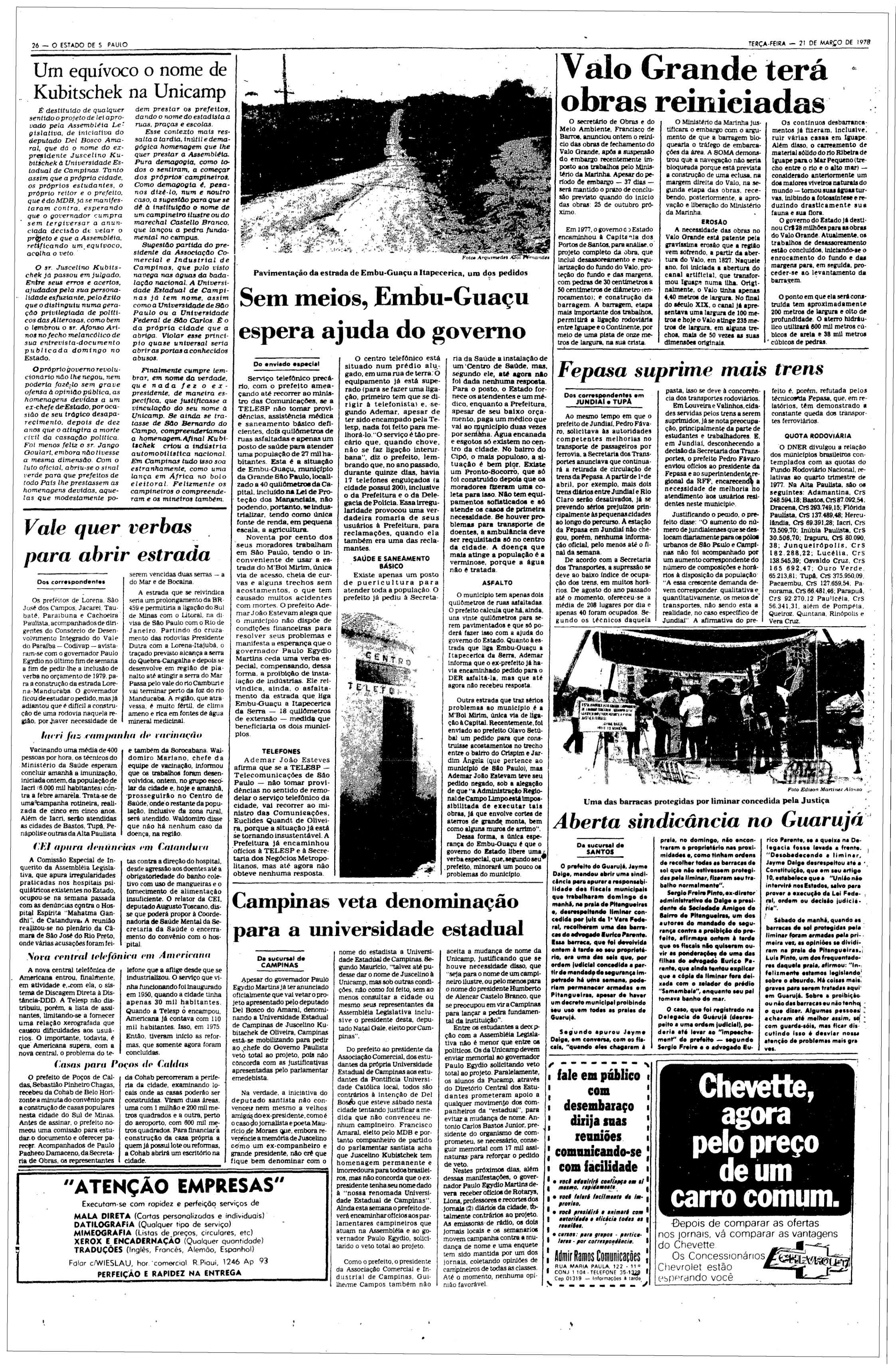
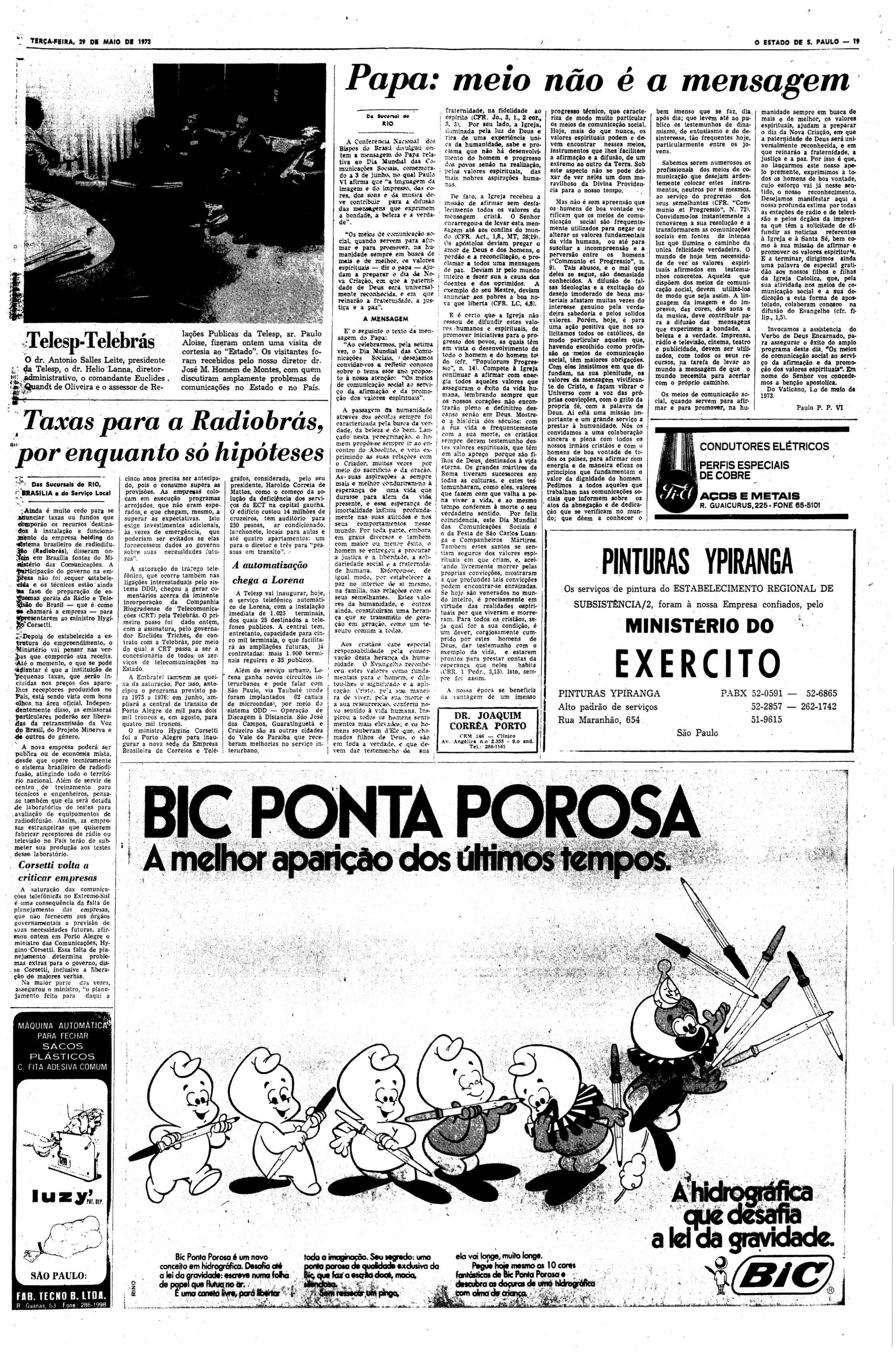
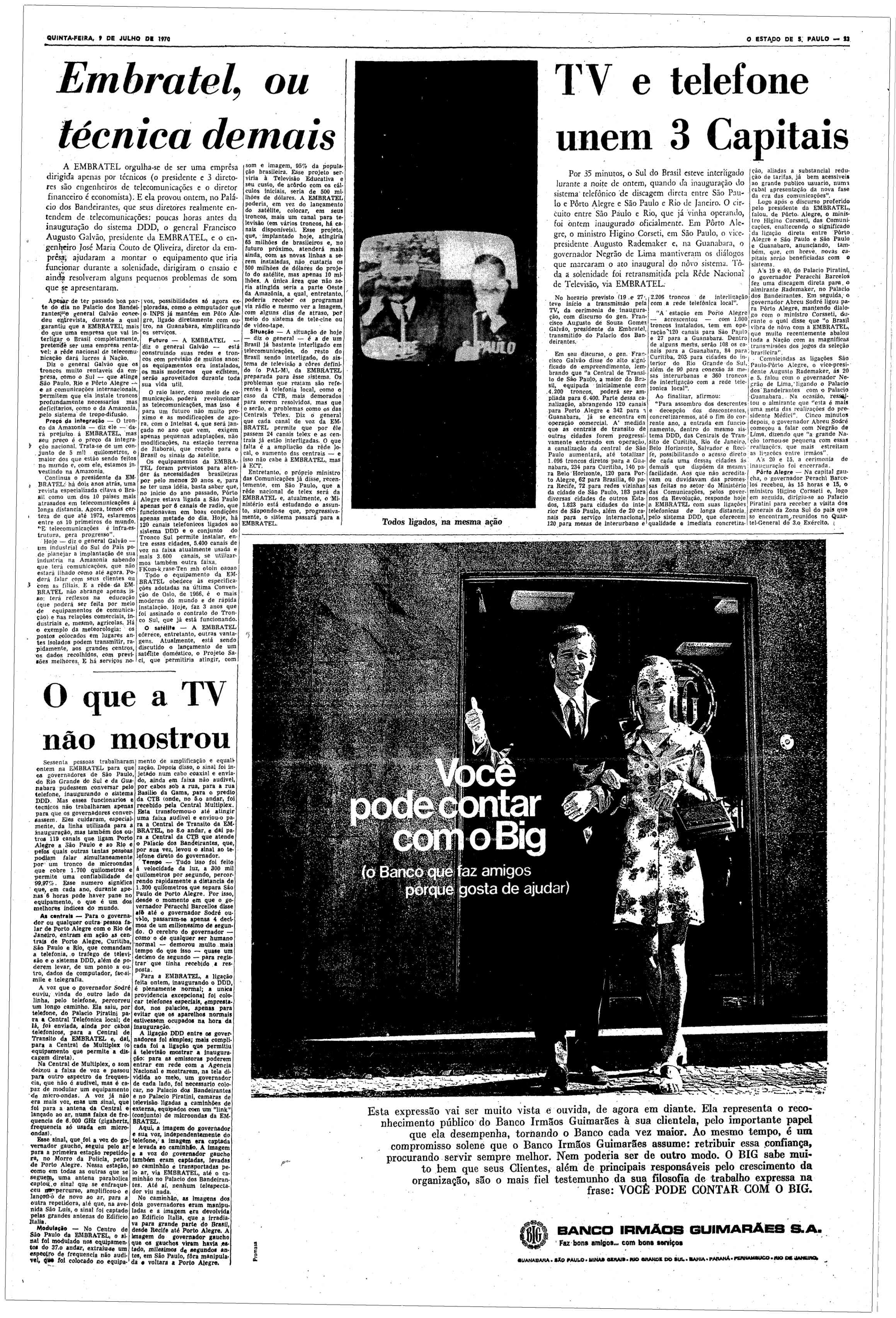
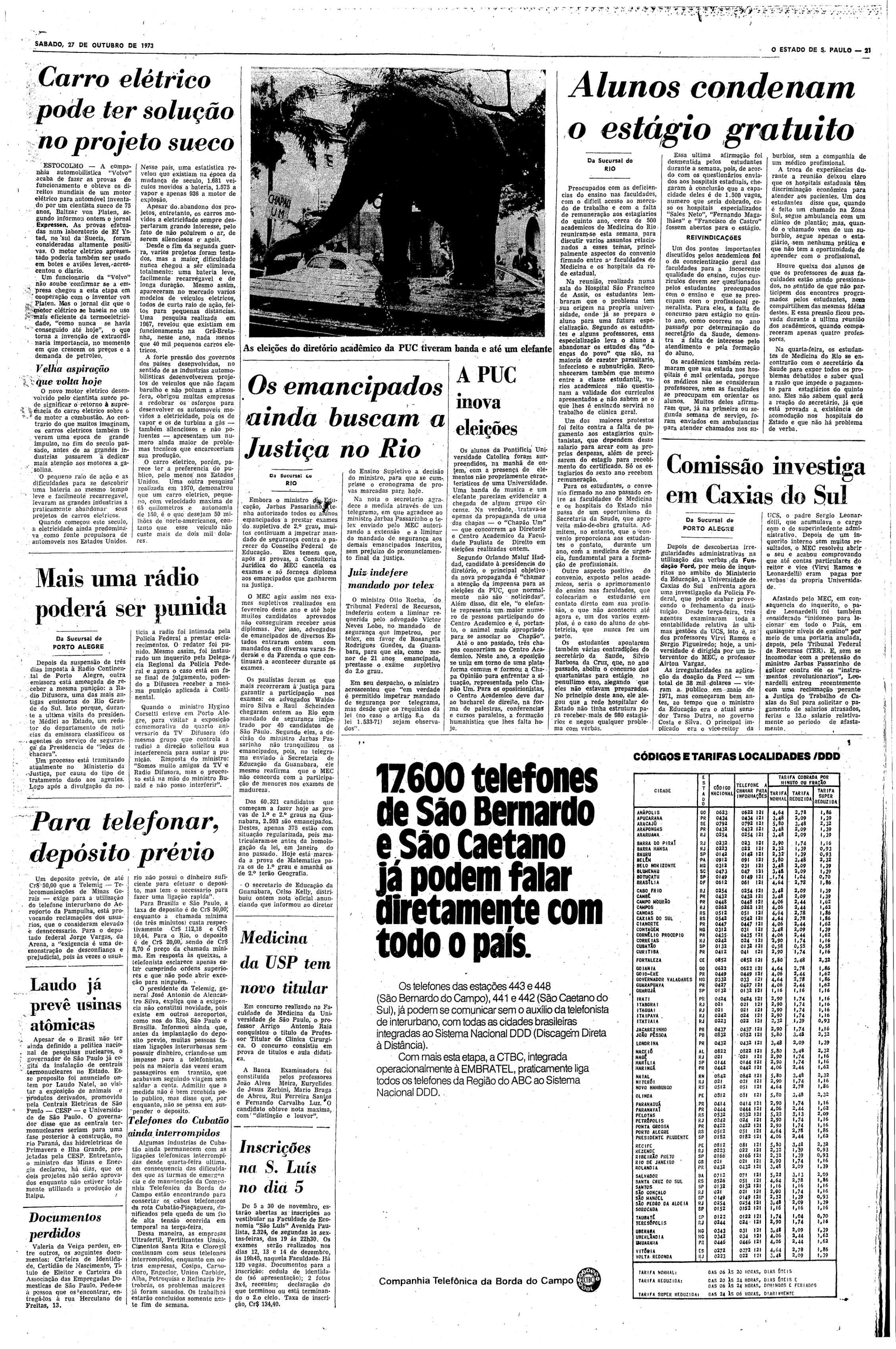
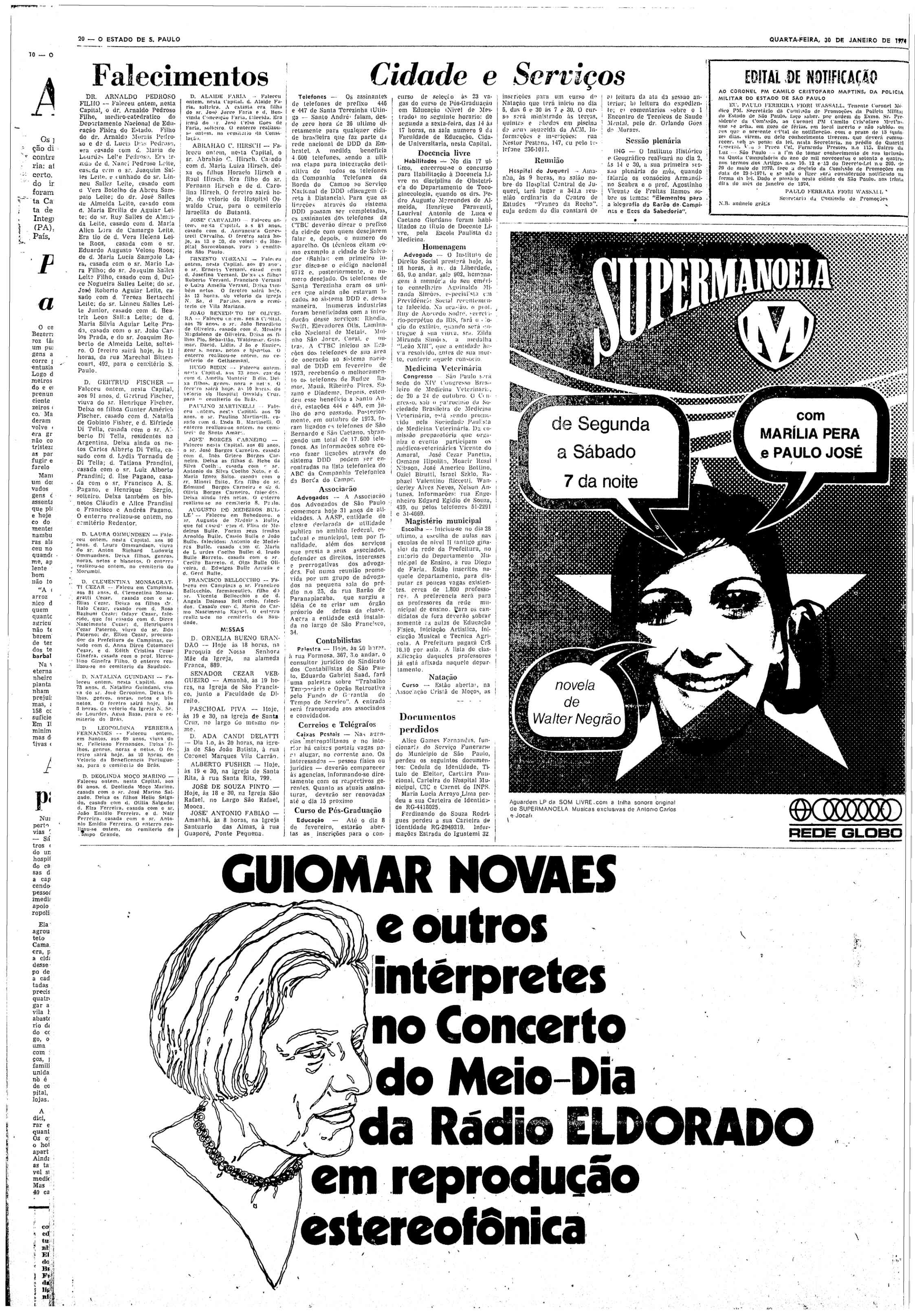
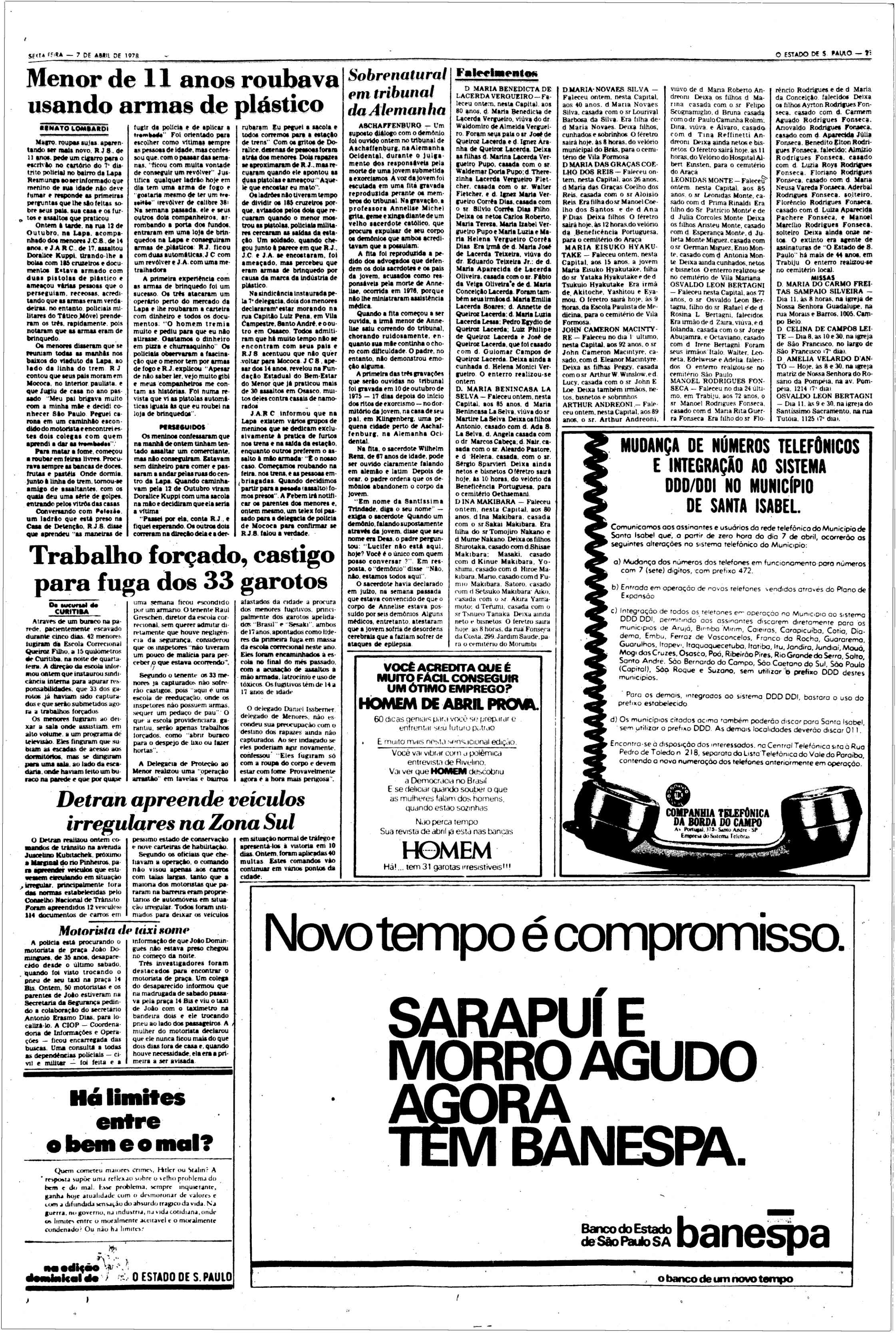
Telesp - Telecomunicações de São Paulo S.A. (in English: Telesp - São Paulo Telecommunications) was the telephony operator company of the Telecomunicações Brasileiras S.A. (Telebrás) system in the Brazilian state of São Paulo,[1][2] successor to the CTB,[3][4] later incorporating the Companhia de Telecomunicações do Estado de São Paulo (COTESP) and other smaller companies. It remained in operation from May 1973 until the privatization process in July 1998, when it was acquired by the Spanish company Telefónica, forming Telefônica Brasil,[5] which in 2012 adopted the Vivo brand for its fixed-line operations.[6]
Of the current 645 municipalities of the state of São Paulo, Telesp operated in all but 43, which were served by the companies CTBC Borda do Campo, CTBC Brasil Central and CETERP.[7]
History
[edit]Background
[edit]From the 1940s and 1950s onward, Brazilian cities, especially the major urban centers, had high pent-up demand for telephones, because a set of technical and economic factors led the country's private telephone operators to stop investing in the expansion and modernization of telephone systems, causing serious friction with the granting authorities. Institutional changes in the sector effectively began in 1962 with the Brazilian Telecommunications Code[8] and resulted in the creation of Embratel (1965)[9], the intervention and nationalization of Companhia Telefônica Brasileira (1966)[10], the creation of the Ministry of Communications (1967)[11], and the creation of the Telebras system (1972)[12][13], the latter promoting the unification of operators at the state level and eliminating the incompatibility that existed between the telephone systems of the time.
Predecessors
[edit]
List of the main telephone operators (public and private) that were incorporated and formed Telesp:[14][15]
CTB
Company that gave rise to Telesp, through its São Paulo Operations Directorate (DOSP). It served São Paulo, Campinas, Santos and about 180 more cities throughout the state.[16] It incorporated the following companies: S.T.M. Paulínia, S.T.M. Tabatinga, S.T.M. São José dos Campos, S.M.T.A. Araraquara, S.M.T.A. Taubaté, S.M.T.A. Guarujá, Soc. Telefônica da Estância (Serra Negra), S.T.M. Aguaí, S.T.M. Porto Ferreira, S.M.T.A. Rio Claro and Telefônica Lemense.
COTESP
Created in 1964 by the government of the state of São Paulo through the purchase of shares of the former Companhia Telefônica Tupi, it served about 170 cities. It incorporated the telephone service of the Estrada de Ferro Campos do Jordão, the Central Telefônica de Cachoeira Paulista, the Telefônica Salto de Pirapora and various municipal telephone systems (including S.M.T.A. Aparecida and the Telefônica Municipal de Caraguatatuba). Its concessions were transferred in 1973 and 1975 through an agreement.[17][18]
S.T.M. / S.M.T.A.
Many cities had their own Municipal Telephone Systems (S.T.M.), almost all with obsolete manual exchanges. Some larger cities were able to obtain automatic exchanges; for this purpose, Municipal Automatic Telephone Services (S.M.T.A.) were created.
Main private operators:
| Company | Tel. (thousands) |
Locations served | Notes |
|---|---|---|---|
| Cia Telefônica Rio Preto[19] | 15.0 |
|
|
| Cia Paulista de Telecomunicações (CIPATEL)[20][21] | 13.8 |
|
|
| Empr. Telefônica Paulista[19] | 12.5 |
|
|
| Telefônica Jundiaí[22][23] | 12.5 |
|
|
| Companhia Rede Telefônica Sorocabana | 11.8 |
|
|
| Cia Telefônica Alta Paulista[24] | 7.7 |
|
|
| Cia Telefônica Suburbana Paulista (COTESPA)[25] | 7.4 |
|
|
| Telefônica de Limeira[26] | 6.3 |
|
|
| Telefônica Central Paulista[27] | 5.9 |
|
|
| Cia Telefônica do Litoral Paulista[28] | 5.7 |
|
|
| Cia Telefônica de Guarulhos[29][30] | 3.8 |
|
|
| Telefônica Nacional | 3.1 |
|
|
| Empr. Telefônica Ararense | 2.6 |
|
|
| Empr. Telefônica de Americana | 2.3 |
|
|
| Empresa Melhoramentos de Andradina (EMA) | 1.9 |
|
|
| Cia Telefônica de Valinhos | 1.8 |
|
|
| Cia Telefônica de Ourinhos | 1.7 |
|
|
| Telefônica Pirassununga | 1.6 |
|
|
| Telefônica Pinhal | 1.5 |
|
|
| Telefônica Barbarense[31][32] | 1.3 |
|
|
| Cia Telefônica de Atibaia | 1.2 |
|
|
| Cia Telefônica de Pindamonhangaba | 1.2 |
|
|
| Empr. Telefônica Irmãos Camargo | 1.2 |
|
|
| Cia Telefônica de Itanhaém[33] | 1.1 |
|
|
| Telefônica Jacareí | 1.1 |
|
|
| Cia Telefônica Média Mogiana[34] | 1.0 |
|
|
Creation of Telesp
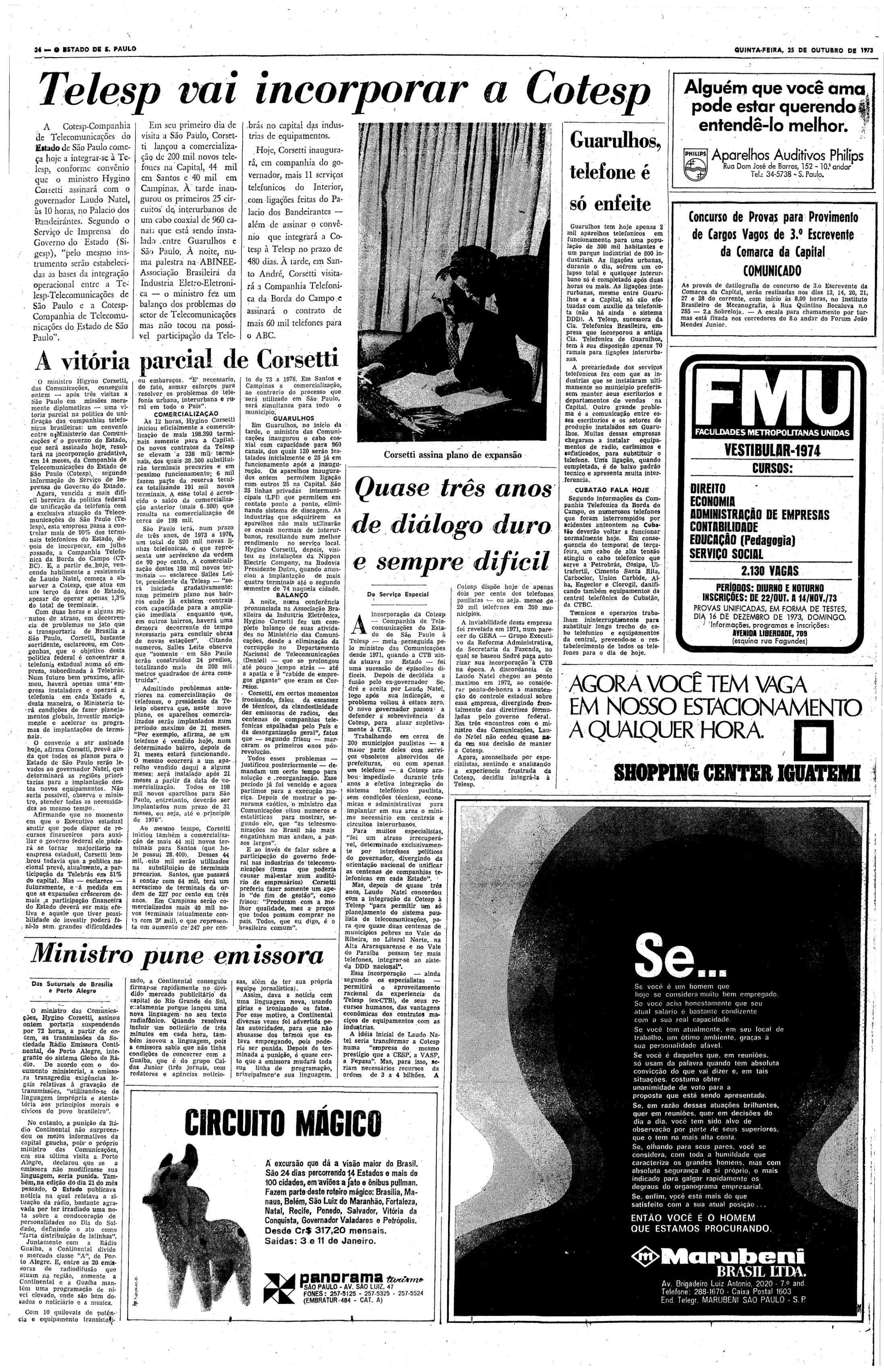
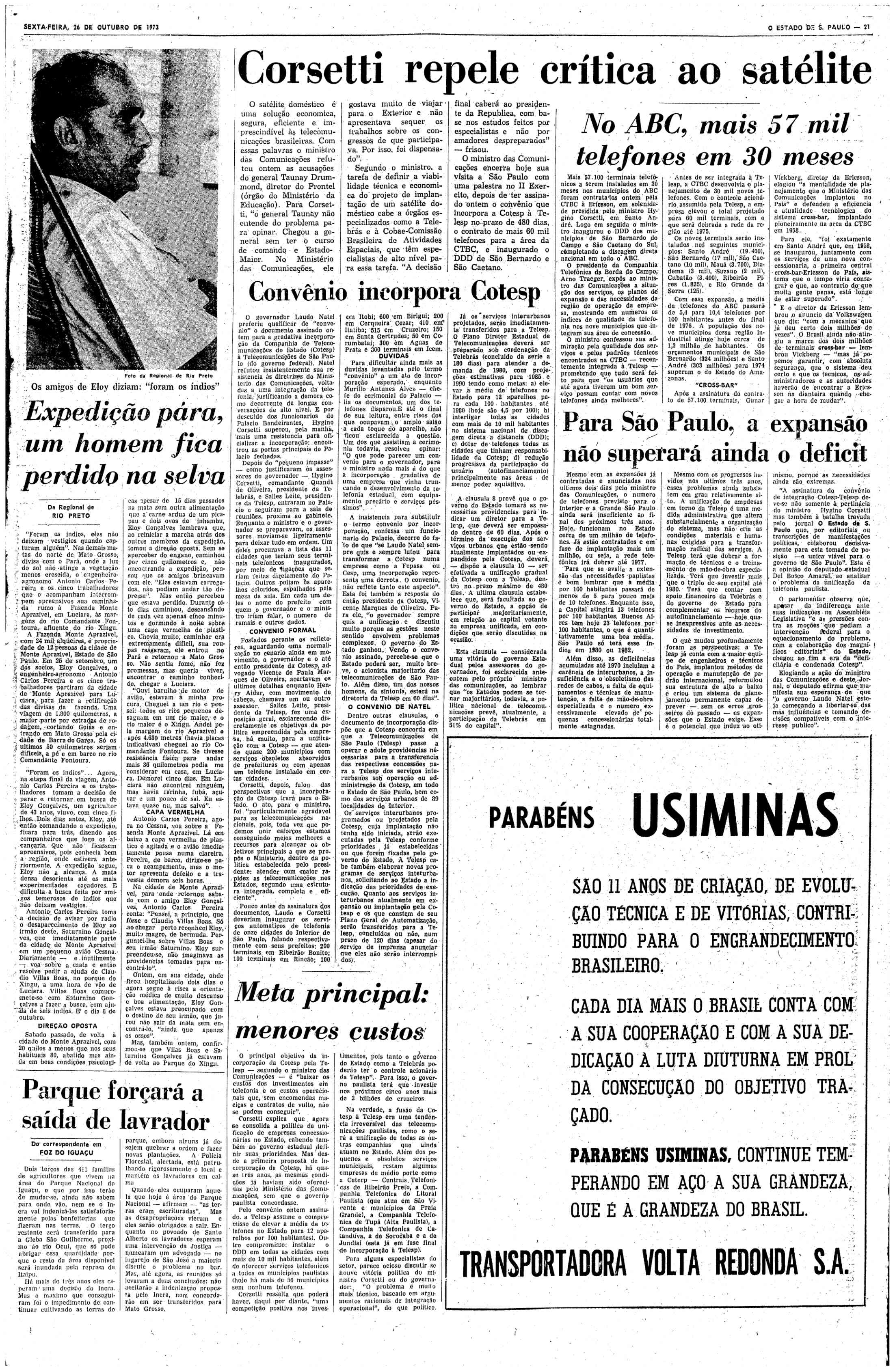
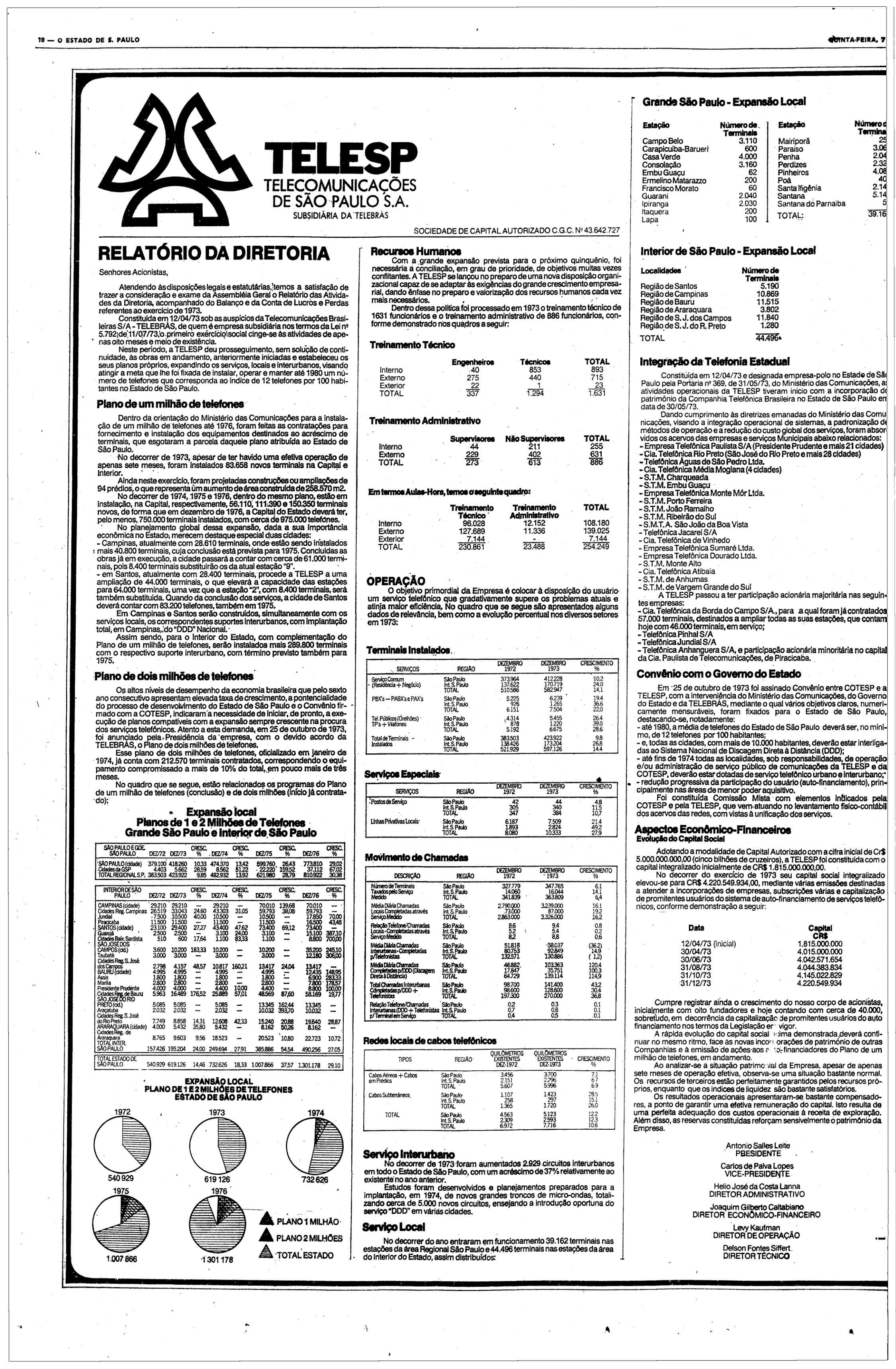
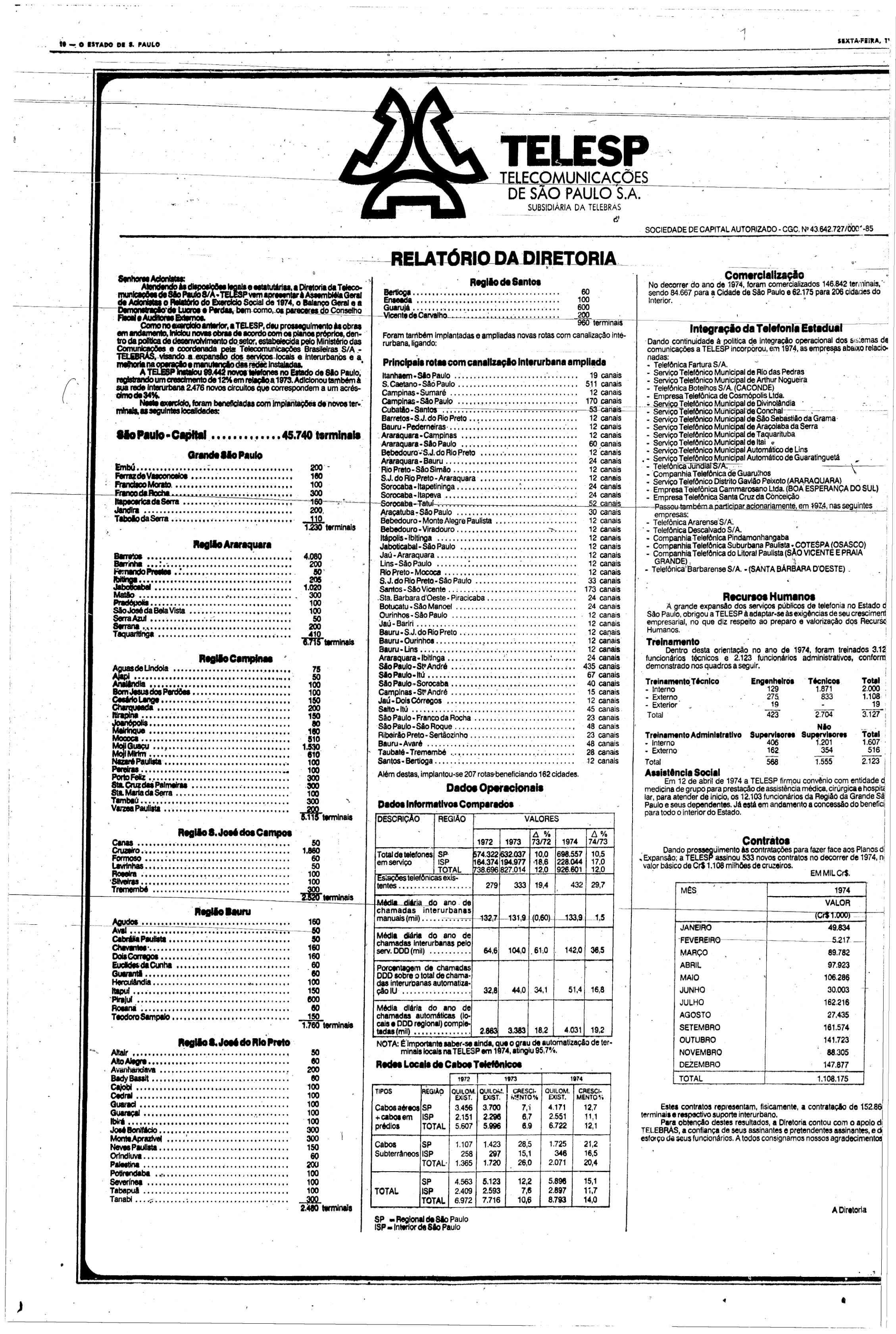
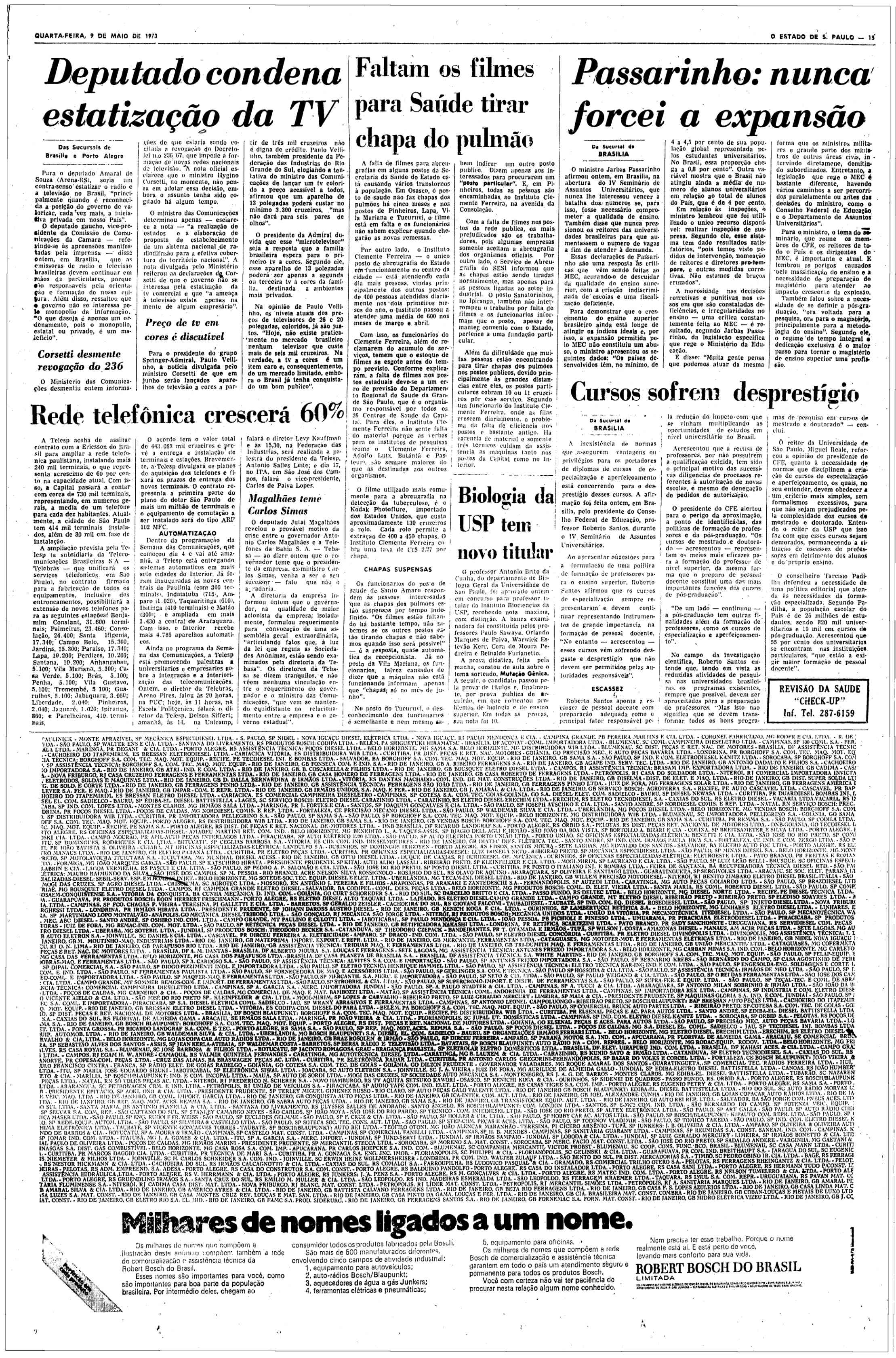
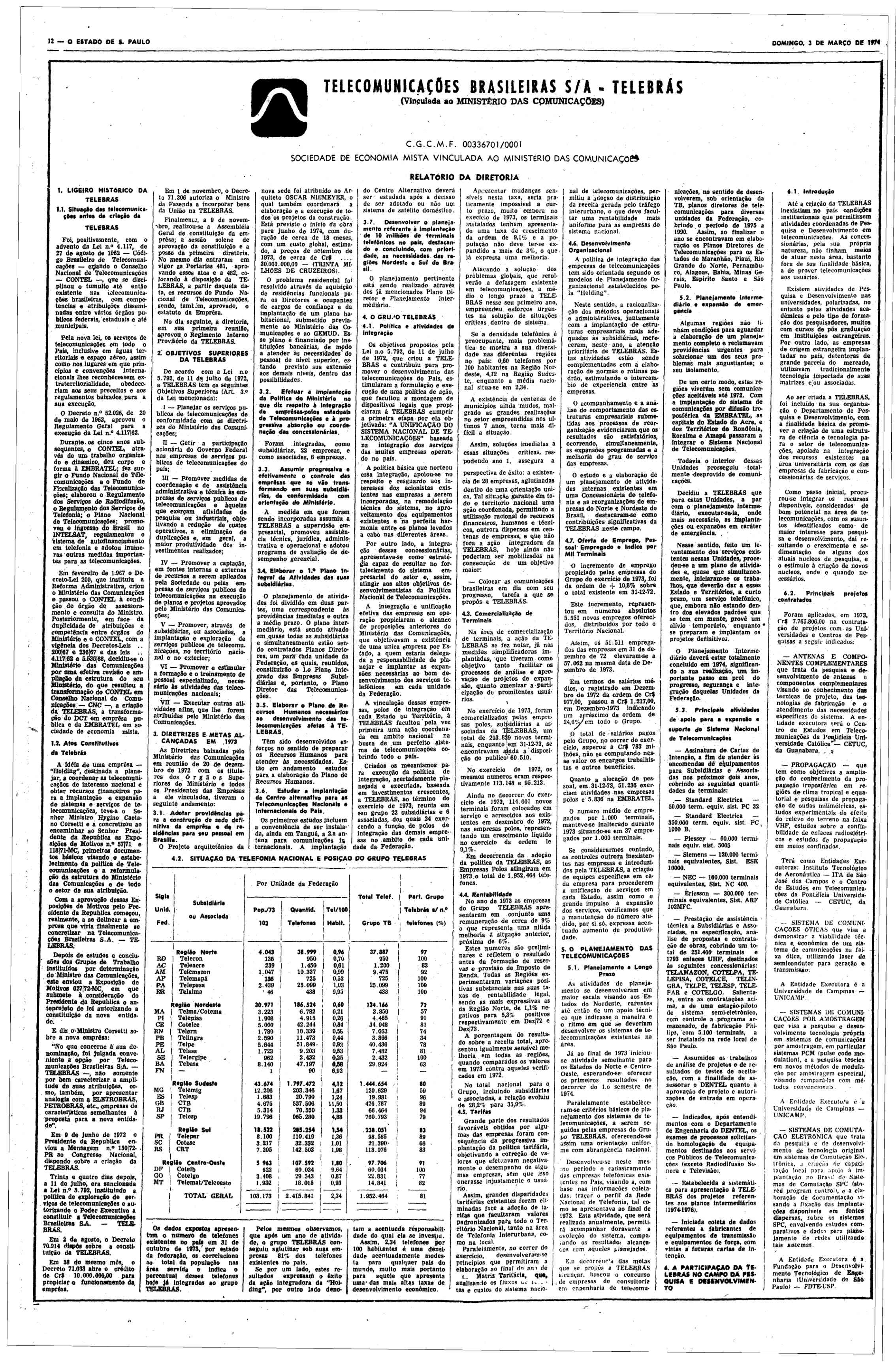
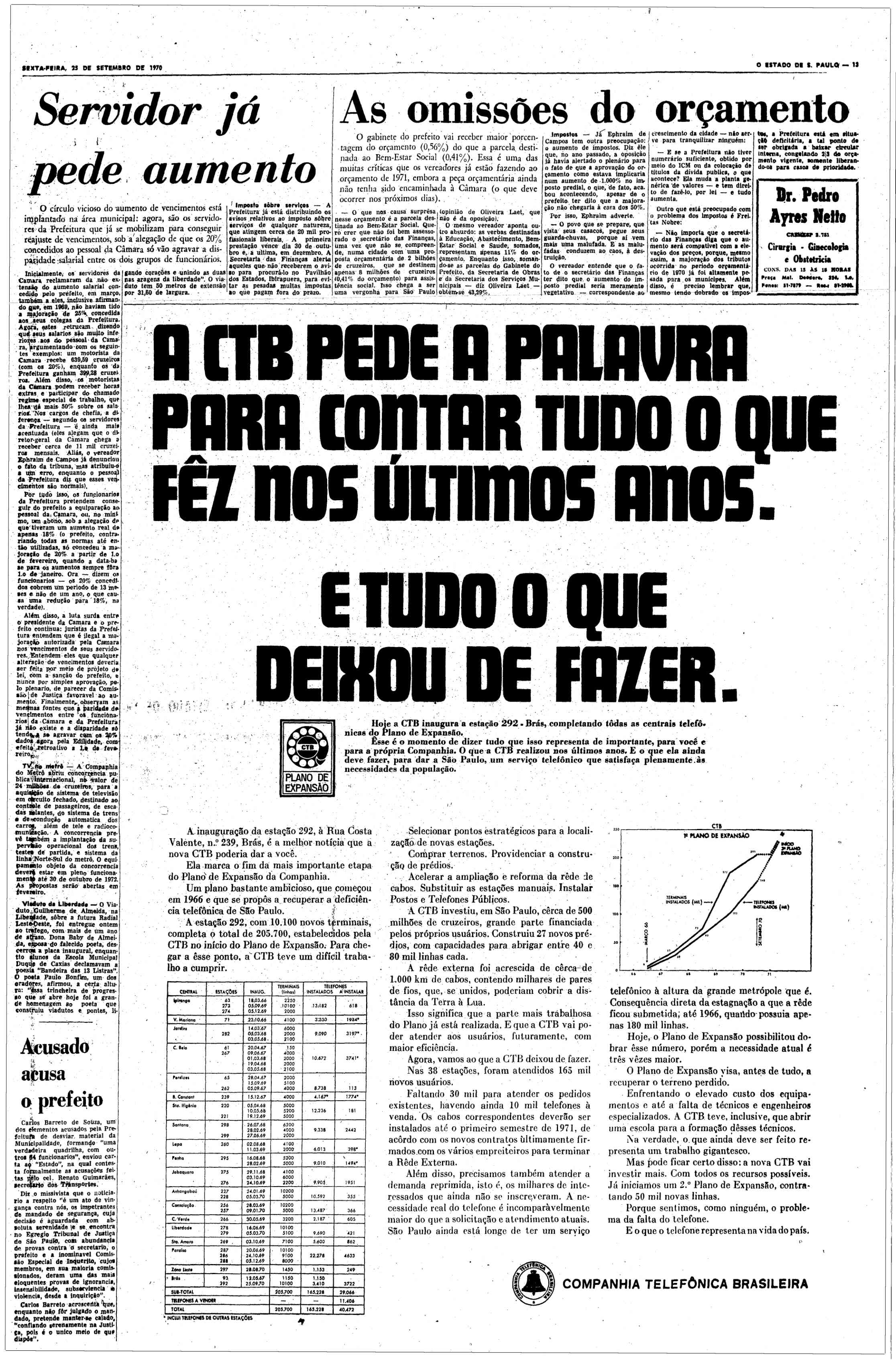
[edit]Formed as a subsidiary of Telebras on 12 April 1973,[35][36] it began operational activities on 31 May 1973 with the incorporation of the assets of Companhia Telefônica Brasileira in the state of São Paulo.[37][38][39]
Telesp was accredited as a holding company in the state by Ordinance No. 369 of 31 May 1973, in accordance with the guidelines and the policy of unifying the telephone system adopted by the Ministry of Communications, since the telephone system was granted at the time to several operators, both private and public.[40][41]
Expansion
[edit]Integration of state telephony
[edit]_42.jpg?lang=en)
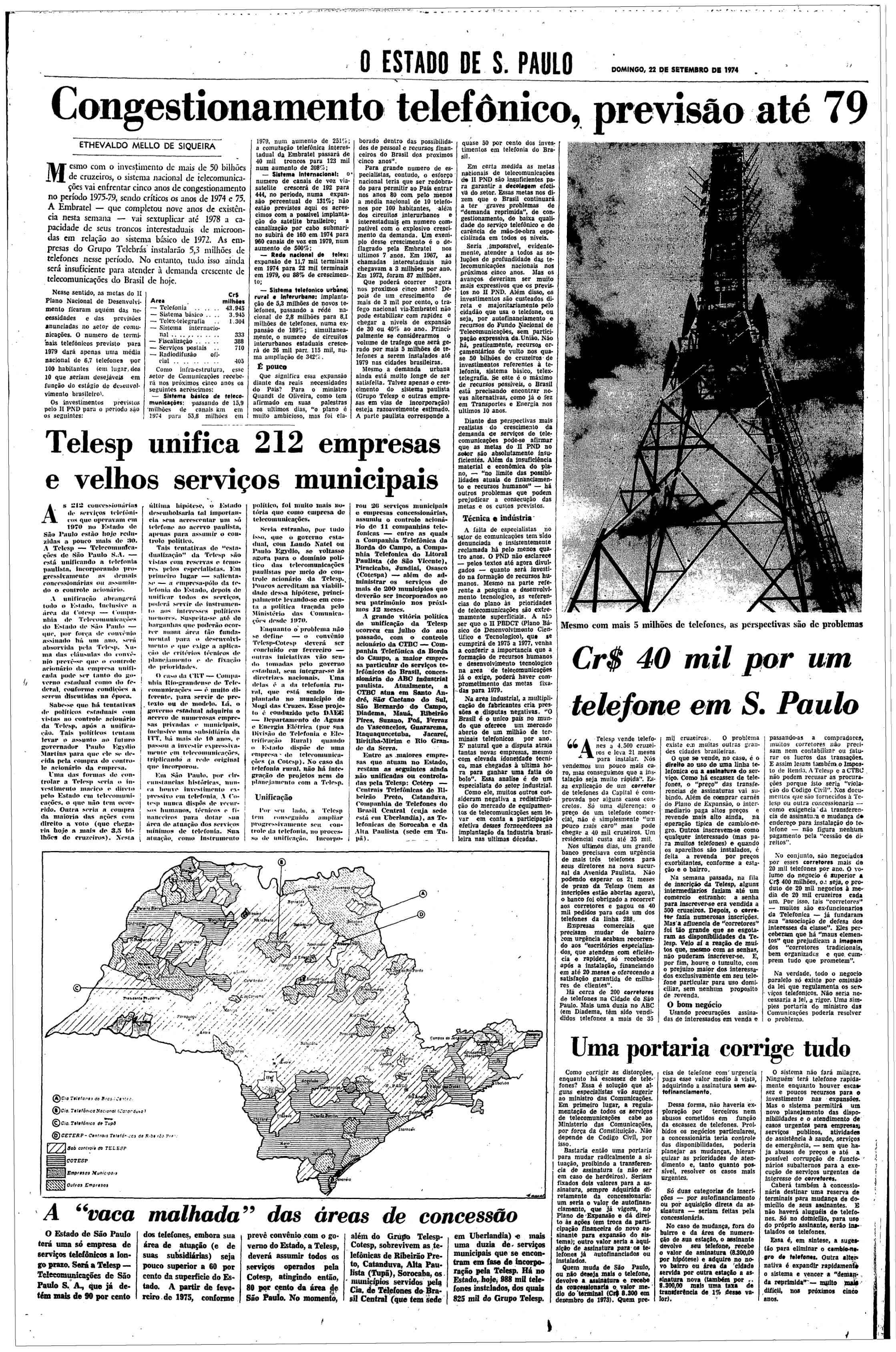
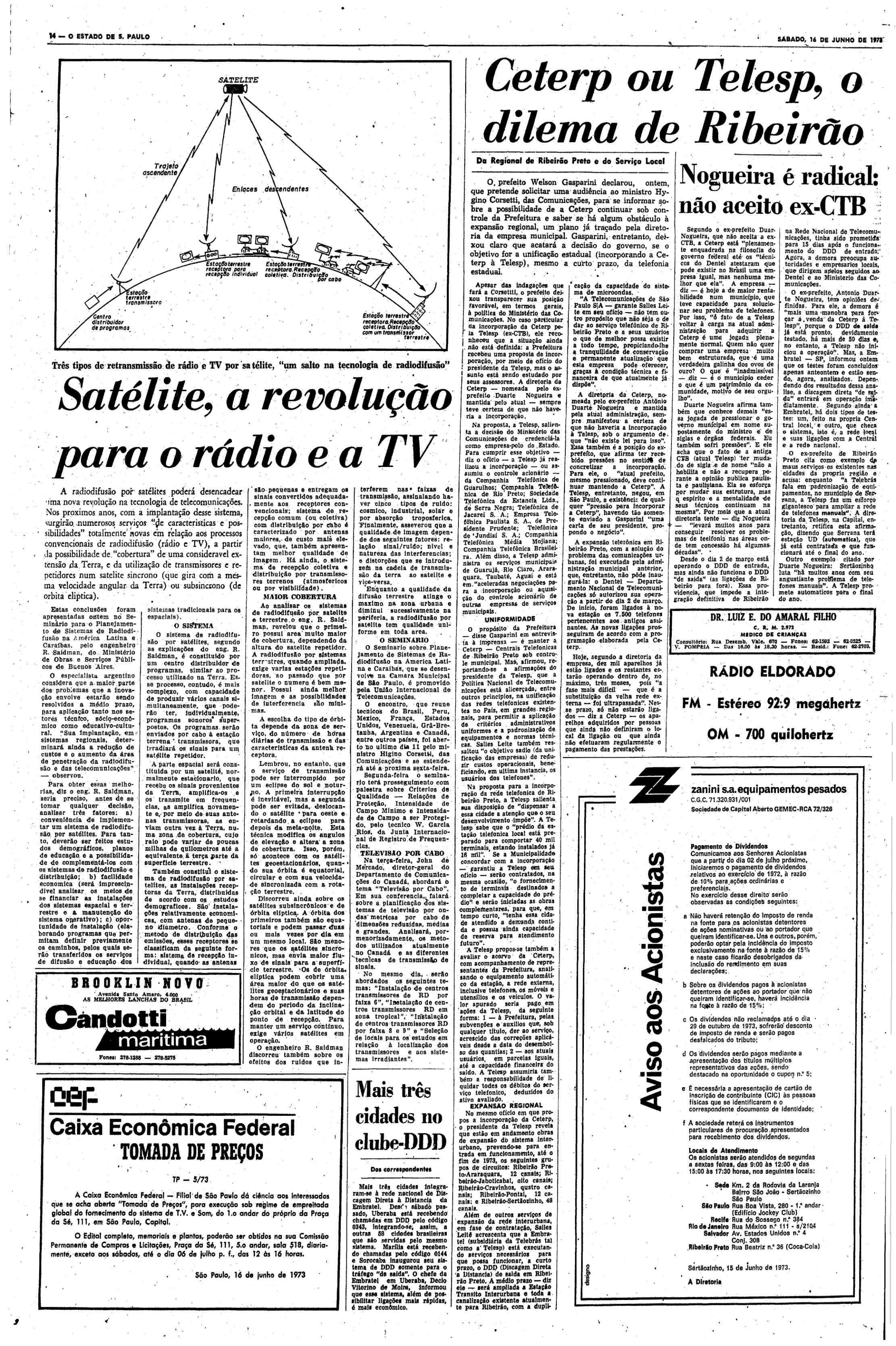
After its creation in April 1973, the processes of incorporation, expropriation, acquisition of holdings, or transfer of concession of the other operators existing in the state were gradual, from June 1973 until the beginning of 1980, with Teleoesp remaining last; its concession was revoked in July 1987.[42] In cases of incorporation of a company, Telesp would first acquire controlling interest or become a shareholder and only then incorporate it. The only exception was Companhia Telefônica da Borda do Campo, whose controlling interest Telesp acquired but kept under separate administration without incorporation.[43]
1973
- Incorporation: Empresa Telefônica Paulista,[44] Cia. Telefônica Rio Preto,[45] Cia. Telefônica Média Mogiana and S.T.M. Porto Ferreira,[46] Cia. Telefônica de Vinhedo and Telefônica Jacareí,[47] Cia. Telefônica de Atibaia[48]
- Acquisition of holdings: Empresa Telefônica Monte Mor, Telefônica Águas de São Pedro, S.T.M. Charqueada and S.T.M. Embu-Guaçu, S.M.T.A. São João da Boa Vista, S.T.M. João Ramalho and S.T.M. Ribeirão do Sul, Empresa Telefônica Sumaré, S.T.M. Vargem Grande do Sul, S.T.M. Monte Alto, Empresa Telefônica Dourado and S.T.M. Anhumas
- Transfer of concession: S.T.M. Elias Fausto,[49] S.T.M. Ariranha,[50] S.T.M. Marabá Paulista,[51] S.T.M. Pirangi,[52] S.T.M. Santo Expedito,[53] S.T.M. Morungaba,[54] S.T.M. Cabreúva,[55] S.T.M. Santo Antônio do Jardim,[56] S.T.M. Mairiporã,[57] S.T.M. Ipeúna,[58] COTESP (urban services in 89 locations),[59] S.T.M. Paraíso,[60] S.T.M. Luís Antônio,[61] S.T.M. Dumont,[62] S.T.M. Alfredo Marcondes and S.T.M. Nazaré Paulista
1974[63]
- Incorporation: Telefônica Fartura,[64] Telefônica Jundiaí and Cia. Telefônica de Guarulhos,[65] Empresa Telefônica de Cosmópolis, Empresa Telefônica Cammarosano and Empresa Telefônica Santa Cruz da Conceição
- Acquisition of holdings: S.T.M. Artur Nogueira and S.T.M. Rio das Pedras, Telefônica Botelhos, S.T.M. Conchal, S.T.M. Divinolândia and S.T.M. São Sebastião da Grama,[66] S.M.T.A. Lins, S.T.M. Araçoiaba da Serra, S.M.T.A. Guaratinguetá, S.T.M. Itaí and S.T.M. Taquarituba[67]
- Transfer of concession: S.T.M. Bofete,[68] S.T.M. Borborema,[69] S.T.M. Iperó and S.T.M. Taiaçu
1975[70]
- Incorporation: Telefônica Pinhal,[71] Telefônica Nacional,[72] Telefônica Descalvado and Cia. Telefônica Alta Paulista,[73] Empresa Telefônica Tibiriçá Feio
- Acquisition of holdings: S.T.M. Bálsamo,[74] S.T.M. Nova Europa[75] and S.T.M. Palestina[76]
- Transfer of concession: COTESP (urban services in 86 locations),[77][78] S.T.M. Jarinu[79] and S.T.M. Paranapanema
- Indirect extinction: Empresa Telefônica de Jaguariúna[80]
1976[81]
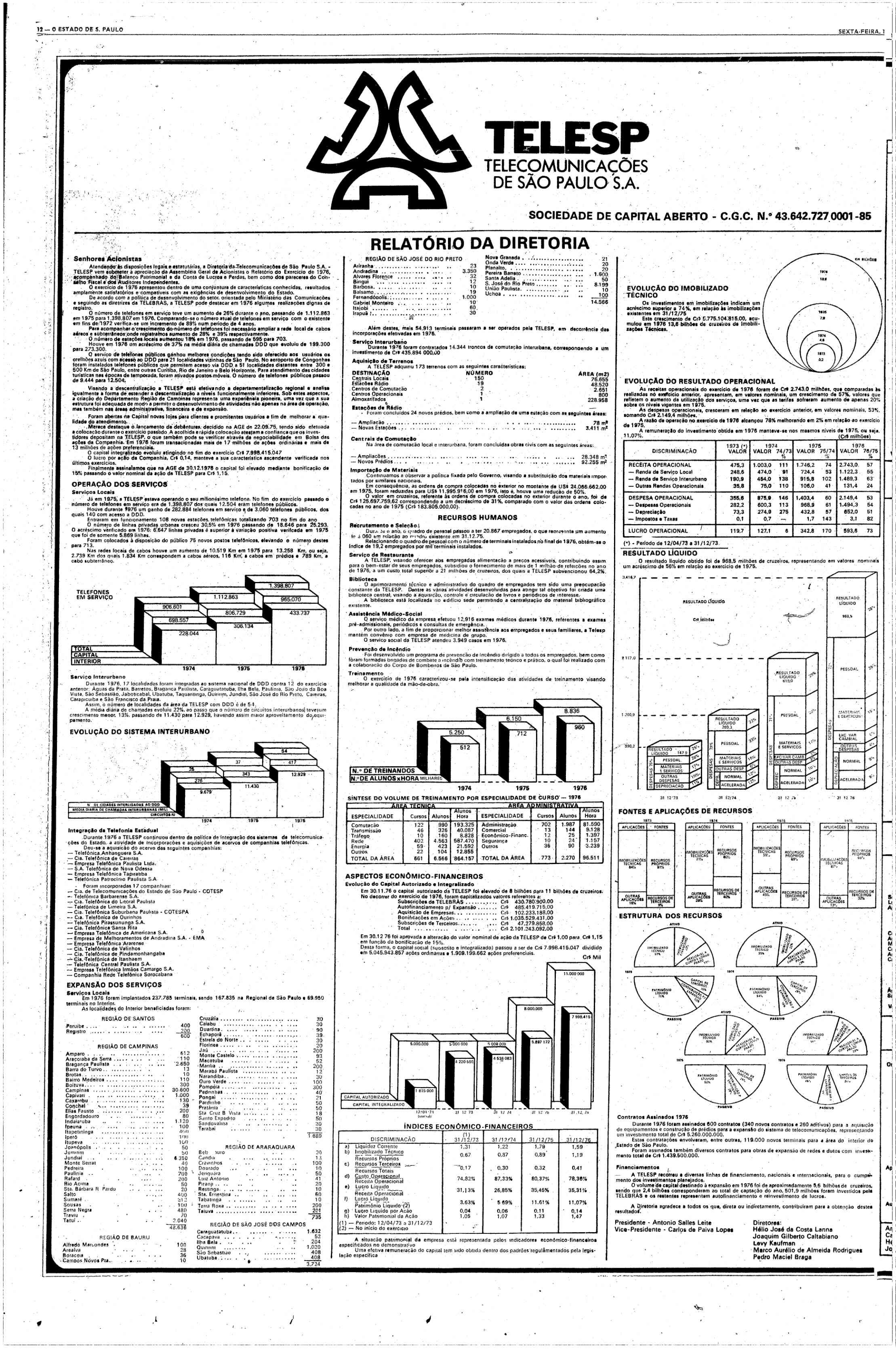
- Incorporation: Telefônica Barbarense and COTESP,[82][83] Cia. Telefônica do Litoral Paulista and Empresa Telefônica de Americana,[84] Telefônica Pirassununga,[85] Telefônica de Limeira, Cia. Telefônica Santa Rita, Cia. Telefônica Suburbana Paulista and Empresa Melhoramentos de Andradina,[86] Cia. Telefônica de Ourinhos,[87] Cia. Telefônica de Itanhaém, Cia. Telefônica de Pindamonhangaba, Cia. Telefônica de Valinhos and Empresa Telefônica Ararense,[88] Telefônica Central Paulista, Empresa Telefônica Irmãos Camargo and Cia. Rede Telefônica Sorocabana[89]
- Acquisition of holdings: Telefônica Anhanguera, Cia. Telefônica de Caieiras, Telefônica de Nova Odessa, Telefônica Patrocínio Paulista, Empresa Telefônica Paulista (Bariri) and Empresa Telefônica Tapiratiba[90]
- Indirect extinction: Empresa Telefônica Coração de Jesus
1977[91]
- Incorporation: CIPATEL[92]
- Acquisition of holdings: Cia. Telefônica Registro and Telefônica Sul Paulista, in addition to municipal telephone services in 89 locations
- Indirect extinction: Empresa Telefônica Mogiana[93]
- Acquisition of holdings: CETELVI and Concessionária Telefônica Figueira e Guerra
1979[96]
- Acquisition of holdings: Empresas Telefônicas Reunidas de Igarapava e Pedregulho[97]
1980
1987[100]
Exchanges with other operators
[edit]The cities of Paraty and Sapucaí-Mirim (former COTESP concession) were transferred to Telerj and Telemig respectively. Telesp also operated in Fronteira, a city that did not have its own telephone exchange, with its telephones connected to the exchange in Icém. In 1997 it began to be served by Companhia Telefônica do Brasil Central.
Operators not incorporated
[edit]Some operators were not acquired by Telesp or by its incorporated companies, such as Cia. Telefônica Alta Mogiana (Orlândia), Cia. Telefônica de Franca, Empresa Telefônica de Buritizal, Empresa Telefônica de Cajuru, Empresa Telefônica de Ituverava, S.T.M. Guaíra, S.T.M. Jardinópolis and Telefônica Intermunicipal (Batatais), all incorporated by Companhia Telefônica do Brasil Central, and Telefônica Mogi das Cruzes, incorporated directly by Companhia Telefônica da Borda do Campo. The only operator that remained active in the state without being incorporated by any other was Centrais Telefônicas de Ribeirão Preto.[104]
Operational structure
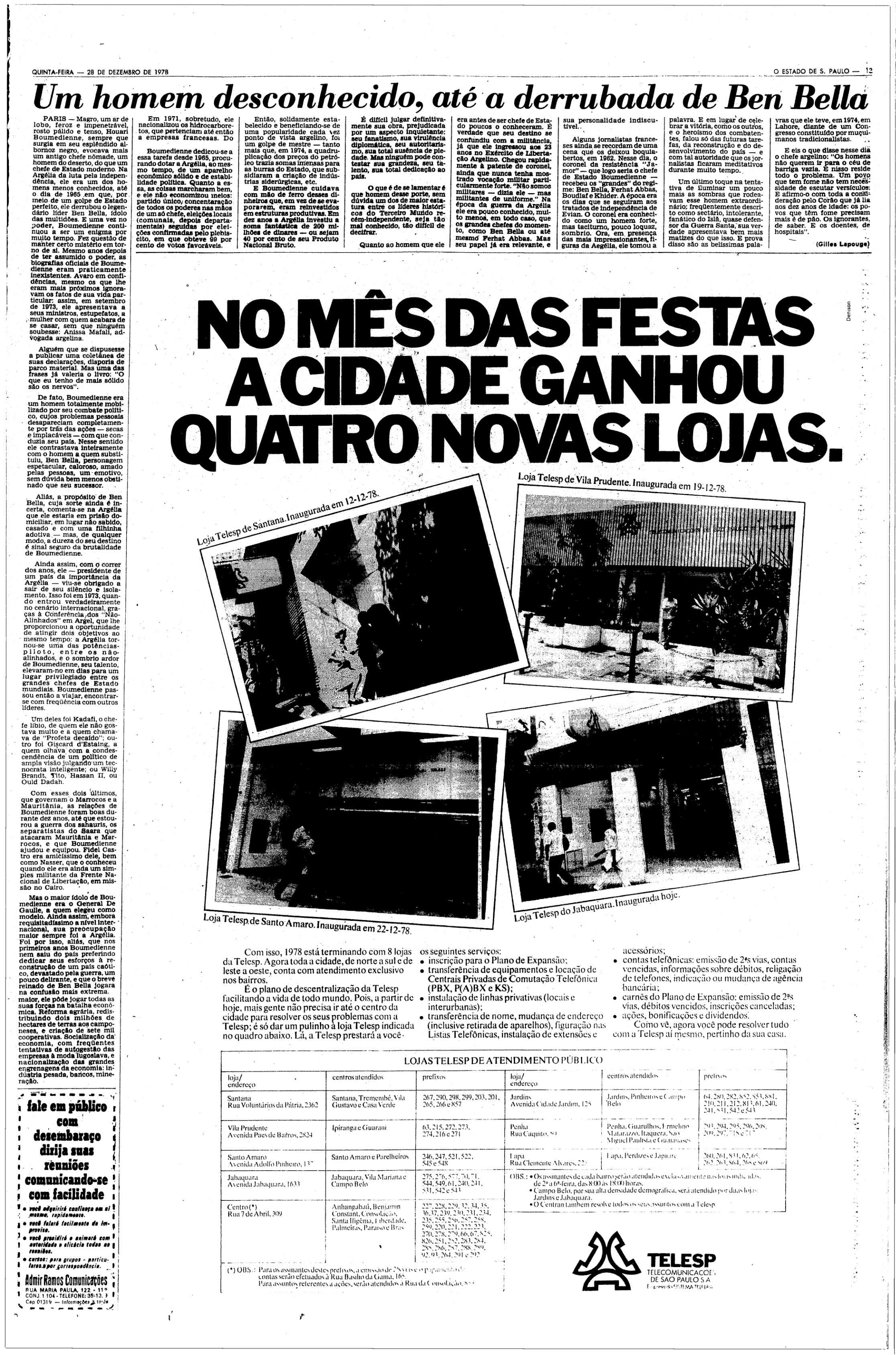
[edit]Because the company operated throughout the state, it was managed through a decentralized hierarchical structure, with its administrative headquarters in the capital. For marketing services and providing customer support, Telesp was divided into six regional management areas, two in Greater São Paulo and four in the interior.
Administrative headquarters
[edit]Its first administrative headquarters was the Sete de Abril Complex, located at Rua Sete de Abril, 309 – República, which had been the headquarters of the CTB's Diretoria de Operação São Paulo (DOSP). Its principal building is the Edifício Sete de Abril, an art deco property designed by Ramos de Azevedo in partnership with Severo & Villares at the renowned Escritório Técnico Ramos de Azevedo, and whose facade was listed in 1992.[105] Its corporate headquarters, meanwhile, was on the 4th floor of the Edifício Itália, at Avenida São Luís, 50 – República. In 1975, the company's new headquarters building was inaugurated at Rua Martiniano de Carvalho, 851 – Paraíso, with 22 floors.[106][107] Its construction had begun in 1972 under CTB, after the demolition of the former Avenida telephone exchange, installed on the site in 1920 and deactivated in 1969.[108][109] After the move, the buildings on Rua Sete de Abril and Rua Basílio da Gama, which together form the Sete de Abril Complex,[105] continued to be used as a customer service center for subscribers. It is currently the second in the city of São Paulo to receive a permit to carry out a retrofit under the rules of the Requalifica Centro program law. After being closed for more than a decade, it will be reopened under the name "Basílio 177", as an apartment condominium with an open gallery of shops and restaurants.[110]
Presidents
[edit]- 1973–1979: The first Telesp board took office in April 1973, with Antonio Salles Leite as president. Until then, he had been CTB's economic-financial director, and he remained in office during the governments of Médici and Geisel.[111]
- 1979–1985: Under the Figueiredo government, a new board took office in April 1979, with Carlos de Paiva Lopes as president; he had been vice-president in the previous administration.[112]
- 1985–1990: A new board took office in March 1985 during the Sarney government, with Antonio Ignacio de Jesus as president; he had been the economic-financial director in the previous administration.
- 1990–1992: Oswaldo Lopes do Nascimento Filho and Marco Antonio Castello Branco, during the Collor government.[113]
- 1992–1995: Waldemar Fernandes Neves, during the governments of Itamar Franco and Fernando Henrique.
- 1995–1998: Still under the Fernando Henrique government, the last Telesp board took office in July 1995, with Carlos Eduardo Sampaio Doria as president.[114]
Regional management areas
[edit]
The purpose of a regional management area was to market and operate telecommunications services, as well as to manage, operate, maintain, and control telecommunications systems and their supporting activities. The six regional management areas were São Paulo East (OL) and São Paulo West (OW),[115] created in 1979 through the division of the regional unit headquartered in São Paulo; Center-South (OA), created in 1976 with headquarters in Campinas; Center-West (OB), created in 1977 with headquarters in Bauru; North (OT), created in 1978 with headquarters in São José do Rio Preto; and Southeast (OS), created in 1979 with headquarters in Santos.[116] The regional management areas were divided into sectors, called operational districts; each had a coverage area composed of one or more tertiary areas. In the most important cities of each district there were Telesp Service Posts, where it was possible to make calls, buy tokens and phone cards, send and receive facsimile, consult telephone directories, etc.[117] There were also Telesp Customer Service Stores, facilities strategically distributed across the state's main cities and structured and organized to offer every type of service that could not be provided through telephone support.[118]
| Regional management area | District | Tertiary area | Locations with service (Service Post/Store) |
|---|---|---|---|
| São Paulo East | OL1 - Consolação | 11 | City center, East Zone, North Zone, Guarulhos |
| OL2 - Penha | |||
| OL3 - Ipiranga | |||
| OL4 - Anhangabaú | |||
| OL5 - Vila Gustavo | |||
| OL6 - Cumbica | |||
| São Paulo West | OW1 - Vila Mariana | 11 | West Zone, South Zone |
| OW2 - Campo Belo | |||
| OW3 - Jabaquara | |||
| OW4 - Lapa | |||
| OW5 - Palmeiras | |||
| OW7 - Campo Limpo | |||
| OW6 - Osasco | 11 | Osasco; Cotia, Embu, Embu-Guaçu, Itapecerica da Serra, Itapevi, and São Roque | |
| Center-South | OA1 - Campinas | 192 | Campinas, Águas de Lindóia, Indaiatuba, Paulínia, Serra Negra, and Valinhos |
| OA2 - Jundiaí | 11 | Jundiaí, Atibaia, Bragança Paulista, Itatiba, Itu, Mairiporã, and Salto | |
| OA3 - Rio Claro | 195 | Rio Claro, Araras, Leme, Pirassununga, and Porto Ferreira | |
| OA4 - Sorocaba | 152, 155 | Sorocaba, Itapetininga, Porto Feliz, and Tatuí; Itapeva, Apiaí, Capão Bonito, and Itararé | |
| OA5 - Piracicaba | 194 | Piracicaba, Águas de São Pedro, Americana, Capivari, Limeira, Nova Odessa, Rio das Pedras, Santa Bárbara d'Oeste, and São Pedro | |
| OA6 - São João da Boa Vista | 192, 196 | Itapira, Mogi Guaçu, and Mogi Mirim; São João da Boa Vista, Casa Branca, Espírito Santo do Pinhal, Mococa, and São José do Rio Pardo | |
| Center-West | OB1 - Bauru | 142, 146, 147, 149 | Bauru, Agudos, Lençóis Paulista, and Pederneiras; Jaú and Barra Bonita; Avaré; Botucatu and São Manuel |
| OB2 - Presidente Prudente | 182, 183 | Presidente Prudente, Presidente Epitácio, and Presidente Venceslau; Assis and Paraguaçu Paulista | |
| OB3 - Marília | 143, 144, 145 | Ourinhos, Piraju, and Santa Cruz do Rio Pardo; Marília, Garça, and Tupã; Lins and Promissão | |
| Southeast | OS1 - Santos | 132 | Santos, Bertioga, Cubatão, Guarujá, and Vicente de Carvalho |
| OS2 - Praia Grande | 132, 138 | Praia Grande, Itanhaém, Mongaguá, Peruíbe, and São Vicente; Registro and Iguape | |
| OS3 - São José dos Campos | 123, 124 | São José dos Campos and Jacareí; Caraguatatuba, São Sebastião, and Ubatuba | |
| OS4 - Taubaté | 122, 125 | Taubaté, Caçapava, Campos do Jordão, and Pindamonhangaba; Guaratinguetá, Aparecida, and Cruzeiro | |
| North | OT1 - São José do Rio Preto | 172, 173, 175 | São José do Rio Preto; Barretos and Bebedouro; Catanduva |
| OT2 - Araçatuba | 186, 187, 188, 189 | Araçatuba, Birigui, and Penápolis; Andradina and Ilha Solteira; Dracena; Adamantina | |
| OT3 - Araraquara | 162, 163, 166, 167 | Araraquara and São Carlos; Jaboticabal; Sertãozinho | |
| OT4 - Votuporanga | 174, 176 | Votuporanga and Fernandópolis; Jales |
Locations served
[edit]Through 1992, its operating area covered a total of 532 cities. After the creation of new municipalities, the operating area increased to 583 cities in 1993 and 602 cities in 1997, serving about 30 million people in the state of São Paulo.[119][120]
Services
[edit]Fixed-line telephony
[edit]
Main services provided:[121]
- Local calls, long-distance calls via Direct Distance Dialing (DDD), and international calls via international direct dialing (DDI)
- Direct Inward Dialing (DDR): a service implemented in the 1970s, serving condominiums and larger companies[122]
- Collect call (DDC): service inaugurated in 1982[123]
- Toll-free dialing (DDG): 0800 service, implemented in the 1980s[124]
- Features of CPA telephone exchanges: implemented gradually beginning in 1982, offering users new telephone-service features that were then unprecedented, including call transfer, call waiting, teleconference, abbreviated dialing, long-distance call blocking, dedicated line, and do-not-disturb service[123][125]
- Telecard: launched in 1982, a card that allowed calls to be made without tokens or a phone card, with no payment at the time of the call; charges were debited to a telephone bill designated by the subscriber[123]
- Disque 200: service inaugurated in 1983, used to provide varied information on different topics[126]
- Modem: service inaugurated in 1984, equipment that turned any telephone into a receiving and transmitting hub for computer data via a video terminal[126]
- Areafone: service inaugurated in 1984, aimed at high-traffic subscribers to reduce call costs[127]
- Local calls to conurbated cities: service inaugurated in 1986 in the São Paulo, Campinas, and Santos areas[128][129]
Public telephones
[edit]
At first, the public telephones provided by Telesp were the "yellow orelhões" (with red telephone handsets that worked with telephone tokens), used to make local calls or long-distance calls to cities and localities within the same tariff area. These orelhões began to be installed in 1972 by CTB.
In 1975, the "blue orelhões" appeared (with blue telephone handsets that worked with DDD tokens), used to place direct long-distance calls to all cities and localities already integrated into the DDD system, or with operator assistance for the others.[130][131]
There were also "semi-public telephones", installed in establishments accredited as bars, restaurants, hotels, and bakeries; they functioned both as a public telephone and as an ordinary telephone, thanks to a selector switch on the device.[132]
In peripheral neighborhoods of large cities, as well as in rural neighborhoods that lacked telephony, there were so-called "vilafones", devices that made and received local and long-distance calls, installed in commercial establishments with easy public access.[133]
To serve low-income populations, Telesp began installing orelhões in public housing developments in 1981. Also in 1981, the first public telephones for people with physical disabilities began to be installed.[133] The first "community orelhão", a public telephone that made and received calls, was installed in August 1982 in the favela of Vila Prudente.[134]
Another type of public telephone was "Falefácil", an alternative to "semi-public" phones, because it was a telephone with no dial or keys and only an indicator of minutes talked; the person who placed the call was the responsible party at the establishment where the device was installed. Implemented starting in 1986.[135]
Later, many orelhões began to be replaced by concrete cabins with clear tempered glass. The cabins were first tested in the cities of São Paulo, Santos, Guarujá, São Vicente, and Campinas, and then installed throughout the state, but they were not well received.
The telephone tokens used in public telephones began to be replaced by telephone cards starting in 1993.[136]
Symbol
[edit]
In 1973, the famous "Orelhão of Itu", seven meters tall, was donated by the Minister of Communications Hygino Corsetti and installed by Telesp in Praça da Matriz in Itu. It is one of the city's main tourist attractions and one of the reasons for its fame as the "city where everything is big", because the minister, honored with a banquet at the inauguration, ended his speech with the following words: O Brasil é grande, mas eu sei que Itu é maior.[137]
Advertising
[edit]In 1979, Telesp launched the TV commercial "Vandalismo", better known as "Morte do Orelhão", due to the high rates of vandalism against the orelhões, and it is considered one of the major milestones of Brazilian advertising.[138]
It was created by the renowned agency DPZ, and had significant cultural and social impact, as well as winning important awards for the agency and its creators Neil Ferreira and José Zaragoza,[139] such as Gold at the Festival of the 5th Yearbook of the Clube de Criação de São Paulo in 1980,[138] Best Special Project at the 3rd edition of the Rede Globo Profissionais do Ano Award in 1980,[140] and the award for best special effects from the Hollywood Radio and Television Society NYC, because of the special effects conceived by Domingos Utimura, thereby obtaining international recognition.[141]
Videotex
[edit]Established through Ordinance No. 107 of 26 May 1980 of the Ministry of Communications, under which Telesp was tasked with preparing a feasibility study for implementing a system intended to transmit information through the telephone network, with output on a television set or other alternatives, authorizing the installation in the city of São Paulo of a service for feasibility evaluation and the respective operational tests.[142]
The contract to supply the equipment required for the pilot deployment of videotex was signed in 1981, with the experimental phase beginning in the first half of 1982.[133] The service was officially inaugurated in December 1982, as Brazil's first experience in this field.[123]
Cellular telephony
[edit]Telesp Celular was the mobile telephone operator of the Telecomunicações Brasileiras S.A. (Telebras) system[143] in the state of São Paulo, a subsidiary of Telecomunicações de São Paulo S/A (TELESP).[144] After being privatized it retained the same name until 2003, when it became known as Vivo.[145]
Origin
[edit]
Initially a superintendence within Telesp, it began operations on August 6, 1993 in the analog system, at a time when cellular telephony was still being established in the country, being designated for the implementation and operation of the cellular telephone system in a concession area that included 620 municipalities.[146][147]
It remained a subsidiary of Telesp until the privatization process carried out in July 1998.
Shortly before privatization, Telesp Celular established itself as the largest operator in Latin America, implementing cellular telephony in record time in the state, serving at the time about 1.141 million subscribers in 371 municipalities.[148]
Privatization
[edit]For the controversial privatization process of the Telebras system in July 1998, Telesp and Telesp Celular were split. The former came under the control of Telefónica;[149] the latter was acquired by Portugal Telecom.[150]
In the year 2000, the shareholding composition of Telesp Celular was as follows:[145]
- 44.78%: Portugal Telecom
- 40.22%: Portelcom (74.20% Portugal Telecom; 25.8% Ptelcom)
In 2000 Telesp Celular assumed the cellular operation of Centrais Telefônicas de Ribeirão Preto (CETERP),[151] which had been acquired by Telefónica in an auction held in December 1999.[152] In July 2001, Telesp Celular operated in 470 municipalities in its service area,[153] then with 622 municipalities (the state of São Paulo has 645 municipalities; subtracting the 23 municipalities in the CTBC service area results in 622 municipalities).
Subsequently Portugal Telecom, in a joint venture action, combined its assets with Telefónica Mobile, and together they created Vivo in 2003.[154]
In 2005, a corporate restructuring occurred that transformed Telesp Celular Participações into Vivo Participações, which extinguished and incorporated Tele Leste, Tele Sudeste, Tele Centro Oeste Celular (acquired in 2003) and CRT (acquired in 1996), companies under the control of Telefónica.
Technology used
[edit]In 1998, months before privatization, the implementation of the digital system began,[155] using the CDMA (IS-95) system,[156] used by the operator for the remainder of its existence. Its successor, Vivo, maintained this technology in operation until November 2012.[157]
Market share
[edit]In 2003, Telesp Celular held a market share of 66% in its service area.[158]
Promotions
[edit]Among the promotions carried out by Telesp Celular, three stand out: in 1999, the product Baby, o celular inteligente,[159] which sought to incorporate a market that at the time (1999) still did not have access to cellular telephony through a prepaid product, without subscription and at low cost.
In the same year Peg & Fale was launched, with a rechargeable system in which a certain amount was paid upfront and then the remainder in monthly recharges, with this amount later converted into credits for the user.[160] In 2001, Peg & Fale was segmented in order to appeal to football supporters of six São Paulo teams (Corinthians, Palmeiras, São Paulo, Santos, Guarani and Ponte Preta), with the creation of Peg & Fale Gol,[161] with cellphone models in the teams' colors and with the clubs' crests.
Coverage area
[edit]Telesp Celular operated on Band A,[162] in practically the entire state of São Paulo, with the exception of 23 municipalities in the region of Franca,[163] whose operation was the responsibility of Companhia de Telecomunicações do Brasil Central (CTBC-Celular, today Algar Telecom Celular).
Although they used area codes 012 to 019 well before fixed telephony, the basic mobility areas of cellular telephony (compatible with the tariff areas of fixed telephony) had their own prefixes, although with the same DDD code.
The initial prefix series used were 97x and 98x, later the 96x and 99x series were used, and finally 93x (only in area 011), all composed of three digits.
From 1996 onward, cellphone prefixes in area 011 began to be changed to four digits, using the 99xx prefix series, the first four-digit cellular prefixes in Brazil.
| Mobility area | DDD | Prefixes |
|---|---|---|
| 11-São Paulo | 011 |
|
| 123-São José dos Campos | 012 |
|
| 124-Caraguatatuba | 012 |
|
| 122-Taubaté | 012 |
|
| 125-Guaratinguetá | 012 |
|
| 132-Santos | 013 |
|
| 138-Registro | 013 |
|
| 142-Bauru | 014 |
|
| 146-Jaú | 014 |
|
| 147-Avaré | 014 |
|
| 149-Botucatu | 014 |
|
| 143-Ourinhos | 014 |
|
| 144-Marília | 014 |
|
| 145-Lins | 014 |
|
| 152-Sorocaba | 015 |
|
| 155-Itapeva | 015 |
|
| 166-Ribeirão Preto (prefixes of CETERP and CTBC-Algar are not included) | 016 |
|
| 167-Franca (prefixes of CTBC-Algar are not included) | 016 |
|
| 162-Araraquara | 016 |
|
| 163-Jaboticabal | 016 |
|
| 172-São José do Rio Preto | 017 |
|
| 173-Barretos (prefixes of CTBC-Algar are not included) | 017 |
|
| 175-Catanduva | 017 |
|
| 174-Votuporanga | 017 |
|
| 176-Jales (prefixes of CTBC-Algar from municipalities of MS are not included) | 017 |
|
| 182-Presidente Prudente | 018 |
|
| 183-Assis | 018 |
|
| 186-Araçatuba | 018 |
|
| 187-Andradina | 018 |
|
| 189-Adamantina | 018 |
|
| 188-Dracena | 018 |
|
| 192-Campinas | 019 |
|
| 196-São João da Boa Vista | 019 |
|
| 194-Piracicaba | 019 |
|
| 195-Rio Claro | 019 |
|
Subsequently, with the popularization of cellphones, numbering had to be expanded. Thus, when the digital system began to be implemented throughout the state in 1998, the prefix series 960x and 970x began to be used in areas 012 to 019.
Between the years 2000 and 2001 the prefixes of areas 012 to 019 that still had three digits were changed to four digits within the 97xx series.
From then on, mobility areas came to include all municipalities with the same DDD code, and their compatibility with fixed telephony tariff areas ceased to exist.
Internet
[edit]It included data communication and dial-up Internet services.
Telephone museum
[edit]The Museu do Telefone de São Paulo,[164] inaugurated on 13 April 1977 as part of Telesp's anniversary celebrations, arose from the desire of president Antonio Salles Leite for there to be, in São Paulo, a museum dedicated to the device that revolutionized global communication.[165] To publicize it, the museum appeared on the cover of the capital's subscriber telephone directory the following year.[166]
Its collection consisted of objects belonging to Telesp and, chiefly, the acquisition of the private collection of gaúcho Carlos Becker, considered at the time the fourth largest private collection of telephones in the world. Combining the collections, the museum was one of the most important in the world, consisting of about 3,000 objects (including countless telephones), 100,000 black-and-white photos, 6,000 digitized photos, telephone directories, telephone cards, and various documents.[167]
Located on the ground floor of Telesp's headquarters building and occupying an area of more than 700 square meters, it became a major cultural attraction in the city. However, it has been closed for years and is inaccessible to the public.[167]
Addresses
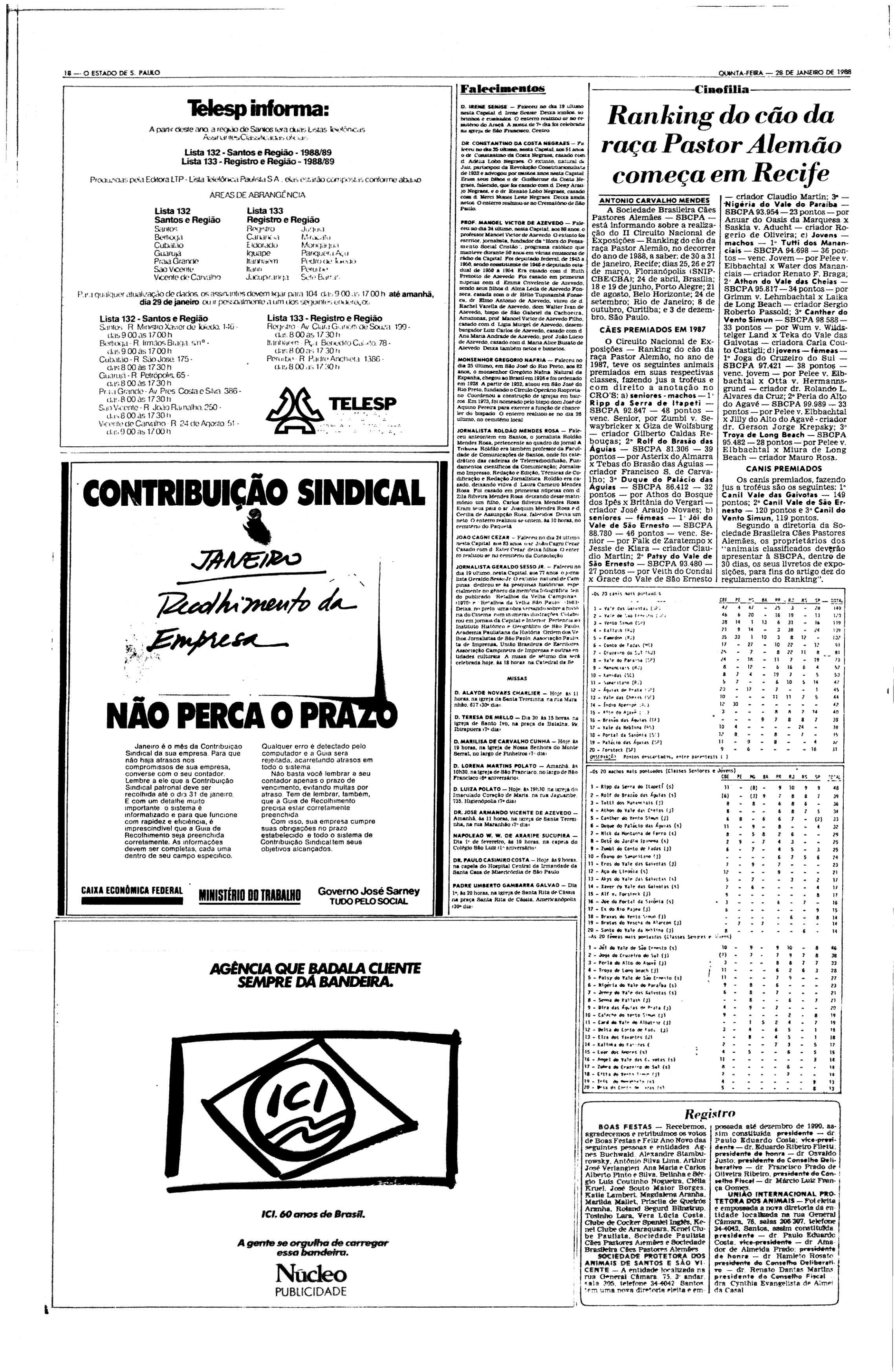
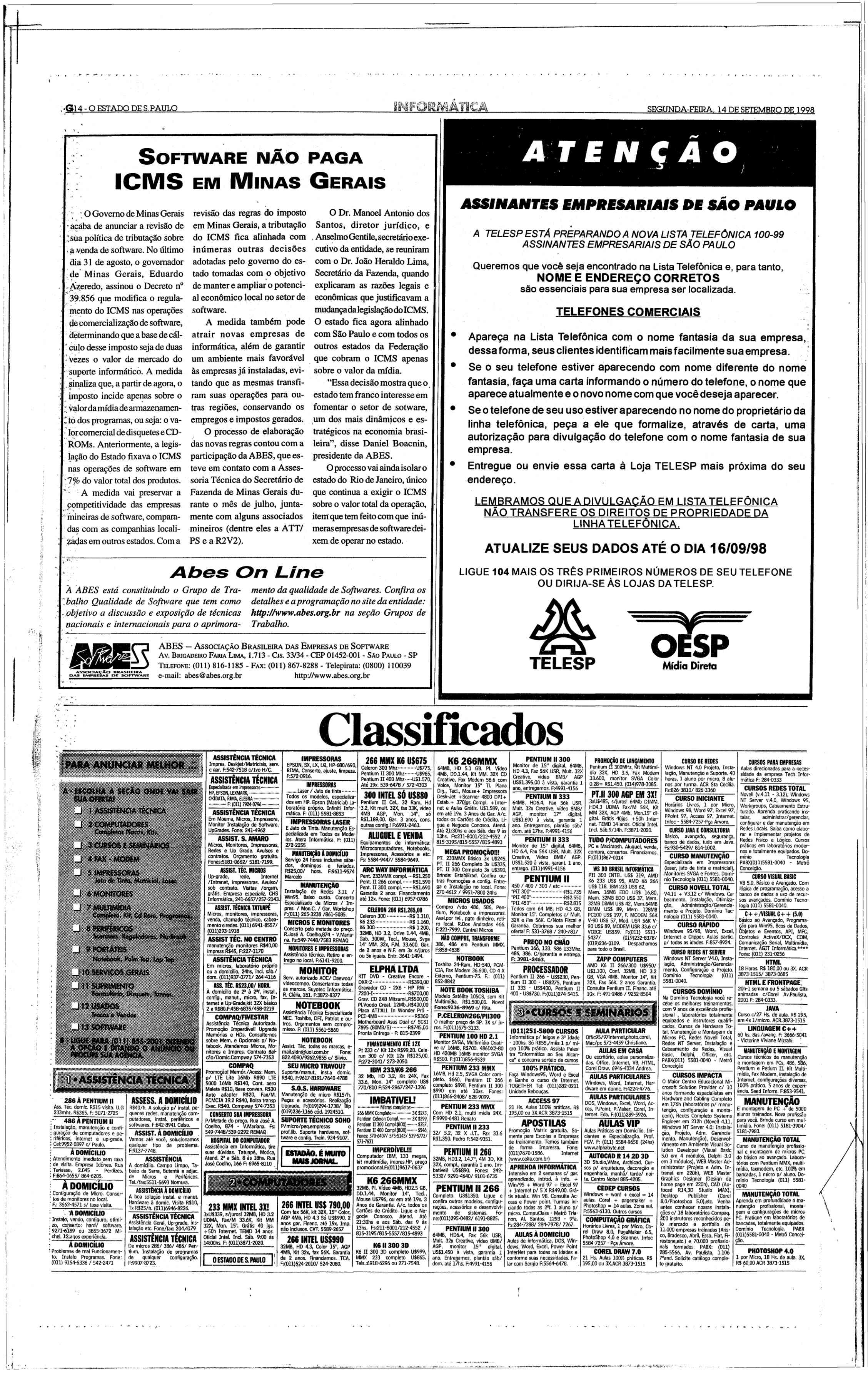
[edit]The first official list of addresses of Telesp for the city of São Paulo was the 80/82 edition,[168][169][170] published by LTB, since the last edition had been published in 1972,[171] when the capital was still served by CTB; its publication was then discontinued due to the high production costs.
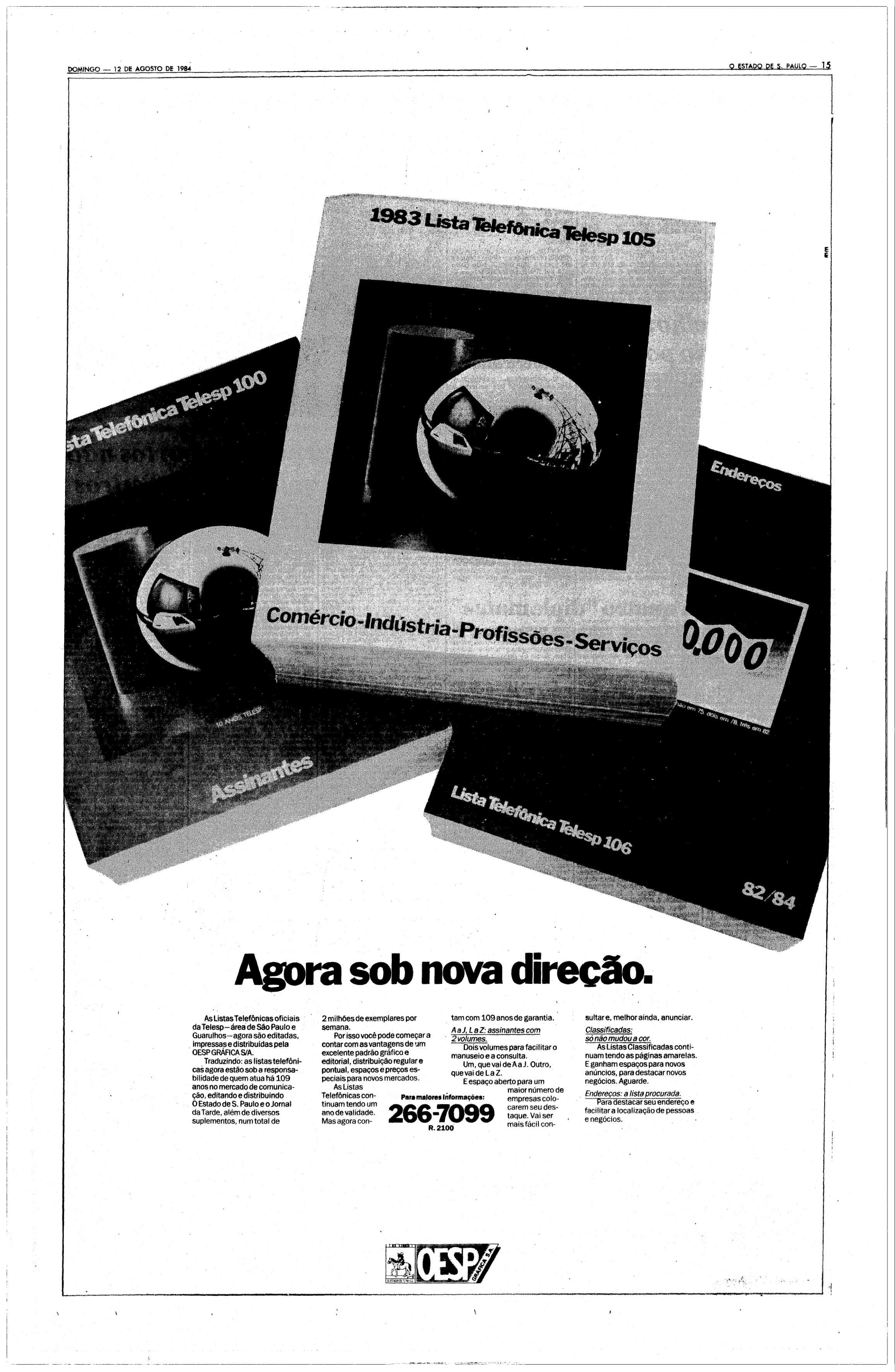
LTB also published the 82/84 edition,[172][173] when the list was discontinued again. It resumed publication starting with the 88/89 edition,[174][175] this time by OESP Gráfica, and from then on the São Paulo address list began to be published regularly every two years.[176]
In the interior, the address lists were published together with the subscriber lists and the classified directory. Starting with the 85/86 edition, they began to be published separately and only for the main cities, as required by regulation.[177] But there were exceptions, such as List 107–Guarulhos, which combined in the same volume the subscriber, address, and classified lists.
Lists published included 130–Santos,[178] 134–São José dos Campos, 141–Campinas, 151–Piracicaba, 152–Limeira, 153–Americana, 154–Santa Bárbara d'Oeste,[179] 156–Jundiaí,[180] among others.
Telephone directories
[edit]Subscribers/classified
[edit]Editions 73/74 to 1977–77/78

The official telephone directories of the city of São Paulo were published by the Editora de Guias LTB[181] since the period when it was still served by the Companhia Telefônica Brasileira, namely the Lista Telefônica Assinantes[182][183] and the Páginas Amarelas.[184] For the interior, the directories were published by LTB[185] (Vale do Paraíba, Norte Paulista, Litoral Santista, Leste Paulista[186] and Sul Paulista), by LTP-Listas Telefônicas Paulista[187] (Região Paulista, Região Sorocabana, Região Alta Paulista and Região Litoral[188]) and by LTN-Lista Telefônica Nacional (Região Araraquarense[189] and Região Noroeste).[190] And for the companies not yet incorporated by Telesp, local telephone directories were published by various publishers, such as those of Sorocaba, Osasco, Guarulhos, Pindamonhangaba, Guaratinguetá, Espírito Santo do Pinhal, among others.[187][191] But the relationship between LTB and Telesp began to deteriorate markedly from 1977 due to various factors, among them the noticeable decline in the quality and reliability of the directories published from 1975 onward, culminating in the very poor quality of the 1977 edition of the São Paulo Subscribers List, and the non-distribution of thousands of copies of that edition to subscribers, resulting from the fact that LTB was experiencing serious financial problems.[192] From the 1977–77/78 edition onward, Telesp's telephone directories began to feature thematic series printed on the covers, starting with figures and places related to the Bandeirantes.[185]
Editions 1978–78/79 to 1983–83/84

From the 1978–78/79 edition onward, the official telephone directories were standardized, each with a national code of Telebrás[166] and coverage based on tertiary areas. For this purpose, the state's tertiary areas were grouped into 12 regions: São Paulo/Guarulhos, Osasco/Jundiaí, Santos, Baixada Santista, São José dos Campos, Campinas, Piracicaba, Bauru, Sorocaba, Araçatuba, São José do Rio Preto and Araraquara.[193] Even with Telesp facing problems with LTB, the president of Telebras ordered the contract with this company to be extended until 1983, because it received government help through loans as a solution to its financial difficulties.[194]

During this period, thematic series continued to be printed on the covers, including museums in the 1978–78/79 edition,[166] the coffee route in the 1979–79/80 edition, the three million installed telephones in the 1982–82/83 edition, and the celebration of the company's tenth anniversary in the 1983–83/84 edition.[173]
Period without publication To comply with the new regulation on publishing telephone directories (Decreto nº 88.221 de 07/04/1983 and Portaria nº 189 de 20/10/1983), Telesp would have to open tender processes to publish them after the end of the contracts then in force.[195] But in June 1983, before its end, LTB unilaterally terminated the contract with Telesp, considering it harmful to the company, even though it had numerous privileges that other publishers did not have. As a result, it stopped publishing the 1984 edition directories that were part of the contract, in addition to not distributing thousands of copies of the 1983 edition of the São Paulo/Guarulhos Subscribers List[196] and of other regions.[197] The termination compromised the production of new directories, causing significant harm to the entire population of the state of São Paulo.[127] LTB wanted to go back, but Telesp had already accepted the termination of the contract, because it did not agree with the requirements the publisher wanted in order to be favored even more.[194][198] At the same time, EBID, another company in the Grupo Gilberto Huber, began to publish guides under the registered brand Páginas Amarelas, distributing them in parallel with the official directories,[194][199] creating a long legal dispute with Telesp that lasted almost eight years (from September 1983 to June 1991), with the courts ultimately guaranteeing the publisher's right to publish them.[200][201] Thus, the requirement for tenders for new contracts and the legal problems with LTB caused the suspension of the publication of the 1984–84/85 and 1985 edition directories.[202][203][204]
Editions 85/86 and 1986–86/87 In compliance with the new regulation, the invitation-letter system was used for the tenders, but only for publishers registered with Telebrás.[205][206][207] The telephone directories were reorganized into 14 regions: List 130 was suppressed, and Lists 115, 150 and 160 were split, giving rise to Lists 155-Jundiaí and region, 145-Rio Claro and region and 165-Marília and region. In addition, the tertiary areas of Jaú, Avaré and Botucatu ceased to be covered by List 170 and were integrated into List 160. In January 1984, Telesp began the tender process for the São Paulo/Guarulhos directories,[208] and in August 1984 OESP Gráfica was contracted.[209] Execution of the contract, with a five-year term, was suspended due to legal measures filed by the Editora de Guias LTB.[210][127] The delay in publishing new directories led those then in circulation, compiled in 1982 and distributed in 1983, to an out-of-dateness that reached 70%. In order to find a solution, still under the terms of the new regulation, Telesp requested and obtained from the Ministry of Communications permission to contract the same publisher, for one year, to print the directories, which were to be distributed in mid-1985. But in November 1984 the process was again halted by legal measures.[127][211] Recognizing the seriousness of the problem generated and seeking to minimize losses for users, in January 1985 the Ministry of Communications authorized Telesp to contract OESP Gráfica to publish the São Paulo/Guarulhos directories.[212] LTB filed a new lawsuit, but in June 1985 Telesp obtained a favorable opinion given definitively by the courts.[213][214] Meanwhile, users in these cities suffered from the lack of updated directories until the situation was normalized, with delivery of the Subscribers List, 1986 edition[215][216] in December 1985[217][218] and of the Classified List, 86/87 edition[219][220] in July 1986,[221] marking the end of a directory out-of-dateness that had already lasted three years.[222] Regarding the interior, in December 1984 several publishers were contracted on an emergency basis, for a period of one year, for the publication of the 85/86 and 1986 edition directories of 11 regions.[206][223][224] Thus, the promise of distribution of directories in the regions of Campinas[225] (OESP Gráfica); São José dos Campos[226] (ABC LISTEL); Bauru (ECTB-Editora de Catálogos Telefônicos do Brasil); Santos,[227] Rio Claro, Piracicaba[228][229] and Jundiaí (LTP-Listas Telefônicas Paulista); Osasco, Marília, Sorocaba and Araraquara[230] (LTN-Lista Telefônica Nacional) was fulfilled. The interior directories began to be distributed in July 1985.[231][232][222] For printing the São Paulo/Guarulhos, Osasco and Campinas directories, a data transfer system to the publishers via magnetic files was implemented. With the implementation of this system, the subscriber complaint rate fell to 0.2%.[129] Another novelty implemented on an experimental basis by Telesp in May 1986 was the electronic telephone directory service on videotext.[233]
Editions 1987–87/88 and 1988–88/89 In June 1986, the legal problems regarding the São Paulo/Guarulhos directories were resolved once and for all, and the following telephone directories were contracted for a period of five years:[234][235]
- OESP:[236] 100-São Paulo Assinantes,[237][238][239] 105-São Paulo Classificada,[240][241] 107-Guarulhos[242][243]
At the end of 1985, negotiations with publishers for the publication of new editions for the interior were concluded,[222] and during 1986, for a period of four years, the following telephone directories were contracted:[129]
- LTP:[244] 131-Santos e região,[245][246] 145-Rio Claro e região,[247] 150-Piracicaba e região,[248][249] 155-Jundiaí e região,[250] 160-Bauru e região, 165-Marília e região
- LTN:[251] 115-Osasco e região,[252] 170-Sorocaba e região,[253] 185-Araraquara e região
- ABC LISTEL:[244] 135-São José dos Campos e região,[254][255][256] 140-Campinas e região[257][258]
For printing the Sorocaba, Piracicaba, Santos, São José dos Campos, Araraquara and Marília directories, the data transfer system to publishers via magnetic files began to be used.[129] And for the 88/89 edition, List 131 was split and suppressed, giving rise to Lists 132-Santos e região and 133-Registro e região.[259] Still in 1986, publication of the 87/88 edition directories for the regions of Presidente Prudente and São José do Rio Preto was contracted on an emergency basis for a period of one year,[260] and then in 1987, for a period of four years, the following telephone directories were contracted:
- LTN:[251] 175-Araçatuba e região, 176-Presidente Prudente e região, 180-São José do Rio Preto e região,[261] 181-Votuporanga e região[261]
Editions 1989–89/90 to 1995–95/96

Once again, the directories were reorganized: for the 1989 edition, List 105 was divided, giving rise to Lists 104-São Paulo Classificada Consumidor and 105-São Paulo Classificada Empresa, and List 135 was split and suppressed, giving rise to Lists 136-Litoral Norte, 137-Alto Vale do Paraíba and 138-Vale do Paraíba e Região Serrana. There was also a change in the roster of publishers: LISTEL incorporated LTP in October 1988 and considerably expanded its coverage in the state, and from the 1989 edition onward began publishing that publisher's directories,[262][263] and in 1994 LTN came to be called EPIL – Editora Pesquisa e Indústria.

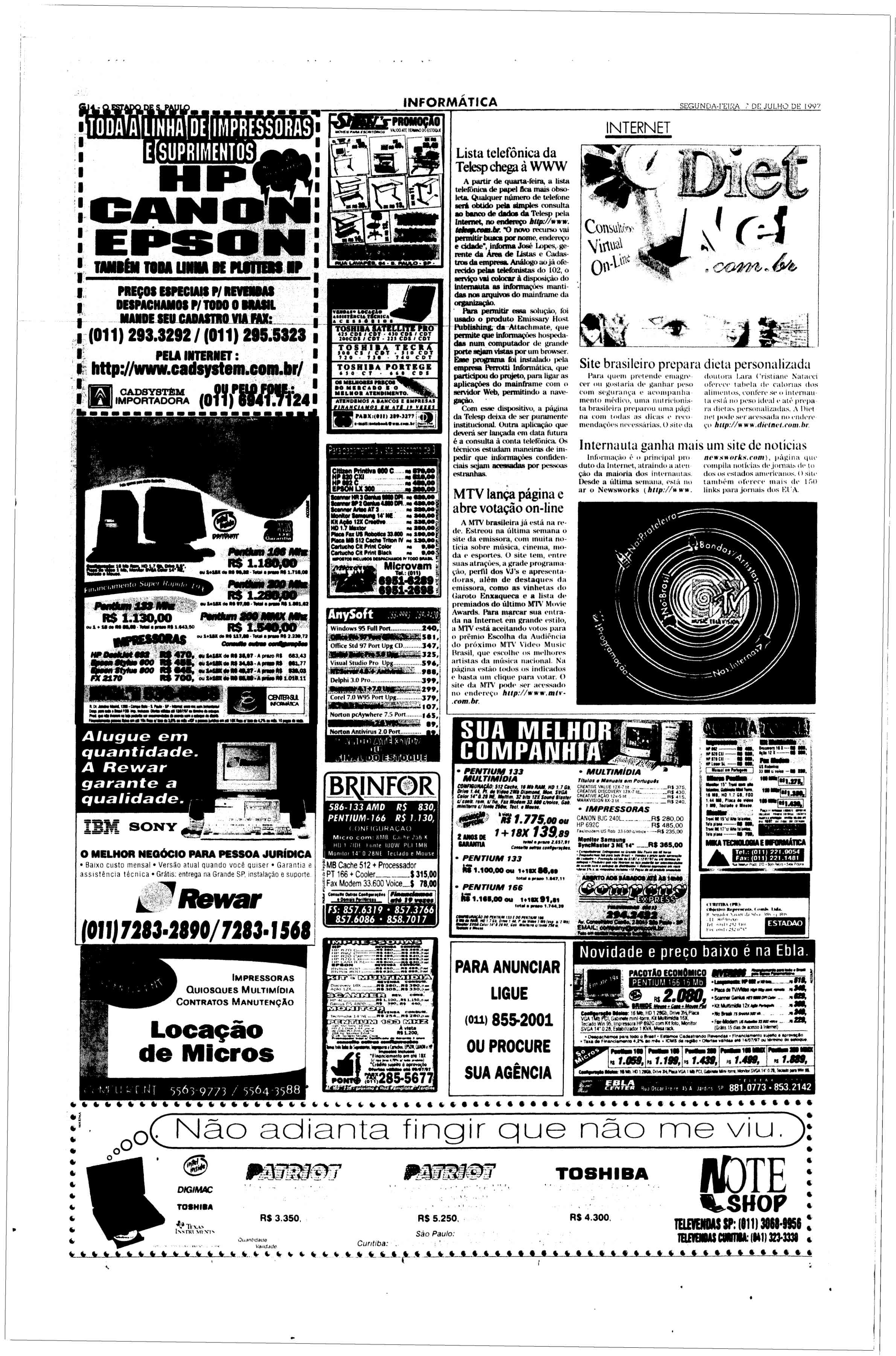
Editions 1996–96/97 to 1999 There was still one last reorganization in the directories: for the 1996 edition, Lists 115, 170 and 180 were split, giving rise to Lists 124-Barueri, São Roque e região, 125-Cotia, Itapecerica da Serra e região, 173-Região Sul Paulista and 182-Barretos, Bebedouro, Catanduva e região, and for the 1997 edition List 100 was divided, giving rise to Lists 100-São Paulo Assinantes Empresariais and 102-São Paulo Assinantes Residenciais. Finally, Telesp's telephone directories reached the internet in July 1997,[264] and the 1999 edition was the last to be published by Telesp,[265] with the 2000 edition already published by Telefônica.
Addresses
[edit]The first official Telesp address directory for the city of São Paulo was the 80/82 edition,[266][267][268] published by LTB, since the last edition had been published in 1972,[269] when the capital was still served by CTB, and its publication was then discontinued due to high production costs. LTB also published the 82/84 edition,[270][173] when the directory was discontinued again. It returned to being published from the 88/89 edition onward,[271][175] this time by OESP Gráfica, and from then on São Paulo's address directory came to be published regularly every two years.[272] In the interior, address directories were published together with subscriber and classified directories. From the 85/86 edition onward, they began to be published separately and only for the main cities, as determined by the regulation.[177] But there were exceptions, such as List 107-Guarulhos, which brought together in the same volume the subscriber, address and classified directories. The directories 130-Santos,[273] 134-São José dos Campos, 141-Campinas, 151-Piracicaba, 152-Limeira, 153-Americana, 154-Santa Bárbara d'Oeste,[274] 156-Jundiaí,[275] among others, were published.
Telephone terminals
[edit]Expansion plans and shares
[edit]
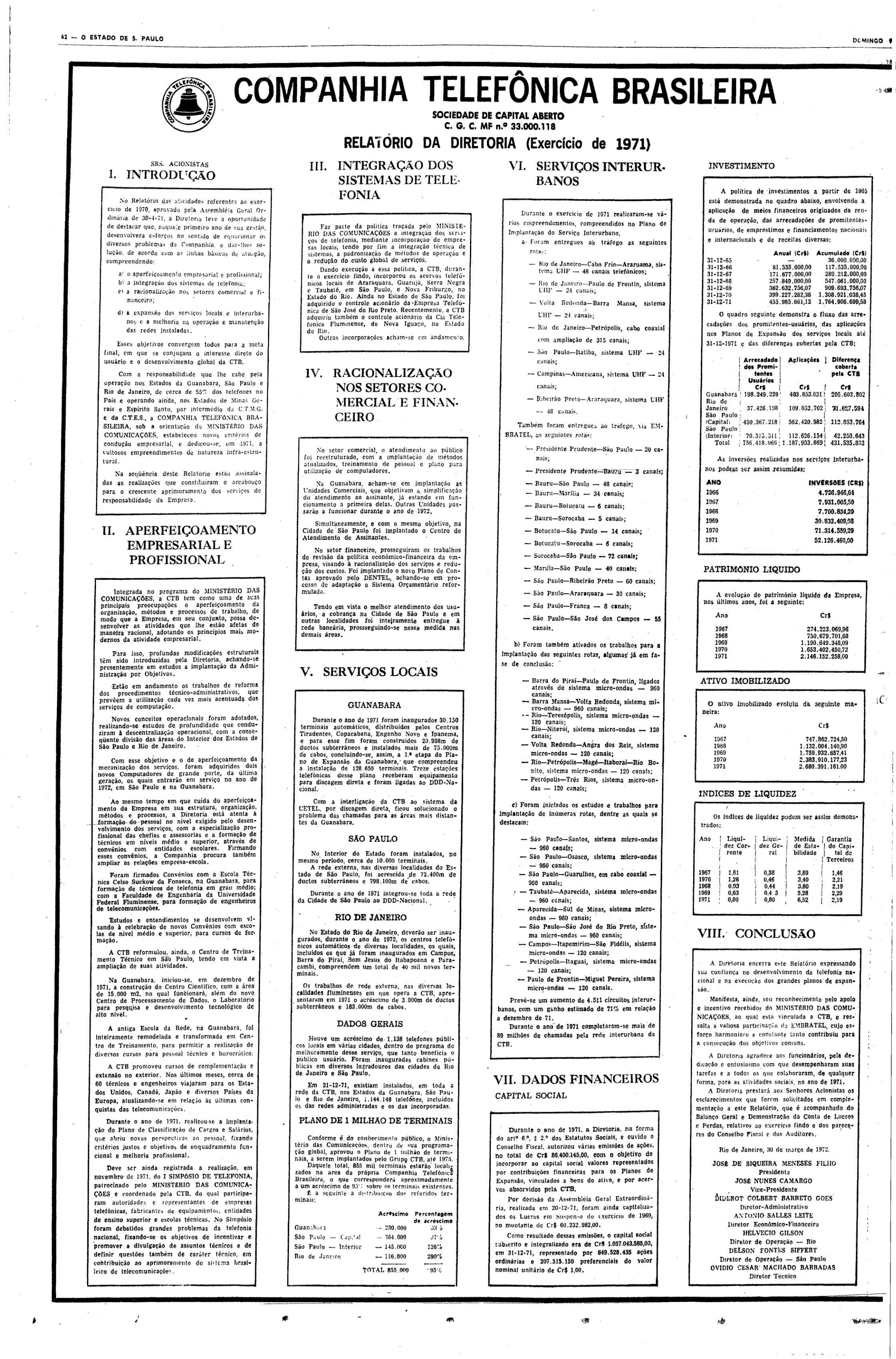
In the Brazilian government's policy of expanding the telephone system, users advanced financial resources to fund it, through the self-financing scheme for telephone lines, adopted in 1967 and which was unique worldwide. Thus, the user received shares of the company concessionaire for the public telecommunications service; that is, they were not only acquiring the line, but also becoming a shareholder of the company.[276]
This was the expansion process for telephone companies: they increased capital by issuing shares that were bought by those interested in having a telephone. Then, the money was used to expand the telephone network and install the purchased lines. Between the sale of the expansion plan and the installation of the line, the process could take two years or more.
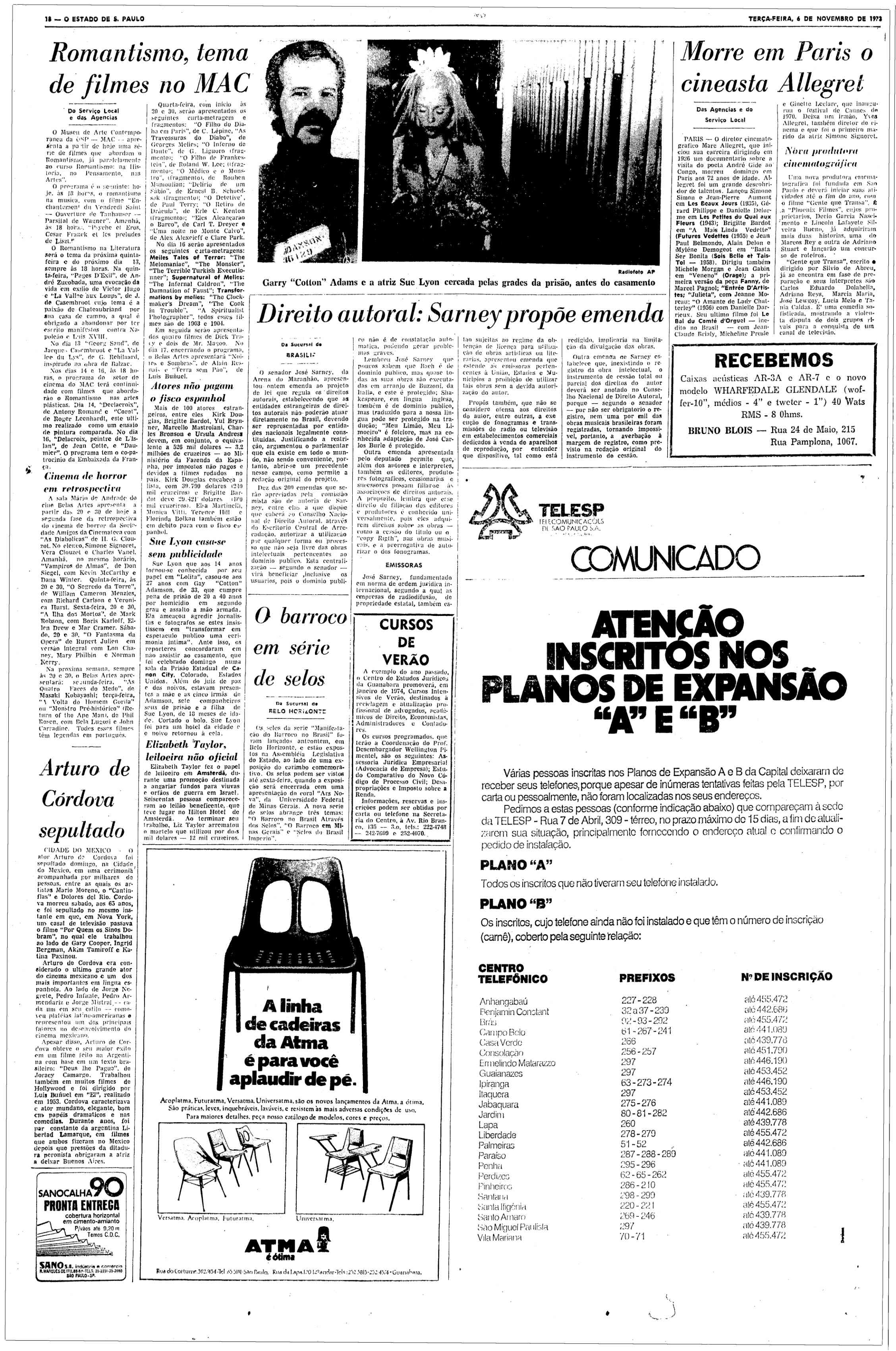
Those who purchased expansion plans from January 1973 to December 1974 and from January 1996 to June 1997 became shareholders of Telesp, while those who purchased expansion plans from January 1975 to December 1995 became shareholders of Telebras.[276]
Only those who bought telephones via expansion plans had the right to shares. Those who bought the line from third parties, which was very common at the time, did not receive the shares; what was transferred was only the right to use the line, because the shares were not associated with the telephone line number but instead assigned to the first holder based on the registration number of the expansion plan carried out directly through Telesp's self-financing system, which held identifying data for the prospective subscriber. Thus, users who sold their lines remained shareholders, and they could also sell their shares, which happened very frequently.
This form of financing was abolished on 30 June 1997, under Ordinance No. 261 of 30 April 1997 of the Ministry of Communications, but subscribers who received shares and did not sell them remained shareholders of other companies after the reorganization that occurred in the system. Those who were shareholders of Telesp also received shares of Telesp Celular, since the company underwent a demerger. Those who were shareholders of Telebras also received shares of the new companies after its demerger, such as Telesp and Embratel. Since 1998, new changes occurred, and those who were still shareholders of Telebras in May of that year also became shareholders of Telefônica Brasil, Oi, Embratel, TIM and others.[277]
Installed telephones
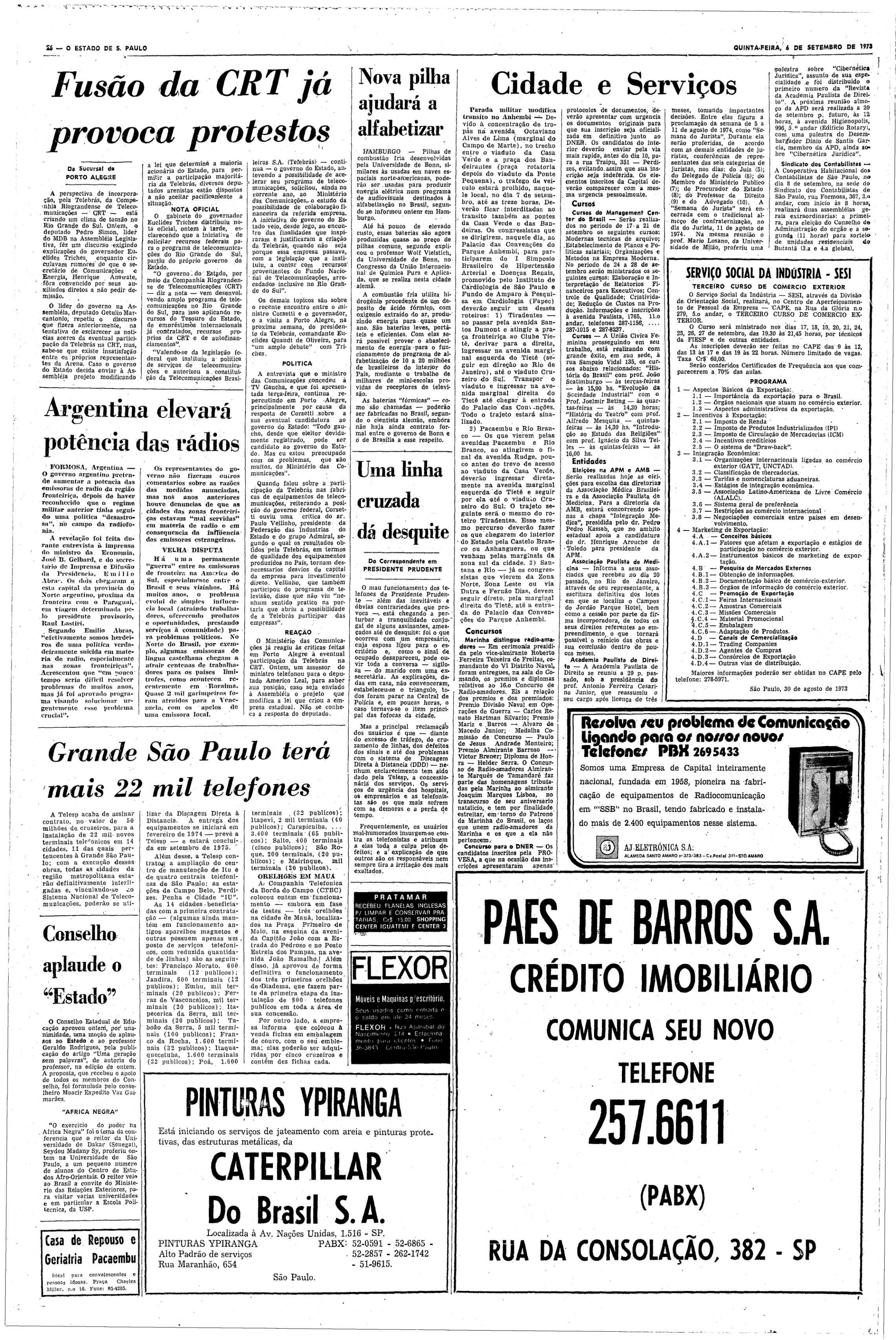
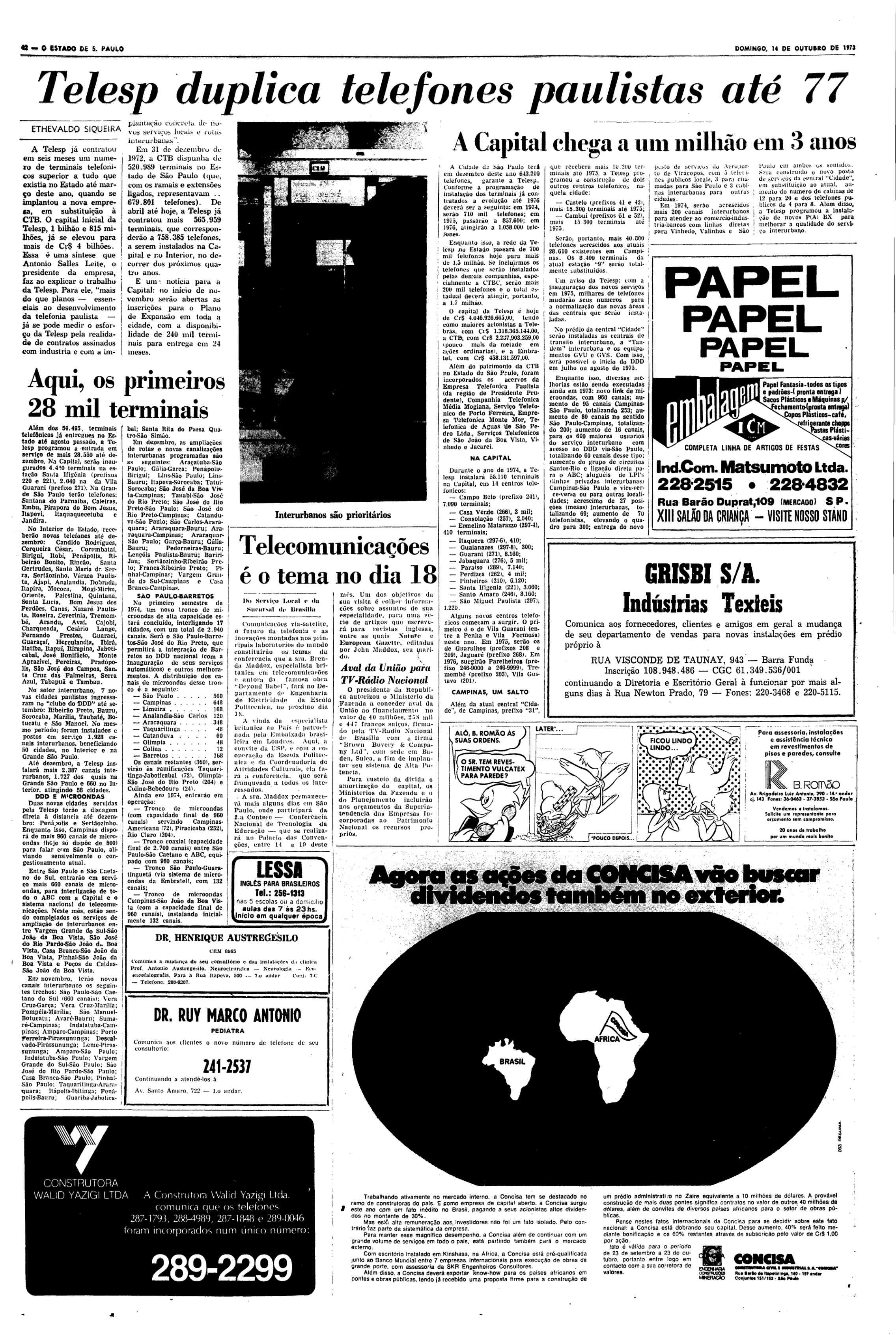
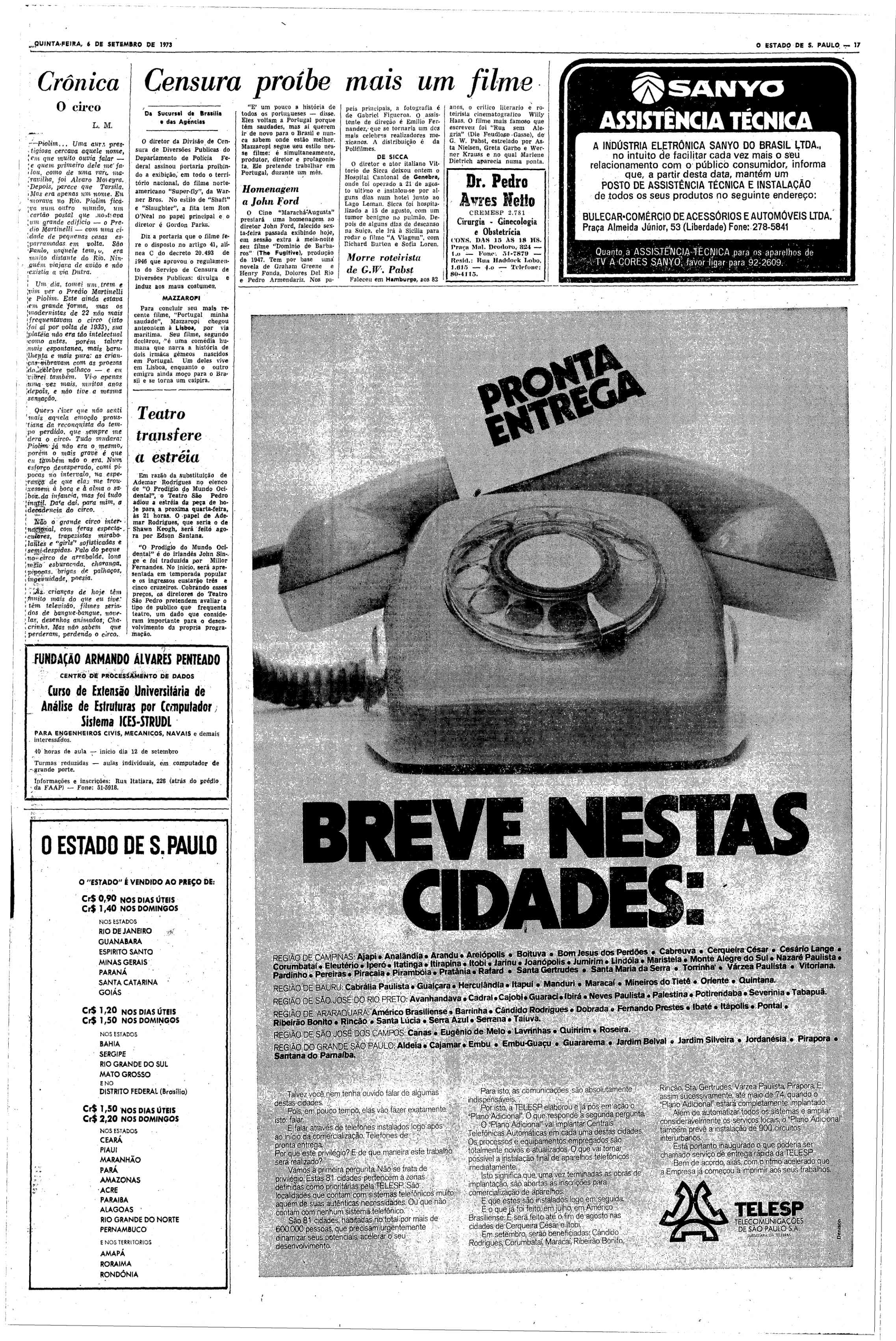
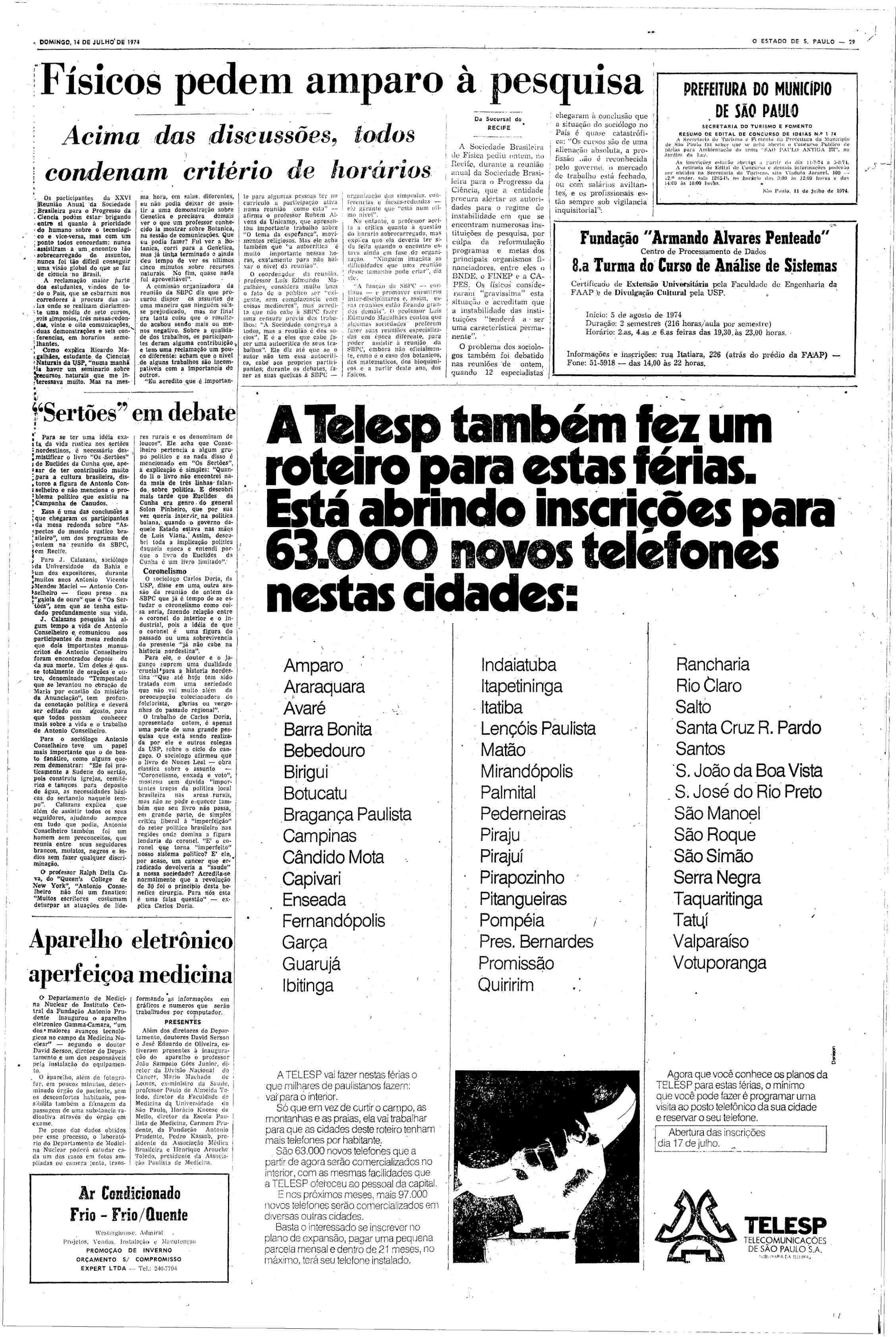
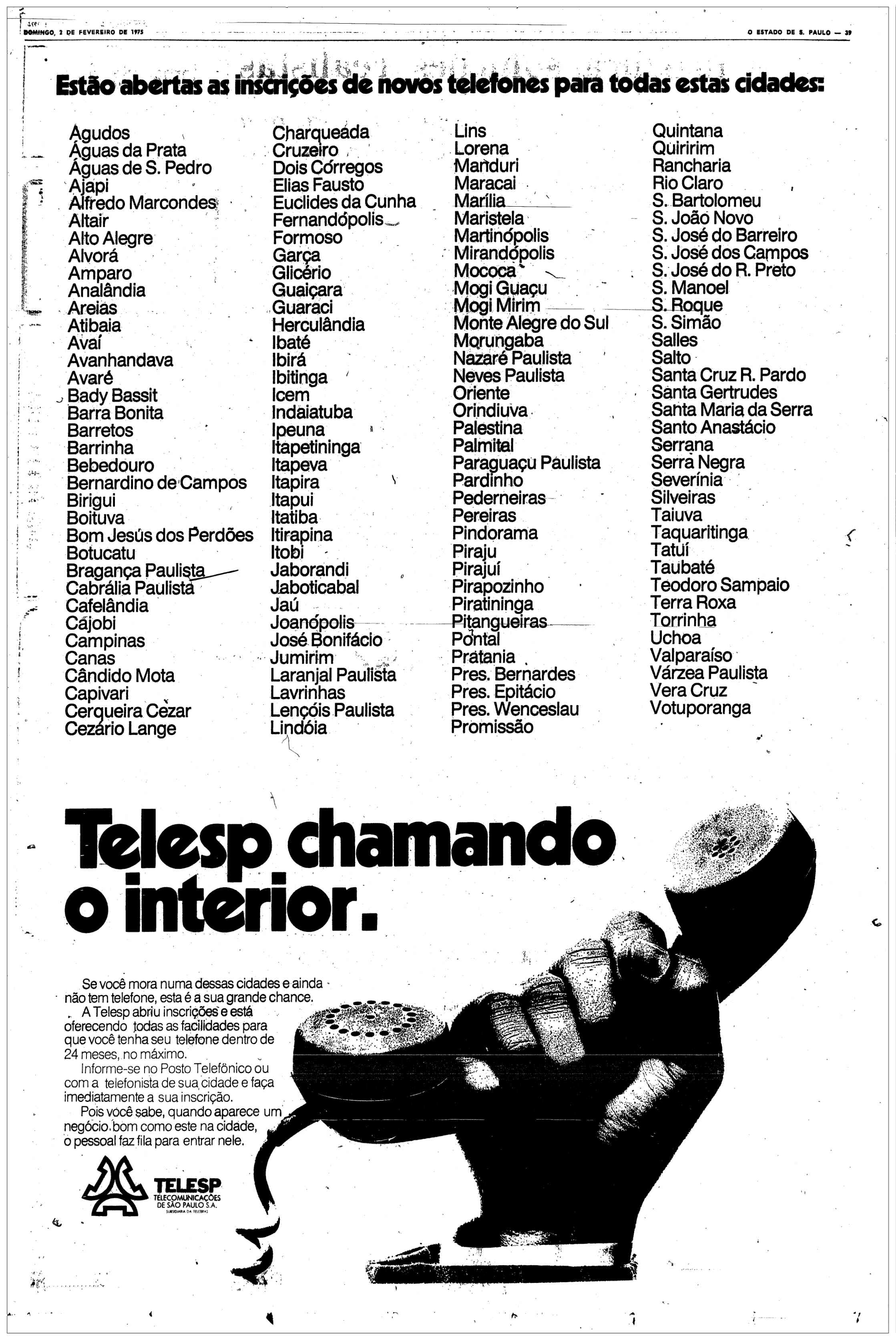
[edit]One-million-telephone plan: As soon as it began operations, Telesp's first action was to continue the one-million-telephone plan (P1M) approved by the Ministry of Communications and started by Companhia Telefônica Brasileira in October 1971,[278] in which 375,000 telephone terminals were intended for the capital[279] and 175,000 intended for the interior,[280] to be installed by 1976. Of this total, CTB had already contracted 240,000 telephone terminals and Telesp completed in 1973 the contracting that exhausted the share of this plan allocated to the state of São Paulo; the milestone of one million telephones in service was reached in 1975.[281][282][283] In the overall planning of this expansion, in addition to the capital, two cities of great economic importance in its service area stood out:

• Campinas – with 28,610 terminals in 1973, a further 40,800 terminals were contracted: 10,200 for station "31" (Cidade), 10,200 for station "41" (Castelo), 5,100 for station "42" (Castelo), 10,200 for station "51" (Cambuí) and 5,100 for station "52" (Cambuí); and the 8,400 terminals of station "9" (Cidade) were replaced, which was deactivated

• Santos – with 28,400 terminals in 1973, a further 44,000 terminals were contracted,[284] of which 10,200 for station "32" and 10,200 for station "33" (both at the Washington Luís exchange),[285][286] 10,200 for station "34" and 10,200 for station "35" (also at the Washington Luís exchange),[287][288] and the 8,400 terminals of station "2" (Brás Cubas) were replaced, which was deactivated[289][290][291] From then on, Telesp established its own expansion plans.[292] Additional plan: An emergency action initiated in July 1973 which, unlike the expansion plans, first consisted of implementing automatic telephone exchanges in localities defined as priorities by Telesp; then, shortly after the completion of the exchange-implementation works, the telephone lines were marketed and installed.[293] Two-million-telephone plan: The high levels of development of the state's growth at the time indicated the need to begin executing new plans aimed at reaching the target set in the agreement signed in October 1973 between Telesp and COTESP through the State Telecommunications Master Plan, under which by 1980 the average number of telephones in the state should be 12 per 100 inhabitants and cities with more than 10,000 inhabitants should be interconnected to the DDD system. In this agreement, the two-million-telephone plan (P2M) was announced, made official in January 1974,[294][295] with the milestone of two million telephones in service reached in 1978.[296][297] Later expansions: From then on, registrations for expansion plans began to be opened continuously, with Telesp signing contracts every year with the main suppliers of telephone equipment.[298][299][300] Thus, in 1982 the milestone of three million telephones in service was reached,[301][302] and in 1986 the milestone of four million telephones in service was reached.[303]
| Year | Increase in terminals |
Terminals installed |
Terminals in service |
Telephones in service |
|---|---|---|---|---|
| 1973 | 83.7 | 597.1 | 530.0 | 827.0 |
| 1974 | 66.5 | 677.0 | 585.0 | 926.6 |
| 1975 | 134.0 | 824.0 | 695.0 | 1,112.9 |
| 1976 | 237.8 | 1,085.0 | 902.0 | 1,398.8 |
| 1977 | 207.6 | 1,314.1 | 1,077.0 | 1,684.5 |
| 1978 | 279.5 | 1,593.6 | 1,320.0 | 2,012.2 |
| 1979 | 206.7 | 1,800.3 | 1,531.0 | 2,365.4 |
| 1980 | 69.4 | 1,869.7 | 1,702.6 | 2,678.1 |
| 1981 | 92.0 | 1,960.3 | 1,806.8 | 2,938.8 |
| 1982 | 135.0 | 2,095.0 | 1,969.9 | 3,221.4 |
| 1983 | 135.0 | 2,229.9 | 2,111.7 | 3,470.8 |
| 1984 | 184.9 | 2,414.8 | 2,284.5 | 3,731.8 |
| 1985 | 118.8 | 2,533.6 | 2,417.6 | 3,991.3 |
| 1986 | 140.3 | 2,673.9 | 2,508.7 | 4,196.1 |
| 1987 | 119.9 | 2,793.8 | 2,567.1 | 4,466.4 |
| 1988 | 125.4 | 2,919.2 | 2,695.6 | 4,506.2 |
| 1989 | 192.0 | 3,111.0 | 2,814.9 | 4,533.4 |
Community telephone plan: In November 1990, the Ministry of Infrastructure regulated the Community Telephone Program (PCT), under which Telebrás subsidiaries were authorized to transfer to private companies the task of expanding telephone networks, making them responsible for marketing and installing telephones with a maximum period of 18 months. As a result, telephones became more widespread and more affordable.[304][305] While there was an expansion of 97,900 terminals in 1990[306] and 241,200 terminals in 1991,[307] when these companies began implementing the PCTs for Telesp, 334,000 terminals were installed in 1992. In 1993, 236,000 terminals were installed and in 1994 there were 221,000 terminals, totaling about 4.2 million telephone terminals installed and about 3.9 million telephone terminals in service.[308]
Final expansions: In 1995, the number of installed telephone terminals was 4.5 million, with 4.2 million telephone terminals in service, and in 1996 the number of installed terminals was 4.9 million, with 4.6 million terminals in service.[309] In 1997, the number of installed terminals reached 5.4 million, with a digitization rate of 55% of the installed base; 94% of installed terminals were in service, reaching 5 million. Of these terminals, 67% were residential (3.4 million), 20% non-residential (1 million), 10% trunks (500,000) and 3% public-use terminals (150,000). The number of terminals per 100 inhabitants (teledensity) that year was 16.64.[310][311]
Main cities in Telesp's operating area (except the capital):
| City[a] | Dist. | Term. 1973 |
Term. 1975 |
Term. 1977 |
Term. 1979 |
Term. 1980 |
Term. 1982 |
Term. 1985 |
Term. 1987 |
Term. 1989 |
Exch. 1989 |
|---|---|---|---|---|---|---|---|---|---|---|---|
| Guarulhos | OL6 | 7140 | 7140 | 17340 | 17340 | 23440 | 35910 | 37950 | 40020 | 7 (2) | |
| Barueri | OW6 | 10520 | 11580 | 11580 | 2 (2) | ||||||
| Cotia | OW6 | 10244 | 10244 | 2 (2) | |||||||
| Osasco | OW6 | 10200 | 20400 | 20400 | 20400 | 32840 | 32840 | 36920 | 5 (1) | ||
| Campinas | OA1 | 28610 | 30410 | 61010 | 76310 | 76310 | 76570 | 111230 | 113290 | 120430 | 13 (4) |
| Jundiaí | OA2 | 10500 | 10500 | 16850 | 16850 | 17850 | 24920 | 33150 | 35190 | 35290 | 5 (3) |
| Americana | OA5 | 10200 | 10200 | 10200 | 12240 | 13260 | 21416 | 3 (1) | |||
| Limeira | OA5 | 5020 | 11708 | 11708 | 11708 | 13748 | 15300 | 25500 | 3 (1) | ||
| Piracicaba | OA5 | 11500 | 11500 | 16500 | 21600 | 21600 | 21600 | 26600 | 27600 | 33740 | 4 (2) |
| Rio Claro | OA3 | 5100 | 5100 | 9180 | 9180 | 11180 | 13260 | 13260 | 13260 | 2 (1) | |
| Sorocaba | OA4 | 9000 | 9040 | 9681 | 20400 | 21800 | 30400 | 30400 | 30400 | 34480 | 4 (2) |
| Bauru | OB1 | 5000 | 5000 | 12140 | 15200 | 15200 | 18200 | 18400 | 25640 | 28642 | 5 (2) |
| Presidente Prudente | OB2 | 8522 | 8522 | 10522 | 15334 | 15334 | 15334 | 3 (1) | |||
| Marília | OB3 | 8160 | 8160 | 10160 | 12260 | 14300 | 16340 | 2 (1) | |||
| Guarujá | OS1 | 6140 | 15700 | 16500 | 19500 | 20758 | 23098 | 25326 | 5 (3) | ||
| Praia Grande | OS2 | 9040 | 13740 | 13740 | 13760 | 4 (4) | |||||
| Santos | OS1 | 28400 | 50280 | 66780 | 66780 | 70280 | 76280 | 100830 | 102230 | 110710 | 12 (5) |
| São Vicente | OS2 | 10000 | 10000 | 14000 | 14000 | 18208 | 18208 | 3 (1) | |||
| Jacareí | OS3 | 10200 | 11424 | 2 (1) | |||||||
| São José dos Campos | OS3 | 10200 | 10200 | 10200 | 24400 | 25400 | 26400 | 32500 | 35660 | 47020 | 6 (3) |
| Taubaté | OS4 | 12180 | 12180 | 16180 | 16180 | 18400 | 20440 | 3 (1) | |||
| São José do Rio Preto | OT1 | 5045 | 5061 | 13260 | 21420 | 21420 | 23420 | 25560 | 25560 | 25560 | 3 (1) |
| Araçatuba | OT2 | 8000 | 8000 | 8000 | 9920 | 12498 | 12498 | 13518 | 2 (1) | ||
| Araraquara | OT3 | 5430 | 8160 | 8160 | 10200 | 12200 | 12200 | 22400 | 22400 | 22400 | 3 (2) |
| São Carlos | OT3 | 12519 | 12767 | 16669 | 16669 | 21309 | 3 (1) |
Telephone exchanges
[edit]When Telesp was created, part of the state's cities did not have telephone systems. Of these, most were served only by a Service Post (PS), but some were still "silent zones", not even having a PS, which was the case for Estrela do Norte, Flora Rica, Igaratá, Palmares Paulista, Pedra Bela, Pinhalzinho, Pirapora do Bom Jesus and Sagres.[312][313][314] There were also cases of cities whose telephone system was abandoned, such as Queiroz,[315] cities that had their telephone system extinguished, such as Caiabu, or cities served by companies that had been halted, such as Empresa Telefônica Mogiana of Santo Antônio de Posse.[316][317] The completion of the implementation of telephone systems in cities that lacked Telesp urban services occurred in 1979, with Rifaina the last city to get a telephone system;[318] Telesp even launched the TV commercial "Rifaina",[319] which received the award for Best Special Project at the 2nd edition of Rede Globo's Profissionais do Ano award in 1979.[320]
Manual exchanges
[edit]Most cities that had telephone systems were served by manual exchanges with switchboards operated by telephone operators. Telesp continued implementing manual exchanges in municipal seats only until 1979 and on an emergency basis. The last cities to have telephone systems implemented through manual exchanges were:
- Adolfo, Flora Rica,[321] Guarani d'Oeste, Itapura, Lagoinha, Mendonça, Mirassolândia, Sagres, São João das Duas Pontes and Sebastianópolis do Sul (1975)[107]
- Barra do Turvo,[322] Estrela do Norte, Gabriel Monteiro, Narandiba, Palmares Paulista, Sandovalina, Santa Clara d'Oeste, Tarabai and União Paulista[322] (1976)[323]
- Pontes Gestal, Rubinéia and São Francisco (1977)[324]
- Mariápolis, Marinópolis, Nova Guataporanga, Paulicéia, Pedranópolis, Pinhalzinho, Platina, Santa Mercedes, Santana da Ponte Pensa and São João do Pau d'Alho (1978)[325]
- Pedra Bela (1979)
Because they were obsolete, manual exchanges were gradually replaced by Telesp with automatic exchanges until 1985, when the automation of telephone exchanges in all municipal seats in its coverage area was completed. However, manual exchanges continued to be installed in districts in the 1980s, including in some that became emancipated in the 1990s, such as Nova Castilho[326] and São João de Iracema.[327]
Automatic exchanges
[edit]Capital
[edit]_06.jpg?lang=en)
In April 1973, Telecomunicações de São Paulo (TELESP) was created. The following month, CTB transferred its entire holdings in the state to this company.[328]
When it came to be served by Telesp, the city of São Paulo was served by 48 automatic exchanges installed in 24 telephone exchange buildings. Soon after, the first contract was signed to expand the capital's telephone network,[329][330] and Telesp had already begun a new expansion plan.[331]
Upon taking over operations, Telesp already inaugurated the new telephone exchanges of the one million telephones plan (P1M): Campo Belo (exchange "241"),[332] Guarani (exchange "271"), Paraíso (exchange "289"), Penha (exchange "296") and Pinheiros (exchange "210").[333][334][335]
_12.jpg?lang=en)
Telesp continued, without interruption, the ongoing works begun by CTB: the telephone exchange building Guarani (inaugurated in 1973) and the planned telephone exchange buildings Jaguaré, Tremembé and Vila Gustavo (inaugurated between 1977 and 1978).[336]
The city of Guarulhos was integrated into the São Paulo area in 1974, and therefore its telephone exchanges began to follow the capital's numbering sequence. However, the DDD system was only installed in the city in 1975, after completion of the works on the new telephone exchange.[337]
During this period, Telesp made an area cutover at the Benjamin Constant center and deactivated exchange "33" to improve telephone traffic in this critical area of the capital.[338] Another area with many problems that were resolved was the Jardins center, where exchanges "80" and "81" were replaced by exchanges "852" and "853" respectively; exchange "81" was switched off and dismantled, and exchange "80" was reused and reactivated in 1977 as exchange "64".[339][340]

Through its own planning, it inaugurated new telephone exchange buildings, the first being Parelheiros (inaugurated in 1978)[341] and Ceagesp (inaugurated in 1981),[342] It also expanded the buildings of the telephone exchange buildings inaugurated by CTB between 1968 and 1970, and built annex buildings to older telephone exchange buildings (Benjamin Constant, Brás, Campo Belo, Guarulhos, Ipiranga, Jardins, Palmeiras, Perdizes and Vila Mariana),[343][344] always using crossbar exchanges as equipment.[345][346][347][348][349]
In 1979 the city of Osasco was integrated into the São Paulo area.[350] The new telephone exchange building was inaugurated in 1977 (exchange "478"),[351] and was changed to exchange "801" when the integration occurred, at the same time that the second telephone exchange (exchange "802") was inaugurated,[352] thereafter following the capital's numbering sequence until 1986, when there was a new change in prefixes.[353]
CPA exchanges
[edit]In December 1977, the country's first digital telephone exchange was inaugurated on an experimental basis (the so-called CPA – centrais controladas por programa armazenado). PRX-series equipment (Philips) was used, and the exchange was installed in Vila Mariana (prefix "544").[354][355]
But it was another digital technology, the AXE-10 series (Ericsson), that was deployed definitively, with the first exchange also inaugurated in Vila Mariana (prefix "572") in April 1982,[356][357] gradually beginning the deployment of digital exchanges in São Paulo.[358][359][360]
In the same year, two more CPAs were inaugurated: in the Guarani telephone exchange building (prefix "918") in September 1982,[358] and Lapa (prefix "832") in December 1982,[361][358] and the following year six more CPAs were inaugurated, in the Jabaquara telephone exchange building (prefix "579") in March 1983,[362] Ipiranga (prefix "914") in May 1983,[362] Casa Verde (prefix "858") and Penha (prefix "941") in November 1983,[363] Campo Belo (prefix "533") and Osasco (prefix "803") in December 1983.[363]
In 1984 the telephone exchange buildings Americanópolis, Campo Limpo, Cumbica, Ibirapuera,[364] Jaraguá, Morumbi, São Mateus and Vila Esperança were inaugurated with only digital exchanges. By that year, 26 CPAs with around 200,000 terminals had already been installed in the capital area.[365]
In the following years, the telephone exchange buildings Anhanguera and Nova Parelheiros (1985), Freguesia do Ó (1986), Anchieta, Guarapiranga and Vila Prudente (1987), Dutra (1988), Cidade Vargas and Itaim Bibi (1989) were inaugurated.
The "áreas mudas" in the municipality still persisted for some years after Telecomunicações de São Paulo (TELESP) took over operations. Parelheiros only began to have telephone service in 1978 (1,000 terminals with the 9 thousand-group of prefix "246", changed to "520" in 1979),[341][366] Jaraguá in 1984 (4,000 digital terminals with prefix "841") and Nova Parelheiros in 1985 (1,000 terminals with the 8 thousand-group of prefix "520").
By the end of the 1980s, there were 45 telephone exchange buildings installed in the city of São Paulo:
| Telephone exchange building | Telephone exchange | |||
|---|---|---|---|---|
| CTB (step-by-step) | CTB (crossbar) | Telesp (crossbar) | Telesp (digital exchanges) | |
| Americanópolis |
| |||
| Anchieta |
| |||
| Anhangabaú |
|
|
||
| Anhanguera |
| |||
| Benjamin Constant (1º prédio) [368] |
|
|
||
| Brás (1º prédio) [369][370] |
|
|
||
| Brás (2º prédio) | ||||
| Campo Belo (1º prédio) |
|
|||
| Campo Belo (2º prédio) | ||||
| Campo Limpo |
| |||
| Casa Verde |
|
|||
| Ceagesp (deactivated) |
|
|||
| Cidade Vargas |
| |||
| Consolação | ||||
| Dutra |
| |||
| Ermelino Matarazzo |
| |||
| Freguesia do Ó |
| |||
| Guaianases | ||||
| Guarani |
|
|||
| Guarapiranga |
| |||
| GRU – Guarulhos (2º prédio) |
| |||
| GRU – Cumbica |
| |||
| Ibirapuera |
| |||
| Ipiranga (1º prédio) |
|
|||
| Ipiranga (2º prédio) |
|
| ||
| Itaim Bibi |
| |||
| Itaquera |
| |||
| Jabaquara |
|
| ||
| Jaguaré |
| |||
| Jaraguá |
| |||
| Jardins (1º prédio) |
|
|||
| Jardins (2º prédio) | ||||
| Lapa |
|
| ||
| Liberdade |
|
| ||
| Morumbi |
|
| ||
| Nova Parelheiros |
|
|||
| OSS – Osasco (2º prédio) | ||||
| Palmeiras (1º prédio) | ||||
| Palmeiras (2º prédio) | ||||
| Paraíso | ||||
| Parelheiros | ||||
| Penha |
| |||
| Perdizes (1º prédio) |
|
|||
| Perdizes (2º prédio) | ||||
| Pinheiros | ||||
| Santa Ifigênia | ||||
| Santana |
| |||
| Santo Amaro |
| |||
| São Mateus |
| |||
| São Miguel Paulista |
| |||
| Tremembé |
| |||
| Vila Esperança |
| |||
| Vila Gustavo |
| |||
| Vila Mariana (1º prédio) | ||||
| Vila Mariana (2º prédio) |
|
|||
| Vila Prudente |
| |||
Interior
[edit]Medium- and large-scale exchanges:


In interior cities that already had automatic exchanges, they were step-by-step, rotary, and crossbar types, from various manufacturers (Automatic Electric, Ericsson, Standard Elétrica and Plessey).[403][404] As the need to expand terminals arose, step-by-step and rotary exchanges were replaced by crossbar exchanges. In cities that already had crossbar exchanges, the number of terminals could be increased without needing to change the equipment. Of the oldest automatic exchanges installed by CTB, only a few were kept, such as Araraquara, Bauru, Campinas, Rio Claro[405] and Santos (Brás Cubas and Tocantins),[406] as well as some exchanges in networks administered by CTB such as Jundiaí,[407][408][409] Piracicaba,[410][411] São João da Boa Vista[412][413][414] and Votuporanga. The automatic exchanges inaugurated by CTB between 1970 and 1972 and that were part of the first expansion plan were kept, some of which had their buildings expanded or replaced:[415]
- Avaré (replaced), Barra Bonita,[416] Botucatu, Bragança Paulista,[417] Cruzeiro, Garça, Itapetininga (replaced),[418] Itapeva, Itapira, Itatiba, Itu,[419] Jaboticabal, Lençóis Paulista, Mococa, Mogi Guaçu (replaced), Mogi Mirim (expanded),[420][421] Penápolis, Piedade, Promissão, Santos–Washington Luís[406][422] and Tatuí[418]
As for the other automatic exchanges installed by CTB and its administered networks, they were replaced by larger buildings and new equipment, such as the exchanges in Assis, Araçatuba, Guaratinguetá,[423][424] Guarujá,[425] Guarulhos,[426][416] Jacareí, Marília, Presidente Prudente, São José do Rio Preto,[427][428] São José dos Campos[429][430] and Sorocaba.[431][432]

Of the automatic exchanges installed by COTESP, some were also kept, such as Ilhabela, Ilha Solteira, Paraibuna, Santa Branca, São Sebastião and Ubatuba.[433][434] In an agreement signed in 1973, for COTESP fell the portion relating to building construction, power supply, engineering, and supervision of new telephone exchanges, which were installed in special buildings of brutalist architecture, of which the architect Ruy Ohtake, one of the most highly regarded in Brazil, produced two designs (Campos do Jordão[435] and Ibiúna[436]), while Telesp took charge of installing and activating the telephone equipment.

Thus the exchanges in Andradina, Caçapava and Campos do Jordão were activated by COTESP, and the others by Telesp, with the exchanges in Angatuba, Auriflama, Capão Bonito, Itararé, Nhandeara, Pereira Barreto, Peruíbe[437][438] and Registro[439] replacing provisional automatic exchanges installed by COTESP, and the exchanges in Cachoeira Paulista,[440] Caraguatatuba,[441] Cardoso, Ibiúna[442] and Piquete replacing manual exchanges. The automatic exchanges received by Telesp from the private companies that were incorporated were, for the most part, replaced by larger buildings, receiving new automatic equipment, such as the exchanges of Americana,[443] Araras, Catanduva, Cotia,[444] Cubatão,[445][446][447] Granja Viana,[444] Limeira, Osasco,[25][448] Ourinhos,[449] Praia Grande,[450] Santa Bárbara d'Oeste,[451] São Carlos (inaugurated in January 1980 already with the DDD system by Governor Paulo Maluf, with the inauguration act being a direct call to President Figueiredo in Brasília),[452] São Vicente[453] and Sumaré. Only the buildings that allowed expansion of telephone equipment were retained.

The first automatic exchanges inaugurated by Telesp were those that were part of the first expansion plan and also of CTB's one-million-telephone plan, and which had been planned by that company: Amparo, Indaiatuba, Paulínia, Ibitinga, Matão, Taquaritinga and Lorena (May 1973),[454][455] Salto, São Roque and Sertãozinho (July 1973),[421] Porto Feliz and São Manuel (August 1973),[427] Laranjal Paulista and Birigui (October 1973),[456][457] Poá and Carapicuíba (1973).[458][459]

The others planned by CTB were inaugurated together with the new exchanges planned by Telesp, in which various types of standard buildings were used, including the PTC-1, of only a single floor:[460][461][462]
- Pirajuí (January 1974)[463], Barretos and Franco da Rocha[464] (March 1974),[465] Monte Aprazível, Teodoro Sampaio and Tremembé (September 1974),[361] José Bonifácio and Tanabi (November 1974),[466] Ferraz de Vasconcelos and Itaquaquecetuba[464] (1974)
- Caieiras, Cosmópolis, Guariba[467] and Tietê (1975)
- Capivari, Fernandópolis, Mairiporã,[468] Quiririm[418] and Sousas (1976)
- Adamantina, Águas de Lindóia, Agudos, Bebedouro,[469] Bernardino de Campos, Cafelândia, Campo Limpo Paulista, Cerquilho, Dois Córregos, Duartina, Fartura, Itapevi,[444] Jandira,[464] Olímpia, Pederneiras, Piraju, Pirapozinho, Presidente Venceslau, Rancharia and Vera Cruz (1977)
- Barão Geraldo, Bariri, Cândido Mota, Cravinhos, Francisco Morato, Guararapes, Itapecerica da Serra, Itápolis, Junqueirópolis, Mairinque, Nova Odessa, Novo Horizonte, Palmital, Paraguaçu Paulista, Pedreira, Presidente Epitácio, Santa Cruz do Rio Pardo, Santa Rosa de Viterbo, São Pedro, Socorro and Taquarituba (1978)
- Bertioga,[470] Lucélia, Mongaguá,[471] Monte Azul Paulista[472] and Tupi Paulista (1979)
- Alphaville,[473][474] Bastos, Embu-Guaçu,[443] Jaguariúna[475] and Parque Petrópolis (1980)
The main types of crossbar exchanges deployed were: ARF-102 (Ericsson), ESK-10000 (Siemens), NC-400 (NEC), PC-1000 (Standard Elétrica) and 5005 (Plessey).[476] In 1983, the first CPA outside the capital is inaugurated, in Osasco (prefix "803").[477] CPAs began to replace crossbar exchanges, although some cities retained the obsolete step-by-step exchanges until they were replaced by CPAs. The main types of digital exchanges deployed were: AXE-10 (Ericsson), EWSD (Equitel / Siemens), NEAX-61 (NEC), 5ESS (AT&T) and TRÓPICO-RA (Promon – current Trópico).[478]
Small exchanges
Before being incorporated, COTESP deployed in 1974 small automatic exchanges in cities that had not yet been transferred to Telesp. They were decadic exchanges of the UD type (Philips-Inbelsa), installed in a prefabricated standard modular-construction building,[479] whose main characteristics were low cost and ease of short-term installation, providing a quick solution to communication problems in areas of low population density:[480][481]
_06.jpg?lang=en)
- Cananéia, Clementina,[482] Eldorado, Estrela d'Oeste, Gastão Vidigal, General Salgado, Getulina, Indiaporã, Iporanga, Itariri, Juquitiba, Macaubal, Meridiano, Miracatu, Pedro de Toledo, Populina, Ribeira, Salto de Pirapora, Santa Rita d'Oeste and Sud Mennucci
The deployment of small automatic exchanges in the cities included in the additional plan is considered Telesp's first achievement. Most were installed in a standard building of the PLAD type, characterized by having a very simple masonry structure.[334] At the same time, the exchanges of cities that were already part of CTB's expansion plan began to be deployed.[460]
The first inaugurated were: Américo Brasiliense (July 1973),[483][482] Águas da Prata, Cerqueira César, Corumbataí, Icém, Itobi, Ribeirão Bonito, Rincão and Santa Gertrudes (October 1973),[456] Cândido Rodrigues, Dobrada, Palestina and Santa Lúcia (January 1974).[463]
They were deployed through 1977:[461][462]
- Ajapi, Analândia, Bom Jesus dos Perdões,[482] Canas, Herculândia, Itapuí, Maracaí, Nazaré Paulista,[484] Oriente, Quintana,[482] Roseira, Santana de Parnaíba, Severínia[485] and Várzea Paulista (March 1974)[465]
- Avaí, Cajobi,[485] Charqueada, Fernando Prestes, Guaraçaí,[484] Guaraci, Ibirá, Itirapina, Neves Paulista, Potirendaba,[485] Pradópolis, Serra Azul, Serrana, Silveiras and Tabapuã (September 1974)[361]
- Altair, Avanhandava, Cabrália Paulista, Cedral[485] and Lavrinhas (November 1974)[466]
- Barrinha, Cesário Lange,[485] Pereiras,[486] Santa Maria da Serra and São José da Bela Vista (1974)
- Areias,[487] Cabreúva,[487] Guaíçara, Guararema, Ibaté, Jaborandi, Jarinu, Manduri, Maristela,[467] Mineiros do Tietê, Monte Alegre do Sul, Oscar Bressane,[487] Pitangueiras,[467] São José do Barreiro,[487] São Simão[467] and Torrinha (1975)
- Alfredo Marcondes, Boituva,[487] Elias Fausto, Ipeúna,[487][482] Jeriquara, Joanópolis, Pardinho,[487] Rafard, Santo Expedito,[487] Taiúva, Terra Roxa and Uchôa (1976)
- Iperó, João Ramalho,[487] Jordanésia, Lindóia, Morungaba,[487] Pirapora do Bom Jesus, Queiroz and Redenção da Serra (1977)
Also between 1976 and 1977, UDK-type automatic exchanges (Philips-Inbelsa) were deployed, most installed in a prefabricated standard modular-construction building:[488]
- Águas de Santa Bárbara, Campos Novos Paulista and Monte Castelo (1976)[489]
- Alvinlândia, Américo de Campos, Apiaí, Aparecida d'Oeste, Barão de Antonina, Biritiba Mirim, Bofete,[482] Braúna, Caiabu, Capela do Alto, Colina, Coronel Macedo, Cosmorama, Cunha, Floreal, Guareí,[482] Guzolândia, Iacanga,[482] Igaratá, Iguape, Itaberá, Itaí, Jaci, Jambeiro, Júlio Mesquita, Macatuba, Macedônia, Mombuca, Monteiro Lobato,[482] Murutinga do Sul, Natividade da Serra, Panorama, Paranapuã, Poloni,[490] Pongaí, Reginópolis, Ribeirão Branco, Riversul, Sabino, Salmourão, Santo Antônio do Pinhal, São Bento do Sapucaí, São Lourenço da Serra,[485] São Pedro do Turvo, Sarapuí[482] and Tapiraí (1977)[489]
- Dolcinópolis, Guaimbê, Lupércio, Magda, Mira Estrela, Ouro Verde[482] and Timburi (1977)
Between 1978 and 1984, the small exchanges deployed were installed in a new type of standard building, with a masonry structure:
- Águas de São Pedro,[487] Araçoiaba da Serra, Artur Nogueira, Buritama,[491] Ipaussu, Pontal, Porangaba,[486] Queluz, Santo Antônio de Posse and Valparaíso (1978)
- Anhumas,[492][484] Ariranha, Bady Bassitt,[490] Bálsamo,[424][490] Bilac,[484] Bocaina, Brotas, Conchal, Dumont, Florínea,[492] Guapiaçu, Guarani d'Oeste, Hortolândia,[493] Ibirarema, Igarapava,[494] Itajobi, Itatinga, Itirapuã, Juquiá,[495] Luís Antônio, Lutécia,[492][484] Marabá Paulista,[492] Nova Europa, Nova Veneza,[424] Palmeira d'Oeste, Patrocínio Paulista, Pedregulho, Pirangi, Rifaina, Santa Adélia,[484] Tabatinga, Taciba,[496] Taguaí,[492][486] Valentim Gentil[497][490] and Viradouro (1979)
- Cajati,[495][498] Campos de Mairiporã, Conchas, Jacupiranga,[495] Jardim Cinco Lagos, Pacaembu, Parque Suísso, Pedro Barros and Terra Preta (1980)[332][499][500][501][502][503]
- Borborema, Cordeirópolis,[504] Ilha Comprida, Paraíso,[496][485] Paranapanema, Pindorama and Santo Antônio do Jardim[475] (1980)
- Álvares Machado, Areiópolis, Barbosa, Castilho,[505] Chavantes, Coroados, Cristais Paulista, Echaporã, Gália, Glicério, Guarantã, Iacri, Irapuã, Irapuru, Massaguaçu,[484] Nova Aliança, Parapuã, Pedra Bela, Pilar do Sul, Piratininga, Porto Cubatão, Quatá, Regente Feijó, Rinópolis, Rosana, Samaritá, Santa Albertina, Urânia and Urupês (1981)[332][499][501][502][503][506]
- Álvares Florence, Anhembi, Boa Esperança do Sul, Dourado,[498] Indiana, Itupeva, Mendonça, Nova Granada, Orindiúva, Paulo de Faria, Piracaia, Santa Cruz da Conceição, Santa Ernestina and São Sebastião da Grama (1981)
- Bento de Abreu, Cruzália, Euclides da Cunha, Flórida Paulista, Gavião Peixoto, Ibitiúva, Inúbia Paulista, Itaporanga, Lagoinha, Lavínia, Luiziânia, Palmares Paulista, Pedrinhas, Piacatu, Planalto, Pontes Gestal, Praia da Lagoinha, Riolândia, Sales, Santópolis do Aguapeí, Sarutaiá, Taiaçu, Tapiratiba, Taquaral and Vista Alegre do Alto (1982)[332][499][500][501][502][503][506]
- Adolfo, Álvaro de Carvalho, Arealva, Boracéia, Divinolândia, Mariápolis, Nova Guataporanga,[507] Paulicéia, Pinhalzinho, Porto Primavera, Praia do Juqueí,[508] Presidente Alves, Salto Grande,[486] Santa Mercedes, São João do Pau d'Alho, São Luiz do Paraitinga[482] and Ubirajara (1982)
- Restinga and Três Fronteiras (1983)
- Catiguá, Piquerobi, Polvilho[509] and Ribeirão do Sul (1984)
In 1985, automatic exchanges were deployed in the last 38 cities that were still served by manual exchanges, installed in a standard building of the PTC-600 type:
- Alto Alegre, Balbinos, Barra do Turvo, Borá, Caiuá, Estrela do Norte, Flora Rica, Gabriel Monteiro, Itaju, Itapura, Lucianópolis, Marinópolis, Mirassolândia, Monções, Narandiba, Nipoã, Nova Independência, Nova Luzitânia, Ocauçu, Óleo, Onda Verde, Pedranópolis, Platina, Rubiácea, Rubinéia, Sagres, Sandovalina, Santa Clara d'Oeste, Santana da Ponte Pensa, São Francisco, São João das Duas Pontes, Sebastianópolis do Sul, Tarabai, Tejupá, Turiúba, Turmalina, União Paulista and Uru
From the late 1980s, the small digital exchanges of the TRÓPICO-R series (Promon and PHT) and CPR (Equitel) began to be deployed; they were modular and installed in transportable containers.[485][486][484][490][498]
| Year | Cities with automatic exchanges |
Cities with manual exchanges |
Cities without telephone systems |
|---|---|---|---|
| 1973 | 145 | 317 | 66 |
| 1974[e] | 215 | 262 | 51 |
| 1975 | 233 | 257 | 38 |
| 1976[f] | 257 | 244 | 28 |
| 1977 | 332 | 184 | 13 |
| 1978 | 363 | 164 | 2 |
| 1979 | 400 | 129 | – |
| 1980[g] | 412 | 118 | – |
| 1981 | 450 | 80 | – |
| 1982 | 487 | 43 | – |
| 1983 | 489 | 41 | – |
| 1984 | 492 | 38 | – |
| 1985 | 530 | – | – |
| 1988[h] | 531 | – | – |
| 1989[i] | 532 | – | – |
Buildings
[edit]Telesp used several types of standard buildings, which were designed for the sole purpose of housing telephone exchanges, according to their size:[510]
- For the larger exchanges, various types of masonry buildings were used, such as the standard buildings PTC1, PTC2, PTC4, 10KT, 20KT, 40KT, 50KT, 80KT, etc.[511][512][513][514][515]
- For smaller exchanges, containers were used, as well as modular or masonry buildings, such as the standard buildings PLAD, PTC, PTRI, 4KT, etc.
The telephone exchange buildings are still used today by Vivo, but they are real-estate assets subject to reversion (reversible assets).[516][517][518]
Area cuts
[edit]
As the telecommunications plant expanded, the capacity for expanding telephone exchanges was exhausted in the areas of highest telephone demand, making it necessary to build new exchanges to serve the growing number of users.
Thus, when a new telephone exchange was built within the service area of a single existing one, the customers who were farthest from the old exchange and closest to the new one were reassigned to it, freeing up terminals for new customers near the old exchange and increasing service capacity within the area.
This reassignment of telephone terminals from one telephone exchange to another was called an area cut. When the cuts occurred, the telephones reassigned to the new exchange had their prefix and the thousands digit(s) of the number changed.
In the capital, given its enormous demand for telephones, area cuts were frequent. In the other cities, before Telesp was created, they had only been carried out in Santos. Most of the area cuts were made in the 1990s, due to the major telephone expansion that took place, with hundreds of new exchanges being inaugurated to meet existing demand for telephones.
List of the first area cuts in the main cities served by Telesp (except the capital):
- Santos – with no possibility of expanding the city's first automatic exchange, CTB inaugurated the Tocantins exchange in 1948 and later inaugurated the Washington Luís exchange in 1971,[519] to which the telephones from the two older exchanges were later reassigned.[406] Telesp carried out new area cuts,[520][521][522][523] with the inauguration of the José Menino and Ponta da Praia exchanges in 1977,[524][525] and Areia Branca in 1982[526][527]
- Campinas – the city where Telesp made the first area cuts in the interior, with the inauguration of the Cambuí and Castelo exchanges in 1976,[528][529][441] and Campos Elíseos in 1984[530]
- Bauru – inauguration of the Altos da Cidade exchange in 1977[531][532][533]

- Jundiaí – inauguration of the Vila Arens exchanges in 1982,[534][535][536] and Vila Industrial in 1989
- Guarulhos – inauguration of the Cumbica exchange in 1984
- São José dos Campos – inauguration of the Jardim Satélite exchanges in 1984, and Tatetuba in 1988
- Araraquara – inauguration of the Fonte Luminosa exchange in 1984[537][538]

- Barueri – the cut was made in the area of the Alphaville exchange, with the inauguration of the Barueri exchange in 1984
- Itu – inauguration of the Tiradentes exchange in 1984
- Piracicaba – inauguration of the Vila Resende exchange in 1987
- Carapicuíba – inauguration of the Vila Dirce exchange in 1988
- Sorocaba – inauguration of the Cerrado exchange in 1989[539][540][541]

- São José do Rio Preto – inauguration of the Maceno and Redentora exchanges in 1991[542]
- Americana – inauguration of the Praia Azul and Praia dos Namorados exchanges in 1991
- Santa Bárbara d'Oeste – inauguration of the Jardim Esmeralda exchange in 1995[543][544]
In other important cities such as Araçatuba, Jacareí, Marília, Osasco, Presidente Prudente, Rio Claro, São Carlos, São Vicente and Taubaté all the area cuts were made in the 1990s.
Of the main cities served by Telesp, only in Limeira were there no area cuts, due to the large capacity of the telephone exchange building.
Some cities had more than one telephone exchange, but these were not area cuts; rather, they were service to regions that did not have telephone systems, such as the Hortolândia[493] and Nova Veneza[424] exchanges in Sumaré.
There were also cities that already had more than one exchange installed by the previous operator in areas that lacked service, and these were replaced by Telesp with new exchanges, such as the Granja Viana exchange[444] in Cotia, the Enseada[545] and Vicente de Carvalho[546][547] exchanges in Guarujá,[548] and the Cidade Ocian,[549][550] Solemar[551] and Vila Caiçara,[376] exchanges in Praia Grande.
There was also an area cut in the case of cities that shared the telephone exchange of a nearby city for technical convenience, as in the case of Barueri, which shared the exchange of Carapicuíba until an area cut was made, with the inauguration of the Alphaville telephone exchange in 1980,[552] as well as Igaraçu do Tietê, which shared the exchange of Barra Bonita until 1988, and Vargem Grande Paulista, which shared the exchange of Cotia until 1989.
Rural cooperatives
[edit]After the pioneering initiative of the Cooperativa Rural de Telecomunicações de Mogi das Cruzes (operating area of the Companhia Telefônica da Borda do Campo), when two rural automatic telephone exchanges were inaugurated in 1975, the way was opened for rural telecommunications cooperatives to emerge across the state with the same initiative to solve the communications problem among their members through the implementation of rural telephony systems.[553][554]
The projects were designed and executed by the Department of Water and Electric Energy (DAEE) in partnership with Telesp,[555][556] and in total 17 rural cooperatives benefited.[557]
Telesp began to assume operation of these systems from the late 1970s,[558] most in 1981 (8 exchanges) and 1982 (15 exchanges), until in 1985 the Plano Diretor de Telecomunicações Rurais was launched for work in the area.[222]
Among the rural telephone exchanges installed, the one in the former rural nucleus of Holambra stands out, which at the time belonged to the municipalities of Jaguariúna and Artur Nogueira, and which in 1993 became a municipality.

| Rural cooperative | Rural exchange |
|---|---|
| Cortemc – Coop. Rural Telecom. Mogi das Cruzes[559][560] |
|
| Cortenep – Coop. Rural Telecom. Nordeste Paulista[561][562][563][564] |
|
| Cortelju – Coop. Rural Telecom. Região Jundiaí[565][564] |
|
| Cortelim – Coop. Rural Telecom. Itu Mairinque[566][567][568] |
|
| Coterso – Coop. Telef. Rural Região Sorocabana |
|
| Cetril – Coop. Eletrif. Telef. Rurais Ibiúna |
|
| Cetert – Coop. Eletrif. Telef. Rurais Tapiraí[569][570] |
|
| Ceripa – Coop. Eletrif. Telef. Rurais Itaí Paranapanema Avaré |
|
| Cetrur – Coop. Eletrif. Telef. Rurais Registro[571] |
|
| Cetermm – Coop. Eletrif. Telef. Rurais Região Mogi Mirim |
|
| Cortelpa – Coop. Rural Telecom. Região Paulista[572][573][574][575] |
|
| Cetersj – Coop. Eletrif. Telef. Rurais São João da Boa Vista[576] |
|
| Cortevalp – Coop. Rural Telecom. Vale do Rio Pardo[577][496] |
|
| Cotersc – Coop. Telef. Rural Região São Carlos[578][579] |
|
| Corterc – Coop. Rural Telecom. Região Central Est. São Paulo[580] |
|
| Coteralp – Coop. Telef. Rural Alta Paulista[581][582] |
|
Telephone numbering
[edit]Before the implementation of the DDD system, long-distance calls were made almost entirely via operator, and there was no need for telephone numbers to have prefixes, except in cities with more than one exchange. In Telesp's operating area, telephone numbers without a prefix existed until 1989 in municipal seats and until 1994 in the other localities.
Manual exchanges
In manual exchanges, telephone numbers did not have a prefix and varied as follows: between 01 and 099 and between 100 and 999 in exchanges of the former concession Cia. Telefônica Alta Paulista, between 1 and 999 in most exchanges, and only in some specific cases between 1000 and 9999.
Automatic exchanges (without prefix)
In automatic exchanges that did not have a prefix, telephone numbers varied as follows: between 20 and 99 in the smallest localities, between 200 and 999 in most cities, and between 1000 and 9999 in medium and large cities.
Automatic exchanges (with prefix)
Until 1969, the city of São Paulo had exchanges with two-digit prefixes (the oldest) and with three-digit prefixes, inaugurated from 1967 onwards, being the first in the country in this format (they were also the first in the state to be integrated into DDD, in 1970).[583][584] In Greater São Paulo, besides the capital, only the cities of the ABC Region, Guarulhos and Osasco had exchanges with prefixes (two-digit prefixes beginning with 4x). These same cities later formed São Paulo's tertiary area.
In the other areas, only the cities of Santos, Cubatão, Guarujá, São Vicente, Campinas, Sorocaba and Votorantim had exchanges with prefixes, and of only one digit.
In view of the reality of the implementation of DDD from 1970 onwards, all automatic exchanges inaugurated by CTB in the interior came to have one-digit prefixes.[415] COTESP began to use one-digit prefixes in the larger automatic exchanges inaugurated from 1971 onwards and in all exchanges, including small ones, from 1973 onwards.

They soon began to be replaced by Telesp with two-digit prefixes so that the telephone system could be expanded,[585][586][587] and the last to be replaced were the "8" prefix of Campinas changed to "34" (1993),[588] the "2" also of Campinas changed to "36" (1994)[589] and the "4" of Santos changed to "284" (1995).
Telephone numbers in exchanges with one-digit prefixes ranged between 2–0000 and 9–9999.
As soon as Telesp assumed operations, it began to use two-digit prefixes in the medium and large automatic exchanges that were being activated in the interior. Marília was the only exception; even after receiving the DDD system in 1973, its telephone numbers remained without a prefix until a new exchange was inaugurated in 1978 (prefix "33").

Between 1976 and 1977, all automatic exchanges, including small ones, as they were already prepared for DDD, were activated with two-digit prefixes; some exchanges in the Sorocaba and Itapeva areas were activated with three-digit prefixes (later changed to two digits).[489] But from 1978 onwards, small telephone exchanges began to be activated without telephone prefixes, only receiving two-digit prefixes with the implementation of DDD.
Telephone numbers in exchanges with two-digit prefixes ranged between 20–0000 and 99–9999.
In Greater São Paulo and surroundings (which encompassed São Paulo's tertiary areas, Cotia, Jundiaí and Mogi das Cruzes), whose telephone demand was much higher, automatic exchanges were already activated with three-digit prefixes and area code (011), in order to rationalize the long-distance system and carry out the operational integration of Greater São Paulo.

In the São Paulo area, prefixes beginning with 2xx were used in the Center, North Zone and in Guarulhos, 5xx in the South Zone, 8xx in the West Zone and in Osasco[590] (later replaced by 70x in Osasco), and 9xx in the East Zone and in Guarulhos (later replaced by 6xx). In the Cotia area[590] prefixes beginning with 42x, 49x, 72x and 79x were used, and in the Jundiaí area those beginning with 40x, 43x, 48x, 73x and 78x.

In the northeast of the state, where Telesp held concessions in the Ribeirão Preto and Franca areas together with CETERP and CTBC, the pattern initially followed was two-digit prefixes, but later shifted to three digits for standardization with those operators.
Telephone numbers in exchanges with three-digit prefixes ranged between 201–0000 and 999–9999.
The last cities to have a telephone prefix are among those that were integrated into DDD in 1989: Balbinos, Borá, Marinópolis, Monções, Nova Independência, Nova Luzitânia, Óleo, Pedranópolis, Platina, Rubiácea, São Francisco, São João das Duas Pontes, Sebastianópolis do Sul, Tejupá, Turmalina, União Paulista and Uru, which received automatic exchanges in 1985, together with Álvares Florence, Anhumas, Florínea, Guarantã, Lavínia, Luís Antônio, Lutécia, Porangaba, Rifaina and Valentim Gentil, which received automatic exchanges before 1985.
In the 1980s, for the implementation of Direct dial collect (DDC) and Direct dial toll-free (DDG) systems, exchanges that had prefix "90" and also prefixes beginning with "80x" had their prefixes changed. And in the early 1990s, for the implementation of the cellular telephone system, exchanges that had prefix "97", some with prefix "98", and also prefixes beginning with 9xx had their prefixes changed.
From 1995 onwards, Telesp began changing telephone numbering throughout the state to expand the network.[591] In the (011) area, four-digit prefixes began to be implemented; in July of that year, the "61" prefix of the Campo Belo exchange was changed to "5561", making it the first four-digit telephone prefix in Brazil.[592]
The prefixes were gradually replaced: in the capital, the 3xxx, 5xxx and 6xxx series were used (prefixes beginning with 6xxx were later replaced by 2xxx), and in the other cities the 7xxx series and later the 4xxx series (prefixes beginning with 7xxx were later replaced by 4xxx, except in Osasco, where prefixes beginning with 70xx and 720x were replaced by 36xx).[593]
The other areas began to follow the national DDD standardization with three digits (012 to 019) and three-digit prefixes as well. The addition of the fourth digit to telephone prefixes in these areas began in 2000 and was completed in December 2005.
DDD/DDI systems
[edit]In the early 1970s the direct distance dialing (DDD) system began to be implemented throughout the country. At the beginning, several cities first received inbound DDD, that is, they only received long-distance calls via DDD from other cities but could not place calls via DDD; those had to be made via operator. Later they received outbound DDD, also enabling them to place long-distance calls via DDD to other cities through their telephone exchange, without needing an operator. But the vast majority of cities received the complete inbound and outbound system at once.
Also in the 1970s, Brazil integrated into the international direct dialing (DDI) system through Embratel's Earth station in Tanguá. The satellite communications system was expanded in 1976 with the inauguration of the Satellite Monitoring Station, also located in Tanguá.
Tertiary and tariff areas
[edit]The Ministry of Communications created the National Telephony Plan, which was approved and began to be implemented in 1972. Under it, the states would be divided into Operational Districts, whose objective, among others, was to facilitate control and calls.[594]
In each of these districts there would be at least one Transit Exchange, which would allow national calls through the direct distance dialing (DDD) system. Also, in each Operational District the most important cities in the region would be connected to the Transit Exchanges, forming a link between them.[594]
The operational districts were composed of one or more tertiary areas, which are a set of cities grouped in a closed numbering region, and each of them corresponds to a national code in the DDD system.[595][596]
The division of the state into tertiary areas was carried out for operational purposes, aiming at a specific numbering plan for each area. The numbering of the area codes (DDD) followed the Ministry of Communications' National Telephone Numbering Plan.[595]

The formation of each area depended on a series of planning factors, such as telephone traffic interests, the design of an appropriate switching plan, and the system's own economics. The tertiary areas presented two immediate advantages: speed and ease in telephone calls.[595]
The cities within the same tertiary area integrated the Regional DDD,[597] where calls between these cities could be made directly without the need to dial the area code before the telephone number.[598] If the telephone exchange of a city already had a telephone prefix, which constituted the regional code of the city, even if the DDD system had not yet been implemented in that exchange, calls could also be made directly, but only within the regional scope of the tertiary area.[599]
The intercity area-to-area charging system began to be developed from 1972,[600] with studies carried out by Telebras together with the integration-holding companies of each state and Embratel,[601] and being implemented in 1976 by the Ministry of Communications, dividing the states into tariff areas based on the tertiary areas.[602][603]
The main city of each tariff area is called the area center, being the geodetic reference for the others for calculating long-distance intercity call charges. In the cities within the same tariff area, which integrated the Regional DDD, intercity calls between them had a lower cost.[598]

The tariffing system underwent several updates, which included modifications related to geographic coordinates, harmonization of the numbering of tariff areas with the national telephone numbering plan, creation of new areas, merger of some areas, change of area-center localities, and relocation of a locality from one tariff area to another:[604][605]
- the tariff areas of Cotia (133), Jundiaí (134), and Mogi das Cruzes (136) were integrated into the tariff area of São Paulo (11) in 1978, following the numbering plan that had already adopted the DDD code (011) for these areas, but the respective tertiary areas continued to exist[606]
- the tertiary area of Registro was changed from (158) to (138) in 1979, following the numbering plan that had adopted the DDD code (0138) for the area[607]
- Auriflama was part of the Jales area (176), but with the implementation of DDD in 1978 it became part of the Votuporanga area (174)
- Itariri and Pedro de Toledo were part of the Registro area (138), but with the implementation of incoming DDD in 1979 they became part of the Santos area (132)[608]
- Juquitiba was part of the Registro area (138), but with the implementation of DDD in 1981 it became part of the Cotia area with DDD code (011)
- Salesópolis was part of the São José dos Campos area (123), but in the 1990s it became part of the Mogi das Cruzes area with the DDD code changed to (011)
- Fronteira was part of the São José do Rio Preto area (172), but in the 1990s it became part of the Frutal area (344)
The tertiary areas of Ribeirão Preto (166)[j] and Franca (167)[k] had their DDD code changed to (016), and the São Joaquim da Barra area (168) had the DDD code implemented as (016), but despite the same DDD code the tertiary areas continued to be distinct.
In the Mogi das Cruzes (11) and São Joaquim da Barra (168) areas, Telesp did not operate in any municipality. In the São Paulo (11), Ribeirão Preto (166), Franca (167), and Barretos (173) areas, Telesp operated in part of the municipalities.
And although the DDD code (0176) was implemented in some cities of Mato Grosso do Sul, they were not part of the Jales area (176) but rather the Paranaíba (176-A) and Cassilândia (675-A) areas.
Telephone integration of Greater São Paulo
[edit]Telephone integration of the Greater São Paulo began in 1958 when, for intercity communications with the capital, CTBC introduced the automatic direct dialing system via coaxial cables, without assistance from operators, connecting the ABC cities to the IU station of the capital, located in the Edifício Sete de Abril. This was a system similar to the one used from Santos to São Paulo, inaugurated in the same year by CTB.[609][610] At first, direct calls could only be made directly from the ABC to the capital, because in the reverse direction operator assistance was still needed, via code (07).[610]
.jpg?lang=en)
The ABC localities were part of "line 4": São Caetano do Sul ("42"), Rudge Ramos ("42-7"), São Bernardo do Campo ("43"), Santo André ("44"), Diadema ("45"), Santa Terezinha ("46"), Mauá ("46-0"), and Ribeirão Pires ("46-7"). Also part of "line 4" were Osasco ("48") and Guarulhos ("49").[611] The prefixes of the telephone exchanges of "line 4" between 1972 and 1973 were replaced by three-digit prefixes, where an additional digit 4 was added at the beginning of each prefix, except in Guarulhos, standardizing with the system already being adopted in the capital.[612] It was the cities of "line 4" that constituted the São Paulo tertiary area (11), and consequently, in the implementation of the direct distance dialing (DDD) system they were the first to receive the area code (011) after the capital. Around the São Paulo tertiary area, the tertiary areas of Santos (132), Cotia (133), Jundiaí (134), and Mogi das Cruzes (136) were created.[602] With the exception of the Santos tertiary area, which received the area code (0132), all the cities of the Cotia, Jundiaí, and Mogi das Cruzes tertiary areas received the area code (011) in the process of implementing the DDD system, following the National Telephone Numbering Plan, considerably increasing the number of cities in "line 4",[613] aiming at telephone integration of the region.[614]
.jpg?lang=en)
Another problem to be solved was the number of operators working in Greater São Paulo.[615] In order to rationalize the use of the intercity system and accelerate operational integration in Greater São Paulo, telephone operation in the region would be divided between CTB and CTBC. By federal decrees in 1969 the city of Suzano had its concession transferred to CTBC,[616] and in 1970 the cities of Poá, Carapicuíba, Pirapora de Bom Jesus, Santana de Parnaíba, Jandira, Itapevi, Barueri, and Itapecerica da Serra were placed under CTB's concession.[617] In 1973, CTB's concessions were transferred to Telesp,[618] a holding company in the state that incorporated the other operators. From 1974 the process began of transferring the cities of the Mogi das Cruzes tertiary area under Telesp's concession to CTBC administration,[619] while Mogi das Cruzes began to be served by CTBC in 1975.[620] The cities of the Cotia and Jundiaí tertiary areas remained under Telesp's operation. In 1974 the city of Guarulhos was integrated into São Paulo's urban network. Thus its calls to the capital became direct, without operator assistance, and considered local, not intercity like the other cities of "line 4"; therefore its telephone exchanges began to follow the capital's numbering sequence.[621][622] The same happened with Osasco, which ceased to be part of "line 4" in 1979 and was integrated into São Paulo's urban network.[25] The main forms of intercity communication were as follows:[623][624]

- the capital's IU exchange, in the Edifício Sete de Abril, was connected by coaxial cables to the Tucuruvi repeater station, making connection with all of Brazil through Embratel's microwave trunks
- the ABC region, via the São Caetano do Sul transit exchange,[625] and the Santos area were connected to the capital's IU exchange and to each other by coaxial cables
- the city of Suzano was connected to the São Caetano do Sul transit exchange by microwave[626]
- the city of Guarulhos and the Mogi das Cruzes area were connected to the capital's IU exchange and to each other by coaxial cables
- the Jundiaí area was connected to the Tucuruvi repeater station by microwave, via the Serra do Japi repeater station
- the Campinas area was connected to the Tucuruvi repeater station by microwave, via the Cabreúva repeater station
- the capital's IU exchange was connected by coaxial cables to the terminal station installed on the terrace of the Edifício Copan[627][628]
- the Cotia area was connected to the Osasco transit exchange by coaxial cables, which was connected to the Copan terminal station by microwave[628]
- the Santos area was connected to the Copan terminal station by microwave, via the Paranapiacaba repeater station[628]
The cities were integrated into the DDD system in the following years:[312][314]
- 1969 – only incoming DDD was implemented in São Paulo
- 1970/1971 – outgoing DDD was implemented in São Paulo, with an official inauguration in July 1970 broadcast live to the country by TV Tupi[629]
_34.jpg?lang=en)
- 1973 – Diadema, Mauá, Ribeirão Pires, Rio Grande da Serra, Rudge Ramos, and Suzano (February),[630] Santo André (June),[631][632] Osasco (July),[633] São Bernardo do Campo and São Caetano do Sul (October)[634]
_08.jpg?lang=en)
- 1974 – Santa Terezinha (January),[635] Itatiba – "incoming" (September),[361] Itu – "incoming", Salto – "incoming", and São Roque – "incoming" (November)
- 1975 – Guarulhos (March), São Roque – "outgoing" (November), Franco da Rocha – "incoming"
- 1976 – Bragança Paulista (January),[636] Poá (October), Ferraz de Vasconcelos (November), Barueri, Caieiras, Carapicuíba, Itaquaquecetuba, and Jundiaí (December)
- 1977 – Jandira and Salesópolis[637][638] (July), Embu (September), Itu – "outgoing" (October), Cotia and Itapevi (December),[444] São Lourenço da Serra
- 1978 – Mogi das Cruzes (January),[639] Arujá (February),[640] Guararema (March),[641] Atibaia,[642] Santa Isabel[643] and Várzea Paulista (April), Campo Limpo Paulista, Itatiba – "outgoing", and Taboão da Serra (May), Itapecerica da Serra (June),[644] Franco da Rocha – "outgoing" (July), Mairinque (August), Francisco Morato (September), Mairiporã (October)
- 1979 – Biritiba Mirim and Igaratá (March)[645]
- 1980 – Embu-Guaçu,[646][647] Jordanésia, Parque Petrópolis
- 1981 – Bairro do Jacaré, Cabreúva, Campos de Mairiporã, Itupeva, Jardim Cinco Lagos, Joanópolis, Juquitiba, Piracaia,[648] Santana de Parnaíba, Terra Preta
- 1982 – Bom Jesus dos Perdões,[649] Jarinu, Parque Suíço, Pinhalzinho, Pirapora do Bom Jesus
- 1983 – Nazaré Paulista, Vargem Grande Paulista
- 1984 – Morungaba
- 1988 – Pedra Bela
With the same area code (011), all the cities became part of the Regional DDD, which allowed direct calls without codes. Despite this convenience, calls between the capital area (São Paulo, Guarulhos, and Osasco) and the cities of "line 4", and between those cities themselves or to the São Paulo area, were intercity calls.[650][613] The international direct dialing (DDI) system was inaugurated in February 1976 in the city of São Paulo and in the cities that were already integrated into DDD.[651][636] In the other cities, DDI was installed together with DDD.
Deployment in the interior
[edit]When Telesp began operations, DDD had been implemented only in Santos, Cubatão, and Guarujá (May 1971 – incoming)[652] and Presidente Prudente (June 1972).[653] From May 1973, Telesp began implementing the DDD system in the cities of its concession area together with Embratel. The first cities were Santos (May 1973 – outgoing),[654] Marília (June 1973),[655] Bauru, Botucatu, São Manuel, and Taubaté (August 1973),[427] São José dos Campos (December 1973),[656] Cubatão and Guarujá (June 1974 – outgoing),[657] Tremembé (August 1974), and Avaré (November 1974),[658] with the implementation process intensifying from 1975 onward.[659] In this period, some cities were integrated into the DDD system before their incorporation by Telesp: Sorocaba (June 1973), Campos do Jordão (April 1974)[660] and São Vicente (July 1974).[661][662]
_10.jpg?lang=en)
In 1975 the following were integrated into the national DDD system:[107] • Araraquara, Caçapava, Campinas,[467] Cruzeiro, Franca, Garça,[321] Lençóis Paulista, Lorena,[321] Piracicaba, Rio Claro • incoming DDD: Itapetininga,[663] Itapeva,[663] Sertãozinho, Tatuí, Votorantim During 1976 the following were integrated into the national DDD system:[323] • Águas da Prata,[636] Barretos, Caraguatatuba,[441] Ilhabela,[441] Jaboticabal, Paulínia,[636] Quiririm, São Francisco da Praia, São João da Boa Vista,[636] São José do Rio Preto, São Sebastião,[441] Taquaritinga, Ubatuba[664] In 1977 the following localities entered DDD:[324]

• Agudos, Amparo, Andradina, Araçatuba, Araras, Arcadas, Bebedouro,[469] Cachoeira Paulista, Cardoso, Dois Córregos, Fernandópolis, Guaratinguetá, Indaiatuba, Jacareí, José Bonifácio, Lençóis Paulista (outgoing), Martinópolis, Matão, Mirandópolis, Mogi Mirim, Monte Aprazível, Nhandeara, Olímpia, Pederneiras, Penápolis, Pereira Barreto, Piquete, Presidente Venceslau, Rancharia, Santo Anastácio, Serra Negra, Sertãozinho (outgoing), Tanabi,[665] Votuporanga As per the agreement signed in October 1973 under Telebras coordination, cities with more than 10 thousand inhabitants were to be interconnected to DDD by 1980,[666] the last large and medium-sized cities to receive the system were Americana and Sumaré (1978), Limeira, Praia Grande, and Santa Bárbara d'Oeste (1979), and São Carlos (1980). In 1978 the following localities entered DDD:[325][667]


• Adamantina, Águas de Lindóia, Americana,[443][668] Assis, Auriflama, Bariri, Barra Bonita, Birigui, Cafelândia, Catanduva,[669] Colina, Cosmópolis, Cravinhos,[670] Cunha, Descalvado, Dracena,[671] Duartina,[672] Espírito Santo do Pinhal, Estrela d'Oeste, Guararapes, Guariba, Ibitinga, Icém, Igaraçu do Tietê, Ipaussu, Itapetininga (outgoing), Itapira, Itápolis, Jaú,[673] Junqueirópolis, Lins,[672] Mococa, Monte Alto, Novo Horizonte, Ourinhos, Panorama, Paraibuna, Pedreira, Pindamonhangaba, Piraju, Pirajuí,[672] Pirassununga, Pompéia, Porto Ferreira, Promissão,[672] Registro,[439] Rubião Júnior, Santa Cruz do Rio Pardo, Santa Rita do Passa Quatro, São Simão, Sumaré, Taquarituba, Tatuí (outgoing), Tupã,[674] Valinhos, Valparaíso,[675] Vera Cruz, Vinhedo In 1979 the following localities entered DDD:[318]

- Aguaí, Águas de São Pedro, Américo Brasiliense, Angatuba, Aparecida,[676] Araçoiaba da Serra, Bernardino de Campos, Bertioga,[470] Bocaina, Boqueirão,[677] Buritama,[665] Cândido Mota, Capão Bonito,[678] Capivari,[679] Cerquilho, Cidade Ocian,[549] Conchal, Fartura, Getulina, Holambra II, Hortolândia,[493] Iacanga, Ibiúna, Itaí, Itanhaém,[680] Itapeva (outgoing), Itararé, Jurumirim, Laranjal Paulista, Leme, Limeira,[681] Louveira, Lucélia,[665] Mogi Guaçu, Mongaguá,[471] Monte Azul Paulista,[472] Moreira César, Nova Odessa,[682] Nova Veneza,[424] Osvaldo Cruz, Palmeira d'Oeste, Palmital, Paraguaçu Paulista, Peruíbe,[438] Piedade, Pirapozinho, Pitangueiras,[574] Pontal, Porto Feliz, Praia do Lázaro, Presidente Epitácio, Ribeirão Bonito, Salto de Pirapora, Santa Bárbara d'Oeste,[683][684][685] Santa Branca,[645] Santa Rosa de Viterbo, São José do Rio Pardo, São Pedro,[686] Socorro,[687] Solemar,[551] Teodoro Sampaio, Tietê,[688] Tupi Paulista,[665] Vila Caiçara,[376] Votorantim (outgoing)
- incoming DDD: Ariranha, Capela do Alto,[689] Ibirá, Itariri,[690] Pedro de Toledo,[690] Santa Lúcia, Tapiraí
In that year, 200 of the 203 cities integrated into DDD were also already integrated into DDI. From then on, all cities integrated into the DDD system were simultaneously integrated into the DDI system.
In 1980 the following localities entered DDD/DDI:[142]

- Apiaí,[691] Bastos,[692] Brotas, Conchas, Cordeirópolis,[504] Igarapava,[693] Iracemápolis,[694] Itajobi, Jaguariúna,[475][695][647] Mineiros do Tietê, Monte Alegre do Sul,[696] Monte Mor, Nova Europa, Pedregulho,[579] Pirangi, Praia Grande,[697] Rio das Pedras,[698] Santa Adélia, São Bento do Sapucaí,[496] São Carlos,[699][452] Tabatinga,[507] Tambaú[700]
- incoming DDD: Barão de Antonina, Boituva,[701][702] Buri,[647] Cananéia,[703][704] Eldorado,[705][704] Iguape,[706][704] Itaberá, Jacupiranga,[706][704] Miracatu,[703][704] Ribeirão Branco,[707][647] Rincão, Riversul
- In addition, Ribeirão Bonito,[691] which was already in DDD, was integrated into DDI
In 1981 the following localities entered DDD/DDI:[133]
- Álvares Machado, Artur Nogueira, Boa Esperança do Sul, Caconde, Cananéia (outgoing), Castilho,[505] Chavantes, Dourado,[708] Echaporã, Elias Fausto, Gália, Ibaté, Iguape (outgoing), Irapuru, Itapuí,[709] Itirapina, Macatuba, Massaguaçu, Miracatu (outgoing), Mirante do Paranapanema, Nova Granada, Pacaembu, Parapuã, Paulo de Faria, Piratininga,[710] Quatá,[711] Regente Feijó, Rinópolis,[712] Santa Albertina, Santa Cruz das Palmeiras,[713] Santa Fé do Sul, Santo Antônio de Posse, São Francisco da Praia (outgoing), São Sebastião da Grama, Serrana, Urânia, Urupês, Vargem Grande do Sul
In 1982 the following localities entered DDD/DDI:[123]
- Águas de Santa Bárbara, Analândia, Boituva (outgoing),[715] Borborema, Cajati, Carapiranga (rural), Casa Branca,[716] Cedral, Cerqueira César, Charqueada,[717] Divinolândia, Dumont, Flórida Paulista, General Salgado,[718][719] Guapiaçu,[717] Ibirá (outgoing), Icém (DDI), Iepê,[720] Iperó (outgoing), Itaberá (outgoing), Juquiá, Lindóia, Maracaí, Mirassol, Neves Paulista,[649] Paranapanema, Patrocínio Paulista,[721] Pilar do Sul, Pindorama, Poloni, Porto Primavera, Potirendaba,[720] Pradópolis, Praia da Lagoinha, Presidente Bernardes, Riolândia, Roseira, Saltinho, Salto Grande, Santa Gertrudes, São Luís do Paraitinga, São Miguel Arcanjo, Tabapuã, Valparaíso (DDI), Vila Engenheiro Coelho, Viradouro
- incoming DDD: Dobrada, Iporanga, Palmares Paulista, Ribeira, Sales, Taiaçu, Vista Alegre do Alto
In 1983 the following localities entered DDD/DDI:
- Barrinha,[649] Buri (outgoing),[507] Eldorado (outgoing), Itaporanga, Itariri (outgoing), Jacupiranga (outgoing), Pedro de Toledo (outgoing), Rafard,[722][723] Rincão (outgoing), Taiúva
- incoming DDD: Arandu, Bofete, Coronel Macedo, Guareí, Pardinho, Sarapuí
In 1984 the following localities entered DDD/DDI:[127]

- Catiguá, Ilha Solteira, Pariquera-Açu (outgoing), Piquerobi, Praia do Juqueí
In 1985 the following localities entered DDD/DDI:[222]
- Adolfo, Altair, Avanhandava, Bady Bassitt, Bálsamo, Braúna, Cesário Lange, Clementina, Guaraçaí, Guaraci, Ibirarema, Itatinga, Jaborandi, Jeriquara, Macaubal, Orindiúva, Palestina, Paraíso, São José da Bela Vista,[724] Severínia, Taguaí, Terra Roxa, Torrinha, Uchoa
In 1986, the 40 municipalities below were integrated into the DDD/DDI system, which by the end of the year totaled 392:[129]
- Américo de Campos, Aparecida d'Oeste, Bananal, Bilac, Coroados, Cosmorama, Cristais Paulista, Floreal, Glicério, Guaiçara, Guaimbê, Herculândia, Indiaporã, Inúbia Paulista, Itirapuã, Luiziânia, Mariápolis, Mendonça, Mombuca, Nova Aliança, Nova Guataporanga, Oriente, Oscar Bressane, Ouro Verde, Paranapuã, Paulicéia, Piacatu, Planalto, Pontes Gestal, Populina, Queiroz, Queluz, Quintana, Sabino, Santa Mercedes, Santópolis do Aguapeí, São João do Pau d'Alho, São Pedro do Turvo, Serra Azul, Três Fronteiras
In 1987, 10 more municipalities were integrated into the DDD/DDI system, listed below, raising the total to 402, thus representing 76% of the 531 municipalities in the state operated by TELESP:[725]
- Alfredo Marcondes, Areias, Bento de Abreu, Gastão Vidigal, Lagoinha, Lavrinhas, Monte Castelo, São José do Barreiro, Silveiras, Tapiratiba
In 1988, the DDD/DDI system was extended to 80 more municipalities, listed below, raising the total to 482 municipalities, or 90.6% of the 532 municipalities served by the company:[726]
- Alto Alegre, Alvinlândia, Anhembi (outgoing), Arealva, Areiópolis (outgoing), Ariranha (outgoing), Avaí, Barra do Turvo, Boraceia, Cabrália Paulista, Caiabu, Caiuá,[727] Cajobi, Campos Novos Paulista, Cândido Rodrigues, Capela do Alto (outgoing), Corumbataí, Cruzália, Estrela do Norte, Fernando Prestes, Flora Rica, Gabriel Monteiro, Guarani d'Oeste, Guareí (outgoing), Iacri, Indiana, Ipeúna, Iporanga (outgoing), Itaju, Itapura, Itobi, Jaci, Jales, Jambeiro, João Ramalho, Júlio Mesquita, Lucianópolis, Lupércio, Manduri, Marabá Paulista,[727] Mirassolândia, Monteiro Lobato, Narandiba, Natividade da Serra, Nipoã, Ocauçu, Onda Verde, Palmares Paulista (outgoing), Pardinho (outgoing), Pereiras, Pongaí, Presidente Alves, Redenção da Serra, Reginópolis, Restinga, Ribeirão Branco (outgoing), Ribeirão do Sul, Rubinéia, Sagres, Sales (outgoing), Salmourão, Sandovalina, Santa Clara d'Oeste, Santa Cruz da Conceição, Santa Ernestina, Santa Maria da Serra, Santa Rita d'Oeste, Santana da Ponte Pensa, Santo Antônio do Jardim, Santo Antônio do Pinhal, Santo Expedito, Sarutaiá, Sete Barras (outgoing), Taciba, Taiaçu (outgoing), Tarabai, Timburi, Turiúba, Ubirajara
During 1989, the last 50 municipalities – of the 532 operated by TELESP – that still did not have this service were integrated into the DDD/DDI system:[728]
- Álvares Florence, Álvaro de Carvalho, Anhumas, Arandu (outgoing), Balbinos, Barão de Antonina (outgoing), Barbosa, Bofete (outgoing), Borá, Coronel Macedo (outgoing), Dobrada (outgoing), Dolcinópolis, Florínea, Guapiara (outgoing), Guarantã, Guzolândia, Irapuã (outgoing), Lavínia, Luís Antônio, Lutécia, Macedônia, Magda, Marinópolis, Meridiano, Mira Estrela, Monções, Murutinga do Sul, Nova Independência, Nova Luzitânia, Óleo, Pedranópolis, Platina, Porangaba, Ribeira (outgoing), Rifaina, Riversul (outgoing), Rubiácea, Santa Lúcia (outgoing), São Francisco, São João das Duas Pontes, Sarapuí (outgoing), Sebastianópolis do Sul, Sud Mennucci, Tapiraí (outgoing), Tejupá, Turmalina, União Paulista, Uru, Valentim Gentil, Vista Alegre do Alto (outgoing)
| Year | DDD entry |
DDD exit |
DDD completion |
Total DDD |
IDD | Total IDD |
|---|---|---|---|---|---|---|
| 1969 | 1 | - | - | - | - | - |
| 1970 | - | 1 | - | 1 | - | - |
| 1971 | 3 | - | - | 1 | - | - |
| 1972 | - | - | 1 | 2 | - | - |
| 1973 | - | 1 | 8 | 11 | - | - |
| 1974 | 4 | 2 | 4 | 17 | - | - |
| 1975 | 7 | 1 | 9 | 26 | - | - |
| 1976 | - | 1 | 16 | 42 | 21 | 21 |
| 1977 | - | 3 | 34 | 80 | 43 | 64 |
| 1978 | - | 4 | 63 | 148 | 72 | 136 |
| 1979[l] | 5 | 2 | 54 | 203 | 64 | 200 |
| 1980 | 14 | 1 | 23 | 228 | 26 | 226 |
| 1981 | 6 | 3 | 39 | 270 | 42 | 268 |
| 1982 | 8 | 4 | 38 | 312 | 44 | 312 |
| 1983[m] | 6 | 6 | 6 | 324 | 12 | 324 |
| 1984 | - | 1 | 3 | 328 | 4 | 328 |
| 1985 | - | - | 24 | 352 | 24 | 352 |
| 1986 | - | - | 40 | 392 | 40 | 392 |
| 1987 | - | - | 10 | 402 | 10 | 402 |
| 1988[n] | - | 12 | 68 | 482 | 80 | 482 |
| 1989 | - | 13 | 37 | 532 | 50 | 532 |
| Tertiary area | 71 | 72 | 73 | 74 | 75 | 76 | 77 | 78 | 79 | 80 | 81 | 82 | 83 | 84 | 85 | 86 | 87 | 88 | 89 | |
|---|---|---|---|---|---|---|---|---|---|---|---|---|---|---|---|---|---|---|---|---|
| 11–São Paulo | 1 | 1 | 1 | |||||||||||||||||
| 11–Cotia | 1 | 2 | 4 | 3 | 1 | 2 | 1 | 1 | ||||||||||||
| 11–Jundiaí | 4 | 5 | 1 | 4 | 3 | 1 | 1 | 1 | ||||||||||||
| 122–Taubaté | 1 | 2 | 1 | 1 | 2 | 1 | 3 | |||||||||||||
| 123–São José dos Campos | 1 | 2 | 1 | 1 | 1 | 2 | ||||||||||||||
| 124–Caraguatatuba | 4 | |||||||||||||||||||
| 125–Guaratinguetá | 2 | 3 | 1 | 1 | 2 | 4 | ||||||||||||||
| 132–Santos | 1 | 3 | 4 | 2 | ||||||||||||||||
| 138–Registro | 1 | 3 | 1 | 2 | 1 | 1 | ||||||||||||||
| 142–Bauru | 1 | 1 | 2 | 2 | 1 | 3 | 8 | 3 | ||||||||||||
| 143–Ourinhos | 4 | 2 | 1 | 1 | 2 | 1 | 4 | 2 | ||||||||||||
| 144–Marília | 1 | 1 | 3 | 1 | 5 | 7 | 1 | |||||||||||||
| 145–Lins | 3 | 1 | 3 | |||||||||||||||||
| 146–Jaú | 1 | 4 | 1 | 2 | 1 | 1 | 1 | |||||||||||||
| 147–Avaré | 1 | 1 | 1 | 3 | 2 | |||||||||||||||
| 149–Botucatu | 2 | 1 | 1 | 4 | 1 | |||||||||||||||
| 152–Sorocaba | 1 | 2 | 10 | 4 | 1 | 2 | 3 | |||||||||||||
| 155–Itapeva | 3 | 1 | 1 | 2 | 3 | 4 | ||||||||||||||
| 162–Araraquara | 1 | 1 | 1 | 2 | 2 | 3 | 3 | 1 | 1 | 3 | 2 | |||||||||
| 163–Jaboticabal | 1 | 2 | 1 | 1 | 1 | |||||||||||||||
| 166–Ribeirão Preto | 1 | 2 | 3 | 1 | 2 | 1 | 1 | 1 | ||||||||||||
| 167–Franca | 2 | 1 | 2 | 2 | 1 | 1 | ||||||||||||||
| 172–São José do Rio Preto | 1 | 4 | 1 | 2 | 7 | 9 | 2 | 4 | 1 | |||||||||||
| 173–Barretos | 1 | 1 | 1 | 1 | 1 | 1 | 2 | |||||||||||||
| 174–Votuporanga | 4 | 2 | 1 | 1 | 5 | 1 | 1 | 11 | ||||||||||||
| 175–Catanduva | 2 | 2 | 1 | 3 | 1 | 1 | 4 | 1 | ||||||||||||
| 176–Jales | 2 | 3 | 4 | 4 | 5 | |||||||||||||||
| 182–Presidente Prudente | 1 | 4 | 3 | 3 | 2 | 1 | 1 | 11 | 1 | |||||||||||
| 183–Assis | 1 | 3 | 2 | 1 | 1 | 4 | ||||||||||||||
| 186–Araçatuba | 2 | 3 | 1 | 3 | 7 | 1 | 3 | 3 | ||||||||||||
| 187–Andradina | 3 | 1 | 1 | 1 | 3 | |||||||||||||||
| 188–Dracena | 3 | 1 | 2 | 5 | 1 | 1 | ||||||||||||||
| 189–Adamantina | 1 | 2 | 2 | 1 | 2 | 2 | ||||||||||||||
| 192–Campinas | 1 | 1 | 4 | 7 | 4 | 3 | 3 | 1 | ||||||||||||
| 194–Piracicaba | 1 | 1 | 6 | 2 | 1 | 1 | 1 | 1 | ||||||||||||
| 195–Rio Claro | 1 | 1 | 4 | 1 | 1 | 1 | 2 | 3 | ||||||||||||
| 196–São João da Boa Vista | 2 | 2 | 2 | 1 | 4 | 2 | 1 | 2 |
Several districts that became emancipated in the 1990s were integrated into the DDD system with their own exchanges, such as São Lourenço da Serra (1977), Holambra (1978), Bertioga and Hortolândia (1979), Cajati, Engenheiro Coelho and Saltinho (1982), Ilha Solteira (1984), Ilha Comprida, Pratânia, Jumirim and Gavião Peixoto (1985), Pedrinhas Paulista (1988), Novais (1991), etc.
Cities that shared the telephone exchange of a nearby city for technical convenience were integrated into DDD before having their own exchanges, as were districts that shared the exchange of the municipal seat, several of them through PABX, such as Alumínio, Arco-Íris, Canitar, Suzanápolis,[729] Trabiju, etc.
Some of these districts that later became municipalities were served only by "vilafones", being integrated later into the DDD system, such as Barra do Chapéu, Bom Sucesso de Itararé, Itaoca, Itapirapuã Paulista and Nova Campina.[730]
Change of area codes
[edit]
In 1995 and 1996 the area codes (DDD) were changed from four to three digits:
- Apr 1995: part of (0132) to (013)[731][732]
- May 1995–Jul 1995: part of (0192) to (019)[733]
- Jun 1995: part of (0132) to (013)[734][735][736] and (0189) to (018)
- Aug 1995: (0138) to (013)[737] and (0186, 0187, 0188) to (018)[738][739]
- Sep 1995: (0146) to (014) and (0162, 0163) to (016)[740]
- Oct 1995: (0149) to (014)[741] and (0172, 0173, 0175) to (017)[742]
- Feb 1996: (0125) to (012)[743]
- Mar 1996: (0122) to (012)[743] and part of (0192) to (019)[744]
- Apr 1996: (0124) to (012)[743] and (0174, 0176) to (017)[745]
- May 1996: (0123) to (012),[743] (0143, 0144, 0145) to (014)[746] and part of (0152) to (015)
- Jul 1996: part of (0152) to (015), (0182, 0183) to (018)[747] and (0195, 0196) to (019)[748][749]
- Aug 1996: (0194) to (019)[750]
- Sep 1996: (0142, 0147) to (014)[751]
- Oct 1996: (0155) to (015)
After the change of the DDD codes, the tertiary numbering areas ceased to exist, but for the long-distance calling system the tariff areas remain in force to this day, according to Resolution No. 424 of 6 December 2005 of the Anatel.[752]
Interiorization of television signals
[edit]To comply with the expansion of TV signals to the interior contained in Ordinance 725 of the Ministry of Communications, Telesp prepared its microwave transmission system for this purpose.[753][754]
In 1980 Telesp began contracting equipment for the state of São Paulo for retransmission of TV signals via microwave link on the following routes:[142]
- São Paulo – Japi – Campinas
- São Paulo – Cabreúva – Campinas
- Campinas – Araraquara
- Araraquara – Avaré
- Araraquara – São José do Rio Preto
- São José do Rio Preto – Santa Fé do Sul
- São José do Rio Preto – Araçatuba
- Araçatuba – Andradina
- Araçatuba – Presidente Prudente
- Presidente Prudente – Assis
- Mirante da Lajinha (São João da Boa Vista) – Ribeirão Preto
In February 1981 an agreement was signed between the Government of the state of São Paulo and the Ministry of Communications, with Telesp acting as intermediary, for the interior distribution of television from the Fundação Padre Anchieta - Centro Paulista de Rádio e Televisão Educativas (RTC - Rádio e Televisão Cultura - Channel 2),[755] with Telesp providing the TV signal in 26 locations for RTC to distribute.[133]
In July 1981 a contract was also signed between Telesp and the Rádio e Televisão Bandeirantes (TV Bandeirantes - Channel 13),[756] for the interior distribution of its TV signals, with Telesp delivering the TV signal in 6 locations from which TV Bandeirantes carried out its distribution. Thus 212 localities were served by TV signal through Telesp's transmission system.[133]
In 1982, using Telesp's microwave routes, the two television broadcasters transmitted TV signals through 36 relay stations to 501 municipalities.[123]
Coverage area: São Paulo / Guarulhos
[edit]End of the company
[edit]After the controversial privatization process in July 1998, Telesp was acquired by the Spanish company Telefónica, forming Telefônica Brasil, which in 2012 adopted the Vivo brand for its fixed-line telephony operations.[757]
Notes
[edit]- ^ 1973–1977: cities with more than 5,000 terminals
1979–1982: cities with more than 8,000 terminals
1985–1987: cities with more than 10,000 terminals
1989: Main cities by number of installed telephone terminals, with number of installed telephone exchanges and, in parentheses, number of existing telephone centers - ^ a b c d e Installed by CTB but activated by Telesp
- ^ Former exchange "80", deactivated in 1976 and reactivated in 1977 as exchange "64"
- ^ a b Exchanges "852" and "853" replaced exchanges "80" and "81"
- ^ Including COTESP automatic exchanges
- ^ Including Rafard, which stopped sharing Capivari's exchange
- ^ Including Barueri, which stopped sharing Carapicuíba's exchange
- ^ Including Igaraçu do Tietê, which stopped sharing Barra Bonita's exchange
- ^ Including Vargem Grande Paulista, which stopped sharing Cotia's exchange
- ^ Only some municipalities received the code 0166 (including Ribeirão Preto); the other municipalities in this area received directly the code 016 because they were integrated into DDD after 1980
- ^ Only the municipality of Franca received the code 0167; the other municipalities in this area received directly the code 016 because they were integrated into DDD after 1977
- ^ Including Jacareí, Salesópolis and Santa Branca, municipalities reincorporated by Telesp in 1979
- ^ Including Vargem Grande Paulista, municipality created in 1983
- ^ Including Jales, municipality incorporated by Telesp in 1987
References
[edit]- ^ "Creation of Telesp - April 12, 1973". www.imprensaoficial.com.br (in Portuguese). Retrieved 2020-01-12.
- ^ "LEI Nº 5.792, DE 11 DE JULHO DE 1972 - Autoriza o Poder Executivo a constituir a empresa Telecomunicações Brasileiras S.A. - TELEBRÁS" [LAW No. 5,792, OF 11 JULY 1972 - Authorizes the Executive Branch to establish the company Telecomunicações Brasileiras S.A. - TELEBRÁS]. Presidência da República.
- ^ "Transfer of concessions from Companhia Telefônica Brasileira to Telesp to operate public telephone services in the State of São Paulo". www2.camara.leg.br (in Portuguese). Retrieved 2020-01-12.
- ^ "Page 31 - Telebrasil - Março/Abril 1977" [Page 31 - Telebrasil - March/April 1977]. mfpaper.com.br. Retrieved 20 November 2020.
- ^ "Our History". Telefônica (in Portuguese). Retrieved 2020-01-12.
- ^ "Telefonica completes brand exchange for Vivo". G1 - Negócios (in Portuguese). Retrieved 2020-01-12.
- ^ "Page 22 - Telebrasil - Março/Abril 1995" [Page 22 - Telebrasil - March/April 1995]. mfpaper.com.br. Retrieved 6 November 2020.
- ^ "Portal da Câmara dos Deputados - LEI No. 4.117, DE 27 DE AGOSTO DE 1962" [Chamber of Deputies Portal - LAW No. 4,117, OF 27 AUGUST 1962]. www2.camara.leg.br. Retrieved 22 September 2024.
- ^ "Linha do Tempo l Embratel" [Timeline l Embratel]. www.embratel.com.br (in Brazilian Portuguese). Retrieved 22 September 2024.
- ^ "O Estado de S. Paulo – 3 March 1966" [O Estado de S. Paulo – 3 March 1966]. Acervo. Retrieved 22 September 2024.
- ^ "Portal da Câmara dos Deputados - DECRETO-LEI No. 200, DE 25 DE FEVEREIRO DE 1967" [Chamber of Deputies Portal - DECREE-LAW No. 200, OF 25 FEBRUARY 1967]. www2.camara.leg.br. Retrieved 22 September 2024.
- ^ "PLN-03 de 1972 – Instituição da TELEBRAS" [PLN-03 of 1972 – Establishment of TELEBRAS] (PDF). Telebras (in Portuguese). Retrieved 15 December 2024.
- ^ "Portal da Câmara dos Deputados - LEI No. 5.792, DE 11 DE JULHO DE 1972" [Chamber of Deputies Portal - LAW No. 5,792, OF 11 JULY 1972]. www2.camara.leg.br. Retrieved 22 September 2024.
- ^ Departamento Estadual de Estatística (1957). Resumo Anual 1955 [Annual Summary 1955]. Serviço Gráfico do D. E. E.; São Paulo. Retrieved 7 April 2023.
- ^ "IBGE | Biblioteca | Detalhes | Empresas telefônicas" [IBGE | Library | Details | Telephone companies]. biblioteca.ibge.gov.br. Retrieved 11 August 2019.
- ^ "Mapa da área de concessão da CTB em São Paulo" [Map of CTB's concession area in São Paulo]. O Estado de São Paulo.
- ^ "O Estado de S. Paulo – 25 October 1973" [O Estado de S. Paulo – 25 October 1973]. Acervo. Retrieved 28 July 2021.
- ^ "O Estado de S. Paulo – 26 October 1973" [O Estado de S. Paulo – 26 October 1973]. Acervo. Retrieved 28 July 2021.
- ^ a b "O Estado de S. Paulo – 1 May 1973" [O Estado de S. Paulo – 1 May 1973]. Acervo. Retrieved 6 November 2020.
- ^ "Diário Oficial do Estado de São Paulo – 14 November 1970" [Official Gazette of the State of São Paulo – 14 November 1970]. www.imprensaoficial.com.br. Retrieved 13 February 2023.
- ^ "O Estado de S. Paulo – 20 February 1977" [O Estado de S. Paulo – 20 February 1977]. Acervo. Retrieved 29 November 2021.
- ^ "O Estado de S. Paulo – 30 June 1957" [O Estado de S. Paulo – 30 June 1957]. Acervo. Retrieved 2 December 2021.
- ^ "O Estado de S. Paulo – 28 October 1973" [O Estado de S. Paulo – 28 October 1973]. Acervo. Retrieved 2 December 2021.
- ^ "Folha de Rio Preto – 16 October 1975" [Folha de Rio Preto – 16 October 1975]. riopreto.sp.gov.br. Retrieved 19 January 2023.
- ^ a b c "O Estado de S. Paulo – 3 June 1976" [O Estado de S. Paulo – 3 June 1976]. Acervo. Retrieved 29 November 2021.
- ^ "IBGE | Biblioteca | Detalhes | Telefônica Brasil S. A. : Banco Artur Scatena S. A. : Limeira (SP)" [IBGE | Library | Details | Telefônica Brasil S. A. : Banco Artur Scatena S. A. : Limeira (SP)]. biblioteca.ibge.gov.br. Retrieved 12 November 2021.
- ^ "O Estado de S. Paulo – 17 May 1959" [O Estado de S. Paulo – 17 May 1959]. Acervo. Retrieved 30 July 2021.
- ^ "A Tribuna (SP) – Ano 1975\\Edição 00045" [A Tribuna (SP) – Year 1975\\Issue 00045]. memoria.bn.br. Retrieved 3 December 2021.
- ^ "IBGE | Biblioteca | Detalhes | Companhia Telefônica de Guarulhos : Guarulhos, SP" [IBGE | Library | Details | Companhia Telefônica de Guarulhos : Guarulhos, SP]. biblioteca.ibge.gov.br. Retrieved 4 August 2021.
- ^ "O Estado de S. Paulo – 5 February 1961" [O Estado de S. Paulo – 5 February 1961]. Acervo. Retrieved 4 September 2023.
- ^ "Edição Barbarense – 3 April 1976" [Edição Barbarense – 3 April 1976] (PDF). Retrieved 21 February 2023.
- ^ "Jornal d'Oeste – 4 April 1976" [Jornal d'Oeste – 4 April 1976] (PDF). Retrieved 21 February 2023.
- ^ "O Estado de S. Paulo – 9 July 1975" [O Estado de S. Paulo – 9 July 1975]. Acervo. Retrieved 4 August 2021.
- ^ "O Estado de S. Paulo – 11 August 1967" [O Estado de S. Paulo – 11 August 1967]. Acervo. Retrieved 25 November 2021.
- ^ "Ata da Assembleia de Constituição da Telesp, realizada em 12 de abril de 1973" [Minutes of the Telesp Constitutive General Meeting, held on 12 April 1973]. D.O.E. São Paulo.
- ^ "O Estado de S. Paulo – 15 April 1973" [O Estado de S. Paulo – 15 April 1973]. Acervo. Retrieved 3 July 2021.
- ^ "A Casa e Sua - História da Telesp" [The House Is Yours - History of Telesp]. web.archive.org. 14 January 1998. Retrieved 22 September 2024.
- ^ "Imóveis (prédios) incorporados em 31/05/1973" [Properties (buildings) incorporated on 31 May 1973]. www.imprensaoficial.com.br.
- ^ "Imóveis (terrenos) incorporados em 31/05/1973" [Properties (land) incorporated on 31 May 1973]. www.imprensaoficial.com.br.
- ^ "Acervos Históricos do Diário Oficial da União e do Diário da Justiça - 19730619" [Historical Collections of the Official Gazette of the Union and the Official Gazette of Justice - 19730619] (PDF). biblioteca.in.gov.br (in Brazilian Portuguese). Retrieved 27 December 2022.
- ^ "Telesp - Relatório Anual de 1973" [Telesp - 1973 Annual Report]. O Estado de S. Paulo.
- ^ "Page 8 - Telebrasil - Setembro/Outubro 1987" [Page 8 - Telebrasil - September/October 1987]. mfpaper.com.br. Retrieved 18 January 2021.
- ^ "O Estado de S. Paulo – 22 July 1973" [O Estado de S. Paulo – 22 July 1973]. Acervo. Retrieved 10 July 2021.
- ^ "Incorporações em 30/06/1973" [Incorporations on 30 June 1973]. D.O.E. São Paulo.
- ^ "Incorporações em 01/08/1973" [Incorporations on 1 August 1973]. D.O.E. São Paulo.
- ^ "Incorporações em 01/09/1973" [Incorporations on 1 September 1973]. D.O.E. São Paulo.
- ^ "Incorporações em 01/10/1973" [Incorporations on 1 October 1973]. D.O.E. São Paulo.
- ^ "Incorporações em 31/12/1973" [Incorporations on 31 December 1973]. D.O.E. São Paulo.
- ^ "Lei Ordinária 0889 - 31/07/1973" [Ordinary Law 0889 - 31 July 1973]. www.camaraeliasfausto.sp.gov.br. Retrieved 12 February 2023.
- ^ "Lei 520 - 22/08/1973" [Law 520 - 22 August 1973]. sapl.camaraariranha.sp.gov.br. Retrieved 12 February 2023.
- ^ "O Estado de S. Paulo – 1 September 1973" [O Estado de S. Paulo – 1 September 1973]. Acervo. Retrieved 30 June 2021.
- ^ "Lei no. 519, de 16/08/1973" [Law No. 519, of 16 August 1973]. leg.camarapirangi.sp.gov.br. Retrieved 3 August 2021.
- ^ "Lei 385 - 28/08/1973" [Law 385 - 28 August 1973]. www.santoexpedito.sp.gov.br. Retrieved 26 July 2021.
- ^ "Lei ordinária no. 201 - 24/09/1973" [Ordinary Law No. 201 - 24 September 1973]. legislacaodigital.com.br. Retrieved 26 July 2021.
- ^ "Lei Ordinária 554 - 01/10/1973" [Ordinary Law 554 - 1 October 1973]. cabreuva.lawsystem.com.br. Retrieved 26 July 2021.
- ^ "LEI N 329 de 05/10/1973" [LAW N 329 of 5 October 1973]. Câmara Municipal de Santo Antônio do Jardim (in Brazilian Portuguese). Retrieved 30 October 2024.
- ^ "Lei Ordinária 548 de 08/10/1973" [Ordinary Law 548 of 8 October 1973]. leismunicipais.com.br. Retrieved 26 July 2021.
- ^ "Lei Ordinária No. 141 - 15/10/1973" [Ordinary Law No. 141 - 15 October 1973]. Consulta. Retrieved 26 July 2021.
- ^ "PL 1414/1973 - AUTORIZA O PODER EXECUTIVO A DESAPROPRIAR AS AÇÕES DA COMPANHIA DE TELECOMUNICAÇÕES DO ESTADO DE SÃO PAULO - COTESP" [Bill 1414/1973 - AUTHORIZES THE EXECUTIVE BRANCH TO EXPROPRIATE THE SHARES OF THE TELECOMMUNICATIONS COMPANY OF THE STATE OF SÃO PAULO - COTESP]. camara.leg.br. Retrieved 16 September 2019.
- ^ "Lei Ordinária No. 11 - 26/10/1973" [Ordinary Law No. 11 - 26 October 1973]. Consulta. Retrieved 3 August 2021.
- ^ "Lei Ordinária 0251 - 23/11/1973" [Ordinary Law 0251 - 23 November 1973]. www.camaraluizantonio.sp.gov.br. Retrieved 26 July 2021.
- ^ "Lei 386 - 03/12/1973" [Law 386 - 3 December 1973] (PDF). camaradumont.sp.gov.br. Retrieved 26 July 2021.
- ^ "Telesp - Relatório Anual de 1974" [Telesp - 1974 Annual Report]. O Estado de S. Paulo.
- ^ "Incorporações em 01/03/1974" [Incorporations on 1 March 1974]. D.O.E. São Paulo.
- ^ "Incorporações em 20/12/1974" [Incorporations on 20 December 1974]. D.O.E. São Paulo.
- ^ "Incorporações em 31/07/1974" [Incorporations on 31 July 1974]. D.O.E. São Paulo.
- ^ "Incorporações em 06/10/1974" [Incorporations on 6 October 1974]. D.O.E. São Paulo.
- ^ "Lei Ordinária no. 612, de 18/03/1974" [Ordinary Law No. 612, of 18 March 1974]. sapl.bofete.sp.leg.br. Retrieved 4 July 2021.
- ^ "Lei Ordinária 0688 - 12/08/1974" [Ordinary Law 0688 - 12 August 1974]. www.camaraborborema.sp.gov.br. Retrieved 26 July 2021.
- ^ "Telesp - Relatório Anual de 1975" [Telesp - 1975 Annual Report]. O Estado de S. Paulo.
- ^ "Incorporações em 30/09/1975" [Incorporations on 30 September 1975]. D.O.E. São Paulo.
- ^ "Incorporações em 03/12/1975" [Incorporations on 3 December 1975]. D.O.E. São Paulo.
- ^ "Incorporações em 24/12/1975" [Incorporations on 24 December 1975]. D.O.E. São Paulo.
- ^ "LEI N. 0748 - 18/11/1974" [LAW N. 0748 - 18 November 1974]. www.cmbalsamo.sp.gov.br. Retrieved 11 August 2021.
- ^ "Lei No. 0597 - 05/12/1974" [Law No. 0597 - 5 December 1974]. www.camaranovaeuropa.sp.gov.br. Retrieved 11 August 2021.
- ^ "Lei Ordinária No. 718 - 15/03/1975" [Ordinary Law No. 718 - 15 March 1975]. Consulta. Retrieved 11 August 2021.
- ^ "Mapa da área de cobertura da Cotesp em 1974" [Map of Cotesp's coverage area in 1974]. O Estado de São Paulo.
- ^ "Telesp vai servir mais 86 cidades do Estado" [Telesp will serve 86 more cities in the state]. Folha de S.Paulo – 12 March 1975.
- ^ "Lei Ordinária No. 710 - 16/05/1975" [Ordinary Law No. 710 - 16 May 1975]. Consulta. Retrieved 26 July 2021.
- ^ "Lei Ordinária 482 - 30/07/1975" [Ordinary Law 482 - 30 July 1975]. leismunicipais.com.br. Retrieved 4 July 2021.
- ^ "Telesp - Relatório Anual de 1976" [Telesp - 1976 Annual Report]. O Estado de S. Paulo.
- ^ "Imóveis (prédios) incorporados em 01/04/1976" [Properties (buildings) incorporated on 1 April 1976]. www.imprensaoficial.com.br.
- ^ "Imóveis (terrenos) incorporados em 01/04/1976" [Properties (land) incorporated on 1 April 1976]. www.imprensaoficial.com.br.
- ^ "Incorporações em 01/06/1976" [Incorporations on 1 June 1976]. D.O.E. São Paulo.
- ^ "Incorporações em 31/07/1976" [Incorporations on 31 July 1976]. D.O.E. São Paulo.
- ^ "Incorporações em 01/09/1976" [Incorporations on 1 September 1976]. D.O.E. São Paulo.
- ^ "Incorporações em 01/10/1976" [Incorporations on 1 October 1976]. D.O.E. São Paulo.
- ^ "Incorporações em 01/12/1976" [Incorporations on 1 December 1976]. D.O.E. São Paulo.
- ^ "Incorporações em 30/12/1976" [Incorporations on 30 December 1976]. D.O.E. São Paulo.
- ^ "Page 38 - Telebrasil - Março/Abril 1977" [Page 38 - Telebrasil - March/April 1977]. mfpaper.com.br. Retrieved 20 November 2020.
- ^ "Telesp - Relatório Anual de 1977" [Telesp - 1977 Annual Report]. D.O.E. São Paulo.
- ^ "Incorporações em 14/02/1977" [Incorporations on 14 February 1977]. D.O.E. São Paulo.
- ^ "Lei Ordinária 0841 - 12/12/1977" [Ordinary Law 0841 - 12 December 1977]. www.camarasaposse.sp.gov.br. Retrieved 10 February 2023.
- ^ "Telesp - Ano 5 - pág. 1" [Telesp - Year 5 - p. 1]. O Estado de S. Paulo.
- ^ "Telesp - Ano 5 - pág. 2" [Telesp - Year 5 - p. 2]. O Estado de S. Paulo.
- ^ "Telesp - Ano 6" [Telesp - Year 6]. Folha de S.Paulo.
- ^ "O Estado de S. Paulo – 14 September 1979" [O Estado de S. Paulo – 14 September 1979]. Acervo. Retrieved 23 October 2024.
- ^ "O Estado de S. Paulo – 15 August 1979" [O Estado de S. Paulo – 15 August 1979]. Acervo. Retrieved 29 September 2024.
- ^ "O Estado de S. Paulo – 26 February 1980" [O Estado de S. Paulo – 26 February 1980]. Acervo. Retrieved 11 August 2021.
- ^ "Telesp - Relatório Anual de 1987" [Telesp - 1987 Annual Report]. D.O.E. São Paulo.
- ^ "O Estado de S. Paulo – 23 December 1976" [O Estado de S. Paulo – 23 December 1976]. Acervo. Retrieved 30 October 2024.
- ^ "O Estado de S. Paulo – 12 January 1979" [O Estado de S. Paulo – 12 January 1979]. Acervo. Retrieved 27 October 2024.
- ^ "Lei Ordinária No. 1541 - 11/02/1987" [Ordinary Law No. 1541 - 11 February 1987]. www.camaradejales.sp.gov.br. Retrieved 27 June 2021.
- ^ "O Estado de S. Paulo – 16 June 1973" [O Estado de S. Paulo – 16 June 1973]. Acervo. Retrieved 4 September 2023.
- ^ a b museudotelefone (27 February 2009). "Série Nossa História: Complexo Sete de Abril" [Our History Series: Sete de Abril Complex]. Acervo Fotográfico Fundação Telefônica. Retrieved 31 August 2021.
- ^ "Sede da TELESP" [TELESP Headquarters]. Arquivo Arq. Retrieved 14 November 2021.
- ^ a b c "Telesp – Relatório Anual de 1975". Acervo Estadão (in Portuguese). O Estado de S. Paulo.
- ^ "Revista Acrópole - May 1971 - ANO 32 - N° 384, p. 28" [Acrópole Magazine - May 1971 - Year 32 - No. 384, p. 28]. www.acropole.fau.usp.br. Retrieved 28 August 2024.
- ^ "CTB - Relatório Anual de 1972" [CTB - Annual Report of 1972]. Jornal do Brasil (RJ).
- ^ Orbi (14 July 2023). "Prédio da Telesp guarda elevadores do Empire State e telefonia de 1915 • Orbi" [Telesp building has Empire State elevators and 1915 telephony • Orbi]. Orbi (in Brazilian Portuguese). Retrieved 9 May 2023.
- ^ "O Estado de S. Paulo - 13/04/1973" [O Estado de S. Paulo - 13 April 1973]. Acervo. Retrieved 17 April 2022.
- ^ "O Estado de S. Paulo - 10/04/1979" [O Estado de S. Paulo - 10 April 1979]. Acervo. Retrieved 17 April 2022.
- ^ "O Estado de S. Paulo - 18/06/1993" [O Estado de S. Paulo - 18 June 1993]. Acervo. Retrieved 7 March 2023.
- ^ "O Estado de S. Paulo - 11/08/1995" [O Estado de S. Paulo - 11 August 1995]. Acervo. Retrieved 7 March 2023.
- ^ "O Estado de S. Paulo - 02/07/1994" [O Estado de S. Paulo - 2 July 1994]. Acervo. Retrieved 26 April 2022.
- ^ "Estrutura Operacional da Telesp" [Telesp Operational Structure]. web.archive.org. 14 January 1998.
- ^ "Rede de Atendimento - Postos de Serviço Telesp" [Customer Service Network - Telesp Service Posts]. web.archive.org. 14 January 1998.
- ^ "Rede de Atendimento - Lojas Telesp" [Customer Service Network - Telesp Stores]. web.archive.org. 14 January 1998.
- ^ "A Casa é Sua – História da Telesp". Wayback Machine (in Portuguese). Internet Archive. 14 January 1998. Retrieved 22 September 2024.
- ^ "IMP - Informações dos Municípios Paulistas" [IMP - Information on Municipalities of São Paulo]. www.imp.seade.gov.br. Retrieved 1 December 2019.
- ^ "O Estado de S. Paulo - 21/01/1979" [O Estado de S. Paulo - 21 January 1979]. Acervo. Retrieved 3 December 2021.
- ^ "O Estado de S. Paulo - 25/10/1983" [O Estado de S. Paulo - 25 October 1983]. Acervo. Retrieved 27 October 2024.
- ^ a b c d e f "Telesp – Relatório Anual de 1982" [Telesp – Annual Report of 1982] (PDF). Diário Oficial do Estado de São Paulo (in Portuguese). Imprensa Oficial do Estado de São Paulo. 25 March 1983. Retrieved 5 March 2026.
- ^ "O Estado de S. Paulo - 13/06/1984" [O Estado de S. Paulo - 13 June 1984]. Acervo. Retrieved 24 October 2024.
- ^ "O Estado de S. Paulo - 21/06/1983" [O Estado de S. Paulo - 21 June 1983]. Acervo. Retrieved 16 January 2023.
- ^ a b "O Estado de S. Paulo - 12/01/1984" [O Estado de S. Paulo - 12 January 1984]. Acervo. Retrieved 24 October 2024.
- ^ a b c d e "Telesp – Relatório Anual de 1984" [Telesp – Annual Report of 1984] (PDF). Diário Oficial do Estado de São Paulo (in Portuguese). Imprensa Oficial do Estado de São Paulo. 28 February 1985. Retrieved 5 March 2026.
- ^ "Acervos Históricos do Diário Oficial da União e do Diário da Justiça - 19860130" [Historical Archives of the Official Gazette of the Union and the Official Gazette of Justice - 30 January 1986] (PDF). biblioteca.in.gov.br (in Brazilian Portuguese). Retrieved 16 January 2023.
- ^ a b c d e "Telesp – Relatório Anual de 1986" [Telesp – Annual Report of 1986] (PDF). Diário Oficial do Estado de São Paulo (in Portuguese). Imprensa Oficial do Estado de São Paulo. 31 March 1987. Retrieved 5 March 2026.
- ^ "Telesp - Orelhão Azul - 1982" [Telesp - Blue Orelhão - 1982]. YouTube (in Portuguese). Retrieved 20 August 2019.
- ^ "O Estado de S. Paulo - 23/01/1983" [O Estado de S. Paulo - 23 January 1983]. Acervo. Retrieved 3 December 2021.
- ^ "O Estado de S. Paulo - 11/01/1983" [O Estado de S. Paulo - 11 January 1983]. Acervo. Retrieved 3 December 2021.
- ^ a b c d e f "Telesp – Relatório Anual de 1981" [Telesp – Annual Report of 1981] (PDF). Diário Oficial do Estado de São Paulo (in Portuguese). Imprensa Oficial do Estado de São Paulo. 2 April 1982. Retrieved 5 March 2026.
- ^ "O Estado de S. Paulo - 19/11/1981" [O Estado de S. Paulo - 19 November 1981]. Acervo. Retrieved 3 December 2021.
- ^ "O Estado de S. Paulo - 09/11/1986" [O Estado de S. Paulo - 9 November 1986]. Acervo. Retrieved 15 December 2024.
- ^ "Telesp – Relatório Anual de 1993" [Telesp – Annual Report of 1993] (PDF). Diário Oficial do Estado de São Paulo (in Portuguese). Imprensa Oficial do Estado de São Paulo. 6 April 1994. Retrieved 5 March 2026.
- ^ "IBGE | Biblioteca | Detalhes | Praça Padre Miguel : Coreto : Orelhão [Gigante] : Itu, SP" [IBGE | Library | Details | Praça Padre Miguel: Bandstand: Orelhão [Giant]: Itu, SP]. Biblioteca IBGE (in Portuguese). Instituto Brasileiro de Geografia e Estatística. Retrieved 20 October 2021.
- ^ a b Jr, Dalmir Reis. "TELESP (Morte do Orelhão) - 1979" [TELESP (Death of the Orelhão) - 1979]. Propagandas Históricas | Propagandas Antigas. Retrieved 2 December 2021.
- ^ "Orelhão da Telesp - Agência Cor" [Telesp Orelhão - Agência Cor]. agenciacor.com.br (in Brazilian Portuguese). 25 September 2024. Retrieved 5 November 2024.
- ^ "Memorabilia - Profissionais do Ano - 3ª Edição: 1980" [Memorabilia - Profissionais do Ano - 3rd Edition: 1980]. Profissionais do Ano (in Brazilian Portuguese). Retrieved 5 November 2024.
- ^ "A morte do orelhão | Exame" [The death of the orelhão | Exame]. Exame (in Brazilian Portuguese). Grupo Abril. Retrieved 5 November 2024.
- ^ a b c "Telesp – Relatorio Anual de 1980" [Telesp – Annual Report 1980]. D.O.E. Sao Paulo.
- ^ "LAW No. 5,792, OF 11 JULY 1972 - Authorizes the Executive Branch to establish the company Telecomunicações Brasileiras S/A. - TELEBRÁS" [Lei Nº 5.792, de 11 de julho de 1972 - Autoriza o Poder Executivo a constituir a empresa Telecomunicações Brasileiras S/A. - TELEBRÁS]. Presidência da República.
- ^ "Page 22 - Telebrasil - March/April 1995" [Page 22 - Telebrasil - Março/Abril 1995]. mfpaper.com.br. Retrieved November 29, 2020.
- ^ a b BNDES - Área de Projetos de Infra-Estrutura Urbana (July 2001). "Infrastructure Notebooks (Facts-Strategies), number 19" [Cadernos de Infra-Estrutura (Fatos-Estratégias), número 19] (PDF). Banco Nacional de Desenvolvimento Econômico e Social - BNDES. Retrieved August 6, 2015.
- ^ "Telesp - Annual Report 1993" [Telesp - Relatório Anual de 1993]. Diário Oficial do Estado de São Paulo.
- ^ "Telesp Celular" [Telesp Celular]. web.archive.org. January 14, 1998. Retrieved November 5, 2024.
- ^ "Telesp Celular - The Company" [Telesp Celular - A Empresa]. web.archive.org. January 14, 1998. Retrieved November 5, 2024.
- ^ "Our History" [Nossa História]. Telefónica - Vivo. Retrieved August 6, 2015.
- ^ "Ten years of achievements in the Brazilian market" [Dez anos de conquistas no mercado brasileiro]. Portugal Telecom. February 18, 2009. Retrieved August 6, 2015.
- ^ SASTRE, Ângelo (July 21, 2000). "Tele obtains control of Ceterp Celular" [Tele obtém controle da Ceterp Celular]. Folha de S.Paulo. Retrieved August 6, 2015.
- ^ Folha Ribeirão (December 20, 1999). "Telefônica and CTBC engage in a duel" [Telefônica e CTBC fazem duelo]. Folha de S.Paulo. Retrieved August 6, 2015.
- ^ Agência Estado (July 7, 2001). "Cell phone does not work in 175 cities of São Paulo" [Celular não funciona em 175 cidades de São Paulo]. O Estado de São Paulo. Retrieved August 6, 2015.
- ^ Agência LUSA (April 13, 2013). "Vivo, from the Brazilian PT/Telefonica joint venture, launches today" [Vivo, da "joint-venture" brasileira PT/Telefonica, arranca hoje]. Público. Retrieved August 6, 2015.
- ^ PEREIRA FILHO, Arthur (May 11, 1998). "SP will have digital cell phone by the end of the month" [SP terá celular digital até final do mês]. Folha de S.Paulo. Retrieved July 18, 2015.
- ^ NASSIF, Luís (August 6, 2006). "GSM and CDMA" [O GSM e o CDMA]. GGN. Retrieved July 18, 2015.
- ^ "Vivo Notice - Replacement of the Network with CDMA Technology by GSM/3G" [Comunicado Vivo - Substituição da Rede com a Tecnologia CDMA pela GSM/3G]. Vivo. 2012. Retrieved August 6, 2015.
- ^ SANTOS, Célia (July 25, 2013). "Telesp Celular reduces loss and increases revenue" [Telesp Celular reduz prejuízo e aumenta receita]. Computer World. Retrieved August 6, 2015.
- ^ "Telesp Celular - Baby, the intelligent cellphone" [Telesp Celular - Baby, o celular inteligente]. Marketing Best. January 1, 1999. Retrieved August 6, 2015.
- ^ "Telesp Celular launches another prepaid cellphone" [Telesp Celular lança outro celular pré-pago]. Jornal de Negócios. August 18, 1999. Retrieved August 6, 2015.
- ^ "Telesp Celular - Peg & Fale Gol - The fan's cellphone" [Telesp Celular - Peg & Fale Gol - O celular do torcedor]. Marketing Best. January 1, 2001. Retrieved August 6, 2015.
- ^ Agência Estado (October 3, 2001). "PT [Portugal Telecom] studies increasing capital of Telesp Celular" [PT [Portugal Telecom] estuda aumentar capital da Telesp Celular]. O Estado de São Paulo. Retrieved August 6, 2015.
- ^ "CTBC Coverage Area" [Área de Cobertura CTBC] (PDF). CTBC. Retrieved August 6, 2015.
- ^ "Museu do Telefone - Fundação Telefônica" [Telephone Museum - Telefônica Foundation]. web.archive.org. 15 January 2006. Retrieved 6 December 2021.
- ^ "O Estado de S. Paulo - 24/04/1977" [O Estado de S. Paulo - 24 April 1977]. Acervo. Retrieved 6 December 2021.
- ^ a b c "Lista 100 (1978)". Biblioteca Nacional Digital (in Portuguese). Diário da Noite (SP).
- ^ a b "O sumiço do Museu do Telefone » São Paulo Antiga" [The disappearance of the Telephone Museum » São Paulo Antiga]. São Paulo Antiga (in Brazilian Portuguese). 10 August 2021. Retrieved 6 December 2021.
- ^ "Lista 106 (80/82)" [List 106 (80/82)]. O Estado de S. Paulo – 15 June 1980.
- ^ "Lista 106 (80/82)" [List 106 (80/82)]. O Estado de S. Paulo – 8 October 1980.
- ^ "Page 58 - Telebrasil - Janeiro/Fevereiro 1981" [Page 58 - Telebrasil - January/February 1981]. mfpaper.com.br. Retrieved 30 March 2022.
- ^ "O Estado de S. Paulo - 28/09/1980" [O Estado de S. Paulo - 28 September 1980]. Acervo. Retrieved 8 December 2021.
- ^ "Lista 106 (82/84)" [List 106 (82/84)]. O Estado de S. Paulo – 20 May 1982.
- ^ a b c "Listas 100 e 105 (1983) e Lista 106 (82/84)". Acervo Estadão (in Portuguese). O Estado de S. Paulo.
- ^ "Lista 106 (88/89)" [List 106 (88/89)]. O Estado de S. Paulo – 1 December 1987.
- ^ a b "O Estado de S. Paulo - 21/02/1988" [O Estado de S. Paulo - 21 February 1988]. Acervo. Retrieved 14 October 2021.
- ^ "O Estado de S. Paulo - 18/10/1991" [O Estado de S. Paulo - 18 October 1991]. Acervo. Retrieved 10 December 2021.
- ^ a b "Page 14 - Telebrasil - Janeiro/Fevereiro 1986" [Page 14 - Telebrasil - January/February 1986]. mfpaper.com.br. Retrieved 6 November 2020.
- ^ "Lista 130 (88/90)" [List 130 (88/90)]. A Tribuna (SP) – Ano 1988\Edição 00117.
- ^ "Lista 154 (88/89)" [List 154 (88/89)] (PDF). Diário de Santa Bárbara – 6 October 1988.
- ^ "Lista 156 (88/89)" [List 156 (88/89)]. Folha de S.Paulo – 19 June 1988.
- ^ "O Estado de S. Paulo – 18 May 1975" [O Estado de S. Paulo – 18 May 1975]. Acervo. Retrieved 22 December 2021.
- ^ "O Estado de S. Paulo – 8 October 1975" [O Estado de S. Paulo – 8 October 1975]. Acervo. Retrieved 27 December 2021.
- ^ "O Estado de S. Paulo – 10 October 1976" [O Estado de S. Paulo – 10 October 1976]. Acervo. Retrieved 22 December 2021.
- ^ "O Estado de S. Paulo – 5 January 1977" [O Estado de S. Paulo – 5 January 1977]. Acervo. Retrieved 27 December 2021.
- ^ a b "O Estado de S. Paulo – 24 December 1976" [O Estado de S. Paulo – 24 December 1976]. Acervo. Retrieved 8 December 2021.
- ^ "Folha de S.Paulo – 4 December 1975" [Folha de S.Paulo – 4 December 1975]. Acervo Digital – Folha de S.Paulo (in Brazilian Portuguese). Retrieved 8 December 2021.
- ^ a b "O Estado de S. Paulo – 17 October 1976" [O Estado de S. Paulo – 17 October 1976]. Acervo. Retrieved 8 December 2021.
- ^ "A Tribuna (SP) – Ano 1978\Edição 00306B" [A Tribuna (SP) – Year 1978\Edition 00306B]. memoria.bn.br. Retrieved 21 March 2023.
- ^ "Folha de Rio Preto – 4 June 1974" [Folha de Rio Preto – 4 June 1974]. riopreto.sp.gov.br. Retrieved 20 January 2023.
- ^ "Page 2 – Telebrasil – Janeiro/Fevereiro 1975" [Page 2 – Telebrasil – January/February 1975]. mfpaper.com.br. Retrieved 20 November 2020.
- ^ "O Estado de S. Paulo – 17 February 1977" [O Estado de S. Paulo – 17 February 1977]. Acervo. Retrieved 8 December 2021.
- ^ "O Estado de S. Paulo – 12 June 1977" [O Estado de S. Paulo – 12 June 1977]. Acervo. Retrieved 6 September 2021.
- ^ "O Estado de S. Paulo – 28 January 1983" [O Estado de S. Paulo – 28 January 1983]. Acervo. Retrieved 9 December 2021.
- ^ a b c "O Estado de S. Paulo – 9 October 1983" [O Estado de S. Paulo – 9 October 1983]. Acervo. Retrieved 9 December 2021.
- ^ "Acervos Históricos do Diário Oficial da União e do Diário da Justiça – 19831028" [Historical collections of the Official Gazette of the Union and of the Official Gazette of Justice – 19831028] (PDF). biblioteca.in.gov.br (in Brazilian Portuguese). Retrieved 16 January 2023.
- ^ "O Estado de S. Paulo – 17 June 1983" [O Estado de S. Paulo – 17 June 1983]. Acervo. Retrieved 9 December 2021.
- ^ "Cidade de Santos (SP) – Ano 1983\Edição 05751" [Cidade de Santos (SP) – Year 1983\Edition 05751]. memoria.bn.gov.br. Retrieved 26 June 2025.
- ^ "O Estado de S. Paulo – 11 October 1983" [O Estado de S. Paulo – 11 October 1983]. Acervo. Retrieved 17 May 2022.
- ^ "O Estado de S. Paulo – 19 October 1983" [O Estado de S. Paulo – 19 October 1983]. Acervo. Retrieved 17 May 2022.
- ^ "O Estado de S. Paulo – 24 July 1991" [O Estado de S. Paulo – 24 July 1991]. Acervo. Retrieved 17 May 2022.
- ^ "Folha de S.Paulo – 28 July 1991" [Folha de S.Paulo – 28 July 1991]. Acervo Digital – Folha de S.Paulo (in Brazilian Portuguese). Retrieved 25 November 2020.
- ^ "O Estado de S. Paulo – 3 January 1984" [O Estado de S. Paulo – 3 January 1984]. Acervo. Retrieved 17 May 2022.
- ^ "A Tribuna (SP) – Ano 1984\Edição 00336" [A Tribuna (SP) – Year 1984\Edition 00336]. memoria.bn.br. Retrieved 10 December 2021.
- ^ "A Tribuna (SP) – Ano 1984\Edição 00073" [A Tribuna (SP) – Year 1984\Edition 00073]. memoria.bn.br. Retrieved 10 December 2021.
- ^ "Folha de S.Paulo – 22 March 1984" [Folha de S.Paulo – 22 March 1984]. Acervo Digital – Folha de S.Paulo (in Brazilian Portuguese). Retrieved 17 May 2022.
- ^ a b "O Estado de S. Paulo – 8 April 1984" [O Estado de S. Paulo – 8 April 1984]. Acervo. Retrieved 9 December 2021.
- ^ "Telebrasil – Maio/Junho 1984" [Telebrasil – May/June 1984]. mfpaper.com.br. Retrieved 16 August 2020.
- ^ "O Estado de S. Paulo – 10 May 1984" [O Estado de S. Paulo – 10 May 1984]. Acervo. Retrieved 24 October 2024.
- ^ "O Estado de S. Paulo – 11 August 1984" [O Estado de S. Paulo – 11 August 1984]. Acervo. Retrieved 9 December 2021.
- ^ "O Estado de S. Paulo – 18 April 1984" [O Estado de S. Paulo – 18 April 1984]. Acervo. Retrieved 17 May 2022.
- ^ "Folha de S.Paulo – 18 July 1985" [Folha de S.Paulo – 18 July 1985]. Acervo Digital – Folha de S.Paulo (in Brazilian Portuguese). Retrieved 21 December 2021.
- ^ "O Estado de S. Paulo – 19 January 1985" [O Estado de S. Paulo – 19 January 1985]. Acervo. Retrieved 27 December 2021.
- ^ "O Estado de S. Paulo – 21 June 1985" [O Estado de S. Paulo – 21 June 1985]. Acervo. Retrieved 21 January 2023.
- ^ "O Estado de S. Paulo – 22 June 1985" [O Estado de S. Paulo – 22 June 1985]. Acervo. Retrieved 7 November 2024.
- ^ "Lista 100 (1986)" [List 100 (1986)]. O Estado de S. Paulo – 7 October 1985.
- ^ "Lista 100 (1986)" [List 100 (1986)]. O Estado de S. Paulo – 24 December 1985.
- ^ "O Estado de S. Paulo – 19 December 1985" [O Estado de S. Paulo – 19 December 1985]. Acervo. Retrieved 14 October 2021.
- ^ "O Estado de S. Paulo – 20 December 1985" [O Estado de S. Paulo – 20 December 1985]. Acervo. Retrieved 14 October 2021.
- ^ "Lista 105 (86/87)" [List 105 (86/87)]. Folha de S.Paulo – 2 May 1986.
- ^ "Lista 105 (86/87)" [List 105 (86/87)]. O Estado de S. Paulo – 19 July 1986.
- ^ "O Estado de S. Paulo – 24 July 1986" [O Estado de S. Paulo – 24 July 1986]. Acervo. Retrieved 3 January 2025.
- ^ a b c d e "Telesp – Relatório Anual de 1985" [Telesp – 1985 Annual Report]. Folha de S.Paulo.
- ^ "O Estado de S. Paulo – 7 December 1984" [O Estado de S. Paulo – 7 December 1984]. Acervo. Retrieved 14 October 2021.
- ^ "O Estado de S. Paulo – 11 December 1984" [O Estado de S. Paulo – 11 December 1984]. Acervo. Retrieved 14 October 2021.
- ^ "Lista 140 (85/86)" [List 140 (85/86)]. O Estado de S. Paulo – 31 March 1985.
- ^ "Lista 135 (85/86)" [List 135 (85/86)]. O Estado de S. Paulo – 15 January 1985.
- ^ "Lista 131 (1986)" [List 131 (1986)]. O Estado de S. Paulo – 18 July 1985.
- ^ "Lista 150 (85/86)" [List 150 (85/86)] (PDF). Jornal d'Oeste – 28 February 1985.
- ^ "Lista 150 (85/86)" [List 150 (85/86)] (PDF). Jornal d'Oeste – 4 June 1985.
- ^ "O Estado de S. Paulo – 4 April 1985" [O Estado de S. Paulo – 4 April 1985]. Acervo. Retrieved 14 October 2021.
- ^ "O Estado de S. Paulo – 10 July 1985" [O Estado de S. Paulo – 10 July 1985]. Acervo. Retrieved 14 October 2021.
- ^ "Jornal d'Oeste – 1 August 1985" [Jornal d'Oeste – 1 August 1985] (PDF). Retrieved 22 December 2021.
- ^ "Folha de S.Paulo – 21 May 1986" [Folha de S.Paulo – 21 May 1986]. Acervo Digital – Folha de S.Paulo (in Brazilian Portuguese). Retrieved 21 January 2023.
- ^ "O Estado de S. Paulo – 21 June 1986" [O Estado de S. Paulo – 21 June 1986]. Acervo. Retrieved 26 December 2021.
- ^ "[PDF] LICITAÇÃO - CARTA-CONVITE - LISTA TELEFONICA - Free Download PDF" [[PDF] Tender – invitation letter – telephone directory – free download PDF]. silo.tips. Retrieved 10 December 2021.
- ^ "Página 79 do Diário Oficial da União – Seção 3, número 198, de 16/10/1995" [Page 79 of the Official Gazette of the Union – Section 3, number 198, of 16 October 1995]. pesquisa.in.gov.br. Retrieved 26 January 2023.
- ^ "Lista 100 (1987)" [List 100 (1987)]. O Estado de S. Paulo – 16 November 1986.
- ^ "Lista 100 (1987)" [List 100 (1987)]. Folha de S.Paulo – 29 April 1987.
- ^ "Lista 100 (1988)" [List 100 (1988)]. O Estado de S. Paulo – 3 April 1988.
- ^ "Lista 105 (87/88)" [List 105 (87/88)]. O Estado de S. Paulo – 22 May 1987.
- ^ "Lista 105 (87/88)" [List 105 (87/88)]. O Estado de S. Paulo – 20 August 1987.
- ^ "Lista 107 (1987)" [List 107 (1987)]. O Estado de S. Paulo – 30 November 1986.
- ^ "Lista 107 (1988)" [List 107 (1988)]. O Estado de S. Paulo – 24 April 1988.
- ^ a b "Página 77 do Diário Oficial da União – Seção 3, número 214, de 11/11/1994" [Page 77 of the Official Gazette of the Union – Section 3, number 214, of 11 November 1994]. pesquisa.in.gov.br. Retrieved 26 January 2023.
- ^ "Lista 131 (1987)" [List 131 (1987)]. A Tribuna (SP) – Ano 1986\Edição 00189.
- ^ "Lista 131 (1987)" [List 131 (1987)]. A Tribuna (SP) – Ano 1986\Edição 00211.
- ^ "Lista 145 (1988)" [List 145 (1988)]. O Estado de S. Paulo – 25 June 1987.
- ^ "Lista 150 (1987)" [List 150 (1987)] (PDF). Diário de Santa Bárbara – 24 July 1986.
- ^ "Lista 150 (1988)" [List 150 (1988)] (PDF). Jornal d'Oeste – 25 July 1987.
- ^ "Lista 155 (1988)" [List 155 (1988)]. O Estado de S. Paulo – 19 August 1987.
- ^ a b "Página 55 do Diário Oficial da União – Seção 3, número 240, de 20/12/1994" [Page 55 of the Official Gazette of the Union – Section 3, number 240, of 20 December 1994]. pesquisa.in.gov.br. Retrieved 10 December 2021.
- ^ "Lista 115 (88/89)" [List 115 (88/89)]. O Estado de S. Paulo – 21 June 1988.
- ^ "Lista 170 (1988)" [List 170 (1988)]. O Estado de S. Paulo – 12 July 1987.
- ^ "Lista 135 (1987)" [List 135 (1987)]. O Estado de S. Paulo – 30 March 1986.
- ^ "Lista 135 (1987)" [List 135 (1987)]. O Estado de S. Paulo – 20 April 1986.
- ^ "Lista 135 (1988)" [List 135 (1988)]. O Estado de S. Paulo – 8 November 1987.
- ^ "Lista 140 (1987)" [List 140 (1987)]. O Estado de S. Paulo – 16 March 1986.
- ^ "Lista 140 (1988)" [List 140 (1988)]. O Estado de S. Paulo – 12 July 1987.
- ^ "Listas 132 e 133 (88/89)" [Lists 132 and 133 (88/89)]. O Estado de S. Paulo – 28 January 1988.
- ^ "Lista 180 (87/88)" [List 180 (87/88)]. Diário da Região – 11 October 1987.
- ^ a b "Listas 180 e 181 (88/89)" [Lists 180 and 181 (88/89)]. O Estado de S. Paulo – 10 January 1988.
- ^ "A Tribuna (SP) – Ano 1988\Edição 00207" [A Tribuna (SP) – Year 1988\Edition 00207]. memoria.bn.br. Retrieved 10 December 2021.
- ^ "A Tribuna (SP) – Ano 1988\Edição 00208" [A Tribuna (SP) – Year 1988\Edition 00208]. memoria.bn.br. Retrieved 10 December 2021.
- ^ "O Estado de S. Paulo – 7 July 1997" [O Estado de S. Paulo – 7 July 1997]. Acervo. Retrieved 10 December 2021.
- ^ "Lista 100 (1999)" [List 100 (1999)]. O Estado de S. Paulo – 14 September 1998.
- ^ "Lista 106 (80/82)" [List 106 (80/82)]. O Estado de S. Paulo – 15 June 1980.
- ^ "Lista 106 (80/82)" [List 106 (80/82)]. O Estado de S. Paulo – 8 October 1980.
- ^ "Page 58 – Telebrasil – Janeiro/Fevereiro 1981" [Page 58 – Telebrasil – January/February 1981]. mfpaper.com.br. Retrieved 30 March 2022.
- ^ "O Estado de S. Paulo – 28 September 1980" [O Estado de S. Paulo – 28 September 1980]. Acervo. Retrieved 8 December 2021.
- ^ "Lista 106 (82/84)" [List 106 (82/84)]. O Estado de S. Paulo – 20 May 1982.
- ^ "Lista 106 (88/89)" [List 106 (88/89)]. O Estado de S. Paulo – 1 December 1987.
- ^ "O Estado de S. Paulo – 18 October 1991" [O Estado de S. Paulo – 18 October 1991]. Acervo. Retrieved 10 December 2021.
- ^ "Lista 130 (88/90)" [List 130 (88/90)]. A Tribuna (SP) – Ano 1988\Edição 00117.
- ^ "Lista 154 (88/89)" [List 154 (88/89)] (PDF). Diário de Santa Bárbara – 6 October 1988.
- ^ "Lista 156 (88/89)" [List 156 (88/89)]. Folha de S.Paulo – 19 June 1988.
- ^ a b "TELEBRAS (Telecomunicações Brasileiras S. A.)" [TELEBRAS (Brazilian Telecommunications S. A.)]. FGV / CPDOC - Centro de Pesquisa e Documentação de História Contemporânea do Brasil.
- ^ "Saiba se você tem ações de telefônicas e veja como vendê-las" [Find out whether you have telephone-company shares and see how to sell them]. Revista Exame. 30 December 2013.
- ^ "CTB - Relatório Anual de 1971" [CTB - 1971 Annual Report]. O Estado de S. Paulo.
- ^ "Sino Azul (RJ) - Ano 1973\Edição 00002" [Sino Azul (RJ) - Year 1973\Issue 00002]. memoria.bn.br. Retrieved 25 September 2019.
- ^ "Plano de expansão 1973 - CTB" [1973 expansion plan - CTB]. Edição Digital - Folha de S.Paulo. Retrieved 31 August 2019.
- ^ "O Estado de S. Paulo - 09/05/1973" [O Estado de S. Paulo - 9 May 1973]. Acervo. Retrieved 8 September 2023.
- ^ "O Estado de S. Paulo - 06/09/1973" [O Estado de S. Paulo - 6 September 1973]. Acervo. Retrieved 17 November 2021.
- ^ "O Estado de S. Paulo - 14/10/1973" [O Estado de S. Paulo - 14 October 1973]. Acervo. Retrieved 14 November 2021.
- ^ "A Tribuna (SP) - Ano 1973\Edição 00114" [A Tribuna (SP) - Year 1973\Issue 00114]. memoria.bn.br. Retrieved 25 July 2021.
- ^ "A Tribuna (SP) - Ano 1974\Edição 00115" [A Tribuna (SP) - Year 1974\Issue 00115]. memoria.bn.br. Retrieved 29 April 2024.
- ^ "A Tribuna (SP) - Ano 1975\Edição 00027" [A Tribuna (SP) - Year 1975\Issue 00027]. memoria.bn.br. Retrieved 29 April 2024.
- ^ "A Tribuna (SP) - Ano 1976\Edição 00297" [A Tribuna (SP) - Year 1976\Issue 00297]. memoria.bn.br. Retrieved 29 April 2024.
- ^ "A Tribuna (SP) - Ano 1976\Edição 00231" [A Tribuna (SP) - Year 1976\Issue 00231]. memoria.bn.br. Retrieved 29 April 2024.
- ^ "Cidade de Santos (SP) - Ano 1975\Edição 02981" [Cidade de Santos (SP) - Year 1975\Issue 02981]. memoria.bn.gov.br. Retrieved 26 June 2025.
- ^ "A Tribuna (SP) - Ano 1983\Edição 00252" [A Tribuna (SP) - Year 1983\Issue 00252]. memoria.bn.br. Retrieved 29 February 2024.
- ^ "A Tribuna (SP) - Ano 1984\Edição 00085" [A Tribuna (SP) - Year 1984\Issue 00085]. memoria.bn.br. Retrieved 29 February 2024.
- ^ "Planos de expansão A e B da capital - 1973" [Expansion plans A and B for the capital - 1973]. Acervo. Retrieved 27 October 2019.
- ^ "Plano Adicional Telesp - 1973" [Telesp Additional Plan - 1973]. O Estado de S. Paulo.
- ^ "O Estado de S. Paulo - 18/01/1974" [O Estado de S. Paulo - 18 January 1974]. Acervo. Retrieved 14 November 2021.
- ^ "O Estado de S. Paulo - 30/06/1974" [O Estado de S. Paulo - 30 June 1974]. Acervo. Retrieved 31 July 2021.
- ^ "Diário da Noite (SP) - Ano 1978\Edição 16283" [Diário da Noite (SP) - Year 1978\Issue 16283]. memoria.bn.br. Retrieved 19 August 2023.
- ^ "O Estado de S. Paulo - 17/12/1978" [O Estado de S. Paulo - 17 December 1978]. Acervo. Retrieved 24 October 2024.
- ^ "Plano de expansão 1973" [1973 expansion plan]. Acervo Digital - Folha de S.Paulo. Retrieved 8 November 2019.
- ^ "Plano de expansão 1974" [1974 expansion plan]. O Estado de S. Paulo.
- ^ "Plano de expansão 1975" [1975 expansion plan]. O Estado de S. Paulo.
- ^ "O Estado de S. Paulo - 23/03/1982" [O Estado de S. Paulo - 23 March 1982]. Acervo. Retrieved 3 December 2021.
- ^ Jr, Dalmir Reis. "TELESP (3 Milhões de Linhas)" [TELESP (3 Million Lines)]. Propagandas Históricas | Propagandas Antigas. Retrieved 14 November 2021.
- ^ "Telesp - 4 milhões de telefones" [Telesp - 4 million telephones]. Acervo Digital - Folha de S.Paulo. Retrieved 31 December 2019.
- ^ "Plano de expansão (PCT) 1992" [Expansion plan (PCT) 1992]. O Estado de São Paulo.
- ^ "O Liberal - 01/12/1994" [O Liberal - 1 December 1994] (PDF). cdoc.fundacaoromi.org.br. Retrieved 6 January 2026.
- ^ "Telesp - Relatório Anual de 1990" [Telesp - 1990 Annual Report]. O Estado de São Paulo.
- ^ "Telesp - Relatório Anual de 1991" [Telesp - 1991 Annual Report]. D.O.E. São Paulo.
- ^ "Telesp - Relatório Anual de 1994" [Telesp - 1994 Annual Report]. Folha de S.Paulo.
- ^ "Telesp - Relatório Anual de 1996" [Telesp - 1996 Annual Report]. Folha de S.Paulo.
- ^ "Telesp - Relatório Anual de 1997" [Telesp - 1997 Annual Report]. D.O.E. São Paulo.
- ^ "Decisão 464/1998 | Tribunal de Contas da União" [Decision 464/1998 | Federal Court of Accounts]. pesquisa.apps.tcu.gov.br. Retrieved 2 December 2019.
- ^ a b "Telesp – Ano 5 – p. 1". Acervo Estadão (in Portuguese). O Estado de S. Paulo.
- ^ "Telesp – Ano 5 – p. 2". Acervo Estadão (in Portuguese). O Estado de S. Paulo.
- ^ a b "Telesp – Ano 6". Acervo Folha (in Portuguese). Folha de S.Paulo.
- ^ "O Estado de S. Paulo - 22/10/1974" [O Estado de S. Paulo - 22 October 1974]. Acervo. Retrieved 12 November 2021.
- ^ "O Estado de S. Paulo - 25/05/1977" [O Estado de S. Paulo - 25 May 1977]. Acervo. Retrieved 3 July 2021.
- ^ "O Estado de S. Paulo - 28/05/1978" [O Estado de S. Paulo - 28 May 1978]. Acervo. Retrieved 3 July 2021.
- ^ a b "Telesp - Relatório Anual de 1979" [Telesp - 1979 Annual Report]. D.O.E. São Paulo.
- ^ "Memória: TELESP e a cidade de Rifaina" [Memory: TELESP and the city of Rifaina.] (in Portuguese). Retrieved 20 August 2019.
- ^ "Memorabilia - Profissionais do Ano - 2ª Edição: 1979" [Memorabilia - Profissionais do Ano - 2nd Edition: 1979]. Profissionais do Ano (in Brazilian Portuguese). Retrieved 5 November 2024.
- ^ a b c "O Estado de S. Paulo - 22/03/1975" [O Estado de S. Paulo - 22 March 1975]. Acervo. Retrieved 28 October 2024.
- ^ a b "O Estado de S. Paulo - 31/03/1976" [O Estado de S. Paulo - 31 March 1976]. Acervo. Retrieved 16 February 2025.
- ^ a b "Telesp – Relatório Anual de 1976". Acervo Estadão (in Portuguese). O Estado de S. Paulo.
- ^ a b "Telesp – Relatório Anual de 1977". Diário Oficial do Estado de São Paulo (in Portuguese). Imprensa Oficial do Estado de São Paulo.
- ^ a b "Telesp - Relatório Anual de 1978" [Telesp - 1978 Annual Report]. D.O.E. São Paulo.
- ^ "O Estado de S. Paulo - 28/05/1982" [O Estado de S. Paulo - 28 May 1982]. Acervo. Retrieved 3 January 2025.
- ^ "O Estado de S. Paulo - 13/10/1981" [O Estado de S. Paulo - 13 October 1981]. Acervo. Retrieved 3 January 2025.
- ^ "Diário Oficial do Estado de São Paulo – 20/06/1973" [Official Gazette of the State of São Paulo – 20 June 1973]. www.imprensaoficial.com.br. Retrieved 26 November 2024.
- ^ "O Estado de S. Paulo – 05/05/1973" [O Estado de S. Paulo – 5 May 1973]. Acervo. Retrieved 10 February 2025.
- ^ "O Estado de S. Paulo – 09/05/1973" [O Estado de S. Paulo – 9 May 1973]. Acervo. Retrieved 8 September 2023.
- ^ "O Estado de S. Paulo – 16/11/1975" [O Estado de S. Paulo – 16 November 1975]. Acervo. Retrieved 10 February 2025.
- ^ a b c d e f g h "Plano de expansão – 13 July 1980" [Expansion plan – 13 July 1980]. Acervo. Retrieved 24 March 2023.
- ^ "Sino Azul (RJ) - Ano 1971\Edição 00003" [Sino Azul (RJ) - Year 1971\Issue 00003]. memoria.bn.br. Retrieved June 29, 2023.
- ^ a b c d e f "Plano Adicional Telesp – 1973". O Estado de S. Paulo (in Portuguese).
- ^ "Centrais telefônicas na cidade de São Paulo em 1973" [Telephone exchanges in the city of São Paulo in 1973]. Acervo. Retrieved 25 August 2023.
- ^ a b c d e f g h i j k l m n o "Terminais implantados em 1974 – O Estado de S. Paulo – 14/10/1973" [Terminals implemented in 1974 – O Estado de S. Paulo – 14 October 1973]. Acervo. Retrieved 3 September 2023.
- ^ a b "O Estado de S. Paulo – 04/06/1974" [O Estado de S. Paulo – 4 June 1974]. Acervo. Retrieved 30 October 2024.
- ^ "O Estado de S. Paulo – 01/05/1977" [O Estado de S. Paulo – 1 May 1977]. Acervo. Retrieved 10 December 2024.
- ^ a b "O Estado de S. Paulo – 12/03/1976" [O Estado de S. Paulo – 12 March 1976]. Acervo. Retrieved 10 December 2024.
- ^ "O Estado de S. Paulo – 27/06/1976" [O Estado de S. Paulo – 27 June 1976]. Acervo. Retrieved 10 February 2025.
- ^ a b c d e f "Diário da Noite (SP) – Ano 1978\Edição 16246" [Diário da Noite (SP) – Year 1978\Issue 16246]. memoria.bn.br. Retrieved 19 August 2023.
- ^ a b "O Estado de S. Paulo – 29/07/1981" [O Estado de S. Paulo – 29 July 1981]. Acervo. Retrieved 13 October 2021.
- ^ "O Estado de S. Paulo – 28/08/1973" [O Estado de S. Paulo – 28 August 1973]. Acervo. Retrieved 29 November 2021.
- ^ "O Estado de S. Paulo – 06/09/1973" [O Estado de S. Paulo – 6 September 1973]. Acervo. Retrieved 17 November 2021.
- ^ "Centrais telefônicas na cidade de São Paulo em 1978" [Telephone exchanges in the city of São Paulo in 1978]. Acervo. Retrieved 5 December 2021.
- ^ "Centrais telefônicas na cidade de São Paulo em 1979" [Telephone exchanges in the city of São Paulo in 1979]. Acervo. Retrieved 4 December 2024.
- ^ a b c d e f g h "Centrais telefônicas na cidade de São Paulo em 1980" [Telephone exchanges in the city of São Paulo in 1980]. Acervo (in Brazilian Portuguese). Retrieved 6 September 2019.
- ^ "Centrais telefônicas na cidade de São Paulo em 1981" [Telephone exchanges in the city of São Paulo in 1981]. Acervo (in Brazilian Portuguese). Retrieved 31 August 2019.
- ^ a b "Centrais telefônicas na cidade de São Paulo em 1982" [Telephone exchanges in the city of São Paulo in 1982]. Acervo (in Brazilian Portuguese). Retrieved 2 September 2019.
- ^ "O Estado de S. Paulo – 31/03/1979" [O Estado de S. Paulo – 31 March 1979]. Acervo. Retrieved 12 February 2025.
- ^ "O Estado de S. Paulo – 15/08/1978" [O Estado de S. Paulo – 15 August 1978]. Acervo. Retrieved 11 February 2025.
- ^ a b "Diário da Noite (SP) – Ano 1979\Edição 16486" [Diário da Noite (SP) – Year 1979\Issue 16486]. memoria.bn.br. Retrieved 11 February 2025.
- ^ "O Estado de S. Paulo – 27/04/1986" [O Estado de S. Paulo – 27 April 1986]. Acervo. Retrieved 3 December 2024.
- ^ a b "O Estado de S. Paulo – 02/12/1977" [O Estado de S. Paulo – 2 December 1977]. Acervo. Retrieved 28 September 2021.
- ^ "Page 57 – Telebrasil – Maio/Junho 1978" [Page 57 – Telebrasil – May/June 1978]. mfpaper.com.br. Retrieved 28 September 2021.
- ^ "O Estado de S. Paulo – 13/04/1982" [O Estado de S. Paulo – 13 April 1982]. Acervo. Retrieved 8 November 2024.
- ^ a b "O Estado de S. Paulo – 14/04/1982" [O Estado de S. Paulo – 14 April 1982]. Acervo. Retrieved 8 November 2024.
- ^ a b c d "Relatório 1982 – Ericsson do Brasil" [1982 Report – Ericsson do Brasil]. Acervo. Retrieved 8 November 2024.
- ^ "Relatório 1983 – Ericsson do Brasil" [1983 Report – Ericsson do Brasil]. Acervo. Retrieved 8 November 2024.
- ^ "O Estado de S. Paulo – 07/01/1984" [O Estado de S. Paulo – 7 January 1984]. Acervo. Retrieved 12 February 2025.
- ^ a b c d "Inauguração de centrais automáticas em setembro de 1974" [Inauguration of automatic exchanges in September 1974]. O Estado de S. Paulo – Acervo Estadao. Retrieved November 8, 2019.
- ^ a b c d e f g "O Estado de S. Paulo – 10/03/1983" [O Estado de S. Paulo – 10 March 1983]. Acervo. Retrieved 7 January 2022.
- ^ a b c d e "O Estado de S. Paulo – 25/10/1983" [O Estado de S. Paulo – 25 October 1983]. Acervo. Retrieved 10 February 2025.
- ^ "Telecomunicações de São Paulo – TELESP · ACERVOS · FAU" [Telecommunications of São Paulo – TELESP · ACERVOS · FAU]. www.acervos.fau.usp.br. Retrieved 28 August 2024.
- ^ "O Estado de S. Paulo – 18/04/1985" [O Estado de S. Paulo – 18 April 1985]. Acervo. Retrieved 7 January 2022.
- ^ a b "Alteração de prefixos – setembro de 1979" [Prefix changes – September 1979]. memoria.bn.br. Retrieved 19 August 2023.
- ^ a b c d e f "O Estado de S. Paulo – 13/06/1984" [O Estado de S. Paulo – 13 June 1984]. Acervo. Retrieved 24 October 2024.
- ^ Telesp – Desativação de centrais Telefônicas no ano de 1996. [Telesp – Deactivation of telephone exchanges in the year 1996] (in Portuguese), retrieved 21 August 2019
- ^ "O Estado de S. Paulo – 24/08/1989 – pág.10" [O Estado de S. Paulo – 24 August 1989 – p. 10]. Acervo. Retrieved 8 November 2024.
- ^ "O Estado de S. Paulo – 24/08/1989 – pág.16" [O Estado de S. Paulo – 24 August 1989 – p. 16]. Acervo. Retrieved 7 November 2024.
- ^ a b c d e f g h i j k l m n o p q "Telesp – Relatório Anual de 1978" [Telesp – 1978 Annual Report]. D.O.E. São Paulo.
- ^ a b c d e "O Estado de S. Paulo – 08/11/1983" [O Estado de S. Paulo – 8 November 1983]. Acervo. Retrieved 7 November 2024.
- ^ a b c "Alteração de prefixos – 1974" [Prefix changes – 1974]. Acervo (in Brazilian Portuguese). Retrieved 10 September 2019.
- ^ a b c d e f g h i j k "Jornal do Brasil (RJ) – Ano 1973\Edição 00094" [Jornal do Brasil (RJ) – Year 1973\Issue 00094]. memoria.bn.br. Retrieved 17 March 2024.
- ^ a b "O Estado de S. Paulo – 05/07/1985" [O Estado de S. Paulo – 5 July 1985]. Acervo. Retrieved 7 November 2024.
- ^ a b c d e f g h i j k l "A Tribuna (SP) – Ano 1979\Edição 00281" [A Tribuna (SP) – Year 1979\Issue 00281]. memoria.bn.br. Retrieved 13 December 2021.
- ^ "O Estado de S. Paulo – 20/08/1985" [O Estado de S. Paulo – 20 August 1985]. Acervo. Retrieved 8 November 2024.
- ^ a b "Diário da Noite (SP) – Ano 1979\Edição 16498" [Diário da Noite (SP) – Year 1979\Issue 16498]. memoria.bn.br. Retrieved 19 August 2023.
- ^ a b c "Alteração de prefixos – dezembro de 1979" [Prefix changes – December 1979]. memoria.bn.br. Retrieved 19 August 2023.
- ^ a b c d e "O Estado de S. Paulo – 16/08/1984" [O Estado de S. Paulo – 16 August 1984]. Acervo. Retrieved 8 November 2024.
- ^ "O Estado de S. Paulo – 07/05/1975" [O Estado de S. Paulo – 7 May 1975]. Acervo. Retrieved 16 February 2025.
- ^ "Telesp – Relatório Anual de 1979" [Telesp – 1979 Annual Report]. D.O.E. São Paulo.
- ^ "O Estado de S. Paulo – 24/07/1984" [O Estado de S. Paulo – 24 July 1984]. Acervo. Retrieved 8 November 2024.
- ^ a b c d "O Estado de S. Paulo – 25/01/1976" [O Estado de S. Paulo – 25 January 1976]. Acervo. Retrieved 4 November 2024.
- ^ "O Estado de S. Paulo – 17/11/1979" [O Estado de S. Paulo – 17 November 1979]. Acervo. Retrieved 23 October 2024.
- ^ "Diário da Noite (SP) – Ano 1979\Edição 16552" [Diário da Noite (SP) – Year 1979\Issue 16552]. memoria.bn.br. Retrieved 19 August 2023.
- ^ "O Estado de S. Paulo – 23/08/1977" [O Estado de S. Paulo – 23 August 1977]. Acervo. Retrieved 4 November 2024.
- ^ "O Estado de S. Paulo – 18/11/1983" [O Estado de S. Paulo – 18 November 1983]. Acervo. Retrieved 8 November 2024.
- ^ "O Estado de S. Paulo – 14/07/1983" [O Estado de S. Paulo – 14 July 1983]. Acervo. Retrieved 10 December 2024.
- ^ "O Estado de S. Paulo – 04/05/1976" [O Estado de S. Paulo – 4 May 1976]. Acervo. Retrieved 30 October 2024.
- ^ a b "Alteração de prefixos – julho de 1976" [Prefix changes – July 1976]. Acervo. Retrieved 24 August 2023.
- ^ a b c "O Estado de S. Paulo – 26/07/1980" [O Estado de S. Paulo – 26 July 1980]. Acervo. Retrieved 28 August 2024.
- ^ "O Estado de S. Paulo – 11/01/1983" [O Estado de S. Paulo – 11 January 1983]. Acervo. Retrieved 7 November 2024.
- ^ a b c d "Alteração de prefixos – abril de 1986" [Prefix changes – April 1986]. Acervo. Retrieved 13 November 2025.
- ^ a b "Alteração de prefixos – janeiro de 1975" [Prefix changes – January 1975]. Acervo (in Brazilian Portuguese). Retrieved 10 September 2019.
- ^ "O Estado de S. Paulo – 25/07/1979" [O Estado de S. Paulo – 25 July 1979]. Acervo. Retrieved 16 February 2025.
- ^ "Diário da Noite (SP) – Ano 1979\Edição 16567" [Diário da Noite (SP) – Year 1979\Issue 16567]. memoria.bn.br. Retrieved 19 August 2023.
- ^ "O Estado de S. Paulo – 06/12/1979" [O Estado de S. Paulo – 6 December 1979]. Acervo. Retrieved 30 October 2024.
- ^ "O Estado de S. Paulo – 25/02/1976" [O Estado de S. Paulo – 25 February 1976]. Acervo. Retrieved 28 October 2024.
- ^ "Diário da Noite (SP) – Ano 1979\Edição 16563" [Diário da Noite (SP) – Year 1979\Issue 16563]. memoria.bn.br. Retrieved 19 August 2023.
- ^ "O Estado de S. Paulo – 22/05/1980" [O Estado de S. Paulo – 22 May 1980]. Acervo. Retrieved 30 October 2024.
- ^ a b "Alteração de prefixos – junho de 1981" [Prefix changes – June 1981]. Acervo. Retrieved 25 August 2023.
- ^ "Centrais telefônicas automáticas Standard Elétrica instaladas na década de 50" [Standard Electrica automatic telephone exchanges installed in the 1950s]. O Estado de São Paulo.
- ^ "Centrais telefônicas automáticas Ericsson instaladas na década de 50" [Ericsson automatic telephone exchanges installed in the 1950s]. O Estado de São Paulo.
- ^ Redação (8 August 2024). "Há 50 anos no Diário do Rio Claro, 8 de agosto de 1974" [50 years ago in Diario do Rio Claro, 8 August 1974]. Diário do Rio Claro (in Brazilian Portuguese). Retrieved 12 November 2024.
- ^ a b c "Novo Milênio: Histórias e Lendas de Santos: Um século de telecomunicações" [Novo Milênio: Stories and Legends of Santos: A century of telecommunications]. www.novomilenio.inf.br. Retrieved 4 December 2021.
- ^ Breternitz, Vivaldo José (30 March 2021). "JUNDIAHY ANTIGA: EM 1957 OS 'TELEFONES AUTOMÁTICOS' CHEGAVAM A NOSSA CIDADE" [OLD JUNDIAHY: In 1957 the 'automatic telephones' arrived in our city]. JUNDIAHY ANTIGA. Retrieved 21 April 2024.
- ^ "Central Telefônica Jundiaí" [Jundiaí Telephone Exchange] (in Portuguese). Retrieved 21 August 2019.
- ^ "Central ARF de Jundiaí" [Jundiaí ARF Exchange.] (in Portuguese). Retrieved 21 August 2019.
- ^ "Diário Oficial do Estado de São Paulo - 10/03/1972" [Official Gazette of the State of Sao Paulo - 10 March 1972]. www.imprensaoficial.com.br. Retrieved 4 December 2021.
- ^ "Diário Oficial do Estado de São Paulo - 27/02/1973" [Official Gazette of the State of Sao Paulo - 27 February 1973]. www.imprensaoficial.com.br. Retrieved 25 February 2024.
- ^ "O Estado de S. Paulo - 05/01/1979" [O Estado de S. Paulo - 5 January 1979]. Acervo. Retrieved 28 October 2024.
- ^ "Telesp-87 S.J.Boa Vista" [Telesp-87 S.J.Boa Vista] (in Brazilian Portuguese). Retrieved 3 March 2024.
- ^ "Telesp de S.J.Boa Vista" [Telesp in S.J.Boa Vista] (in Brazilian Portuguese). Retrieved 3 March 2024.
- ^ a b "CTB - Relatório Anual de 1970" [CTB - 1970 Annual Report]. O Estado de S. Paulo.
- ^ a b "O Estado de S. Paulo - 07/05/1975" [O Estado de S. Paulo - 7 May 1975]. Acervo. Retrieved 16 February 2025.
- ^ "Central Telefônica Plessey de Bragança Paulista" [Plessey Telephone Exchange of Braganca Paulista] (in Portuguese). Retrieved 21 August 2019.
- ^ a b c "O Estado de S. Paulo - 24/08/1973" [O Estado de S. Paulo - 24 August 1973]. Acervo. Retrieved 16 February 2025.
- ^ "Central Telefônica Plessey de Itu" [Plessey Telephone Exchange of Itu] (in Portuguese). Retrieved 21 August 2019.
- ^ "O Estado de S. Paulo - 23/06/1976" [O Estado de S. Paulo - 23 June 1976]. Acervo. Retrieved 16 February 2025.
- ^ a b "O Estado de S. Paulo – 15 July 1973" [O Estado de S. Paulo – 15 July 1973]. Acervo. Retrieved 27 July 2021.
- ^ "O Estado de S. Paulo - 18/07/1973" [O Estado de S. Paulo - 18 July 1973]. Acervo. Retrieved 16 February 2025.
- ^ "O Estado de S. Paulo - 04/03/1972" [O Estado de S. Paulo - 4 March 1972]. Acervo. Retrieved 12 December 2024.
- ^ a b c d e "O Estado de S. Paulo – 17 November 1979" [O Estado de S. Paulo – 17 November 1979]. Acervo. Retrieved 23 October 2024.
- ^ "A Tribuna (SP) - Ano 1978\Edição 00015" [A Tribuna (SP) - Year 1978\Issue 00015]. memoria.bn.br. Retrieved 13 December 2021.
- ^ "O Estado de S. Paulo - 04/06/1974" [O Estado de S. Paulo - 4 June 1974]. Acervo. Retrieved 8 November 2024.
- ^ a b c "O Estado de S. Paulo – 22 August 1973" [O Estado de S. Paulo – 22 August 1973]. Acervo. Retrieved 27 July 2021.
- ^ "IBGE | Biblioteca | Detalhes | Telesp : São José do Rio Preto, SP" [IBGE | Library | Details | Telesp: Sao Jose do Rio Preto, SP]. biblioteca.ibge.gov.br. Retrieved 1 November 2021.
- ^ "Sino Azul (RJ) - Ano 1973\Edição 00002" [Sino Azul (RJ) - Year 1973\Issue 00002]. memoria.bn.br. Retrieved 5 December 2021.
- ^ "TELESP - São José dos Campos - Humaitá · ACERVOS · FAU" [TELESP - Sao Jose dos Campos - Humaita · COLLECTIONS · FAU]. www.acervos.fau.usp.br. Retrieved 28 August 2024.
- ^ "O Estado de S. Paulo - 18/01/1976" [O Estado de S. Paulo - 18 January 1976]. Acervo. Retrieved 7 November 2024.
- ^ "O Estado de S. Paulo - 25/07/1979" [O Estado de S. Paulo - 25 July 1979]. Acervo. Retrieved 16 February 2025.
- ^ "Cotesp - Relatório Anual de 1971" [Cotesp - 1971 Annual Report]. D.O.E. São Paulo.
- ^ "Diário Oficial do Estado de São Paulo - 02/04/1974" [Official Gazette of the State of Sao Paulo - 2 April 1974]. www.imprensaoficial.com.br. Retrieved 17 September 2020.
- ^ "Ohtake - Central Telefônica Campos do Jordão" [Ohtake - Campos do Jordao Telephone Exchange]. Ohtake (in Brazilian Portuguese). Retrieved 28 October 2024.
- ^ "Ohtake - Central Telefônica Ibiúna" [Ohtake - Ibiuna Telephone Exchange]. Ohtake (in Brazilian Portuguese). Retrieved 28 October 2024.
- ^ "A Tribuna (SP) - Ano 1973\Edição 00258" [A Tribuna (SP) - Year 1973\Issue 00258]. memoria.bn.br. Retrieved 14 December 2021.
- ^ a b "A Tribuna (SP) - Ano 1979\Edição 00150A" [A Tribuna (SP) - Year 1979\Issue 00150A]. memoria.bn.gov.br. Retrieved 24 June 2024.
- ^ a b "A Tribuna (SP) - Ano 1978\Edição 00026" [A Tribuna (SP) - Year 1978\Issue 00026]. memoria.bn.br. Retrieved 9 January 2022.
- ^ "Prédio da Telesp em Cachoeira Paulista" [Telesp building in Cachoeira Paulista]. Minube (in Brazilian Portuguese). Retrieved 20 October 2021.
- ^ a b c d e "O Estado de S. Paulo - 22/04/1976" [O Estado de S. Paulo - 22 April 1976]. Acervo. Retrieved 7 August 2021.
- ^ "O Correio Regional - 25 de janeiro de 1976" [O Correio Regional - 25 January 1976]. Revista Vitrine Online (in Brazilian Portuguese). 25 May 2016. Retrieved 9 June 2022.
- ^ a b c "O Estado de S. Paulo – 21 March 1978" [O Estado de S. Paulo – 21 March 1978]. Acervo. Retrieved 28 June 2021.
- ^ a b c d e "O Estado de S. Paulo – 03/02/1978" [O Estado de S. Paulo – 03/02/1978]. Acervo. Retrieved 20 December 2021.
- ^ "A Tribuna (SP) – Year 1975\Issue 00299" [A Tribuna (SP) – Year 1975\Issue 00299]. memoria.bn.br. Retrieved 19 August 2023.
- ^ "A Tribuna (SP) – Year 1977\Issue 00018" [A Tribuna (SP) – Year 1977\Issue 00018]. memoria.bn.br. Retrieved 3 February 2024.
- ^ "A Tribuna (SP) – Year 1977\Issue 00132" [A Tribuna (SP) – Year 1977\Issue 00132]. memoria.bn.br. Retrieved 19 March 2023.
- ^ "Diário da Noite (SP) – Year 1979\Issue 16486" [Evening Daily (SP) – Year 1979\Issue 16486]. memoria.bn.br. Retrieved 19 August 2023.
- ^ "IBGE | Library | Details | [Praça Melo Peixoto] : Telesp : Ourinhos (SP)" [IBGE | Library | Details | [Melo Peixoto Square] : Telesp : Ourinhos (SP)]. biblioteca.ibge.gov.br. Retrieved 15 October 2021.
- ^ "A Tribuna (SP) – Year 1976\Issue 00323" [A Tribuna (SP) – Year 1976\Issue 00323]. memoria.bn.br. Retrieved 5 December 2021.
- ^ Lipi, Gustavo. "CEDOC lança exposição virtual sobre a história do telefone" [CEDOC launches virtual exhibition on the history of the telephone]. diariosbo.com.br (in Brazilian Portuguese). Retrieved 7 November 2024.
- ^ a b "Page 77 – Telebrasil – May/June 1980" [Page 77 – Telebrasil – May/June 1980]. mfpaper.com.br. Retrieved 12 March 2023.
- ^ "A Tribuna (SP) – Year 1978\Issue 00068" [A Tribuna (SP) – Year 1978\Issue 00068]. memoria.bn.br. Retrieved 13 December 2021.
- ^ "O Estado de S. Paulo – 9 May 1973". Acervo Estadão (in Portuguese). Retrieved 8 September 2023.
- ^ "O Estado de S. Paulo – 29 May 1973" [O Estado de S. Paulo – 29 May 1973]. Acervo. Retrieved 27 July 2021.
- ^ a b "Inauguração de centrais automáticas em October 1973" [Inauguration of automatic exchanges in October 1973]. O Estado de S. Paulo.
- ^ "IBGE | Library | Details | Telesp : Birigui (SP)" [IBGE | Library | Details | Telesp : Birigui (SP)]. biblioteca.ibge.gov.br. Retrieved 5 December 2021.
- ^ "O Estado de S. Paulo – 15 May 1973" [O Estado de S. Paulo – 15 May 1973]. Acervo. Retrieved 27 July 2021.
- ^ "O Estado de S. Paulo – 6 September 1973". Acervo Estadão (in Portuguese). Retrieved 17 November 2021.
- ^ a b "Plano de expansão 1973 – CTB". Folha de S.Paulo Digital Archive (in Portuguese). Folha de S.Paulo. Retrieved 31 August 2019.
- ^ a b "Plano de expansão 1974". Acervo Estadão (in Portuguese). O Estado de S. Paulo.
- ^ a b "Plano de expansão 1975". Acervo Estadão (in Portuguese). O Estado de S. Paulo.
- ^ a b "Inauguração de centrais automáticas em January 1974" [Inauguration of automatic exchanges in January 1974]. Acervo Digital - Folha de S.Paulo. Retrieved 5 November 2022.
- ^ a b c "Telecomunicações de São Paulo (TELESP): standard design 10 Kl · ACERVOS · FAU" [Telecommunications of Sao Paulo (TELESP): standard design 10 Kl · ACERVOS · FAU]. www.acervos.fau.usp.br. Retrieved 28 August 2024.
- ^ a b "Inauguração de centrais automáticas em March 1974" [Inauguration of automatic exchanges in March 1974]. Folha de S.Paulo.
- ^ a b "Inauguração de centrais automáticas em November 1974" [Inauguration of automatic exchanges in November 1974]. Acervo Digital - Folha de S.Paulo. Retrieved 8 November 2019.
- ^ a b c d e "O Estado de S. Paulo – 11 October 1975" [O Estado de S. Paulo – 11 October 1975]. Acervo. Retrieved 5 November 2022.
- ^ "O Estado de S. Paulo – 28 November 1976" [O Estado de S. Paulo – 28 November 1976]. Acervo. Retrieved 29 September 2024.
- ^ a b "O início da telefonia automática pela TELESP em 1977" [The beginning of automatic telephony by TELESP in 1977]. bebedourohistoriaememoria.com.br. Retrieved 27 December 2023.
- ^ a b "A Tribuna (SP) – Year 1979\Issue 00124" [A Tribuna (SP) – Year 1979\Issue 00124]. memoria.bn.br. Retrieved 9 April 2024.
- ^ a b "A Tribuna (SP) – Ano 1979\Edição 00222" [A Tribuna (SP) – Year 1979\Issue 00222]. memoria.bn.gov.br. Retrieved June 24, 2024.
- ^ a b "O Estado de S. Paulo – 15 August 1979". Acervo Estadão (in Portuguese). Retrieved 29 September 2024.
- ^ "Centro Telefônico Alphaville · ACERVOS · FAU" [Alphaville Telephone Center · ACERVOS · FAU]. www.acervos.fau.usp.br. Retrieved 28 August 2024.
- ^ "Folha de S.Paulo – 29 July 1980" [Folha de S.Paulo – 29 July 1980]. Acervo Digital - Folha de S.Paulo. Retrieved 4 March 2023.
- ^ a b c "Diário da Noite (SP) – Year 1980\Issue 16741" [Evening Daily (SP) – Year 1980\Issue 16741]. memoria.bn.br. Retrieved 17 July 2021.
- ^ "O Estado de S. Paulo – 3 March 1974" [O Estado de S. Paulo – 3 March 1974]. Acervo. Retrieved 17 July 2023.
- ^ "Relatório 1983 – Ericsson do Brasil" [1983 report – Ericsson do Brasil]. D.O.E. São Paulo.
- ^ "Telebrasil – May/June 1984 – p. VIII" [Telebrasil – May/June 1984 – p. VIII]. mfpaper.com.br. Retrieved 23 August 2020.
- ^ "Companhia de Telecomunicações do Estado de São Paulo (COTESP): Central Telefônica Modulada · ACERVOS · FAU" [Telecommunications Company of the State of São Paulo (COTESP): Modular Telephone Exchange · ACERVOS · FAU]. www.acervos.fau.usp.br. Retrieved 28 August 2024.
- ^ "Cotesp – Relatório Anual de 1973" [Cotesp – Annual Report for 1973]. D.O.E. São Paulo.
- ^ "Page 27 – Telebrasil – September/October 1974" [Page 27 – Telebrasil – September/October 1974]. mfpaper.com.br. Retrieved 20 November 2020.
- ^ a b c d e f g h i j k l "O Estado de S. Paulo – 6 September 1996" [O Estado de S. Paulo – 6 September 1996]. Acervo. Retrieved 23 October 2024.
- ^ "O Estado de S. Paulo – 19 July 1973" [O Estado de S. Paulo – 19 July 1973]. Acervo. Retrieved 20 December 2021.
- ^ a b c d e f g h "Folha de S.Paulo – 31 January 1988" [Folha de S.Paulo – 31 January 1988]. Acervo Digital - Folha de S.Paulo. Retrieved 20 December 2021.
- ^ a b c d e f g h "O Estado de S. Paulo – 16 December 1987" [O Estado de S. Paulo – 16 December 1987]. Acervo. Retrieved 6 January 2023.
- ^ a b c d e "O Estado de S. Paulo – 15 January 1988" [O Estado de S. Paulo – 15 January 1988]. Acervo. Retrieved 20 December 2021.
- ^ a b c d e f g h i j k "O Estado de S. Paulo – 1 October 1974" [O Estado de S. Paulo – 1 October 1974]. Acervo. Retrieved 5 November 2022.
- ^ "Page 69 – Telebrasil – November/December 1976" [Page 69 – Telebrasil – November/December 1976]. mfpaper.com.br. Retrieved 20 November 2020.
- ^ a b c "Centrais telefônicas Philips para 64 cidades de SP" [Philips telephone exchanges for 64 cities in SP]. Folha de S.Paulo.
- ^ a b c d e "O Estado de S. Paulo – 19 April 1988" [O Estado de S. Paulo – 19 April 1988]. Acervo. Retrieved 20 December 2021.
- ^ "O Estado de S. Paulo – 20 January 1978" [O Estado de S. Paulo – 20 January 1978]. Acervo. Retrieved 4 September 2024.
- ^ a b c d e "Diário da Noite (SP) – Year 1979\Issue 16556" [Evening Daily (SP) – Year 1979\Issue 16556]. memoria.bn.br. Retrieved 17 July 2021.
- ^ a b c "O Estado de S. Paulo – 13 December 1979" [O Estado de S. Paulo – 13 December 1979]. Acervo. Retrieved 24 October 2024.
- ^ "O Estado de S. Paulo – 14 September 1979". Acervo Estadão (in Portuguese). Retrieved 23 October 2024.
- ^ a b c "O Estado de S. Paulo – 6 March 1979" [O Estado de S. Paulo – 6 March 1979]. Acervo. Retrieved 27 October 2024.
- ^ a b c d "O Estado de S. Paulo – 10/09/1980" [O Estado de S. Paulo – 10/09/1980]. Acervo. Retrieved 28 September 2020.
- ^ "O Estado de S. Paulo – 8 August 1980" [O Estado de S. Paulo – 8 August 1980]. Acervo. Retrieved 29 September 2024.
- ^ a b c "O Estado de S. Paulo – 19 May 1988" [O Estado de S. Paulo – 19 May 1988]. Acervo. Retrieved 20 December 2021.
- ^ a b c "Plano de expansão – 28 September 1980" [Expansion plan – 28 September 1980]. Acervo. Retrieved 24 March 2023.
- ^ a b "Plano de expansão – 19 October 1980" [Expansion plan – 19 October 1980]. Acervo. Retrieved 24 March 2023.
- ^ a b c "Plano de expansão – 21 December 1980" [Expansion plan – 21 December 1980]. Acervo. Retrieved 24 March 2023.
- ^ a b c "Plano de expansão – 29 March 1981" [Expansion plan – 29 March 1981]. Acervo. Retrieved 24 March 2023.
- ^ a b c "Plano de expansão – 28 June 1981" [Expansion plan – 28 June 1981]. Folha de S.Paulo. Retrieved 24 March 2023.
- ^ a b "A telefonia em Cordeirópolis até a implantação do sistema automático (1980) – Portal Cordero Virtual" [Telephony in Cordeirópolis up to the implementation of the automatic system (1980) – Portal Cordero Virtual]. cordeiropolis.corderovirtual.com.br. Retrieved 18 October 2022.
- ^ a b "O Estado de S. Paulo – 12 August 1981" [O Estado de S. Paulo – 12 August 1981]. Acervo. Retrieved 27 October 2024.
- ^ a b "Plano de expansão – 24 December 1981" [Expansion plan – 24 December 1981]. Acervo. Retrieved 24 March 2023.
- ^ a b c "O Estado de S. Paulo – 3 May 1983" [O Estado de S. Paulo – 3 May 1983]. Acervo. Retrieved 28 August 2024.
- ^ "Cidade de Santos (SP) – Year 1983\Issue 05660" [City of Santos (SP) – Year 1983\Issue 05660]. memoria.bn.gov.br. Retrieved 26 June 2025.
- ^ "O Estado de S. Paulo – 5 July 1983" [O Estado de S. Paulo – 5 July 1983]. Acervo. Retrieved 4 September 2024.
- ^ "ACERVOS · FAU – Edifícios para Comunicações" [ACERVOS · FAU – Buildings for Communications]. acervos.fau.usp.br. Retrieved 15 October 2021.
- ^ "Construtora Cinzel – Telecomunicações" [Cinzel Construction Company – Telecommunications]. www.cinzel.com. Retrieved 15 October 2021.
- ^ "Splice do Brasil – Infra Estrutura para Telecomunicações" [Splice do Brasil – Infrastructure for Telecommunications]. www.splconstpav.com.br. Retrieved 15 October 2021.
- ^ "G.D8 Engenharia > Clientes" [G.D8 Engineering > Clients]. www.gd8.com.br. Retrieved 15 October 2021.
- ^ "Linha do Tempo | Construtora Caparaó" [Timeline | Caparaó Construction Company]. www.caparao.com.br. Retrieved 12 November 2021.
- ^ "O Estado de S. Paulo – 03/03/1988" [O Estado de S. Paulo – 03/03/1988]. Acervo. Retrieved 5 January 2023.
- ^ "Continuidade do STFC em Regime Público" [Continuity of the STFC under the Public Regime]. Agência Nacional de Telecomunicações. Retrieved 30 March 2022.
- ^ Soares, Renata. "Privatização: os bilhões ocultos nas barbas da Anatel | AFBNB" [Privatization: the billions hidden under Anatel's nose | AFBNB]. Retrieved 23 April 2023.
- ^ "Telefônicas têm ganho bilionário com venda irregular de bens públicos" [Phone companies reap billions from irregular sales of public assets]. Intercept Brasil (in Brazilian Portuguese). 21 February 2022. Retrieved 19 November 2024.
- ^ "A Tribuna (SP) – Ano 1971\Edição 00283" [A Tribuna (SP) – Year 1971\Issue 00283]. memoria.bn.br. Retrieved 13 December 2021.
- ^ "A Tribuna (SP) – Ano 1974\Edição 00197" [A Tribuna (SP) – Year 1974\Issue 00197]. memoria.bn.br. Retrieved 13 December 2021.
- ^ "A Tribuna (SP) – Ano 1975, Edição 00027". Biblioteca Nacional Digital (in Portuguese). Retrieved 29 April 2024.
- ^ "A Tribuna (SP) – Ano 1976, Edição 00297". Biblioteca Nacional Digital (in Portuguese). Retrieved 29 April 2024.
- ^ "A Tribuna (SP) – Ano 1980\Edição 00018" [A Tribuna (SP) – Year 1980\Issue 00018]. memoria.bn.gov.br. Retrieved 29 August 2024.
- ^ "A Tribuna (SP) – Ano 1977\Edição 00125B" [A Tribuna (SP) – Year 1977\Issue 00125B]. memoria.bn.br. Retrieved 13 December 2021.
- ^ "A Tribuna (SP) – Ano 1977\Edição 00143" [A Tribuna (SP) – Year 1977\Issue 00143]. memoria.bn.br. Retrieved 13 December 2021.
- ^ "A Tribuna (SP) – Ano 1981\Edição 00357" [A Tribuna (SP) – Year 1981\Issue 00357]. memoria.bn.gov.br. Retrieved 29 August 2024.
- ^ "A Tribuna (SP) – Ano 1982\Edição 00287" [A Tribuna (SP) – Year 1982\Issue 00287]. memoria.bn.gov.br. Retrieved 29 August 2024.
- ^ "O Estado de S. Paulo – 14 October 1973". Acervo Estadão (in Portuguese). Retrieved 14 November 2021.
- ^ "O Estado de S. Paulo – 28/05/1975" [O Estado de S. Paulo – 28/05/1975]. Acervo. Retrieved 13 October 2021.
- ^ "Telecomunicações de São Paulo – TELESP · ACERVOS · FAU" [Telecommunications of São Paulo – TELESP · ACERVOS · FAU]. www.acervos.fau.usp.br. Retrieved 28 August 2024.
- ^ "O Estado de S. Paulo – 17/09/1981" [O Estado de S. Paulo – 17/09/1981]. Acervo. Retrieved 10 November 2024.
- ^ "Folha de S.Paulo – 30.abr.1987" [Folha de S.Paulo – 30 Apr 1987]. Acervo Digital – Folha de S.Paulo (in Brazilian Portuguese). Retrieved 23 October 2024.
- ^ "O Estado de S. Paulo – 08/05/1987" [O Estado de S. Paulo – 08/05/1987]. Acervo. Retrieved 13 October 2021.
- ^ "Centro Telefônico Jundiaí – TELESP · ACERVOS · FAU" [Jundiaí Telephone Center – TELESP · ACERVOS · FAU]. www.acervos.fau.usp.br. Retrieved 28 August 2024.
- ^ "O Estado de S. Paulo – 31/01/1981" [O Estado de S. Paulo – 31/01/1981]. Acervo. Retrieved 26 April 2022.
- ^ "O Estado de S. Paulo – 10/03/1984" [O Estado de S. Paulo – 10/03/1984]. Acervo. Retrieved 7 November 2024.
- ^ "TELESP – Araraquara · ACERVOS · FAU" [TELESP – Araraquara · ACERVOS · FAU]. www.acervos.fau.usp.br. Retrieved 28 August 2024.
- ^ "O Estado de S. Paulo – 18/05/1984" [O Estado de S. Paulo – 18/05/1984]. Acervo. Retrieved 13 October 2021.
- ^ "O Estado de S. Paulo – 09/09/1988" [O Estado de S. Paulo – 09/09/1988]. Acervo. Retrieved 15 October 2021.
- ^ "Cruzeiro do Sul – 03/06/1990" [Cruzeiro do Sul – 03/06/1990]. digital.jornalcruzeiro.com.br. Retrieved 11 July 2024.
- ^ Garcia, Manuel (29 July 2020). "TBT: A história do telefone em Sorocaba" [TBT: The history of the telephone in Sorocaba]. Cruzeiro do Sul. Retrieved 20 December 2021.
- ^ "Folha de S.Paulo – 22.out.1991" [Folha de S.Paulo – 22 Oct 1991]. Acervo Digital – Folha de S.Paulo (in Brazilian Portuguese). Retrieved 13 October 2021.
- ^ "O Liberal – 21/07/1994" [O Liberal – 21/07/1994] (PDF). cdoc.fundacaoromi.org.br. Retrieved 6 January 2026.
- ^ "Diário de Santa Bárbara – 19/03/1995" [Diário de Santa Bárbara – 19/03/1995] (PDF). cdoc.fundacaoromi.org.br. Retrieved 7 November 2024.
- ^ "A Tribuna (SP) – Ano 1979\Edição 00325" [A Tribuna (SP) – Year 1979\Issue 00325]. memoria.bn.br. Retrieved 12 December 2021.
- ^ "Cidade de Santos (SP) – Ano 1973\Edição 02105" [City of Santos (SP) – Year 1973\Issue 02105]. memoria.bn.gov.br. Retrieved 26 June 2025.
- ^ "A Tribuna (SP) – Ano 1978\Edição 00054" [A Tribuna (SP) – Year 1978\Issue 00054]. memoria.bn.br. Retrieved 12 December 2021.
- ^ "A Tribuna (SP) – Ano 1976\Edição 00277" [A Tribuna (SP) – Year 1976\Issue 00277]. memoria.bn.br. Retrieved 13 December 2021.
- ^ a b "A Tribuna (SP) – Ano 1979\Edição 00085" [A Tribuna (SP) – Year 1979\Issue 00085]. memoria.bn.br. Retrieved 13 December 2021.
- ^ "A Tribuna (SP) – Ano 1979\Edição 00086" [A Tribuna (SP) – Year 1979\Issue 00086]. memoria.bn.br. Retrieved 13 December 2021.
- ^ a b "A Tribuna (SP) – Ano 1979\Edição 00273" [A Tribuna (SP) – Year 1979\Issue 00273]. memoria.bn.br. Retrieved 13 December 2021.
- ^ "O Estado de S. Paulo – 31/07/1980" [O Estado de S. Paulo – 31/07/1980]. Acervo. Retrieved 30 October 2024.
- ^ "Convênio para a telefonia rural" [Agreement for rural telephony]. Acervo Digital – Folha de S.Paulo. Retrieved 8 November 2019.
- ^ "Page 4 – Telebrasil – Maio/Junho 1978" [Page 4 – Telebrasil – May/June 1978]. mfpaper.com.br. Retrieved 20 November 2020.
- ^ "Page 39 – Telebrasil – Maio/Junho 1977" [Page 39 – Telebrasil – May/June 1977]. mfpaper.com.br. Retrieved 20 November 2020.
- ^ "Folha de S.Paulo – 08.jul.1978" [Folha de S.Paulo – 8 Jul 1978]. Acervo Digital – Folha de S.Paulo. Retrieved 12 October 2020.
- ^ "Eletrorural – Ano 1979\Edição 00019" [Eletrorural – Year 1979\Issue 00019]. memoria.bn.br. Retrieved 12 October 2020.
- ^ "Eletrorural – Ano 1979\Edição 00021" [Eletrorural – Year 1979\Issue 00021]. memoria.bn.br. Retrieved 12 October 2020.
- ^ "O Estado de S. Paulo – 26/10/1975" [O Estado de S. Paulo – 26/10/1975]. Acervo. Retrieved 12 July 2021.
- ^ "Folha de S.Paulo – 23.jan.1982" [Folha de S.Paulo – 23 Jan 1982]. Acervo Digital – Folha de S.Paulo. Retrieved 28 September 2020.
- ^ "O Estado de S. Paulo – 20/12/1977" [O Estado de S. Paulo – 20/12/1977]. Acervo. Retrieved 11 July 2021.
- ^ "O Estado de S. Paulo – 20/04/1979" [O Estado de S. Paulo – 20/04/1979]. Acervo. Retrieved 29 September 2024.
- ^ "Folha de S.Paulo – 30.jan.1983" [Folha de S.Paulo – 30 Jan 1983]. Acervo Digital – Folha de S.Paulo. Retrieved 20 September 2020.
- ^ a b "O Estado de S. Paulo – 06/06/1984" [O Estado de S. Paulo – 06/06/1984]. Acervo. Retrieved 3 January 2025.
- ^ "Folha de S.Paulo – 07.abr.1978" [Folha de S.Paulo – 7 Apr 1978]. Acervo Digital – Folha de S.Paulo. Retrieved 28 September 2020.
- ^ "Folha de S.Paulo – 05.ago.1981" [Folha de S.Paulo – 5 Aug 1981]. Acervo Digital – Folha de S.Paulo. Retrieved 20 September 2020.
- ^ "Folha de S.Paulo – 25.set.1981" [Folha de S.Paulo – 25 Sep 1981]. Acervo Digital – Folha de S.Paulo. Retrieved 20 September 2020.
- ^ "O Estado de S. Paulo – 27/09/1983" [O Estado de S. Paulo – 27/09/1983]. Acervo. Retrieved 7 November 2024.
- ^ "Cruzeiro do Sul – 21/01/1979" [Cruzeiro do Sul – 21/01/1979]. digital.jornalcruzeiro.com.br. Retrieved 11 July 2024.
- ^ "Cruzeiro do Sul – 24/12/1985" [Cruzeiro do Sul – 24/12/1985]. digital.jornalcruzeiro.com.br. Retrieved 7 December 2021.
- ^ "O Estado de S. Paulo – 24/01/1979" [O Estado de S. Paulo – 24/01/1979]. Acervo. Retrieved 20 October 2022.
- ^ "Folha de S.Paulo – 23.jan.1976" [Folha de S.Paulo – 23 Jan 1976]. Acervo Digital – Folha de S.Paulo. Retrieved 28 September 2020.
- ^ "Folha de S.Paulo – 24.nov.1979" [Folha de S.Paulo – 24 Nov 1979]. Acervo Digital – Folha de S.Paulo. Retrieved 20 September 2020.
- ^ a b "O Estado de S. Paulo – 09/12/1979" [O Estado de S. Paulo – 09/12/1979]. Acervo. Retrieved 29 September 2024.
- ^ "Folha de S.Paulo – 29.abr.1980" [Folha de S.Paulo – 29 Apr 1980]. Acervo Digital – Folha de S.Paulo. Retrieved 20 September 2020.
- ^ "Folha de S.Paulo – 03.abr.1980" [Folha de S.Paulo – 3 Apr 1980]. Acervo Digital – Folha de S.Paulo. Retrieved 20 September 2020.
- ^ "O Estado de S. Paulo – 11/07/1979" [O Estado de S. Paulo – 11/07/1979]. Acervo. Retrieved 11 July 2021.
- ^ "Folha de S.Paulo – 07.dez.1978" [Folha de S.Paulo – 7 Dec 1978]. Acervo Digital – Folha de S.Paulo. Retrieved 12 October 2020.
- ^ a b "Folha de S.Paulo – 25.dez.1980" [Folha de S.Paulo – 25 Dec 1980]. Acervo Digital – Folha de S.Paulo. Retrieved 20 September 2020.
- ^ "Diário da Noite (SP) – Ano 1980\Edição 16711" [Diário da Noite (SP) – Year 1980\Issue 16711]. memoria.bn.br. Retrieved 17 July 2021.
- ^ "Folha de S.Paulo – 11.jun.1980" [Folha de S.Paulo – 11 Jun 1980]. Acervo Digital – Folha de S.Paulo. Retrieved 20 September 2020.
- ^ "Diário Oficial do Estado de São Paulo – 07/04/1981" [Official Gazette of the State of São Paulo – 07/04/1981]. www.imprensaoficial.com.br. Retrieved 28 September 2020.
- ^ "Plano de expansão 1966/1970 – CTB" [Expansion plan 1966/1970 – CTB]. Acervo (in Brazilian Portuguese). Retrieved 31 August 2019.
- ^ "O Estado de S. Paulo – 08/03/1967" [O Estado de S. Paulo – 08/03/1967]. Acervo. Retrieved 14 November 2021.
- ^ "A Tribuna (SP) – Ano 1974\Edição 00216" [A Tribuna (SP) – Year 1974\Issue 00216]. memoria.bn.br. Retrieved 13 December 2021.
- ^ "A Tribuna (SP) – Ano 1977\Edição 00132" [A Tribuna (SP) – Year 1977\Issue 00132]. memoria.bn.br. Retrieved 13 December 2021.
- ^ "A Tribuna (SP) – Ano 1978\Edição 00240" [A Tribuna (SP) – Year 1978\Issue 00240]. memoria.bn.br. Retrieved 12 December 2021.
- ^ "Folha de S.Paulo – 21.ago.1993" [Folha de S.Paulo – 21 Aug 1993]. Acervo Digital – Folha de S.Paulo. Retrieved 4 December 2021.
- ^ "Folha de S.Paulo – 22.jul.1994" [Folha de S.Paulo – 22 Jul 1994]. Acervo Digital – Folha de S.Paulo. Retrieved 4 December 2021.
- ^ a b "O Estado de S. Paulo – 22/09/1979" [O Estado de S. Paulo – 22/09/1979]. Acervo. Retrieved 29 September 2024.
- ^ "Alteração Código DDD e Prefixos" [Change to DDD code and prefixes]. Página Oficial da Telesp (arquivada).
- ^ "Alteração de prefixos – julho de 1995" [Prefix changes – July 1995]. Acervo. Retrieved 1 September 2019.
- ^ "O Estado de S. Paulo – 12/08/1995" [O Estado de S. Paulo – 12/08/1995]. Acervo. Retrieved 20 November 2020.
- ^ a b "Sino Azul (RJ) – Ano 1972\Edição 00007" [Sino Azul (RJ) – Year 1972\Issue 00007]. memoria.bn.gov.br. Retrieved December 13, 2024.
- ^ a b c "Sino Azul (RJ) – Ano 1976\Edição 00003" [Sino Azul (RJ) – Year 1976\Issue 00003]. memoria.bn.gov.br. Retrieved December 13, 2024.
- ^ "O Estado de S. Paulo – 06/08/1988" [O Estado de S. Paulo – 06/08/1988]. Acervo. Retrieved December 20, 2021.
- ^ "O Estado de S. Paulo – 15/08/1978" [O Estado de S. Paulo – 15/08/1978]. Acervo. Retrieved March 21, 2023.
- ^ a b "Jornal d'Oeste – 04/08/1979" [Jornal d'Oeste – 4 Aug 1979] (PDF). Retrieved December 20, 2021.
- ^ "O Estado de S. Paulo – 23/12/1979" [O Estado de S. Paulo – 23/12/1979]. Acervo. Retrieved October 20, 2022.
- ^ "Acervos Históricos do Diário Oficial da União e do Diário da Justiça – 19720406" [Historical Collections of the Official Gazette of the Union and the Official Gazette of Justice – 19720406] (PDF). biblioteca.in.gov.br. Retrieved January 29, 2023.
- ^ "Acervos Históricos do Diário Oficial da União e do Diário da Justiça – 19741015" [Historical Collections of the Official Gazette of the Union and the Official Gazette of Justice – 19741015] (PDF). biblioteca.in.gov.br. Retrieved January 29, 2023.
- ^ a b "PORTARIA No. 151, DE 24 DE JUNHO DE 1976" [Ordinance No. 151, of June 24, 1976]. Ministério das Comunicações.
- ^ "Acervos Históricos do Diário Oficial da União e do Diário da Justiça – 19760706" [Historical Collections of the Official Gazette of the Union and the Official Gazette of Justice – 19760706] (PDF). biblioteca.in.gov.br. Retrieved January 29, 2023.
- ^ "Acervos Históricos do Diário Oficial da União e do Diário da Justiça – 19770818" [Historical Collections of the Official Gazette of the Union and the Official Gazette of Justice – 19770818] (PDF). biblioteca.in.gov.br. Retrieved January 29, 2023.
- ^ "PORTARIA No. 195, DE 30 DE MARÇO DE 1994" [Ordinance No. 195, of March 30, 1994]. Ministério das Comunicações. Retrieved November 9, 2020.
- ^ "Acervos Históricos do Diário Oficial da União e do Diário da Justiça – 19780803" [Historical Collections of the Official Gazette of the Union and the Official Gazette of Justice – 19780803] (PDF). biblioteca.in.gov.br. Retrieved January 29, 2023.
- ^ "Acervos Históricos do Diário Oficial da União e do Diário da Justiça – 19790917" [Historical Collections of the Official Gazette of the Union and the Official Gazette of Justice – 19790917] (PDF). biblioteca.in.gov.br. Retrieved January 29, 2023.
- ^ "A Tribuna (SP) – Ano 1979\Edição 00224" [A Tribuna (SP) – Year 1979\Issue 00224]. memoria.bn.gov.br. Retrieved June 24, 2024.
- ^ "Correio Paulistano (SP) – Ano 1958\Edição 31417" [Correio Paulistano (SP) – Year 1958\Issue 31417]. Retrieved December 14, 2024.
- ^ a b "O Estado de S. Paulo – 30/08/1958" [O Estado de S. Paulo – 30/08/1958]. Acervo. Retrieved December 14, 2024.
- ^ "O Estado de S. Paulo – 31/12/1970" [O Estado de S. Paulo – 31/12/1970]. Acervo. Retrieved December 14, 2024.
- ^ "O Estado de S. Paulo – 14/10/1972" [O Estado de S. Paulo – 14/10/1972]. Acervo. Retrieved December 14, 2024.
- ^ a b "O Estado de S. Paulo – 15/08/1978" [O Estado de S. Paulo – 15/08/1978]. Acervo. Retrieved December 14, 2024.
- ^ "O Estado de S. Paulo – 17/04/1970" [O Estado de S. Paulo – 17/04/1970]. Acervo. Retrieved December 14, 2024.
- ^ "Sino Azul (RJ) – Ano 1971\Edição 00001" [Sino Azul (RJ) – Year 1971\Issue 00001]. memoria.bn.gov.br. Retrieved November 9, 2020.
- ^ "DECRETO No. 64.944, DE 6 DE AGOSTO DE 1969" [Decree No. 64,944, of August 6, 1969]. www2.camara.leg.br. Retrieved April 26, 2022.
- ^ "DECRETO No. 67.910, DE 21 DE DEZEMBRO DE 1970 – Outorga a Companhia Telefônica Brasileira concessão para explorar o serviço de telefonia público urbano em diversos Municípios do Estado de São Paulo" [Decree No. 67,910, of December 21, 1970 – Grants Companhia Telefônica Brasileira a concession to operate the urban public telephone service in various municipalities of the State of São Paulo]. Senado Federal.
- ^ "Decreto no. 72.291, de 23 de Maio de 1973 – Transfere para a Telecomunicações de São Paulo S.A. concessões da Companhia Telefônica Brasileira" [Decree No. 72,291, of May 23, 1973 – Transfers to Telecomunicações de São Paulo S.A. the concessions of Companhia Telefônica Brasileira]. Portal da Câmara dos Deputados.
- ^ "CTBC – Relatório Anual de 1973" [CTBC – Annual Report 1973]. Diário Oficial do Estado de São Paulo.
- ^ "CTBC – Relatório Anual de 1975" [CTBC – Annual Report 1975]. O Estado de São Paulo.
- ^ "O Estado de S. Paulo – 04/06/1974" [O Estado de S. Paulo – 04/06/1974]. Acervo. Retrieved October 30, 2024.
- ^ "O Estado de S. Paulo – 07/06/1974" [O Estado de S. Paulo – 07/06/1974]. Acervo. Retrieved December 14, 2024.
- ^ "Sino Azul (RJ) – Ano 1973\Edição 00002" [Sino Azul (RJ) – Year 1973\Issue 00002]. memoria.bn.gov.br. Retrieved December 14, 2024.
- ^ "O Estado de S. Paulo – 18/02/1973" [O Estado de S. Paulo – 18/02/1973]. Acervo. Retrieved February 16, 2025.
- ^ "CTBC – Relatório Anual de 1968" [CTBC – Annual Report 1968]. O Estado de São Paulo.
- ^ "O Estado de S. Paulo – 12/12/1971" [O Estado de S. Paulo – 12/12/1971]. Acervo. Retrieved November 12, 2021.
- ^ "Cidade de Santos (SP) – Ano 1972\Edição 01849" [Cidade de Santos (SP) – Year 1972\Issue 01849]. memoria.bn.gov.br. Retrieved December 23, 2024.
- ^ a b c "Sino Azul (RJ) – Ano 1972\Edição 00012" [Sino Azul (RJ) – Year 1972\Issue 00012]. memoria.bn.gov.br. Retrieved January 3, 2025.
- ^ "O Estado de S. Paulo – 09/07/1970" [O Estado de S. Paulo – 09/07/1970]. Acervo. Retrieved January 9, 2022.
- ^ "O Estado de S. Paulo – 23/02/1973" [O Estado de S. Paulo – 23/02/1973]. Acervo. Retrieved November 21, 2021.
- ^ "O Estado de S. Paulo – 30/06/1973" [O Estado de S. Paulo – 30/06/1973]. Acervo. Retrieved December 14, 2024.
- ^ "O Estado de S. Paulo – 01/07/1973" [O Estado de S. Paulo – 01/07/1973]. Acervo. Retrieved December 19, 2021.
- ^ "O Estado de S. Paulo – 08/08/1973" [O Estado de S. Paulo – 08/08/1973]. Acervo. Retrieved November 5, 2022.
- ^ "O Estado de S. Paulo – 27/10/1973" [O Estado de S. Paulo – 27/10/1973]. Acervo. Retrieved December 19, 2021.
- ^ "O Estado de S. Paulo – 30/01/1974" [O Estado de S. Paulo – 30/01/1974]. Acervo. Retrieved August 31, 2021.
- ^ a b c d e "O Estado de S. Paulo – 25/02/1976" [O Estado de S. Paulo – 25/02/1976]. Acervo. Retrieved October 28, 2024.
- ^ "Folha de S.Paulo – 14.ago.1977" [Folha de S.Paulo – 14 Aug 1977]. Acervo Digital – Folha de S.Paulo (in Brazilian Portuguese). Retrieved December 19, 2021.
- ^ "O Estado de S. Paulo – 16/08/1977" [O Estado de S. Paulo – 16/08/1977]. Acervo. Retrieved September 29, 2024.
- ^ "Folha de S.Paulo – 10.jan.1978" [Folha de S.Paulo – 10 Jan 1978]. Acervo Digital – Folha de S.Paulo (in Brazilian Portuguese). Retrieved December 19, 2021.
- ^ "Folha de S.Paulo – 17.fev.1978" [Folha de S.Paulo – 17 Feb 1978]. Acervo Digital – Folha de S.Paulo (in Brazilian Portuguese). Retrieved December 19, 2021.
- ^ "O Estado de S. Paulo – 23/03/1978" [O Estado de S. Paulo – 23/03/1978]. Acervo. Retrieved November 22, 2021.
- ^ "O Estado de S. Paulo – 05/05/1978" [O Estado de S. Paulo – 05/05/1978]. Acervo. Retrieved September 29, 2024.
- ^ "O Estado de S. Paulo – 07/04/1978" [O Estado de S. Paulo – 07/04/1978]. Acervo. Retrieved November 22, 2021.
- ^ "O Estado de S. Paulo – 30/06/1976" [O Estado de S. Paulo – 30/06/1976]. Acervo. Retrieved September 29, 2024.
- ^ a b "Diario da Noite (SP) – Ano 1979\Edição 16349" [Diario da Noite (SP) – Year 1979\Issue 16349]. memoria.bn.gov.br. Retrieved August 2, 2023.
- ^ "O Estado de S. Paulo – 23/04/1980" [O Estado de S. Paulo – 23/04/1980]. Acervo. Retrieved October 30, 2024.
- ^ a b c d "O Estado de S. Paulo – 26/07/1980" [O Estado de S. Paulo – 26/07/1980]. Acervo. Retrieved August 28, 2024.
- ^ "O Estado de S. Paulo – 21/06/1981" [O Estado de S. Paulo – 21/06/1981]. Acervo. Retrieved November 8, 2024.
- ^ a b c "O Estado de S. Paulo – 10/03/1983" [O Estado de S. Paulo – 10/03/1983]. Acervo. Retrieved August 28, 2024.
- ^ "O Estado de S. Paulo – 28/10/1976" [O Estado de S. Paulo – 28/10/1976]. Acervo. Retrieved January 3, 2025.
- ^ "O Estado de S. Paulo – 24/02/1976" [O Estado de S. Paulo – 24/02/1976]. Acervo. Retrieved September 3, 2023.
- ^ "O Estado de S. Paulo – 13/06/1971" [O Estado de S. Paulo – 13/06/1971]. Acervo. Retrieved August 24, 2023.
- ^ "Folha de S.Paulo – 07.dez.1972" [Folha de S.Paulo – 7 Dec 1972]. Acervo Digital – Folha de S.Paulo (in Brazilian Portuguese). Retrieved November 20, 2020.
- ^ "O Estado de S. Paulo – 04/05/1973" [O Estado de S. Paulo – 04/05/1973]. Acervo. Retrieved July 27, 2021.
- ^ "O Estado de S. Paulo – 22/06/1973" [O Estado de S. Paulo – 22/06/1973]. Acervo. Retrieved November 5, 2022.
- ^ "O Estado de S. Paulo – 17/01/1974" [O Estado de S. Paulo – 17/01/1974]. Acervo. Retrieved December 20, 2021.
- ^ "A Tribuna (SP) – Ano 1974\Edição 00098" [A Tribuna (SP) – Year 1974\Issue 00098]. memoria.bn.gov.br. Retrieved November 5, 2022.
- ^ "O Estado de S. Paulo – 29/11/1974" [O Estado de S. Paulo – 29/11/1974]. Acervo. Retrieved November 29, 2021.
- ^ "O Estado de S. Paulo – 08/02/1976" [O Estado de S. Paulo – 08/02/1976]. Acervo. Retrieved December 29, 2021.
- ^ "Diario Oficial do Estado de São Paulo – 30/05/1974" [Official Gazette of the State of Sao Paulo – 30/05/1974]. www.imprensaoficial.com.br. Retrieved February 29, 2024.
- ^ "A Tribuna (SP) – Ano 1974\Edição 00109" [A Tribuna (SP) – Year 1974\Issue 00109]. memoria.bn.gov.br. Retrieved July 25, 2021.
- ^ "O Estado de S. Paulo – 16/07/1974" [O Estado de S. Paulo – 16/07/1974]. Acervo. Retrieved September 29, 2024.
- ^ a b "Cruzeiro do Sul – 18/03/1974" [Cruzeiro do Sul – 18/03/1974]. digital.jornalcruzeiro.com.br. Retrieved July 11, 2024.
- ^ "O Estado de S. Paulo – 10/07/1976" [O Estado de S. Paulo – 10/07/1976]. Acervo. Retrieved September 4, 2024.
- ^ a b c d "O Estado de S. Paulo – 21/11/1979" [O Estado de S. Paulo – 21/11/1979]. Acervo. Retrieved October 24, 2024.
- ^ "PL 1414/1973 – Autoriza o Poder Executivo a desapropriar as ações da Companhia de Telecomunicações do Estado de São Paulo (COTESP)". Câmara dos Deputados (in Portuguese). Retrieved 16 September 2019.
- ^ "O Estado de S. Paulo – 02/01/1979" [O Estado de S. Paulo – 02/01/1979]. Acervo. Retrieved September 29, 2024.
- ^ "Edicao Barbarense – 29/03/1978" [Edicao Barbarense – 29/03/1978] (PDF). Retrieved December 19, 2021.
- ^ "O Estado de S. Paulo – 04/01/1979" [O Estado de S. Paulo – 04/01/1979]. Acervo. Retrieved September 4, 2024.
- ^ "O Estado de S. Paulo – 24/09/1978" [O Estado de S. Paulo – 24/09/1978]. Acervo. Retrieved October 24, 2024.
- ^ "O Estado de S. Paulo – 17/06/1978" [O Estado de S. Paulo – 17/06/1978]. Acervo. Retrieved November 8, 2024.
- ^ a b c d "O Estado de S. Paulo – 07/07/1978" [O Estado de S. Paulo – 07/07/1978]. Acervo. Retrieved October 28, 2024.
- ^ "O Estado de S. Paulo – 17/03/1978" [O Estado de S. Paulo – 17/03/1978]. Acervo. Retrieved September 4, 2024.
- ^ "O Estado de S. Paulo – 20/06/1978" [O Estado de S. Paulo – 20/06/1978]. Acervo. Retrieved September 29, 2024.
- ^ "O Estado de S. Paulo – 13/09/1978" [O Estado de S. Paulo – 13/09/1978]. Acervo. Retrieved September 29, 2024.
- ^ "O Estado de S. Paulo – 31/08/1979" [O Estado de S. Paulo – 31/08/1979]. Acervo. Retrieved October 28, 2024.
- ^ "A Tribuna (SP) – Ano 1979\Edição 00191" [A Tribuna (SP) – Year 1979\Issue 00191]. memoria.bn.gov.br. Retrieved December 11, 2021.
- ^ "O Estado de S. Paulo – 19/01/1980" [O Estado de S. Paulo – 19/01/1980]. Acervo. Retrieved September 29, 2024.
- ^ "Edicao Barbarense – 02/06/1979" [Edicao Barbarense – 02/06/1979] (PDF). Retrieved June 24, 2024.
- ^ "A Tribuna (SP) – Ano 1979\Edição 00280" [A Tribuna (SP) – Year 1979\Issue 00280]. memoria.bn.gov.br. Retrieved June 24, 2024.
- ^ "Edicao Barbarense – 01/11/1979" [Edicao Barbarense – 01/11/1979] (PDF). Retrieved December 21, 2021.
- ^ "O Estado de S. Paulo – 03/04/1979" [O Estado de S. Paulo – 03/04/1979]. Acervo. Retrieved October 24, 2024.
- ^ "Jornal d'Oeste – 25/03/1979" [Jornal d'Oeste – 25/03/1979] (PDF). Retrieved December 19, 2021.
- ^ "Jornal d'Oeste – 05/04/1979" [Jornal d'Oeste – 05/04/1979] (PDF). Retrieved June 24, 2024.
- ^ "A historia do telefone em Santa Barbara d'Oeste" [The history of the telephone in Santa Barbara d'Oeste]. CEDOC – Exposicao Virtual. Retrieved December 19, 2021.
- ^ "Jornal d'Oeste – 04/08/1979" [Jornal d'Oeste – 04/08/1979] (PDF). Retrieved June 24, 2024.
- ^ "O Estado de S. Paulo – 19/05/1979" [O Estado de S. Paulo – 19/05/1979]. Acervo. Retrieved September 29, 2024.
- ^ "O Estado de S. Paulo – 08/04/1979" [O Estado de S. Paulo – 08/04/1979]. Acervo. Retrieved September 29, 2024.
- ^ "O Estado de S. Paulo – 18/06/1981" [O Estado de S. Paulo – 18/06/1981]. Acervo. Retrieved September 4, 2024.
- ^ a b "A Tribuna (SP) – Ano 1979\Edição 00227" [A Tribuna (SP) – Year 1979\Issue 00227]. memoria.bn.gov.br. Retrieved June 24, 2024.
- ^ a b "O Estado de S. Paulo – 22/02/1980" [O Estado de S. Paulo – 22/02/1980]. Acervo. Retrieved September 29, 2024.
- ^ "O Estado de S. Paulo – 19/07/1980" [O Estado de S. Paulo – 19/07/1980]. Acervo. Retrieved September 4, 2024.
- ^ "O Estado de S. Paulo – 20/02/1981" [O Estado de S. Paulo – 20/02/1981]. Acervo. Retrieved October 23, 2024.
- ^ "O Estado de S. Paulo – 27/02/1981" [O Estado de S. Paulo – 27/02/1981]. Acervo. Retrieved August 29, 2024.
- ^ "O Estado de S. Paulo – 08/02/1980" [O Estado de S. Paulo – 08/02/1980]. Acervo. Retrieved September 29, 2024.
- ^ "O Estado de S. Paulo – 25/07/1985" [O Estado de S. Paulo – 25/07/1985]. Acervo. Retrieved January 3, 2025.
- ^ "A Tribuna (SP) – Ano 1980\Edição 00175" [A Tribuna (SP) – Year 1980\Issue 00175]. memoria.bn.gov.br. Retrieved April 7, 2024.
- ^ "O Estado de S. Paulo – 30/08/1980" [O Estado de S. Paulo – 30/08/1980]. Acervo. Retrieved December 14, 2024.
- ^ "A Tribuna (SP) – Ano 1980\Edição 00353" [A Tribuna (SP) – Year 1980\Issue 00353]. memoria.bn.gov.br. Retrieved April 6, 2024.
- ^ "O Estado de S. Paulo – 12/04/1980" [O Estado de S. Paulo – 12/04/1980]. Acervo. Retrieved December 14, 2024.
- ^ "Cruzeiro do Sul – 15/01/1980" [Cruzeiro do Sul – 15/01/1980]. digital.jornalcruzeiro.com.br. Retrieved July 11, 2024.
- ^ "O Estado de S. Paulo – 08/03/1980" [O Estado de S. Paulo – 08/03/1980]. Acervo. Retrieved August 29, 2024.
- ^ a b "A Tribuna (SP) – Ano 1980\Edição 00043" [A Tribuna (SP) – Year 1980\Issue 00043]. memoria.bn.gov.br. Retrieved April 6, 2024.
- ^ a b c d e "O Estado de S. Paulo – 10/08/1980" [O Estado de S. Paulo – 10/08/1980]. Acervo. Retrieved December 14, 2024.
- ^ "A Tribuna (SP) – Ano 1980\Edição 00092" [A Tribuna (SP) – Year 1980\Issue 00092]. memoria.bn.gov.br. Retrieved April 6, 2024.
- ^ a b "A Tribuna (SP) – Ano 1980\Edição 00175" [A Tribuna (SP) – Year 1980\Issue 00175]. memoria.bn.gov.br. Retrieved June 24, 2024.
- ^ "O Estado de S. Paulo – 22/05/1980" [O Estado de S. Paulo – 22/05/1980]. Acervo. Retrieved October 30, 2024.
- ^ "O Estado de S. Paulo – 05/08/1981" [O Estado de S. Paulo – 05/08/1981]. Acervo. Retrieved October 23, 2024.
- ^ "O Estado de S. Paulo – 17/03/1981" [O Estado de S. Paulo – 17/03/1981]. Acervo. Retrieved September 4, 2024.
- ^ "O Estado de S. Paulo – 27/07/1980" [O Estado de S. Paulo – 27/07/1980]. Acervo. Retrieved September 4, 2024.
- ^ "O Estado de S. Paulo – 15/03/1981" [O Estado de S. Paulo – 15/03/1981]. Acervo. Retrieved October 27, 2024.
- ^ "O Estado de S. Paulo – 14/05/1981" [O Estado de S. Paulo – 14/05/1981]. Acervo. Retrieved October 23, 2024.
- ^ "O Estado de S. Paulo – 22/12/1979" [O Estado de S. Paulo – 22/12/1979]. Acervo. Retrieved October 28, 2024.
- ^ a b "O Estado de S. Paulo – 30/09/1981" [O Estado de S. Paulo – 30/09/1981]. Acervo. Retrieved September 4, 2024.
- ^ "O Estado de S. Paulo – 27/01/1983" [O Estado de S. Paulo – 27/01/1983]. Acervo. Retrieved August 29, 2024.
- ^ "O Estado de S. Paulo – 27/09/1979" [O Estado de S. Paulo – 27/09/1979]. Acervo. Retrieved September 4, 2024.
- ^ a b "O Estado de S. Paulo – 02/02/1983" [O Estado de S. Paulo – 02/02/1983]. Acervo. Retrieved August 29, 2024.
- ^ "O Estado de S. Paulo – 14/02/1982" [O Estado de S. Paulo – 14/02/1982]. Acervo. Retrieved August 29, 2024.
- ^ "O Estado de S. Paulo – 02/02/1984" [O Estado de S. Paulo – 02/02/1984]. Acervo. Retrieved August 29, 2024.
- ^ a b "O Estado de S. Paulo – 25/02/1983" [O Estado de S. Paulo – 25/02/1983]. Acervo. Retrieved September 4, 2024.
- ^ "O Estado de S. Paulo – 29/12/1982" [O Estado de S. Paulo – 29/12/1982]. Acervo. Retrieved September 29, 2024.
- ^ "O Estado de S. Paulo – 21 June 1983". Acervo Estadão (in Portuguese). Retrieved 28 August 2024.
- ^ "O Estado de S. Paulo – 15/07/1983" [O Estado de S. Paulo – 15/07/1983]. Acervo. Retrieved August 28, 2024.
- ^ "O Estado de S. Paulo – 20/08/1985" [O Estado de S. Paulo – 20/08/1985]. Acervo. Retrieved November 8, 2024.
- ^ "Telesp – Relatório Anual de 1987". Diário Oficial do Estado de São Paulo (in Portuguese). Imprensa Oficial do Estado de São Paulo.
- ^ "Telesp – Relatório Anual de 1988" [Telesp – Annual Report 1988]. D.O.E. São Paulo.
- ^ a b "O Estado de S. Paulo – 06/09/1988" [O Estado de S. Paulo – 06/09/1988]. Acervo. Retrieved October 23, 2024.
- ^ "Telesp – Relatório Anual de 1989" [Telesp – Annual Report 1989]. D.O.E. São Paulo.
- ^ "O Estado de S. Paulo - 13 June 1981" [O Estado de S. Paulo - 13 June 1981]. Acervo. Retrieved 3 January 2025.
- ^ José Maria Tomazela (16 November 1992). "Há vários novos municípios que têm apenas um telefone" [There are several new municipalities that have only one telephone]. O Estado de S. Paulo. No. 29, 151. São Paulo: S.A. O Estado de S. Paulo. p. Cidades 3. ISSN 1516-2931. Retrieved 19 August 2024.
- ^ "Alteração de prefixos (Santos)" [Prefix change (Santos)]. A Tribuna.
- ^ "Alteração de prefixos (Santos)" [Prefix change (Santos)]. O Estado de S. Paulo.
- ^ "Alteração de prefixos (0192)" [Prefix change (0192)]. O Estado de S. Paulo.
- ^ "Alteração de prefixos (0132)" [Prefix change (0132)]. A Tribuna.
- ^ "Alteração de prefixos (0132)" [Prefix change (0132)]. A Tribuna.
- ^ "Alteração de prefixos (0132)" [Prefix change (0132)]. O Estado de S. Paulo.
- ^ "Alteração de prefixos (0138)" [Prefix change (0138)]. A Tribuna.
- ^ "Alteração de prefixos (0186)" [Prefix change (0186)]. Folha de S.Paulo.
- ^ "Alteração de prefixos (0187, 0188)" [Prefix change (0187, 0188)]. Folha de S.Paulo.
- ^ "Alteração de prefixos (0162, 0163)" [Prefix change (0162, 0163)]. O Estado de S. Paulo.
- ^ "Alteração de prefixos (0149)" [Prefix change (0149)]. O Estado de S. Paulo.
- ^ "Alteração de prefixos (0172, 0173, 0175)" [Prefix change (0172, 0173, 0175)]. O Estado de S. Paulo.
- ^ a b c d "Alteração de prefixos (0122, 0123, 0124, 0125)" [Prefix change (0122, 0123, 0124, 0125)]. Folha de S.Paulo.
- ^ "Alteração de prefixos (Campinas)" [Prefix change (Campinas)]. O Estado de S. Paulo.
- ^ "Alteração de prefixos (0174, 0176)" [Prefix change (0174, 0176)]. Folha de S.Paulo.
- ^ "Alteração de prefixos (0143, 0144, 0145)" [Prefix change (0143, 0144, 0145)]. Folha de S.Paulo.
- ^ "Alteração de prefixos (0182, 0183)" [Prefix change (0182, 0183)]. Folha de S.Paulo.
- ^ "Alteração de prefixos (0195)" [Prefix change (0195)]. Folha de S.Paulo.
- ^ "Alteração de prefixos (0196)" [Prefix change (0196)]. Folha de S.Paulo.
- ^ "Alteração de prefixos (0194)" [Prefix change (0194)]. O Estado de S. Paulo.
- ^ "Alteração de prefixos (0142)" [Prefix change (0142)] (PDF). Jornal O Eco.
- ^ "Resolução n° 424 de 6 de dezembro de 2005" [Resolution No. 424 of 6 December 2005]. ANATEL - Agência Nacional de Telecomunicações.
- ^ Perestrêlo, Larissa (2020-05-06). "Conceitos Básicos sobre Tecnologia de Rádio Enlace" [Basic Concepts of Radio Link Technology] (in Brazilian Portuguese). Retrieved 2024-06-25.
- ^ "Tecnologia em Rádio e TV - Cap. 3.4 - A Freqüência para Microondas" [Radio and TV Technology - Ch. 3.4 - The Frequency for Microwaves]. willians.pro.br. Retrieved 2024-06-25.
- ^ "O Estado de S. Paulo - 25 February 1981" [O Estado de S. Paulo - 25 February 1981]. Acervo. Retrieved 2024-10-28.
- ^ "O Estado de S. Paulo - 1 August 1981" [O Estado de S. Paulo - 1 August 1981]. Acervo. Retrieved 2024-10-28.
- ^ GASPARIN, Gabriela (12 April 2012). "Telefônica conclui troca da marca por Vivo" [Telefonica completes brand exchange for Vivo]. G1. Retrieved 30 July 2014.
See also
[edit]- Companhia Telefônica Brasileira (CTB)
- Companhia de Telecomunicações do Estado de São Paulo (COTESP)
- Companhia Telefônica da Borda do Campo (CTBC)
- Centrais Telefônicas de Ribeirão Preto (CETERP)
- Telephone exchanges in the city of São Paulo
- List of municipalities of São Paulo by area code