


Talk:Gamma function
 | This  level-4 vital article is rated B-class on Wikipedia's content assessment scale. level-4 vital article is rated B-class on Wikipedia's content assessment scale.It is of interest to the following WikiProjects: | |||||||||||||||||
| ||||||||||||||||||


Euler's definition as an infinite product
[edit]The reference for Euler's infinite product says that the limit goes to n!, not 1. 104.187.53.82 (talk) 16:21, 6 November 2023 (UTC)
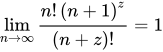
- I believe that you are talking about two different expressions. Both of these are true:
- —Quantling (talk | contribs) 16:41, 6 November 2023 (UTC)
- O tema sobre depressão 45.174.137.0 (talk) 14:19, 7 May 2025 (UTC)
![{\displaystyle \lim _{n\to \infty }{\frac {1}{z}}\prod _{k=1}^{n}\left[{\frac {1}{1+{\frac {z}{k}}}}\left(1+{\frac {1}{k}}\right)^{z}\right]=\Gamma (z)}](/media/api/rest_v1/media/math/render/svg/678a672d709fc1d839aa20d4f2610cec46401044)
t?
[edit]What is t? This is crucial really, but I have never found a definition for it. Is it a constant? If not, how would you go about working it out on a scientific calculator with standard trig and logarithmic functions? Koro Neil (talk) 00:55, 3 August 2024 (UTC)
- You mean the t in the first displayed equation and in the infobox? It's the variable of integration. Obviously. That's what the "dt" part at the end of the integral denotes. If you don't know what a variable of integration is, this article may not be for you. —David Eppstein (talk) 01:35, 3 August 2024 (UTC)
- Yes, it's so obvious. To you. Not so much to the other person, it would appear. I guess that wasn't obvious. ISaveNewspapers (talk) 13:01, 8 February 2025 (UTC)
- Respectfully, it is obvious to anyone who knows elementary calculus, which is a pre-requisite to any hope of understanding this whole topic. And I hugely appreciate this superbly done article. HWSager (talk) 05:17, 9 February 2025 (UTC)
- Simple explanation there: Koro Neil does not have a perfect understanding of elementary calculus and made a mistake. Obviously. ISaveNewspapers (talk) 16:18, 10 February 2025 (UTC)
- Respectfully, it is obvious to anyone who knows elementary calculus, which is a pre-requisite to any hope of understanding this whole topic. And I hugely appreciate this superbly done article. HWSager (talk) 05:17, 9 February 2025 (UTC)
- Yes, it's so obvious. To you. Not so much to the other person, it would appear. I guess that wasn't obvious. ISaveNewspapers (talk) 13:01, 8 February 2025 (UTC)
Missing 0! in image
[edit]In the Generalized factorial function more infos image in the Motivation section, the point 0!=1 is missing. As much as I'd like to know how to fix this, I don't, so can someone else fix it instead? ISaveNewspapers (talk) 07:12, 30 December 2024 (UTC)
- The most likely reason why the 0!=1 point is missing from the image is because the y values of the discrete points come from the original definition of the factorial function, , which doesn’t work for . Also, if you want to fix the image, you can just use an image editor, such as Photopea for example, to add the 0!=1 point into the image, save it, upload it to this website, and then edit the page to replace the current image you mentioned with that. 107.9.41.132 (talk) 23:33, 24 January 2025 (UTC)
- When you say the original definition, are you talking about the definition used by the first person ever to study factorials? I don't think we know enough even to confidently say anything about that. Regardless, I don't think the creator of the image specifically preferred that version over the one we use today; it seems far more likely that they just forgot about 0!=1.
- And yeah, I could probably use an image editor to cobble together a new version of the image that gets the point across adequately. However, it'd almost definitely end up looking sloppy, which I don't want. The original is an SVG image with highlightable text, and I would want that to be maintained in any updated version. It should be as if it were made by the original creator.
- Looking deeper, it appears that the image was created at least partly with the help of Mathematica, a software system for math stuff. I might try to learn how to use that if I want to get this done. However, I won't make any guarantees because I have other things to do. ISaveNewspapers (talk) 13:34, 8 February 2025 (UTC)


The font in the title "Missing 0! in image" makes zero factorial look like lower-case o factorial, even though it is actually the character zero (which I verified by copy-paste into a text editor). Wikipedia should use a more suitable font here. — Preceding unsigned comment added by HWSager (talk • contribs) 05:35, 9 February 2025 (UTC)
- This is why using the letter O or o as a variable to represent a number is frowned upon in mathematics in the first place, and therefore rarely encountered. Due to this mathematical convention, the risk of confusion between symbols when used in context is minimal. In any case, this talk page concerns the Gamma function article, not Wikipedia font usage, so I recommend you look elsewhere for the appropriate place to submit your suggestion if you wish to do so.
- As an aside, please ensure each comment is signed, either automatically or by appending four tildes to the end. ISaveNewspapers (talk) 16:48, 10 February 2025 (UTC)
- It is always my intention to sign my comments. The "unsigned" was an accident, because I'm not well-versed in the Wikipedia editing details. Somehow, my other comments further up in this page did get signed. HWSager (talk) 04:51, 21 March 2025 (UTC)
Why graph of Γ(z) + sin(πz) (3th graph) is there ?
[edit]I don't find any explanations on this graph. I find that it doesn't belong here ! Can I (or someboldy else) delete it ? If not, can somebody give some explanations ? Schlebe (talk) 19:44, 18 January 2026 (UTC)
- It is an illustration of the nearby article text "However, it is not the only analytic function that extends the factorial, as one may add any analytic function that is zero on the positive integers, such as..." —David Eppstein (talk) 20:38, 18 January 2026 (UTC)
Formula in Approximations section
[edit]The article claims that the first formula in the Approximations section, is applicable for complex values of z, but it uses without explanation. However, raising a complex number to a non-integer power usually requires some explanation to make it well defined. Would someone provide that explanation in the article? —Quantling (talk | contribs) 17:28, 23 February 2026 (UTC)



- It is true that exponentiation is not naturally defined for non-interger powers, but it can be extended using the exponential function with base e, which is defined by a particually simple power series, and it’s inverse, along with the laws of exponents. When dealing with more anvanced mathematics, like complex analys, exponentiation using refers to that definition. For more information, see Complex exponentiation ~2026-12585-44 (talk) 18:17, 26 February 2026 (UTC)
- Yes, zz−1/2 = exp((z−1/2) ln z), but that begs the question as to what ln z is. There's a typical power series one can use for ln z when |z − 1| < 1 but what about other values of z? Yes, even they can be handled if one specifies how they should be handled, via branch cuts or whatever. I'm asking that someone specify that in the article. —Quantling (talk | contribs) 18:28, 26 February 2026 (UTC)