


Symbolic Cholesky decomposition
In the mathematical subfield of numerical analysis the symbolic Cholesky decomposition is an algorithm used to determine the non-zero pattern for the factors of a symmetric sparse matrix when applying the Cholesky decomposition or variants.[1][2]

Algorithm
[edit]Let be a sparse symmetric positive definite matrix with elements from a field , which we wish to factorize as .



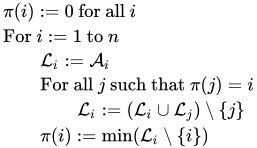
In order to implement an efficient sparse factorization it has been found to be necessary to determine the non zero structure of the factors before doing any numerical work. To write the algorithm down we use the following notation:
- Let and be sets representing the non-zero patterns of columns i and j (below the diagonal only, and including diagonal elements) of matrices A and L respectively.
- Take to mean the smallest element of .
- Use a parent function to define the elimination tree within the matrix.


The following algorithm gives an efficient symbolic factorization of A :[3]
References
[edit]- ^ Duff, Iain S.; Erisman, Albert M.; Reid, John K. (2017). Direct Methods for Sparse Matrices (2 ed.). Oxford University Press. Retrieved 1 January 2026.
- ^ Davis, Timothy A. (2006). Direct Methods for Sparse Linear Systems. Society for Industrial and Applied Mathematics (SIAM). doi:10.1137/1.9780898718881. Retrieved 1 January 2026.
- ^ Chen, Yanqing; Davis, Timothy A.; Hager, William W. (2008). "Algorithm 887: CHOLMOD, Supernodal Sparse Cholesky Factorization and Update/Downdate" (PDF). ACM Transactions on Mathematical Software. Retrieved 1 January 2026.