


Distribution (mathematical analysis): Difference between revisions
m Clarification |
Reorganized |
||
| Line 785: | Line 785: | ||
The convolution of distributions with compact support induces a continuous bilinear map <math>\mathcal{E}' \times \mathcal{E}' \to \mathcal{E}'</math> defined by <math>(S,T) \mapsto S * T,</math> where <math>\mathcal{E}'</math> denotes the space of distributions with compact support.{{sfn | Trèves | 2006 | p=423}} However, the convolution map as a function <math>\mathcal{E}' \times \mathcal{D}' \to \mathcal{D}'</math> is ''not'' continuous{{sfn | Trèves | 2006 | p=423}} although it is separately continuous.{{sfn | Trèves | 2006 | p=294}} The convolution maps <math>\mathcal{D}(\R^n) \times \mathcal{D}' \to \mathcal{D}'</math> and <math>\mathcal{D}(\R^n) \times \mathcal{D}' \to \mathcal{D}(\R^n)</math> given by <math>(f, T) \mapsto f * T</math> both ''fail'' to be continuous.{{sfn | Trèves | 2006 | p=423}} Each of these non-continuous maps is, however, [[separately continuous]] and [[hypocontinuous]].{{sfn | Trèves | 2006 | p=423}} |
The convolution of distributions with compact support induces a continuous bilinear map <math>\mathcal{E}' \times \mathcal{E}' \to \mathcal{E}'</math> defined by <math>(S,T) \mapsto S * T,</math> where <math>\mathcal{E}'</math> denotes the space of distributions with compact support.{{sfn | Trèves | 2006 | p=423}} However, the convolution map as a function <math>\mathcal{E}' \times \mathcal{D}' \to \mathcal{D}'</math> is ''not'' continuous{{sfn | Trèves | 2006 | p=423}} although it is separately continuous.{{sfn | Trèves | 2006 | p=294}} The convolution maps <math>\mathcal{D}(\R^n) \times \mathcal{D}' \to \mathcal{D}'</math> and <math>\mathcal{D}(\R^n) \times \mathcal{D}' \to \mathcal{D}(\R^n)</math> given by <math>(f, T) \mapsto f * T</math> both ''fail'' to be continuous.{{sfn | Trèves | 2006 | p=423}} Each of these non-continuous maps is, however, [[separately continuous]] and [[hypocontinuous]].{{sfn | Trèves | 2006 | p=423}} |
||
| ⚫ | |||
| ⚫ | In general, [[Regularization (physics)|regularity]] is required for multiplication products and [[Principle of locality|locality]] is required for convolution products. It is expressed in the following extension of the [[Convolution theorem|Convolution Theorem]] which guarantees the existence of both convolution and multiplication products. Let <math>F(\alpha) = f \in O'_C</math> be a rapidly decreasing tempered distribution or, equivalently,<math>F(f) = \alpha \in O_M</math> be an ordinary (slowly growing, smooth) function within the space of tempered distributions and let <math>F</math> be the normalized (unitary, ordinary frequency) [[Fourier transform]] <ref>{{cite book | last=Folland | first=G.B. | title=Harmonic Analysis in Phase Space | publisher=Princeton University Press | publication-place=Princeton, NJ | year=1989}}</ref> then, according to {{harvtxt|Schwartz|1951}}, |
||
| ⚫ | |||
| ⚫ | |||
| ⚫ | hold within the space of tempered distributions<ref>{{cite book | last=Horváth | first=John | title=Topological Vector Spaces and Distributions | publisher=Addison-Wesley Publishing Company | publication-place=Reading, MA | year=1966}}</ref><ref>{{cite book | last=Barros-Neto | first=José | title=An Introduction to the Theory of Distributions | publisher=Dekker | publication-place=New York, NY | year=1973}}</ref> |
||
| ⚫ | |||
| ⚫ | |||
| ⚫ | |||
| ⚫ | |||
| ⚫ | |||
| ⚫ | |||
| ⚫ | |||
| ⚫ | |||
| ⚫ | |||
| ⚫ | |||
| ⚫ | |||
| ⚫ | |||
| ⚫ | |||
| ⚫ | |||
| ⚫ | |||
| ⚫ | |||
| ⚫ | For example, let <math>g \equiv \operatorname{\text{Ш}} \in \mathcal{S}'</math> be the Dirac comb and <math>f \equiv \delta \in \mathcal{E}'</math> be the [[Dirac delta function|Dirac delta]] then <math>\alpha \equiv 1 \in PW</math> is the function that is constantly one and both equations yield the [[Dirac comb#Dirac-comb identity|Dirac comb identity]]. Another example is to let <math>g</math> be the Dirac comb and <math>f \equiv rect \in \mathcal{E}'</math> be the [[rectangular function]] then <math>\alpha \equiv sinc \in PW</math> is the [[sinc function]] and both equations yield the [[Nyquist–Shannon sampling theorem|Classical Sampling Theorem]] for suitable <math>rect</math> functions. More generally, if <math>g</math> is the Dirac comb and <math>f \in \mathcal{S} \subseteq O'_C \cap O_M</math> is a [[Smoothness|smooth]] [[window function]] ([[Schwartz space|Schwartz function]]), e.g. the [[Gaussian function|Gaussian]], then <math>\alpha \in \mathcal{S}</math> is another smooth window function (Schwartz function). They are known as [[mollifier]]s, especially in [[partial differential equation]]s theory, or as [[Regularization (mathematics)|regularizers]] in [[Regularization (physics)|physics]] because they allow turning [[generalized function]]s into [[Function (mathematics)|regular functions]]. |
||
=== Tensor product of distributions === |
=== Tensor product of distributions === |
||
| Line 1,060: | Line 1,087: | ||
Inspired by Lyons' [[rough path]] theory,<ref>{{Cite journal | last1 = Lyons | first1 = T. | title = Differential equations driven by rough signals | doi = 10.4171/RMI/240 | journal = Revista Matemática Iberoamericana | pages = 215–310 | year = 1998 | pmid = | pmc = | doi-access = free }}</ref> [[Martin Hairer]] proposed a consistent way of multiplying distributions with certain structure ([[regularity structures]]<ref>{{cite journal|last1=Hairer|first1=Martin|title=A theory of regularity structures|journal=Inventiones Mathematicae|date=2014|doi=10.1007/s00222-014-0505-4|volume=198|issue=2|pages=269–504|bibcode=2014InMat.198..269H|arxiv=1303.5113}}</ref>), available in many examples from stochastic analysis, notably stochastic partial differential equations. See also Gubinelli–Imkeller–Perkowski (2015) for a related development based on [[Jean-Michel Bony|Bony]]'s [[paraproduct]] from Fourier analysis. |
Inspired by Lyons' [[rough path]] theory,<ref>{{Cite journal | last1 = Lyons | first1 = T. | title = Differential equations driven by rough signals | doi = 10.4171/RMI/240 | journal = Revista Matemática Iberoamericana | pages = 215–310 | year = 1998 | pmid = | pmc = | doi-access = free }}</ref> [[Martin Hairer]] proposed a consistent way of multiplying distributions with certain structure ([[regularity structures]]<ref>{{cite journal|last1=Hairer|first1=Martin|title=A theory of regularity structures|journal=Inventiones Mathematicae|date=2014|doi=10.1007/s00222-014-0505-4|volume=198|issue=2|pages=269–504|bibcode=2014InMat.198..269H|arxiv=1303.5113}}</ref>), available in many examples from stochastic analysis, notably stochastic partial differential equations. See also Gubinelli–Imkeller–Perkowski (2015) for a related development based on [[Jean-Michel Bony|Bony]]'s [[paraproduct]] from Fourier analysis. |
||
| ⚫ | |||
| ⚫ | In general, [[Regularization (physics)|regularity]] is required for multiplication products and [[Principle of locality|locality]] is required for convolution products. It is expressed in the following extension of the [[Convolution theorem|Convolution Theorem]] which guarantees the existence of both convolution and multiplication products. Let <math>F(\alpha) = f \in O'_C</math> be a rapidly decreasing tempered distribution or, equivalently,<math>F(f) = \alpha \in O_M</math> be an ordinary (slowly growing, smooth) function within the space of tempered distributions and let <math>F</math> be the normalized (unitary, ordinary frequency) [[Fourier transform]] <ref>{{cite book | last=Folland | first=G.B. | title=Harmonic Analysis in Phase Space | publisher=Princeton University Press | publication-place=Princeton, NJ | year=1989}}</ref> then, according to {{harvtxt|Schwartz|1951}}, |
||
| ⚫ | |||
| ⚫ | |||
| ⚫ | hold within the space of tempered distributions<ref>{{cite book | last=Horváth | first=John | title=Topological Vector Spaces and Distributions | publisher=Addison-Wesley Publishing Company | publication-place=Reading, MA | year=1966}}</ref><ref>{{cite book | last=Barros-Neto | first=José | title=An Introduction to the Theory of Distributions | publisher=Dekker | publication-place=New York, NY | year=1973}}</ref> |
||
| ⚫ | |||
| ⚫ | |||
| ⚫ | |||
| ⚫ | |||
| ⚫ | |||
| ⚫ | |||
| ⚫ | |||
| ⚫ | |||
| ⚫ | |||
| ⚫ | |||
| ⚫ | |||
| ⚫ | |||
| ⚫ | |||
| ⚫ | |||
| ⚫ | |||
| ⚫ | |||
| ⚫ | For example, let <math>g \equiv \operatorname{\text{Ш}} \in \mathcal{S}'</math> be the Dirac comb and <math>f \equiv \delta \in \mathcal{E}'</math> be the [[Dirac delta function|Dirac delta]] then <math>\alpha \equiv 1 \in PW</math> is the function that is constantly one and both equations yield the [[Dirac comb#Dirac-comb identity|Dirac comb identity]]. Another example is to let <math>g</math> be the Dirac comb and <math>f \equiv rect \in \mathcal{E}'</math> be the [[rectangular function]] then <math>\alpha \equiv sinc \in PW</math> is the [[sinc function]] and both equations yield the [[Nyquist–Shannon sampling theorem|Classical Sampling Theorem]] for suitable <math>rect</math> functions. More generally, if <math>g</math> is the Dirac comb and <math>f \in \mathcal{S} \subseteq O'_C \cap O_M</math> is a [[Smoothness|smooth]] [[window function]] ([[Schwartz space|Schwartz function]]), e.g. the [[Gaussian function|Gaussian]], then <math>\alpha \in \mathcal{S}</math> is another smooth window function (Schwartz function). They are known as [[mollifier]]s, especially in [[partial differential equation]]s theory, or as [[Regularization (mathematics)|regularizers]] in [[Regularization (physics)|physics]] because they allow turning [[generalized function]]s into [[Function (mathematics)|regular functions]]. |
||
== See also == |
== See also == |
||
Revision as of 21:10, 11 September 2020
Distributions, also known as Schwartz distributions or generalized functions, are objects that generalize the classical notion of functions in mathematical analysis. Distributions make it possible to differentiate functions whose derivatives do not exist in the classical sense. In particular, any locally integrable function has a distributional derivative. Distributions are widely used in the theory of partial differential equations, where it may be easier to establish the existence of distributional solutions than classical solutions, or appropriate classical solutions may not exist. Distributions are also important in physics and engineering where many problems naturally lead to differential equations whose solutions or initial conditions are distributions, such as the Dirac delta function.
A function f is normally thought of as acting on the points in its domain by "sending" a point x in its domain to the point f (x). Distribution theory reinterprets functions as linear functionals acting on test functions. Test functions are usually infinitely differentiable real (or complex) valued functions with compact support. Many "standard functions" (meaning for example a function that is typically encountered in a Calculus course), say for instance a continuous map f : ℝ → ℝ, can be canonically reinterpreted as acting on test functions (instead of their usual interpretation as acting on points of their domain) via the action of "integration against a test function"; explicitly, this means that f "acts on" a test function g by "sending" g to the number ∫ℝ f g d x. This new action of f is thus a real-valued map Tf whose domain is the space of test functions; this map turns out to have two additional properties[note 1] that make it into what is known as a distribution on ℝ. Distributions that arise from "standard functions" in this way are the prototypical examples of a distributions. But there are many distributions that do not arise in this way and these distributions are the "generalized functions." Examples include the Dirac delta function or some distributions that arise via integration of test functions against measures. However, by using various methods it is nevertheless still possible to reduce any distribution down to a simpler family of related distributions that do arise via such actions of integration.
In applications to physics and engineering, the space of test functions usually consists of smooth functions with compact support that are defined on some given non-empty open subset U ⊆ ℝn. This space of test functions is denoted by or and a distribution on U is by definition a linear functional on that is continuous when given a topology called the canonical LF topology. The space of (all) distributions on U, which is usually denoted by (note the prime), is thus the continuous dual space of and it is these distributions that are the main focus of this article.


There are other possible choices for the space of test functions, which lead to other different spaces of distributions. If U = ℝn then the use of Schwartz functions[note 2] as test functions gives rise to a certain subspace of whose elements are called tempered distributions. These are important because they allow the Fourier transform to be extended from "standard functions" to tempered distributions. The set of tempered distributions forms a vector subspace of the space of distributions and is thus one example of a space of distributions; there are many other spaces of distributions.
There also exist other major classes of test functions that are not subsets of , such as spaces of analytic test functions, which produce very different classes of distributions. The theory of such distributions has a different character from the previous one because there are no analytic functions with non-empty compact support.[note 3] Use of analytic test functions lead to Sato's theory of hyperfunctions.
History
The practical use of distributions can be traced back to the use of Green functions in the 1830s to solve ordinary differential equations, but was not formalized until much later. According to Kolmogorov & Fomin (1957), generalized functions originated in the work of Sergei Sobolev (1936) on second-order hyperbolic partial differential equations, and the ideas were developed in somewhat extended form by Laurent Schwartz in the late 1940s. According to his autobiography, Schwartz introduced the term "distribution" by analogy with a distribution of electrical charge, possibly including not only point charges but also dipoles and so on. Gårding (1997) comments that although the ideas in the transformative book by Schwartz (1951) were not entirely new, it was Schwartz's broad attack and conviction that distributions would be useful almost everywhere in analysis that made the difference.
Notation
Before proceeding we introduce some notation to simplify the expressions and statements below:


- Let be a function and use to denote its domain. The support of denoted by is the closure of the set in




- Throughout this article is a fixed positive integer and is a fixed non-empty open subset of


- For two functions set:
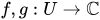
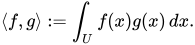
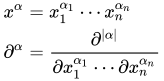
- A multi-index of size is simply an element in (given that is fixed we generally omit specifying the size of multi-indices). The length of a multi-index is defined as and denoted by Multi-indices are particularly useful when dealing with functions of several variables, in particular we introduce the following notations for a given multi-index :




- We also introduce a partial order of all multi-indices by if and only if for all When we define their multi-index binomial coefficient as:


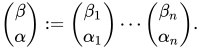
Basic idea

Distributions are a class of linear functionals that map a set of test functions (conventional and well-behaved functions) into the set of real numbers. In the simplest case, the set of test functions considered is which is the set of functions having two properties:


- is smooth (infinitely differentiable);
- has compact support (is identically zero outside some bounded interval).

A distribution T is a linear mapping Instead of writing , it is conventional to write for the value of T acting on a test function . A simple example of a distribution is the Dirac delta, δ, defined by


meaning that δ evaluates a test function at 0. Its physical interpretation is as the density of a point source.
As described next, there are straightforward mappings from both locally integrable functions and Radon measures to corresponding distributions, but not all distributions can be formed in this manner.
Functions and measures as distributions
Suppose that f : ℝ → ℝ is a locally integrable function. Then a corresponding distribution, denoted by Tf, may be defined by

This integral is a real number which depends linearly and continuously on . Conversely, the values of the distribution Tf on test functions in determine the pointwise almost everywhere values of the function f on ℝ. In a conventional abuse of notation, f is often used to represent both the original function f and the corresponding distribution Tf. This example suggests the definition of a distribution as a linear and, in an appropriate sense, continuous functional on the space of test functions .

Similarly, if μ is a Radon measure on ℝ, then a corresponding distribution, denoted by Rμ, may be defined by

This integral also depends linearly and continuously on , so that Rμ is a distribution. If μ is absolutely continuous with respect to Lebesgue measure with density f and dμ = f dx, then this definition for Rμ is the same as the previous one for Tf, but if μ is not absolutely continuous, then Rμ is a distribution that is not associated with a function. For example, if P is the point-mass measure on ℝ that assigns measure one to the singleton set and measure zero to sets that do not contain zero, then

- ,

so that RP = δ is the Dirac delta.
Adding and multiplying distributions
Distributions may be multiplied by real numbers and added together, so they form a real vector space. A distribution may also be multiplied by a rapidly decreasing infinitely differentiable function to get another distribution, but it is not possible to define a product of general distributions that extends the usual pointwise product of functions and has the same algebraic properties. This result was shown by Schwartz (1954), and is usually referred to as the Schwartz Impossibility Theorem.
Derivatives of distributions
It is desirable to choose a definition for the derivative of a distribution which, at least for distributions derived from smooth functions, has the property that (i.e. where is the usual derivative of f and denotes the derivative of the distribution Tf, which we wish to define). If is a test function, we can use integration by parts to see that


![{\displaystyle \langle f',\phi \rangle =\int _{\mathbb {R} }f'\phi \,dx={\Big [}f(x)\phi (x){\Big ]}_{-\infty }^{\infty }-\int _{\mathbb {R} }f\phi '\,dx=-\langle f,\phi '\rangle }](/media/api/rest_v1/media/math/render/svg/d99ff460a03b0b20a26209c0c7b19dc69cc7f9f5)
where the last equality follows from the fact that has compact support, so is zero outside of a bounded set. This suggests that if T is a distribution, we should define its derivative by

- .

It turns out that this is the proper definition; it extends the ordinary definition of derivative, every distribution becomes infinitely differentiable and the usual properties of derivatives hold.
Example: Recall that the Dirac delta (i.e. the so-called Dirac delta "function") is the distribution defined by the equation
- .

It is the derivative of the distribution corresponding to the Heaviside step function H: For any test function

so H′ = δ. Note, because has compact support by our definition of a test function. Similarly, the derivative of the Dirac delta is the distribution defined by the equation


This latter distribution is an example of a distribution that is not derived from a function or a measure. Its physical interpretation is the density of a dipole source. Just as the Dirac impulse can be realized in the weak limit as a sequence of various kinds of constant norm bump functions of ever increasing amplitude and narrowing support, its derivative can by definition be realized as the weak limit of the negative derivatives of said functions, which are now antisymmetric about the eventual distribution's point of singular support.
Definitions of test functions and distributions
In this section, we will formally define real-valued distributions on U. With minor modifications, one can also define complex-valued distributions, and one can replace ℝn with any (paracompact) smooth manifold.
Notation: Suppose .
- Let denote the vector space of all k-times continuously differentiable real-valued functions on U.
- For any compact subset K ⊆ U, let and both denote the vector space of all those functions f ∈ Ck(U) such that supp f ⊆ K.
- Note that depends on both K and U but we will only indicate K, where in particular, if f ∈ Ck(K) then the domain of f is U rather than K. We will use the notation } when only when the notation risks being ambiguous.
- Clearly, every contains the constant 0 map, even if K = ∅.
- Let denote the set of all f ∈ Ck(U) such that f ∈ Ck(K) for some compact subset K of U.
- Equivalently, is the set of all f ∈ Ck(U) such that f has compact support.
- is equal to the union of all as K ranges over 𝕂.
- Note that if f is a real-valued function on U, then f is an element of if and only if f is a bump function.


Note that for all and any compact subsets K and L of U, we have:


Definition: Elements of are called test functions on U and is referred to as the space of test function. We will use both and to denote this space.
Distributions on U are defined to be the continuous linear functionals on the space of test functions on U, when it is endowed with a particular topology called the canonical LF topology. So to define the space of distributions we need a suitable topology on , which in turn requires that several other topological vector spaces (TVSs) be defined first. These are the spaces and for arbitrary


- Choice of compact sets 𝕂
Throughout, 𝕂 will be any collection of compact subsets of U such that (1) , and (2) for any compact K ⊆ U there exists some K2 ∈ 𝕂 such that K ⊆ K2. The most common choices for 𝕂 are:

- The set of all compact subsets of U, or
- A set where , and for all i, and Ui is a relatively compact non-empty open subset of U (i.e. "relatively compact" means that the closure of Ui, in either U or ℝn, is compact).


We make 𝕂 into a directed set by defining K1 ≤ K2 if and only if K1 ⊆ K2. Note that although the definitions of the subsequently defined topologies explicitly reference 𝕂, in reality they do not depend on the choice of 𝕂; that is, if 𝕂1 and 𝕂2 are any two such collections of compact subsets of U, then the topologies defined on and by using 𝕂1 in place of 𝕂 are the same as those defined by using 𝕂2 in place of 𝕂.
Topology on Ck(U)
As before, We now define the seminorms that will define the topology on . That each of the functions defined below is real-valued (i.e. none of the supremums below is ever equal to ∞) is due to the fact that the image of a compact set under a continuous real-valued map is again compact, and thus a bounded subset of ℝ.
Definition: All of the following non-negative ℝ-valued maps are seminorms on and throughout, K will be some arbitrary compact subset of U and f will be an arbitrary element of . If K = ∅ then we define all of the below seminorms to be the constant 0 map (i.e. if K = ∅ then si, K := 0, qi, K := 0, etc.), so we may henceforth assume that K ≠ ∅.


Each of the following families of seminorms generates the same locally convex topology on :

Assumption: We will henceforth assume that is endowed with the locally convex topology defined by any/all of the families of seminorms described above.
With this topology, becomes a locally convex (non-normable) Fréchet space and all of the seminorms defined above are continuous on this space. Under this topology, a net in converges to if and only if for every multi-index p with |p| < k + 1 and every K ∈ 𝕂, the net converges to uniformly on K.[2] For any , any bounded subset of is a relatively compact subset of .[3] In particular, a subset of is bounded if and only if it is bounded in for all [3] The space is a Montel space if and only if k = ∞.[4]


The topology on is the superior limit of the subspace topologies induced on by the TVSs as i ranges over the non-negative integers.[1] Denoting the topology on by τk (for any this means that a subset W of is open in (, τ∞) if and only if there exists such that when is endowed with the subspace topology induced by , which we'll denote by τi|C∞(U), then W is an open subset of (, τi|C∞(U)).


Topology on Ck(K)
As before, fix Recall that for any compact subset K ⊆ U, is a subset of .
Assumption: For any compact K ⊆ U, we will henceforth assume that is endowed with the subspace topology it inherits from the Fréchet space .
For any compact K ⊆ U, is a closed subspace of the Fréchet space and is thus also a Fréchet space. For all compact K, L ⊆ U with K ⊆ L, denote the natural inclusion by where note that this map is a linear embedding of TVSs whose range is closed in its codomain (said differently, the topology on is identical to the subspace topology it inherits from , and is a closed subspace of ). The interior of relative to is empty.[5]



When k ≠ ∞ then is a Banach space[6] with a topology that can be defined by the norm

And when k = 2, is even a Hilbert space.[6] The space is a distinguished Schwartz Montel space so if then it is not normable and thus not a Banach space (although like all other , it is a Fréchet space).
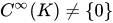
Trivial extensions and independence of Ck(K)'s topology from U
The definition of depends on U so we will let denote the topological space , which by definition is a topological subspace of . Suppose V is an open subset of ℝn such that U ⊆ V ⊆ ℝn. Given we define its trivial extension to V, as follows:


Let denote the map that sends a function in to its trivial extension on V. This map is a linear injection and for every compact subset K ⊆ U, we clearly have where is the topological subspace of consisting of maps with support contained in K (since K ⊆ U ⊆ V, K is a compact subset of V as well). It follows that . If I is restricted to then the following induced map is a homeomorphism (and thus a TVS-isomorphism):



and thus the next two maps (which like the previous map are defined by ) are topological embeddings:


(the topology on is the canonical LF topology, which is defined later). Using we identify with its image in . Since , through this identification can also be considered as a subset of . Importantly, the subspace topology inherits from (when it is viewed as a subset of ) is identical to the subspace topology that it inherits from (when is viewed instead as a subset of via the identification). Thus the topology on is independent of the open subset U of that contains K.[5] This justifies our practice of using instead of


Topology on the space of test functions
Recall that denote all those functions in that have compact support in U, where note that is the union of all as K ranges over 𝕂. Moreover, for every k, is a dense subset of . The spacial case when k = ∞ gives us the space of test functions.
Definition: is called the space of test functions on U and it may also be denoted by .
For any two sets K and L, we declare that K ≤ L if and only if K ⊆ L, which in particular makes the collection 𝕂 of compact subsets of U into a directed set (we say that such a collection is directed by subset inclusion). For all compact K, L ⊆ U with K ⊆ L, there are natural inclusions
- .

all defined by f ↦ f, where recall from above that the map is a topological embedding. The collection of maps

forms a direct system in the category of locally convex topological vector spaces that is directed by 𝕂 (under subset inclusion). This system's direct limit (in the category of locally convex TVSs) is the pair where are the natural inclusions and where is now endowed with the (unique) strongest locally convex topology making all of the inclusion maps continuous.
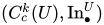
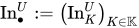

Definition: The canonical LF topology on is the finest locally convex topology on making all of the inclusion maps continuous (where K ranges over 𝕂).

Assumption: We will henceforth assume that is endowed with its canonical LF topology.
As discussed earlier, continuous linear functionals on a are known as distributions on U. Thus the set of all distributions on U is the continuous dual space of , which when endowed with the strong dual topology is denoted by .
- Neighborhoods of the origin
If U is a convex subset of , then U is a neighborhood of the origin in the canonical LF topology if and only if it satisfies the following condition:
| For all compact K ∈ 𝕂, U ∩ Ck(K) is a neighborhood of the origin in . | CN |
Note that any convex set satisfying this condition is necessarily absorbing in . Since the topology of any topological vector space is translation-invariant, any TVS-topology is completely determined by the set of neighborhood of the origin. This means that one could actually define the canonical LF topology by declaring that a convex balanced subset U is a neighborhood of the origin if and only if it satisfies condition CN.
- Canonical LF topology's independence from 𝕂
One benefit of defining the canonical LF topology as the direct limit of a direct system is that we may immediately use the universal property of direct limits. Another benefit is that we can use well-known results from category theory to deduce that the canonical LF topology is actually independent of the particular choice of the directed collection 𝕂 of compact sets. And by considering different collections 𝕂 (in particular, those 𝕂 mentioned at the beginning of this article), we may deduce different properties of this topology. In particular, we may deduce that the canonical LF topology makes into a Hausdorff locally convex strict LF-space (and also a strict LB-space if k ≠ ∞), which of course is the reason why this topology is called "the canonical LF topology" (see this footnote for more details).[note 5]
Topological properties
- Topological vector space categories
The canonical LF topology makes into a complete distinguished strict LF-space (and a strict LB-space if and only if k ≠ ∞[7]), which implies that is a meager subset of itself.[8] Furthermore, , as well as its strong dual space, is a complete Hausdorff locally convex barrelled bornological Mackey space. The strong dual of is a Fréchet space if and only if k ≠ ∞ so in particular, the strong dual of , which is the space of distributions on U, is not metrizable (note that the weak-* topology on also isn't metrizable and moreover, it further lacks almost all of the nice properties that the strong dual topology gives ).
The three spaces , , and the Schwartz space , as well as the strong duals of each of these three spaces, are complete nuclear Montel bornological spaces, which implies that all six of these locally convex spaces are also paracompact[9] reflexive barrelled Mackey spaces. It is known that in the dual space of any Montel space, a sequence converges in the strong dual topology if and only if it converges in the weak* topology,[10] which in particular, is the reason why a sequence of distributions converges (in the strong dual topology) if and only if it converges pointwise (this leads many authors to use pointwise convergence to actually define the convergence of a sequence of distributions; this is fine for sequences but it does not extend to the convergence of nets of distributions since a net may converge pointwise but fail to convergence in the strong dual topology). The spaces and are both distinguished Fréchet spaces and the strong dual spaces of these two spaces are sequential spaces but not Fréchet-Urysohn spaces.[11] Moreover, both and are Schwartz TVSs. Neither the space of test functions nor its strong dual is a sequential space (not even an Ascoli space),[11][12] which in particular implies that their topologies can not be defined entirely in terms of convergent sequences.

- Non-metrizability
For all compact K ⊆ U, the interior of in is empty so that is of the first category in itself. It follows from Baire's theorem that is not metrizable and thus also not normable (see this footnote[note 6] for an explanation of how the non-metrizable space can be complete even thought it doesn't admit a metric). The fact that is a nuclear Montel space more than makes up for the non-metrizability of (see this footnote for a more detailed explanation).[note 7]
- Relationships between spaces
Using the universal property of direct limits and the fact that the natural inclusions are all topological embedding, one may show that all of the maps are also topological embeddings. Said differently, the topology on is identical to the subspace topology that it inherits from , where recall that 's topology was defined to be the subspace topology induced on it by . In particular, both and induces the same subspace topology on . However, this does not imply that the canonical LF topology on is equal to the subspace topology induced on by ; these two topologies on are in fact never equal to each other since the canonical LF topology is never metrizable while the subspace topology induced on it by is metrizable (since recall that is metrizable). The canonical LF topology on is actually strictly finer than the subspace topology that it inherits from (thus the natural inclusion is continuous but not a topological embedding).[6]

Indeed, the canonical LF topology is so fine that if denotes some linear map that is a "natural inclusion" (such as , or , or other maps discussed below) then this map will typically be continuous, which as is shown below, is ultimately the reason why locally integrable functions, Radon measures, etc. all induce distributions (via the transpose of such a "natural inclusion"). Said differently, the reason why there are so many different ways of defining distributions from other spaces ultimately stems from how very fine the canonical LF topology is. Moreover, since distributions are just continuous linear functionals on , the fine nature of the canonical LF topology means that more linear functionals on end up being continuous ("more" means as compared to a coarser topology that we could have placed on such as for instance, the subspace topology induced by some , which although it would have made metrizable, it would have also resulted in fewer linear functionals on being continuous and thus there would have been fewer distributions; moreover, this particular coarser topology also has the disadvantage of not making into a complete TVS[13]).



- Universal property
From the universal property of direct limits, we know that if is a linear map into a locally convex space Y (not necessarily Hausdorff), then u is continuous ⇔ u is bounded ⇔ for every K ∈ 𝕂, u's restriction to , , is continuous (or bounded).[14][15]


- Dependence of the canonical LF topology on U
Suppose that V is an open subset of ℝn such that U ⊆ V ⊆ ℝn and recall that every f : U → ℝ in can be associated with a function in called its trivial extension to V. Let denote the map that sends a function in to its trivial extension on V (which was defined above). Then this map is continuous.

- Bounded subsets
A subset B of is bounded in if and only if there exists some K ∈ 𝕂 such that and B is a bounded subset of .[15] Moreover, if K ⊆ U is compact and then S is bounded in if and only if it is bounded in . For any 0 ≤ k ≤ ∞, any bounded subset of (resp. ) is a relatively compact subset of (resp. ), where ∞ + 1 = ∞.[15]


- Convergent sequences and their insufficiency to describe topologies
A sequence in converges in if and only if there exists some K ∈ 𝕂 such that contains this sequence and this sequence converges in ; equivalently, it converges if and only if the following two conditions hold:[16]

- There is a compact set K ⊆ U containing the supports of all fi:
- .
- For each multi-index α, the sequence of partial derivatives tends uniformly to .


Neither the space nor its strong dual is a sequential space,[11][12] and consequently, their topologies can not be defined entirely in terms of convergent sequences. For this reason, the above characterization of when a sequence converges is not enough to define the canonical LF topology on . The same can be said of the strong dual topology on .
- Other properties
The differentiation map is a surjective continuous linear operator[17]. The bilinear multiplication map given by ( f, g) ↦ f g is not continuous; it is however, hypocontinuous.[18]


- Topology defined via differential operators
A linear differential operator in U with smooth coefficients is a sum
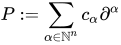
where and all but finitely many of are identically 0. The integer is called the order of the differential operator If is a linear differential operator of order k then it induces a canonical linear map defined by , where we shall reuse notation and also denote this map by .[19]







For any 1 ≤ k ≤ ∞, the canonical LF topology on is the weakest locally convex TVS topology making all linear differential operators in U of order < k + 1 into continuous maps from into .[19]

Distributions
Definition: A distribution on U is a continuous linear functional on . Said differently, a distribution on U is an element of the continuous dual space of when is endowed with its canonical LF topology.
- Characterizations
If T is a linear functional on then the following are equivalent:
- T is a distribution;
- (definition) T is continuous;
- T is continuous at the origin;
- T is uniformly continuous;
- T is a bounded operator;
- T is sequentially continuous; i.e. for every sequence f1, f2, ... of test functions in that converges to f in , ;
- Even though the topology of is not metrizable, a linear functional on is continuous if and only if it is sequentially continuous.
- T is sequentially continuous at the origin; i.e. for every sequence f1, f2, ... of test functions in that converges to 0 in , ;
- The kernel of T is a closed subspace of ;
- The graph of T is a closed;
- There exists a continuous seminorm g on such that |T| ≤ g.
- There exists some constant C > 0 and some finite collection of seminorms g1, ..., gm ∈ 𝒫 (where m > 0) such that |T| ≤ C ( g1 + ⋅⋅⋅ + gm ), where 𝒫 is any collection of (necessarily continuous) seminorms on that define the canonical LF topology of .
- Since the canonical LF topology is locally convex, many such collections 𝒫 of seminorms necessarily exists.
- If 𝒫 is also directed under the usual function comparison ≤ , then T is continuous if and only if there is some C > 0 and some g ∈ 𝒫 such that |T| ≤ C g.
- To every compact subset K of U, there is an integer m ≥ 0 and a constant C > 0 such that for all f ∈ C∞(K),[20]
- ;
- For every compact subset K of U there exists a positive constant CK and a non-negative integer NK such that
- Note that if N can be chosen to be independent of K then the distribution is said to be of finite order and the smallest such N is called the order of the distribution. A distribution is said to have infinite order if it does not have finite order.
- For any compact subset K of U and any sequence of test functions f1, f2, ... belonging to , if converges uniformly to zero for all multi-indices p, then ;
- Any of the three statements immediately above (i.e. statements 12, 13, and 14) but with the additional requirement that compact set K belongs to 𝕂.


We have the canonical duality pairing between a distribution T on U and a test function , which is denoted using angle brackets by

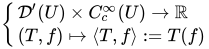
One interprets this notation as the distribution T acting on the test function f to give a scalar, or symmetrically as the test function f acting on the distribution T.
Topology on the space of distributions
Definition and notation: The space of distributions on U, denoted by , is the continuous dual space of endowed with the topology of uniform convergence on bounded subsets of .[6] More succinctly, the space of distributions on U is .

The topology of uniform convergence on bounded subsets is also called the strong dual topology.[note 8] This topology is chosen because it is with this topology that becomes a nuclear Montel space and it is with this topology that the kernels theorem of Schwartz holds.[22] No matter what dual topology is placed on ,[note 9] a sequence of distributions converges in this topology if and only if it converges pointwise (although this need not be true of a net), which is why the topology is sometimes defined to be the weak-* topology. No matter which topology is chosen, will be a non-metrizable, locally convex topological vector space. The space is separable[11] and has the strong Pytkeev property[23] but it is neither a k-space[23] nor a sequential space,[11] which in particular implies that it is not metrizable and also that its topology can not be defined using only sequences.
Each of , and are nuclear Montel spaces.[24] One reason for giving the canonical LF topology is because it is with this topology that and its continuous dual space both become nuclear spaces, which have many nice properties and which may be viewed as a generalization of finite-dimensional spaces (for comparison, normed spaces are another generalization of finite-dimensional spaces that have many "nice" properties).


- Schwartz kernel theorem
It is precisely because is a nuclear space that the Schwartz kernel theorem holds, as Alexander Grothendieck discovered when he investigated why the theorem works for the space of distributions but not for other "nice" spaces like the Hilbert space L2 (this led him to discover nuclear maps and nuclear spaces, among other things). One of the primary results of the Schwartz kernel theorem is that for any open subsets U1 ⊆ ℝm and U2 ⊆ ℝn, the canonical map

is an isomorphism of TVSs (where has the topology of uniform convergence on bounded subsets);[25] this result is false if one replaces the space with L2 (which is a reflexive space that is even isomorphic to its own strong dual space) and replaces with the dual of this L2 space.[26]


- Other topological properties
- Each of and is a nuclear[27] Montel space,[28] which implies that they are each reflexive, barreled, Mackey, and have the Heine-Borel property.
- The topology on (the strong dual topology) is identical to the topology of uniform convergence on compact subsets of ;
- The strong dual space of is TVS isomorphic to via the canonical TVS-isomorphism defined by sending to value at (i.e. to the linear functional on defined by sending to );
- On any bounded subset of , the weak and strong subspace topologies coincide; the same is true for ;
- Every weakly convergent sequence in is strongly convergent (although this does not extend to nets).


- Sequences of distributions
A sequence of distributions T• = (Ti)∞
i=1 converges with respect to the weak-* topology on to a distribution T if and only if

for every test function . For example, if fm : ℝ → ℝ is the function

![{\displaystyle f_{m}(x)={\begin{cases}m&{\text{if }}x\in [0,{\frac {1}{m}}]\\0&{\text{otherwise}}\end{cases}}}](/media/api/rest_v1/media/math/render/svg/3eaa43d3ea88c00d8ef38c89536f943bbf3400da)
and Tm is the distribution corresponding to fm, then

as m → ∞, so Tm → δ in . Thus, for large m, the function fm can be regarded as an approximation of the Dirac delta distribution.

Localization of distributions
There is no way to define the value of a distribution in at a particular point of U. However, as is the case with functions, distributions on U restrict to give distributions on open subsets of U. Furthermore, distributions are locally determined in the sense that a distribution on all of U can be assembled from a distribution on an open cover of U satisfying some compatibility conditions on the overlaps. Such a structure is known as a sheaf.
Restrictions to an open subset
Let U and V be open subsets of ℝn with V ⊆ U. Let be the operator which extends by zero a given smooth function compactly supported in V to a smooth function compactly supported in the larger set U. The transpose of is called the restriction mapping and is denoted by



The map is a continuous injection where if V ⊆ U then it is not a topological embedding and its range is not dense in , which implies that this map's transpose is neither injective nor surjective and that the topology that transfers from onto its image is strictly finer than the subspace topology that induces on this same set.[29] A distribution is said to be extendible to U if it belongs to the range of the transpose of and it is called extendible if it is extendable to ℝn.[29]


For any distribution , the restriction ρVU(T) is a distribution in defined by:


Unless U = V, the restriction to V is neither injective nor surjective. Lack of surjectivity follows since distributions can blow up towards the boundary of V. For instance, if U = ℝ and V = (0, 2), then the distribution
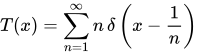
is in but admits no extension to .
Gluing and distributions that vanish in a set
Theorem[30]—Let be a collection of open subsets of ℝn. For each , let and suppose that for all , the restriction of to is equal to the restriction of to (note that both restrictions are elements of ). Then there exists a unique such that for all , the restriction of T to is equal to .


Let V be an open subset of U. is said to vanishes in V if for all such that we have . T vanishes in V if and only if the restriction of T to V is equal to 0, or equivalently, if and only if T lies in the kernel of the restriction map ρVU.
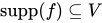

- Corollary.[30] Let be a collection of open subsets of ℝn and let T = 0 if and only if for each , the restriction of T to is equal to 0.

- Corollary.[30] The union of all open subsets of U in which a distribution T vanishes is an open subset of U in which T vanishes.
Support of a distribution
This last corollary implies that for every distribution T on U, there exists a unique largest subset V of U such that T vanishes in V (and doesn't vanish in any open subset of U that is not contained in V); the complement in U of this unique largest open subset is called the support of T.[30] Thus

If f is a locally integrable function on U and if is its associated distribution, then the support of is the smallest closed subset of U in the complement of which f is almost everywhere equal to 0.[30] If f is continuous, then the support of is equal to the closure of the set of points in U at which f doesn't vanish.[30] The support of the distribution associated with the Dirac measure at a point is the set .[30] If the support of a test function f does not intersect the support of a distribution T then Tf = 0. A distribution T is 0 if and only if its support is empty. If f ∈ C∞(U) is identically 1 on some open set containing the support of a distribution T then fT = T. If the support of a distribution T is compact then it has finite order and furthermore, there is a constant C and a non-negative integer N such that:[5]


If T has compact support then it has a unique extension to a continuous linear functional on C∞(U); this functional can be defined by , where is any function that is identically 1 on an open set containing the support of T.[5]


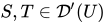
If and then and . Thus, distributions with support in a given subset form a vector subspace of ; such a subspace is weakly closed in if and only if A is closed in U.[31] Furthermore, if is a differential operator in U, then for all distributions T on U and all f ∈ C∞(U) we have and [31]






Support in a point set and Dirac measures
For any , let denote the distribution induced by the Dirac measure at x. For any and distribution , the support of T is contained in if and only if T is a finite linear combination of derivatives of the Dirac measure at [32] If in addition the order of T is then there exist constants such that:[33]


Decomposition of distributions as sums of derivatives of continuous functions
Theorem[34]—Let T be a distribution on U. There exists a sequence in such that each Ti has compact support and every compact subset K ⊆ U intersects the support of only finitely many Ti, and the sequence of partial sums with converges in to T, in other words we have:


Theorem[5]—Suppose T is a distribution on U with compact support K and let V be an open subset of U containing K. Since every distribution with compact support has finite order, take N to be the order of T and define There exists a family of continuous functions f• = ( fp)p ∈ P defined on U with support in V such that


where the derivatives are understood in the sense of distributions.
By combining these results, one may express any distribution on U as the sum of a series of distributions with compact support, where each of these distributions can in turn be written as a finite sum of distributional derivatives of continuous functions on U. In other words for arbitrary we can write:
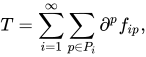
where are finite sets of multi-indices and the functions are continuous.


Operations on distributions
Many operations which are defined on smooth functions with compact support can also be defined for distributions. In general, if is a linear mapping of vector spaces which is continuous with respect to the weak-* topology, then it is possible to extend A to a mapping by passing to the limit. (This approach works for non-linear mappings as well, provided they are assumed to be uniformly continuous.)


In practice, however, it is more convenient to define operations on distributions by means of the transpose.[35] In general the transpose of a continuous linear map is the map defined by , or equivalently, it is the unique map satisfying for all x ∈ X and all .




In the context of distributions if is a continuous linear operator, then the transpose is an operator such that for all the map satisfies


(For operators acting on spaces of complex-valued test functions, the transpose differs from the adjoint A* in that it does not include a complex conjugate.)

If such an operator exists and is continuous on , then the original operator A may be extended to by defining AT for a distribution T as

where we use the notation:

Differential operators
Differentiation
Suppose is the partial derivative operator
- .

For integration by parts gives


so that This operator is a continuous linear transformation on . So, if is a distribution, then the partial derivative of T with respect to the coordinate xk is defined by the formula


With this definition, every distribution is infinitely differentiable, and the derivative in the direction xk is a linear operator on .
More generally, if α is an arbitrary multi-index, then the partial derivative ∂αT of the distribution is defined by

Differentiation of distributions is a continuous operator on ; this is an important and desirable property that is not shared by most other notions of differentiation.
If T is a distribution in ℝ then

in where DT is the derivative of T and τx is translation by x; thus the derivative of T may be viewed as a limit of quotients.[5]
Differential operators acting smooth functions
A linear differential operator in U with smooth coefficients is a sum
where all but finitely many of the C∞(U) functions are identically 0. The integer is called the order of the differential operator If is a linear differential operator of order k then it deduces a canonical linear map defined by where we shall reuse notation and again denote this map by The restriction of the canonical map to induces a continuous linear map

- ,

as well as another continuous linear map:

The transposes of these two map are consequently continuous linear maps and , respectively, where denotes the continuous dual space of C∞(U).[19]


Differential operators acting on distributions and formal transposes
We want to extend the action of a linear differential operator,

to distributions. However for every there is a corresponding canonical distribution, defined by: for all This means we need to impose a consistency requirement: the action of the extension of on the canonical distribution corresponding to a smooth function should match the canonical distribution corresponding to the action of on that smooth function. If is the extension of to distributions, we can express this as: In order to find such an extension we consider the transpose map, By definition it is the unique map such that:


In particular we may take where is an arbitrary smooth function:


Now we calculate the right hand side of the equation:
![{\displaystyle {\begin{aligned}\langle D_{\psi },P(\phi )\rangle &=\langle \psi ,P(\phi )\rangle \\&=\int _{U}\psi (x)P(\phi )(x)\,dx\\&=\int _{U}\psi (x)\left[\sum \nolimits _{\alpha }c_{\alpha }(x)(\partial ^{\alpha }\phi )(x)\right]\,dx\\&=\sum \nolimits _{\alpha }\int _{U}\psi (x)c_{\alpha }(x)(\partial ^{\alpha }\phi )(x)\,dx\\&=\sum \nolimits _{\alpha }(-1)^{|\alpha |}\int _{U}\phi (x)(\partial ^{\alpha }(c_{\alpha }\psi ))(x)\,dx\end{aligned}}}](/media/api/rest_v1/media/math/render/svg/9397d614f436e1249af9b6f27d5c7875661d4488)
For the last line we used integration by parts combined with the fact that and therefore all the functions have compact support.[note 10] Continuing the calculation above we have:

![{\displaystyle {\begin{aligned}\langle D_{\psi },P(\phi )\rangle &=\sum \nolimits _{\alpha }(-1)^{|\alpha |}\int _{U}\phi (x)(\partial ^{\alpha }(c_{\alpha }\psi ))(x)\,dx&&{\text{As shown above}}\\[4pt]&=\int _{U}\phi (x)\sum \nolimits _{\alpha }(-1)^{|\alpha |}(\partial ^{\alpha }(c_{\alpha }\psi ))(x)\,dx\\[4pt]&=\int _{U}\phi (x)\sum \nolimits _{\alpha }\left[\sum \nolimits _{\gamma \leq \alpha }{\binom {\alpha }{\gamma }}(\partial ^{\gamma }c_{\alpha })(x)(\partial ^{\alpha -\gamma }\psi )(x)\right]\,dx&&{\text{Leibniz rule}}\\&=\int _{U}\phi (x)\left[\sum \nolimits _{\alpha }\sum \nolimits _{\gamma \leq \alpha }(-1)^{|\alpha |}{\binom {\alpha }{\gamma }}(\partial ^{\gamma }c_{\alpha })(x)(\partial ^{\alpha -\gamma }\psi )(x)\right]\,dx\end{aligned}}}](/media/api/rest_v1/media/math/render/svg/123331590144d7cde076de225bbf5b7b80f06e64)
By grouping the double sum around derivatives of we get:

To simplify the calculation set:

Then:
![{\displaystyle \langle D_{\psi },P(\phi )\rangle =\int _{U}\phi (x)\left[\sum \nolimits _{\alpha }b_{\alpha }(x)(\partial ^{\alpha }\psi )(x)\right]\,dx=\left\langle \left(\sum \nolimits _{\alpha }b_{\alpha }\partial ^{\alpha }\right)(\psi ),\phi \right\rangle =\left\langle D_{(\sum \nolimits _{\alpha }b_{\alpha }\partial ^{\alpha })(\psi )},\phi \right\rangle .}](/media/api/rest_v1/media/math/render/svg/4f41bf0de7bc2033fe782a12add5ea36c54ae7bc)
We now define the formal transpose of , also denoted by , to be the following differential operator in U:


The above calculation shows that the formal transpose satisfies:

which is equivalent to:

The formal transpose of the formal transpose is the original differential operator, i.e. [19]

If converges to T in then for every multi-index converges to in


Multiplication of a distribution by smooth function
A differential operator of order 0 is just multiplication by a smooth function. And conversely, if is a smooth function then is a differential operator of order 0, whose formal transpose is itself (i.e. ). The induced differential operator maps a distribution T to a distribution denoted by . We have thus defined the multiplication of a distribution by a smooth function. If converges to and converges to then converges to





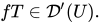
We now give an alternative presentation of multiplication by a smooth function. If is a smooth function and T is a distribution on U, then the product mT is defined by


This definition coincides with the transpose definition since if is the operator of multiplication by the function m (i.e., ), then



so that Mt = M.
Under multiplication by smooth functions, is a module over the ring C∞(U). With this definition of multiplication by a smooth function, the ordinary product rule of calculus remains valid. However, a number of unusual identities also arise. For example, if δ′ is the Dirac delta distribution on ℝ, then mδ = m(0)δ, and if δ′ is the derivative of the delta distribution, then

These definitions of differentiation and multiplication also make it possible to define the operation of a linear differential operator with smooth coefficients on a distribution. A linear differential operator P takes a distribution to another distribution PT given by a sum of the form:

where the coefficients pα are smooth functions on U. The action of the distribution PT on a test function is given by

The minimum integer k for which such an expansion holds for every distribution T is called the order of P. The space is a D-module with respect to the action of the ring of linear differential operators.
The bilinear multiplication map given by (f, T) ↦ f T is not continuous; it is however, hypocontinuous.[18]

Composition with a smooth function
Let T be a distribution on an open set U ⊆ ℝn. Let V be an open set in ℝn, and F : V → U. Then provided F is a submersion, it is possible to define
- .

This is the composition of the distribution T with F, and is also called the pullback of T along F, sometimes written
- .

The pullback is often denoted F*, although this notation should not be confused with the use of '*' to denote the adjoint of a linear mapping.
The condition that F be a submersion is equivalent to the requirement that the Jacobian derivative dF(x) of F is a surjective linear map for every x ∈ V. A necessary (but not sufficient) condition for extending F# to distributions is that F be an open mapping.[36] The inverse function theorem ensures that a submersion satisfies this condition.
If F is a submersion, then F# is defined on distributions by finding the transpose map. Uniqueness of this extension is guaranteed since F# is a continuous linear operator on . Existence, however, requires using the change of variables formula, the inverse function theorem (locally) and a partition of unity argument.[37]
In the special case when F is a diffeomorphism from an open subset V of ℝn onto an open subset U of ℝn change of variables under the integral gives
- .

In this particular case, then, F# is defined by the transpose formula:
- .

Convolution
Under some circumstances, it is possible to define the convolution of a function with a distribution, or even the convolution of two distributions. Recall that if f and g are functions on ℝn then we denote by f ∗ g the convolution of f and g, defined at x ∈ ℝn to be the integral

provided that the integral exists. If are such that 1/r = (1/p) + (1/q) - 1 then for any functions f ∈ Lp(ℝn) and g ∈ Lq(ℝn) we have and .[38] If f and g are continuous functions on ℝn, at least one of which has compact support, then and if A ⊆ ℝn then the value of f ∗ g in the set A do not depend on the values of f outside of the Minkowski sum [38]





Importantly, if g ∈ L1(ℝn) has compact support then for any , the convolution map is continuous when considered as the map or as the map .[38]




- Translation and symmetry
Given a ∈ ℝn, the translation operator τa is sends a function f : ℝn → ℂ to the function τa f : ℝn → ℂ defined by τa f (y) := f (y - a). This can be extended by the transpose to distributions in the following way: given a distribution T, the translation of T by a is the distribution defined by [39][40]


Given a function f : ℝn → ℂ, define the function by . Given a distribution T, let be the distribution defined by . The operator is called the symmetry with respect to the origin.[39]


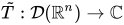


Convolution of a smooth function with a distribution
Let f ∈ C∞(ℝn) and and assume that at least one of f and T has compact support. For any x ∈ ℝn, note that


The convolution of f and T, denoted by or by , is the smooth function:[39]


Satisfying:

If T is a distribution then the map is continuous as a map where if in addition T has compact support then it is also continuous as the map and continuous as the map .[39]




If is a continuous linear map such that for all and all then there exists a distribution such that for all .[5]



Example.[5] Let H be the Heavyside function on ℝ. For any ,

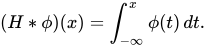
Let be the Dirac measure at 0 and its derivative as a distribution. Then and . Importantly, the associative law fails to hold:



Convolution of a test function with a distribution
Convolution with defines a linear map:


which is continuous with respect to the canonical LF space topology on .

Convolution of f with a distribution can be defined by taking the transpose of Cf relative to the duality pairing of with the space of distributions (Trèves 1967, Chapter 27). If , then by Fubini's theorem



Extending by continuity, the convolution of f with a distribution T is defined by

for all

An alternative way to define the convolution of a function f and a distribution T is to use the translation operator τa. The convolution of the compactly supported function f and the distribution T is then the function defined for each x ∈ ℝn by

It can be shown that the convolution of a smooth, compactly supported function and a distribution is a smooth function. If the distribution T has compact support then if f is a polynomial (resp. an exponential function, an analytic function, the restriction to ℝn of an entire analytic function on ℂn, the restriction to ℝn of an entire function of exponential type in ℂn) then the same is true of .[39] If the distribution T has compact support as well, then f ∗ T is a compactly supported function, and the Titchmarsh convolution theorem (Hörmander 1983, Theorem 4.3.3) implies that

where ch denotes the convex hull and supp denotes the support.
Convolution of distributions
It is also possible to define the convolution of two distributions S and T on ℝn, provided one of them has compact support. Informally, in order to define S ∗ T where T has compact support, the idea is to extend the definition of the convolution ∗ to a linear operation on distributions so that the associativity formula

continues to hold for all test functions .[41]
It is also possible to provide a more explicit characterization of the convolution of distributions (Trèves 1967, Chapter 27). Suppose that S and T are distributions and that S has compact support. Then the linear maps

are continuous. The transposes of these maps,

are consequently continuous and one may show that

This common value is called the convolution of S and T and it is a distribution that is denoted by or . It satisfies .[39] If S and T are two distributions, at least one of which has compact support, then for any a ∈ ℝn, .[39] If T is a distribution in ℝn and if is a Dirac measure then .[39]


Suppose that it is T that has compact support. For consider the function

It can be readily shown that this defines a smooth function of x, which moreover has compact support. The convolution of S and T is defined by

This generalizes the classical notion of convolution of functions and is compatible with differentiation in the following sense: for every multi-index α,

The convolution of a finite number of distributions, all of which (except possibly one) have compact support, is associative.[39]
This definition of convolution remains valid under less restrictive assumptions about S and T.[42]
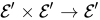
The convolution of distributions with compact support induces a continuous bilinear map defined by where denotes the space of distributions with compact support.[18] However, the convolution map as a function is not continuous[18] although it is separately continuous.[43] The convolution maps and given by both fail to be continuous.[18] Each of these non-continuous maps is, however, separately continuous and hypocontinuous.[18]






Convolution versus multiplication
In general, regularity is required for multiplication products and locality is required for convolution products. It is expressed in the following extension of the Convolution Theorem which guarantees the existence of both convolution and multiplication products. Let be a rapidly decreasing tempered distribution or, equivalently, be an ordinary (slowly growing, smooth) function within the space of tempered distributions and let be the normalized (unitary, ordinary frequency) Fourier transform [44] then, according to Schwartz (1951),


hold within the space of tempered distributions[45][46] .[47] In particular, these equations become the Poisson Summation Formula if is the Dirac Comb .[48] The space of all rapidly decreasing tempered distributions is also called the space of convolution operators and the space of all ordinary functions within the space of tempered distributions is also called the space of multiplication operators . More generally, and .[49][50] A particular case is the Paley-Wiener-Schwartz Theorem which states that and . This is because and . In other words, compactly supported tempered distributions belong to the space of convolution operators and Paley-Wiener functions PW, better known as bandlimited functions, belong to the space of multiplication operators .[51]


For example, let be the Dirac comb and be the Dirac delta then is the function that is constantly one and both equations yield the Dirac comb identity. Another example is to let be the Dirac comb and be the rectangular function then is the sinc function and both equations yield the Classical Sampling Theorem for suitable functions. More generally, if is the Dirac comb and is a smooth window function (Schwartz function), e.g. the Gaussian, then is another smooth window function (Schwartz function). They are known as mollifiers, especially in partial differential equations theory, or as regularizers in physics because they allow turning generalized functions into regular functions.


Tensor product of distributions
Let U (resp. V) be an open subset of ℝm (resp. ℝn). And suppose that all vector fields are over the field 𝔽, where 𝔽 = ℝ or ℂ. For any , if then define to be the map ; if then define to be the map .
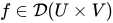


If S is a distribution in U, then define a map by and if T is a distribution in V then define a map by . Note that and . The distribution S on U thus produces a continuous linear map defined by , where if in addition the support of S is compact then it also induces a continuous linear map of .[52] Similarly, a distribution T on V produces a continuous linear map defined by , where if in addition the support of T is compact then it also induces a continuous linear map of .






Fubini's theorem for distributions[52]—Let S be a distribution on U and let T be a distribution on V. Then for every ,

Let S be a distribution on U and let T be a distribution on V. Then the tensor product of S and T is the distribution in , denoted by or , defined by:[52]



There is thus a bilinear map

the span of the range of this map is a dense subspace of its codomain. Furthermore, [52]

The tensor product of distributions induces a continuous bilinear map , where denotes the space of distributions with compact support.[18] The tensor product as the map is also continuous, where is the Schwartz space of rapidly decreasing functions.[18] These maps induce canonical surjective TVS-isomorphisms


where represents the completion of the injective tensor product (which in this case is identical to the completion of the projective tensor product, since these spaces are nuclear).[25] Furthermore, there are canonical TVS-isomorphisms:[25]


Schwartz kernel theorem[25]—We have canonical TVS isomorphisms:

This result is false if one replaces the space with a Hilbert space L2 and replaces with the dual of this L2 space.[26] Why does such a nice result hold for the space of distributions and test functions but not for the Hilbert space L2? This question led Alexander Grothendieck to discover nuclear spaces, nuclear maps, and the injective tensor product.

Spaces of distributions
For all 0 < k < ∞ and all 1 < p < ∞, all of the following canonical injections are continuous and have a range that is dense in their codomain:

as are the following

where the topologies on () are defined as direct limits of the spaces in a manner analogous to how the topologies on were defined (so in particular, they are not the usual norm topologies). The range of each of the maps above (and of any composition of the maps above) is dense in the codomain. Indeed, is even sequentially dense in every .[53] All of the canonical injections () are continuous and the range of this injection is dense in the codomain if and only if (here Lp(U) has its usual norm topology).[54]


Suppose that X is one of the spaces () or () or Lp(U) (). Since the canonical injection is a continuous injection whose image is dense in the codomain, the transpose is a continuous injection. This transpose thus allows us to identify with a certain vector subspace of the space of distributions. This transpose map is not necessarily a TVS-embedding so that topology that this map transfers to the image is finer than the subspace topology that this space inherits from . A linear subspace of carrying a locally convex topology that is finer than the subspace topology induced by is called a space of distributions.[54] Almost all of the spaces of distributions mentioned in this article arise in this way (e.g. tempered distribution, restrictions, distributions of order some integer, distributions induced by a positive Radon measure, distributions induced by an -function, etc.) and any representation theorem about the dual space of X may, through the transpose , be transferred directly to elements of the space .





Radon measures
The natural inclusion is a continuous injection whose image is dense in its codomain, so the transpose is also a continuous injection.


Note that the continuous dual space can be identified as the space of Radon measures, where there is a one-to-one correspondence between the continuous linear functionals and integral with respect to a Radon measure; that is,


- if then there exists a Radon measure on U such that for all , , and
- if is a Radon measure on U then the linear functional on defined by sending to is continuous.


Through the injection , every Radon measure becomes a distribution on U. If f is a locally integrable function on U then the distribution is a Radon measure; so Radon measures form a large and important space of distributions.


The following is the theorem of the structure of distributions of Radon measures, which shows that every Radon measure can be written as a sum of derivatives of locally functions in U:

- Theorem.[34] Suppose that T is a distribution in U ⊆ ℝn that is a Radon measure, V ⊆ U is a neighborhood of the support of T, and There exists is a family of locally functions in U such that
- and for very , .


- Positive Radon measures
A linear function T on a space of functions is called positive if whenever a function f that belongs to the domain of T is non-negative (i.e. f is real-valued and ) then . One may show that every positive linear functional on is necessarily continuous (i.e. necessarily a Radon measure).[55]Note that Lebesgue measure is an example of a positive Radon measure.


Locally integrable functions as distributions
One particularly important class of Radon measures are those that are induced locally integrable functions. The function f : U → ℝ is called locally integrable if it is Lebesgue integrable over every compact subset K of U.[56] This is a large class of functions which includes all continuous functions and all Lp functions. The topology on is defined in such a fashion that any locally integrable function f yields a continuous linear functional on – that is, an element of – denoted here by Tf, whose value on the test function is given by the Lebesgue integral:
- .

Conventionally, one abuses notation by identifying Tf with f, provided no confusion can arise, and thus the pairing between Tf and is often written

If f and g are two locally integrable functions, then the associated distributions Tf and Tg are equal to the same element of if and only if f and g are equal almost everywhere (see, for instance, Hörmander (1983, Theorem 1.2.5)). In a similar manner, every Radon measure μ on U defines an element of whose value on the test function is ∫𝜑 dμ. As above, it is conventional to abuse notation and write the pairing between a Radon measure μ and a test function as . Conversely, as shown in a theorem by Schwartz (similar to the Riesz representation theorem), every distribution which is non-negative on non-negative functions is of this form for some (positive) Radon measure.

The test functions are themselves locally integrable, and so define distributions. As such they are dense in with respect to the topology on in the sense that for any distribution , there is a net such that


This fact follows from the Hahn–Banach theorem, since the dual of with its weak-* topology is the space .[57] A stronger result of sequential density can be proven more constructively by a convolution argument.
Distributions with compact support
The natural inclusion is a continuous injection whose image is dense in its codomain, so the transpose is also a continuous injection. Thus, the image of , denoted by , forms a space of distributions when it is endowed with the strong dual topology of (transferred to it via the transpose map , so 's topology is finer than the subspace topology that this set inherits from ).[31]



The elements of can be identified as the space of distributions with compact support.[31] Explicitly, if T is a distribution on U then the following are equivalent,

- ;
- the support of T is compact;
- the restriction is continuous, where denotes the topology on C∞(U) and denotes with the subspace topology inherits from (which is a coarser topology than the canonical LF topology);[31]
- there is a compact subset K of U such that for every test function whose support is completely outside of K, we have


Compactly supported distributions define continuous linear functionals on the space C∞(U); recall that the topology on C∞(U) is defined such that a sequence of test functions converges to 0 if and only if all derivatives of converge uniformly to 0 on every compact subset of U. Conversely, it can be shown that every continuous linear functional on this space defines a distribution of compact support. Thus compactly supported distributions can be identified with those distributions that can be extended from Cc∞(U) to C∞(U).

Theorem[5]—Suppose that T is a distribution in U with compact support K and let V be an open subset of U containing K. Since every distribution with compact support has finite order, let N be the order of T and let P := { 0, ..., N + 2 }n. Then there exists a family of continuous functions f• = ( fp)p ∈ P defined on U with support in V such that (where these derivatives are to be understood in the sense of distributions).

Distributions of finite order
Let The natural inclusion is a continuous injection whose image is dense in its codomain, so the transpose is also a continuous injection. Thus, the image of , denoted by , forms a space of distributions when it is endowed with the strong dual topology of (transferred to it via the transpose map , so 's topology is finer than the subspace topology that this set inherits from ). The elements of are the distributions of order ≤ k.[34] Note that the distributions of order ≤ 0, which are also called distributions of order 0, are exactly the distributions that are Radon measures (described above).




For a distribution of order k is a distribution of order ≤ k that is not a distribution of order ≤ k − 1.[34]

A distribution is said to be of finite order if there is some integer k such that it is a distribution of order ≤ k, and the set of distributions of finite order is denoted by . Note that if k ≤ l then so that is a vector subspace of and furthermore, if and only if .[34]


- Structure of distributions of finite order
Every distribution with compact support in U is a distribution of finite order.[34] Indeed, every distribution in U is locally a distribution of finite order, in the following sense:[34] If V is an open and relatively compact subset of U and if is the restriction mapping from U to V, then the image of under is contained in .


The following is the theorem of the structure of distributions of finite order, which shows that every distribution of finite order can be written as a sum of derivatives of Radon measures:
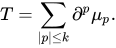
- Theorem.[34] Suppose T is a distribution of finite order ≤ k in U ⊆ ℝn, and Given any open subset V of U containing the support of T, there is a family of Radon measures in U, , such that for very and



Tempered distributions and Fourier transform
Below we define tempered distributions which form a subspace of the space of distributions on This is a proper subspace: while every tempered distribution is a distribution and an element of , the converse is not true. Tempered distributions are useful if one studies the Fourier transform since all tempered distributions have a Fourier transform, which is not true for an arbitrary distributions in


- Schwartz space
The space of test functions employed here, the so-called Schwartz space is the function space of all smooth functions that are rapidly decreasing at infinity along with all partial derivatives. Thus is in the Schwartz space provided that any derivative of , multiplied with any power of |x|, converges towards 0 for |x| → ∞. These functions form a complete topological vector space with a suitably defined family of seminorms. More precisely, for any multi-indices α and β define:



Then is a Schwartz function if all the values satisfy:
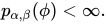
The family of seminorms pα, β defines a locally convex topology on the Schwartz space. For n = 1, the seminorms are, in fact, norms on the Schwartz space. One can also use the following family of seminorms to define the topology:[58]

Otherwise, one can define a norm on via

The Schwartz space is a Fréchet space (i.e. a complete metrizable locally convex space). Because the Fourier transform changes differentiation by xα into multiplication by xα and vice versa, this symmetry implies that the Fourier transform of a Schwartz function is also a Schwartz function.
A sequence in converges to 0 in if and only if the functions converge to 0 uniformly in the whole of ℝn, which implies that such a sequence must converge to zero in C∞(ℝn).[58]


is dense in The subset of all analytic Schwartz functions is dense in as well.[59]

The Schwartz space is nuclear and the tensor product of two maps induces a canonical surjective TVS-isomorphisms

where represents the completion of the injective tensor product (which in this case is the identical to the completion of the projective tensor product).[25]
- Tempered distributions
The natural inclusion is a continuous injection whose image is dense in its codomain, so the transpose is also a continuous injection. Thus, the image of the transpose map, denoted by , forms a space of distributions when it is endowed with the strong dual topology of (transferred to it via the transpose map , so the topology of is finer than the subspace topology that this set inherits from ).



The space is called the space of tempered distributions is it is the continuous dual of the Schwartz space. Equivalently, a distribution T is a tempered distribution if and only if

is true whenever

holds for all multi-indices α, β.
The derivative of a tempered distribution is again a tempered distribution. Tempered distributions generalize the bounded (or slow-growing) locally integrable functions; all distributions with compact support and all square-integrable functions are tempered distributions. More generally, all functions that are products of polynomials with elements of for p ≥ 1 are tempered distributions.

The tempered distributions can also be characterized as slowly growing, meaning that each derivative of T grows at most as fast as some polynomial. This characterization is dual to the rapidly falling behaviour of the derivatives of a function in the Schwartz space, where each derivative of decays faster than every inverse power of |x|. An example of a rapidly falling function is for any positive n, λ, β.
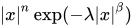
- Fourier transform
To study the Fourier transform, it is best to consider complex-valued test functions and complex-linear distributions. The ordinary continuous Fourier transform is a TVS-automorphism of the Schwartz space, and we will define the Fourier transform to be its transpose , which (abusing notation) will again be denoted by F. So the Fourier transform of the tempered distribution T is defined by (FT)(ψ) = T(Fψ) for every Schwartz function ψ. FT is thus again a tempered distribution. The Fourier transform is a TVS isomorphism from the space of tempered distributions onto itself. This operation is compatible with differentiation in the sense that


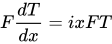
and also with convolution: if T is a tempered distribution and ψ is a slowly increasing infinitely differentiable function on ℝn, ψT is again a tempered distribution and

is the convolution of FT and Fψ. In particular, the Fourier transform of the constant function equal to 1 is the δ distribution.
Distributions as derivatives of continuous functions
The formal definition of distributions exhibits them as a subspace of a very large space, namely the topological dual of (or for tempered distributions). It is not immediately clear from the definition how exotic a distribution might be. To answer this question, it is instructive to see distributions built up from a smaller space, namely the space of continuous functions. Roughly, any distribution is locally a (multiple) derivative of a continuous function. A precise version of this result, given below, holds for distributions of compact support, tempered distributions, and general distributions. Generally speaking, no proper subset of the space of distributions contains all continuous functions and is closed under differentiation. This says that distributions are not particularly exotic objects; they are only as complicated as necessary.
Tempered distributions
If is a tempered distribution, then there exists a constant C > 0, and positive integers M and N such that for all Schwartz functions


- .

This estimate along with some techniques from functional analysis can be used to show that there is a continuous slowly increasing function F and a multi-index α such that

Restriction of distributions to compact sets
If , then for any compact set K ⊆ ℝn, there exists a continuous function F compactly supported in ℝn (possibly on a larger set than K itself) and a multi-index α such that on . This follows from the previously quoted result on tempered distributions by means of a localization argument.


Distributions with point support
If f has support at a single point then f is in fact a finite linear combination of distributional derivatives of the δ function at P. That is, there exists an integer m and complex constants aα such that


where is the translation operator.

General distributions
Finally we can describe the global structure of distributions:
- Theorem.[60] Let T be a distribution on U. For every multi-index α there exists a continuous function gα on U such that
- any compact subset K of U intersects the support of only finitely many gα; and
- Moreover, if T has finite order, then one can choose gα in such a way that only finitely many of them are non-zero.

Note that the infinite sum above is well-defined as a distribution. The value of T for a given can be computed using the finitely many gα that intersect the support of .
Using holomorphic functions as test functions
The success of the theory led to investigation of the idea of hyperfunction, in which spaces of holomorphic functions are used as test functions. A refined theory has been developed, in particular Mikio Sato's algebraic analysis, using sheaf theory and several complex variables. This extends the range of symbolic methods that can be made into rigorous mathematics, for example Feynman integrals.
Problem of multiplication
It is easy to define the product of a distribution with a smooth function, or more generally the product of two distributions whose singular supports are disjoint. With more effort it is possible to define a well-behaved product of several distributions provided their wave front sets at each point are compatible. A limitation of the theory of distributions (and hyperfunctions) is that there is no associative product of two distributions extending the product of a distribution by a smooth function, as has been proved by Laurent Schwartz in the 1950s. For example, if p.v. 1/x is the distribution obtained by the Cauchy principal value
![{\displaystyle \forall \phi \in {\mathcal {S}}(\mathbb {R} ):\qquad \left(\operatorname {p.v.} {\frac {1}{x}}\right)[\phi ]=\lim _{\varepsilon \to 0^{+}}\int _{|x|\geq \varepsilon }{\frac {\phi (x)}{x}}\,dx.}](/media/api/rest_v1/media/math/render/svg/d67650e0a97f12c45d12e0709956d4779a5b9c65)
If δ is the Dirac delta distribution then
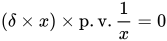
but
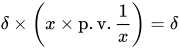
so the product of a distribution by a smooth function (which is always well defined) cannot be extended to an associative product on the space of distributions.
Thus, nonlinear problems cannot be posed in general and thus not solved within distribution theory alone. In the context of quantum field theory, however, solutions can be found. In more than two spacetime dimensions the problem is related to the regularization of divergences. Here Henri Epstein and Vladimir Glaser developed the mathematically rigorous (but extremely technical) causal perturbation theory. This does not solve the problem in other situations. Many other interesting theories are non linear, like for example the Navier–Stokes equations of fluid dynamics.
Several not entirely satisfactory[citation needed] theories of algebras of generalized functions have been developed, among which Colombeau's (simplified) algebra is maybe the most popular in use today.
Inspired by Lyons' rough path theory,[61] Martin Hairer proposed a consistent way of multiplying distributions with certain structure (regularity structures[62]), available in many examples from stochastic analysis, notably stochastic partial differential equations. See also Gubinelli–Imkeller–Perkowski (2015) for a related development based on Bony's paraproduct from Fourier analysis.
See also
- Colombeau algebra
- Current (mathematics)
- Distribution (number theory)
- Distribution on a linear algebraic group
- Gelfand triple
- Generalized function
- Homogeneous distribution
- Hyperfunction
- Laplacian of the indicator
- Limit of a distribution
- Linear form
- Malgrange–Ehrenpreis theorem
- Pseudodifferential operator
- Riesz representation theorem
- Vague topology
- Weak solution
Notes
- ^ Tf turns out to also be linear and continuous when the space of test functions is given a certain topology called the canonical LF topology.
- ^ The Schwartz space consists of smooth rapidly decreasing test functions, where "rapidly decreasing" means that the function decreases faster than any polynomial increases as points in its domain move away from the origin.
- ^ Except for the trivial (i.e. identically 0) map, which of course is always analytic.
- ^ Since ∞ + 1 = ∞, if i is an integer then the inequality "0 ≤ i < k + 1" means: 0 ≤ i < ∞ if k = ∞, while if k ≠ ∞ then it means 0 ≤ i ≤ k.
- ^ If we take 𝕂 to be the set of all compact subsets of U then we can use the use the universal property of direct limits to conclude that the inclusion is a continuous and even that they are topological embedding for every compact subset K ⊆ U. If however, we take 𝕂 to be the set of closures of some countable increasing sequence of relatively compact open subsets of U having all of the properties mentioned earlier in this in this article then we immediately deduce that is a Hausdorff locally convex strict LF-space (and even a strict LB-space when k ≠ ∞). All of these facts can also be proved directly without using direct systems (although with more work).
- ^ For any TVS X (metrizable or otherwise), the notion of completeness depends entirely on a certain so-called "canonical uniformity" that is defined using only the subtraction operation (see the article Complete topological vector space for more details). In this way, the notion of a complete TVS does not require the existence of any metric. However, if the TVS X is metrizable and if d is any translation-invariant metric on X that defines its topology, then X is complete as a TVS (i.e. it is a complete uniform space under its canonical uniformity) if and only if the (X, d) is a complete metric space. So if a TVS X happens to have a topology that can be defined by such a metric d then d may be used to deduce the completeness of X but the existence of such a metric is not necessary for defining completeness and it is even possible to deduce that a metrizable TVS is complete without ever even considering a metric (e.g. since the Cartesian product of any collection of complete TVSs is again a complete TVS, we can immediately deduce that the TVS ℝℕ, which happens to be metrizable, is a complete TVS; note that there was no need to consider any metric on ℝℕ).
- ^ There are two classes of topological vector spaces (TVSs) that are particularly similar to finite-dimensional Euclidean spaces: the Banach spaces (especially Hilbert spaces) and the nuclear Montel spaces. Montel spaces are a class of TVSs in which every closed and bounded subset is compact (this generalizes the Heine–Borel theorem), which is a property that no infinite-dimensional Banach space can have; that is, no infinite-dimensional TVS can be both a Banach space and a Montel space. Also, no infinite-dimensional TVS can be both a Banach space and a nuclear space. All finite dimensional Euclidean spaces are nuclear Montel Hilbert spaces but once one enters infinite-dimensional space then these two classes separate. Nuclear spaces in particular have many of the "nice" properties of finite-dimensional TVSs (e.g. the Schwartz kernel theorem) that infinite-dimensional Banach spaces lack (for more details, see the properties, sufficient conditions, and characterizations given in the article Nuclear space). It is in this sense that nuclear spaces are an "alternative generalization" of finite-dimensional spaces. Also, as a general rule, in practice most "naturally occurring" TVSs are usually either Banach spaces or nuclear space. Typically, most TVSs that are associated with smoothness (i.e. infinite differentiability, such as and ) end up being nuclear TVSs while TVSs associated with finite continuous differentiability (such as with K compact and k ≠ ∞) often end up being non-nuclear spaces, such as Banach spaces.
- ^ In functional analysis, the strong dual topology is often the "standard" or "default" topology placed on the continuous dual space , where if X is a normed space then this strong dual topology is the same as the usual norm-induced topology on .
- ^ Technically, the topology must be coarser than the strong dual topology and also simultaneously be finer that the weak* topology.
- ^ For example let and take to be the ordinary derivative for functions of one real variable and assume the support of to be contained in the finite interval then since


References
- ^ a b Trèves 2006, pp. 85–89.
- ^ Trèves 2006, pp. 885–89.
- ^ a b Trèves 2006, pp. 142–149.
- ^ Trèves 2006, pp. 356–358.
- ^ a b c d e f g h i Rudin 1991, pp. 149–181.
- ^ a b c d Trèves 2006, pp. 131–134.
- ^ Trèves 2006, pp. 195–201.
- ^ Narici & Beckenstein 2011, p. 435.
- ^ "Topological vector space". Encyclopedia of Mathematics. Encyclopedia of Mathematics. Retrieved September 6, 2020.
It is a Montel space, hence paracompact, and so normal.
- ^ Trèves 2006, pp. 351–359.
- ^ a b c d e Gabriyelyan, Saak "Topological properties of Strict LF-spaces and strong duals of Montel Strict LF-spaces" (2017)
- ^ a b T. Shirai, Sur les Topologies des Espaces de L. Schwartz, Proc. Japan Acad. 35 (1959), 31-36.
- ^ Rudin 1991, pp. 149–155.
- ^ Trèves 2006, pp. 126–134.
- ^ a b c Trèves 2006, pp. 136–148.
- ^ According to (Gel'fand & Shilov 1966–1968, v. 1, §1.2)
- ^ Narici & Beckenstein 2011, pp. 446–447.
- ^ a b c d e f g h Trèves 2006, p. 423.
- ^ a b c d e Trèves 2006, pp. 247–252.
- ^ Trèves 2006, pp. 222–223.
- ^ See for example (Grubb 2009, p. 14).
- ^ See for example (Schaefer & Wolff 1999, p. 173).
- ^ a b Gabriyelyan, S.S. Kakol J., and·Leiderman, A. "The strong Pitkeev property for topological groups and topological vector spaces"
- ^ Trèves 2006, pp. 526–534.
- ^ a b c d e Trèves 2006, p. 531.
- ^ a b Trèves 2006, pp. 509–510.
- ^ Trèves 2006, p. 530.
- ^ Trèves 2006, p. 357.
- ^ a b Trèves 2006, pp. 245–247.
- ^ a b c d e f g Trèves 2006, pp. 253–255.
- ^ a b c d e Trèves 2006, pp. 255–257.
- ^ Trèves 2006, pp. 264–266.
- ^ Rudin, p. 165
- ^ a b c d e f g h Trèves 2006, pp. 258–264.
- ^ (Strichartz 1994, §2.3); (Trèves 1967).
- ^ See for example (Hörmander 1983, Theorem 6.1.1).
- ^ See (Hörmander 1983, Theorem 6.1.2).
- ^ a b c Trèves 2006, pp. 278–283.
- ^ a b c d e f g h i j Trèves 2006, pp. 284–297.
- ^ See for example (Rudin 1991, §6.29).
- ^ Hörmander (1983, §IV.2) proves the uniqueness of such an extension.
- ^ See for instance Gel'fand & Shilov (1966–1968, v. 1, pp. 103–104) and Benedetto (1997, Definition 2.5.8).
- ^ Trèves 2006, p. 294.
- ^ Folland, G.B. (1989). Harmonic Analysis in Phase Space. Princeton, NJ: Princeton University Press.
- ^ Horváth, John (1966). Topological Vector Spaces and Distributions. Reading, MA: Addison-Wesley Publishing Company.
- ^ Barros-Neto, José (1973). An Introduction to the Theory of Distributions. New York, NY: Dekker.
- ^ Petersen, Bent E. (1983). Introduction to the Fourier Transform and Pseudo-Differential Operators. Boston, MA: Pitman Publishing.
- ^ Woodward, P.M. (1953). Probability and Information Theory with Applications to Radar. Oxford, UK: Pergamon Press.
- ^ Trèves 2006, pp. 318–319.
- ^ Friedlander, F.G.; Joshi, M.S. (1998). Introduction to the Theory of Distributions. Cambridge, UK: Cambridge University Press.
- ^ Schwartz 1951.
- ^ a b c d Trèves 2006, pp. 416–419.
- ^ Trèves 2006, pp. 150–160.
- ^ a b Trèves 2006, pp. 240–252.
- ^ Trèves 2006, p. 218.
- ^ For more information on such class of functions, see the entry on locally integrable functions.
- ^ See for example (Rudin 1991, Theorem 3.10).
- ^ a b Trèves 2006, pp. 92–94.
- ^ Trèves 2006, pp. 160.
- ^ Theorem 6.28 in (Rudin 1991)
- ^ Lyons, T. (1998). "Differential equations driven by rough signals". Revista Matemática Iberoamericana: 215–310. doi:10.4171/RMI/240.
- ^ Hairer, Martin (2014). "A theory of regularity structures". Inventiones Mathematicae. 198 (2): 269–504. arXiv:1303.5113. Bibcode:2014InMat.198..269H. doi:10.1007/s00222-014-0505-4.
- Barros-Neto, José (1973). An Introduction to the Theory of Distributions. New York, NY: Dekker.
- Benedetto, J.J. (1997), Harmonic Analysis and Applications, CRC Press.
- Folland, G.B. (1989). Harmonic Analysis in Phase Space. Princeton, NJ: Princeton University Press.
- Friedlander, F.G.; Joshi, M.S. (1998). Introduction to the Theory of Distributions. Cambridge, UK: Cambridge University Press..
- Gårding, L. (1997), Some Points of Analysis and their History, American Mathematical Society.
- Gel'fand, I.M.; Shilov, G.E. (1966–1968), Generalized functions, vol. 1–5, Academic Press.
- Grubb, G. (2009), Distributions and Operators, Springer.
- Hörmander, L. (1983), The analysis of linear partial differential operators I, Grundl. Math. Wissenschaft., vol. 256, Springer, doi:10.1007/978-3-642-96750-4, ISBN 3-540-12104-8, MR 0717035.
- Horváth, John (1966). Topological Vector Spaces and Distributions. Addison-Wesley series in mathematics. Vol. 1. Reading, MA: Addison-Wesley Publishing Company. ISBN 978-0201029857.
- Kolmogorov, Andrey; Fomin, Sergei V. (2012) [1957]. Elements of the Theory of Functions and Functional Analysis. Dover Books on Mathematics. New York: Dover Books. ISBN 978-1-61427-304-2. OCLC 912495626.
- Narici, Lawrence; Beckenstein, Edward (2011). Topological Vector Spaces. Pure and applied mathematics (Second ed.). Boca Raton, FL: CRC Press. ISBN 978-1584888666. OCLC 144216834.
- Petersen, Bent E. (1983). Introduction to the Fourier Transform and Pseudo-Differential Operators. Boston, MA: Pitman Publishing..
- Rudin, Walter (1991). Functional Analysis. International Series in Pure and Applied Mathematics. Vol. 8 (Second ed.). New York, NY: McGraw-Hill Science/Engineering/Math. ISBN 978-0-07-054236-5. OCLC 21163277.
- Schaefer, Helmut H.; Wolff, Manfred P. (1999). Topological Vector Spaces. GTM. Vol. 8 (Second ed.). New York, NY: Springer New York Imprint Springer. ISBN 978-1-4612-7155-0. OCLC 840278135.
- Schwartz, Laurent (1954), "Sur l'impossibilité de la multiplications des distributions", C. R. Acad. Sci. Paris, 239: 847–848.
- Schwartz, Laurent (1951), Théorie des distributions, vol. 1–2, Hermann.
- Sobolev, S.L. (1936), "Méthode nouvelle à résoudre le problème de Cauchy pour les équations linéaires hyperboliques normales", Mat. Sbornik, 1: 39–72.
- Stein, Elias; Weiss, Guido (1971), Introduction to Fourier Analysis on Euclidean Spaces, Princeton University Press, ISBN 0-691-08078-X.
- Strichartz, R. (1994), A Guide to Distribution Theory and Fourier Transforms, CRC Press, ISBN 0-8493-8273-4.
- Trèves, François (2006) [1967]. Topological Vector Spaces, Distributions and Kernels. Mineola, N.Y.: Dover Publications. ISBN 978-0-486-45352-1. OCLC 853623322.
- Woodward, P.M. (1953). Probability and Information Theory with Applications to Radar. Oxford, UK: Pergamon Press.
Further reading
- M. J. Lighthill (1959). Introduction to Fourier Analysis and Generalised Functions. Cambridge University Press. ISBN 0-521-09128-4 (requires very little knowledge of analysis; defines distributions as limits of sequences of functions under integrals)
- V.S. Vladimirov (2002). Methods of the theory of generalized functions. Taylor & Francis. ISBN 0-415-27356-0
- Vladimirov, V.S. (2001) [1994], "Generalized function", Encyclopedia of Mathematics, EMS Press.
- Vladimirov, V.S. (2001) [1994], "Generalized functions, space of", Encyclopedia of Mathematics, EMS Press.
- Vladimirov, V.S. (2001) [1994], "Generalized function, derivative of a", Encyclopedia of Mathematics, EMS Press.
- Vladimirov, V.S. (2001) [1994], "Generalized functions, product of", Encyclopedia of Mathematics, EMS Press.
- Oberguggenberger, Michael (2001) [1994], "Generalized function algebras", Encyclopedia of Mathematics, EMS Press.
| Spaces |
| ||||
|---|---|---|---|---|---|
| Theorems | |||||
| Operators | |||||
| Algebras | |||||
| Open problems | |||||
| Applications | |||||
| Advanced topics | |||||
