


Injective function
| Function |
|---|
| x ↦ f (x) |
| History of the function concept |
| Types by domain and codomain |
| Classes/properties |
| Constructions |
| Generalizations |
| List of specific functions |
In mathematics, an injective function (also known as injection, or one-to-one function[1]) is a function f that maps distinct elements of its domain to distinct elements of its codomain; that is, x1 ≠ x2 implies f(x1) ≠ f(x2) (equivalently by contraposition, f(x1) = f(x2) implies x1 = x2). In other words, every element of the function's codomain is the image of at most one element of its domain.[2] The term one-to-one function must not be confused with one-to-one correspondence that refers to bijective functions, which are functions such that each element in the codomain is an image of exactly one element in the domain.
A homomorphism between algebraic structures is a function that is compatible with the operations of the structures. For all common algebraic structures, and, in particular for vector spaces, an injective homomorphism is also called a monomorphism. However, in the more general context of category theory, the definition of a monomorphism differs from that of an injective homomorphism.[3] This is thus a theorem that they are equivalent for algebraic structures; see Homomorphism § Monomorphism for more details.
A function that is not injective is sometimes called many-to-one.[2]

Definition
[edit]
Let be a function whose domain is a set . The function is said to be injective provided that for all and in if , then ; that is, implies . Equivalently, if , then in the contrapositive statement.


Symbolically, which is logically equivalent to the contrapositive,[4]An injective function (or, more generally, a monomorphism) is often denoted by using the specialized arrows ↣ or ↪ (for example, or ), although some authors specifically reserve ↪ for an inclusion map.[5]




Examples
[edit]For visual examples, readers are directed to the gallery section.
- For any set and any subset , the inclusion map (which sends any element to itself) is injective. In particular, the identity function is always injective (and in fact bijective).
- If the domain of a function is the empty set, then the function is the empty function, which is injective.
- If the domain of a function has one element (that is, it is a singleton set), then the function is always injective.
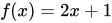
- The function defined by is injective.
- The function defined by is not injective, because (for example) However, if is redefined so that its domain is the non-negative real numbers [0, +∞), then is injective.
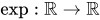
- The exponential function defined by is injective (but not surjective, as no real value maps to a negative number).
- The natural logarithm function defined by is injective.
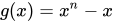
- The function defined by is not injective, since, for example, .










More generally, when and are both the real line , then an injective function is one whose graph is never intersected by any horizontal line more than once. This principle is referred to as the horizontal line test.[2]


Injections can be undone
[edit]Functions with left inverses are always injections. That is, given , if there is a function such that for every , , then is injective. The proof is that



In this case, is called a retraction of . Conversely, is called a section of . For example: is retracted by .


Conversely, every injection with a non-empty domain has a left inverse . It can be defined by choosing an element in the domain of and setting to the unique element of the pre-image (if it is non-empty) or to (otherwise).[6]

![{\displaystyle f^{-1}[y]}](/media/api/rest_v1/media/math/render/svg/c5ffa43f26ddc0c27fedee54ea4051661d56fa21)
The left inverse is not necessarily an inverse of because the composition in the other order, , may differ from the identity on . In other words, an injective function can be "reversed" by a left inverse, but is not necessarily invertible, which requires that the function is bijective.


Injections may be made invertible
[edit]In fact, to turn an injective function into a bijective (hence invertible) function, it suffices to replace its codomain by its actual image That is, let such that for all ; then is bijective. Indeed, can be factored as , where is the inclusion function from into .


More generally, injective partial functions are called partial bijections.
Other properties
[edit]
- If and are both injective then is injective.
- If is injective, then is injective (but need not be).
- is injective if and only if, given any functions , whenever , then . In other words, injective functions are precisely the monomorphisms in the category Set of sets.
- If is injective and is a subset of , then . Thus, can be recovered from its image .
- If is injective and and are both subsets of , then .
- Every function can be decomposed as for a suitable injection and surjection . This decomposition is unique up to isomorphism, and may be thought of as the inclusion function of the range of as a subset of the codomain of .
- If is an injective function, then has at least as many elements as in the sense of cardinal numbers. In particular, if, in addition, there is an injection from to , then and have the same cardinal number. (This is known as the Cantor–Bernstein–Schroeder theorem.)
- If both and are finite with the same number of elements, then is injective if and only if is surjective (in which case is bijective).
- An injective function which is a homomorphism between two algebraic structures is an embedding.
- Unlike surjectivity, which is a relation between the graph of a function and its codomain, injectivity is a property of the graph of the function alone; that is, whether a function is injective can be decided by only considering the graph (and not the codomain) of .


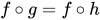


Proving that functions are injective
[edit]A proof that a function is injective depends on how the function is presented and what properties the function holds. For functions that are given by some formula there is a basic idea. We use the definition of injectivity, namely that if , then .[7]


Here is an example:
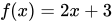
Proof: Let . Suppose . So implies , which implies . Therefore, it follows from the definition that is injective.


There are multiple other methods of proving that a function is injective. For example, in calculus if is a differentiable function defined on some interval, then it is sufficient to show that the derivative is always positive or always negative on that interval. In linear algebra, if is a linear transformation it is sufficient to show that the kernel of contains only the zero vector. If is a function with finite domain it is sufficient to look through the list of images of each domain element and check that no image occurs twice on the list.
A graphical approach for a real-valued function of a real variable is the horizontal line test. If every horizontal line intersects the curve of in at most one point, then is injective or one-to-one.


Gallery
[edit]-
 An injective non-surjective function (injection, not a bijection)
 -
 An injective surjective function (bijection)
 -
 A non-injective surjective function (surjection, not a bijection)
 -
 A non-injective non-surjective function (also not a bijection)


-
 Not an injective function. Here and are subsets of and are subsets of : for two regions where the function is not injective because more than one domain element can map to a single range element. That is, it is possible for more than one in to map to the same in .
 -
 Making functions injective. The previous function can be reduced to one or more injective functions (say) and , shown by solid curves (long-dash parts of initial curve are not mapped to anymore). Notice how the rule has not changed – only the domain and range. and are subsets of and are subsets of : for two regions where the initial function can be made injective so that one domain element can map to a single range element. That is, only one in maps to one in .
 -
 Injective functions. Diagramatic interpretation in the Cartesian plane, defined by the mapping , where , domain of function, range of function, and denotes image of . Every one in maps to exactly one unique in . The circled parts of the axes represent domain and range sets — in accordance with the standard diagrams above


See also
[edit]- Bijection, injection and surjection – Properties of mathematical functions
- Injective metric space – Type of metric space
- Monotonic function – Order-preserving mathematical function
- Univalent function – Mathematical concept
Notes
[edit]- ^ Sometimes one-one function in Indian mathematical education. "Chapter 1: Relations and functions" (PDF). Archived (PDF) from the original on December 26, 2023 – via NCERT.
- ^ a b c "Injective, Surjective and Bijective". Math is Fun. Retrieved 2019-12-07.
- ^ "Section 7.3 (00V5): Injective and surjective maps of presheaves". The Stacks project. Retrieved 2019-12-07.
- ^ Farlow, S. J. "Section 4.2 Injections, Surjections, and Bijections" (PDF). Mathematics & Statistics - University of Maine. Archived from the original (PDF) on Dec 7, 2019. Retrieved 2019-12-06.
- ^ "What are usual notations for surjective, injective and bijective functions?". Mathematics Stack Exchange. Retrieved 2024-11-24.
- ^ Unlike the corresponding statement that every surjective function has a right inverse, this does not require the axiom of choice, as the existence of is implied by the non-emptiness of the domain. However, this statement may fail in less conventional mathematics such as constructive mathematics. In constructive mathematics, the inclusion of the two-element set in the reals cannot have a left inverse, as it would violate indecomposability, by giving a retraction of the real line to the set {0,1}.
- ^ Williams, Peter (Aug 21, 1996). "Proving Functions One-to-One". Department of Mathematics at CSU San Bernardino Reference Notes Page. Archived from the original on 4 June 2017.

References
[edit]- Bartle, Robert G. (1976), The Elements of Real Analysis (2nd ed.), New York: John Wiley & Sons, ISBN 978-0-471-05464-1, p. 17 ff.
- Halmos, Paul R. (1974), Naive Set Theory, New York: Springer, ISBN 978-0-387-90092-6, p. 38 ff.
External links
[edit]

- Earliest Uses of Some of the Words of Mathematics: entry on Injection, Surjection and Bijection has the history of Injection and related terms.
- Khan Academy – Surjective (onto) and Injective (one-to-one) functions: Introduction to surjective and injective functions
| General | |||||||||
|---|---|---|---|---|---|---|---|---|---|
| Theorems (list), paradoxes | |||||||||
| Logics |
| ||||||||
| Set theory |
| ||||||||
| Formal systems (list), language, syntax |
| ||||||||
| Proof theory | |||||||||
| Model theory | |||||||||
| Computability theory | |||||||||
| Related | |||||||||
