Function used to generate other functions
This article is about generating functions in physics. For generating functions in mathematics, see
Generating function .
Generating a sine from a circle. In physics, and more specifically in Hamiltonian mechanics , a generating function is, loosely, a function whose partial derivatives generate the differential equations that determine a system's dynamics. Common examples are the partition function of statistical mechanics , the Hamiltonian, and the function which acts as a bridge between two sets of canonical variables when performing a canonical transformation .
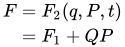
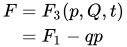
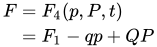
There are four basic generating functions, summarized by the following table:[ 1]
Generating function
Its derivatives
F
=
F
1
(
q
,
Q
,
t
)
{\displaystyle F=F_{1}(q,Q,t)}
p
=
∂
F
1
∂
q
{\displaystyle p=~~{\frac {\partial F_{1}}{\partial q}}\,\!}
P
=
−
∂
F
1
∂
Q
{\displaystyle P=-{\frac {\partial F_{1}}{\partial Q}}\,\!}
F
=
F
2
(
q
,
P
,
t
)
=
F
1
+
Q
P
{\displaystyle {\begin{aligned}F&=F_{2}(q,P,t)\\&=F_{1}+QP\end{aligned}}}
p
=
∂
F
2
∂
q
{\displaystyle p=~~{\frac {\partial F_{2}}{\partial q}}\,\!}
Q
=
∂
F
2
∂
P
{\displaystyle Q=~~{\frac {\partial F_{2}}{\partial P}}\,\!}
F
=
F
3
(
p
,
Q
,
t
)
=
F
1
−
q
p
{\displaystyle {\begin{aligned}F&=F_{3}(p,Q,t)\\&=F_{1}-qp\end{aligned}}}
q
=
−
∂
F
3
∂
p
{\displaystyle q=-{\frac {\partial F_{3}}{\partial p}}\,\!}
P
=
−
∂
F
3
∂
Q
{\displaystyle P=-{\frac {\partial F_{3}}{\partial Q}}\,\!}
F
=
F
4
(
p
,
P
,
t
)
=
F
1
−
q
p
+
Q
P
{\displaystyle {\begin{aligned}F&=F_{4}(p,P,t)\\&=F_{1}-qp+QP\end{aligned}}}
q
=
−
∂
F
4
∂
p
{\displaystyle q=-{\frac {\partial F_{4}}{\partial p}}\,\!}
Q
=
∂
F
4
∂
P
{\displaystyle Q=~~{\frac {\partial F_{4}}{\partial P}}\,\!}
Sometimes a given Hamiltonian can be turned into one that looks like the harmonic oscillator Hamiltonian, which is
H
=
a
P
2
+
b
Q
2
.
{\displaystyle H=aP^{2}+bQ^{2}.}
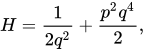
For example, with the Hamiltonian
H
=
1
2
q
2
+
p
2
q
4
2
,
{\displaystyle H={\frac {1}{2q^{2}}}+{\frac {p^{2}q^{4}}{2}},}
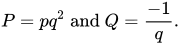
where p is the generalized momentum and q is the generalized coordinate , a good canonical transformation to choose would be
P
=
p
q
2
and
Q
=
−
1
q
.
{\displaystyle P=pq^{2}{\text{ and }}Q={\frac {-1}{q}}.}
1
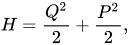
This turns the Hamiltonian into
H
=
Q
2
2
+
P
2
2
,
{\displaystyle H={\frac {Q^{2}}{2}}+{\frac {P^{2}}{2}},}
which is in the form of the harmonic oscillator Hamiltonian.
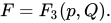
The generating function F
F
=
F
3
(
p
,
Q
)
.
{\displaystyle F=F_{3}(p,Q).}
To find F
P
=
−
∂
F
3
∂
Q
,
{\displaystyle P=-{\frac {\partial F_{3}}{\partial Q}},}
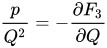
and substitute the expression for P from equation (1 p and Q :
p
Q
2
=
−
∂
F
3
∂
Q
{\displaystyle {\frac {p}{Q^{2}}}=-{\frac {\partial F_{3}}{\partial Q}}}
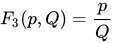
Integrating this with respect to Q results in an equation for the generating function of the transformation given by equation (1
F
3
(
p
,
Q
)
=
p
Q
{\displaystyle F_{3}(p,Q)={\frac {p}{Q}}}
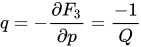
To confirm that this is the correct generating function, verify that it matches (1
q
=
−
∂
F
3
∂
p
=
−
1
Q
{\displaystyle q=-{\frac {\partial F_{3}}{\partial p}}={\frac {-1}{Q}}}
^ Goldstein, Herbert; Poole, C. P.; Safko, J. L. (2001). Classical Mechanics (3rd ed.). Addison-Wesley. p. 373. ISBN 978-0-201-65702-9