


Dedekind zeta function
In mathematics, the Dedekind zeta function of an algebraic number field K, generally denoted , is a generalization of the Riemann zeta function that represents information of ideals in number ring in the similar way as Riemann zeta function represents information about integers.

Dedekind zeta functions generalize many properties of Riemann zeta function: they can be defined as a Dirichlet series, have an analytic continuation to a meromorphic function on the complex plane C with only a simple pole at s = 1, have an Euler product expansion, and satisfies a functional equation. Values of Dedekind zeta functions encode important arithmetic data of K.
The Dedekind zeta function is named for Richard Dedekind who introduced it in his supplement to Peter Gustav Lejeune Dirichlet's Vorlesungen über Zahlentheorie.[1]
Motivation
[edit]Unique factorization of non-zero elements into powers of prime elements that is fundamental property for usual (rational) integer numbers, generally fails in rings of integers for arbitrary number field. More precisely, it holds only for number rings being principal ideal domains. The most notable examples except rational integers are Gaussian integers or Eisenstein integers.
However, since ring of integers is Dedekind ring, then holds unique factorization of non-zero ideals into powers of prime ideals. Then for general number rings, the prime ideals rather than prime numbers are point of interest. To describe distribution of prime ideals among all ideals, a kind of quantity that measures "size" of ideal need to be introduced. The natural way for it is absolute norm defined as cardinality of quotient ring:

It is easy to check that for rational integers it equals to absolute value of integer number generating that ideal. Having this preparation, the generalization of Riemann zeta function can be defined.
Definition
[edit]Let be an algebraic number field, with ring of integers and denote absolute norm of ideal. Dedekind zeta function for field is first defined by series:


where index runs through all non-zero ideals in ring of integers. This definition is valid only in domain of convergence of this series (which can be shown to be ), so for the rest of complex numbers it is defined as analytic continuation of this series.

Basic Properties
[edit]Dirichlet series
[edit]Despite original definition of Dedekind zeta function shows its importance for number field, it is easier to show its analytical properties in form of classical Dirichlet series. Denoting by number of ideals of norm , we can rewrite series in the domain of absolute convergence as:


Using Minkowski's bound and summing over all ideal classes one can show that[2]:

From basic properties of Dirichlet series this shows that series is absolutely convergent in and defines holomorphic function in this domain.

Euler product
[edit]For every number field its ring of integers is Dedekind domain, hence every ideal can be uniquely factorized into product of prime ideals. Norm is multiplicative with respect to multiplication of ideals, this implies that Dedekind zeta function has an Euler product where index ranges through every non-zero prime ideal in :

Since in this is absolutely convergent product of non-zero elements it follows that in this half-plane.


Analytic continuation
[edit]Erich Hecke first proved that has an analytic continuation to a meromorphic function that is analytic at all points of the complex plane except for one simple pole at s = 1. The residue at that pole is given by the class number formula and is made up of important arithmetic data involving invariants of the unit group and class group of field .
Functional equation
[edit]The Dedekind zeta function satisfies a functional equation relating its values at and , more general case of equation satisfied by Riemann zeta function. Functional equation involves important invariants of number field:


- denote the discriminant of ,
- denote the number of real places of
- denote number of non-conjugated complex places of


Let denote gamma function. Define gamma factors related to that places the following way:


Then, the function:

satisfy the functional equation:

The functional equation for Dedekind zeta function allows to distinguish trivial zeros from nontrivial ones: trivial zeros are zeros that cancels poles of gamma factors in equation. In another words, nontrivial zeros are common zeros of and . Functional equation combined with Euler product shows that nontrivial zeros must lie in vertical strip: and are symmetric with respect to critical line: .


In a way analogical to function defined for Riemann zeta function one can define:


Which is basically removing poles from (thus obtaining entire function) and changing critical line into real line. Functional equation above is equivalent to:

Special values
[edit]Analogously to the Riemann zeta function, the values (or quantities that resembles values, like: residue, multiplicity of zero or leading coefficient in Taylor expansion at zero) of the Dedekind zeta function at integers may encode (at least conjecturally) important arithmetic data of the field K. Denote:
- be absolute dicsriminant of field
- be number of real places of field
- be number of non-conjugated complex places of field
- be ideal class number for field
- be regulator for field
- be number of roots of unity in field


Dedekind zeta function have only one simple pole at . Class number formula relates residue at that pole to important field invariants:


From functional equation one can deduce that has trivial zeros of multiplicity at non-zero even negative integers and of multiplicity at odd negative integers. In zero has trivial zero of multiplicity , which equals rank of group of units in . Combining class number formula with functional equation one can deduce that at , leading term at this point is:


- .

Only case when function is non-vanishing at odd negative numbers is when is totally real number field. Carl Ludwig Siegel showed that in this case is a non-zero rational number at negative odd integers.
Arithmetically equivalent fields
[edit]Two fields are called arithmetically equivalent if they have the same Dedekind zeta function. They are useful as counterexamples to show which arithmetic invariants cannot be determined by Dedekind zeta function itself.
Perlis (1977) showed that two number fields K and L are arithmetically equivalent if and only if all but finitely many prime numbers p have the same inertia degrees in the two fields, i.e., if are the prime ideals in K lying over p, then the tuples need to be the same for K and for L for almost all p.

![{\displaystyle ([{\mathcal {O}}_{K}/{\mathfrak {p}}_{i}:\mathbb {F} _{p}])}](/media/api/rest_v1/media/math/render/svg/896db83ca2b77c5be7527daa9616806cdab24b8b)
Bosma & de Smit (2002) used Gassmann triples to give some examples of pairs of non-isomorphic fields that are arithmetically equivalent. In particular some of these pairs have different class numbers, so the Dedekind zeta function of a number field does not determine its class number.
Relations to other L-functions and zeta functions
[edit]Special cases
[edit]For special case , Dedekind zeta function is Riemann zeta function, a prototypical example for all functions called zeta functions or L-functions.

More general zeta functions
[edit]Dedekind zeta function is special case of arithmetic zeta function and Hasse–Weil zeta function for spectrum of [3]. Additionally it is the motivic L-function of the motive coming from the cohomology of .

Artin L-functions
[edit]By definition, Artin L-functions are attached rather to number field extensions than number fields themselves, but Dedekind zeta functions are special case of them. For any finite number field extension taking trivial representation of its Galois group, resulting Artin L-function is:


Artin L-functions are very useful for providing non-trivial factorizations for Dedekind zeta functions. If is finite Galois extension, then Dedekind zeta function of larger field is Artin L-function for regular representation of and have factorization into L-functions for irreducible representations of this group:


Without assumption that extension is Galois, the formula becomes more complicated, but is also possible to obtain similar factorization using normal closure for larger field and induced representations.
- be for normal closure for
- be Galois group for
- be Galois group for
- be product defined on characters of representations
- be character of irreducible representation
- denote representation induced from
- be character of


Then factorization of Dedekind zeta function is as follows:

Hecke L-functions
[edit]In special case of being abelian extension using Artin reciprocity factorization can be described in terms of Hecke L-functions:

where index runs over primitive Hecke characters corresponding to irreducible representations of abelian group.
Dirichlet L-functions
[edit]Taking even more special case when is abelian extension, the Hecke characters become Dirichlet characters and Hecke L-functions become Dirichlet L-functions.

For example, a quadratic field K is simplest case of non-trivial, abelian extension of rational numbers. This shows that:

In case of quadratic field is a Jacobi symbol used as Dirichlet character. Fact that the zeta function of a quadratic field is a product of the Riemann zeta function and a certain Dirichlet L-function with Jacobi symbol is an analytic formulation of the quadratic reciprocity law.

Conjectures
[edit]Dedekind conjecture
[edit]Dedekind conjectured that for every number field function:

is entire function. The more general version of Dedekind conjecture says that for every finite extension of number field the quotient:

is entire function. For abelian extensions Dedekind conjecture follows from factorization into Hecke L-functions and fact that Hecke L-functions for nontrivial characters are entire. For solvable extensions it was proven independently by Uchida (1975) and van der Waall (1975).
General case is still open, but follows directly from more general conjectures like Artin conjecture or Selberg orthonormality conjecture.
Extended Riemann hypothesis
[edit]Functional equation allows to distinguish trivial and non-trivial zeros of Dedekind zeta functions and guarantees that nontrivial ones lie in vertical strip: and are symmetric with respect to line . Extended Riemann hypothesis says that all nontrivial zeros of Dedekind zeta functions lie on critical line.
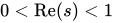
This is generalization of ordinary Riemann hypothesis. Generalization of Riemann hypothesis for Dirichlet L-functions is equivalent to ERH for being abelian extension of rational numbers. Many results in analytic number theory and algebraic number theory follows are result of this conjecture.
Values at negative integers
[edit]There are attempts to generalize relation between values of Riemann zeta function at negative odd integers and Bernoulli numbers:
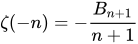
From Siegel's proof follows that in case of totally real field, these values are nonzero rational numbers. Stephen Lichtenbaum conjectured specific values for these rational numbers in terms of the algebraic K-theory of K.
Notes
[edit]- ^ Narkiewicz 2004, §7.4.1
- ^ Markus, Daniel A. (2018). Number Fields. Universitext (2 ed.). Springer Nature Switzerland AG. pp. 111–116. doi:10.1007/978-3-319-90233-3. ISBN 978-3-319-90232-6.
- ^ Flach 2004, §1.1
References
[edit]- Bosma, Wieb; de Smit, Bart (2002), "On arithmetically equivalent number fields of small degree", in Kohel, David R.; Fieker, Claus (eds.), Algorithmic number theory (Sydney, 2002), Lecture Notes in Comput. Sci., vol. 2369, Berlin, New York: Springer-Verlag, pp. 67–79, doi:10.1007/3-540-45455-1_6, ISBN 978-3-540-43863-2, MR 2041074
- Section 10.5.1 of Cohen, Henri (2007), Number theory, Volume II: Analytic and modern tools, Graduate Texts in Mathematics, vol. 240, New York: Springer, doi:10.1007/978-0-387-49894-2, ISBN 978-0-387-49893-5, MR 2312338
- Deninger, Christopher (1994), "L-functions of mixed motives", in Jannsen, Uwe; Kleiman, Steven; Serre, Jean-Pierre (eds.), Motives, Part 1, Proceedings of Symposia in Pure Mathematics, vol. 55, American Mathematical Society, pp. 517–525, ISBN 978-0-8218-1635-6
- Flach, Mathias (2004), "The equivariant Tamagawa number conjecture: a survey", in Burns, David; Popescu, Christian; Sands, Jonathan; et al. (eds.), Stark's conjectures: recent work and new directions (PDF), Contemporary Mathematics, vol. 358, American Mathematical Society, pp. 79–125, ISBN 978-0-8218-3480-0
- Martinet, J. (1977), "Character theory and Artin L-functions", in Fröhlich, A. (ed.), Algebraic Number Fields, Proc. Symp. London Math. Soc., Univ. Durham 1975, Academic Press, pp. 1–87, ISBN 0-12-268960-7, Zbl 0359.12015
- Narkiewicz, Władysław (2004), Elementary and analytic theory of algebraic numbers, Springer Monographs in Mathematics (3 ed.), Berlin: Springer-Verlag, Chapter 7, ISBN 978-3-540-21902-6, MR 2078267
- van der Waall, Robert (1975). "On a conjecture of Dedekind on zeta functions". Indagationes Math. (78): 83–86.
- Uchida, Koji (1975). "On Artin L-functions". Tohoku Mathematical Journal (27): 75–81.
- Perlis, Robert (1977), "On the equation ", Journal of Number Theory, 9 (3): 342–360, doi:10.1016/0022-314X(77)90070-1
