The best answers address the question directly, and back up facts with wikilinks and links to sources. Do not edit others' comments and do not give any medical or legal advice.
How did this dude pull it off prior to the likes of machine learning and gen-AI becoming mainstream (the video was published in 2019)? It's not like they had access to something akin to the MAL model in "Now and Then" which removed the mains noise from Lennon's recording, yet it sounded at least vaguely like someone brought Shirley to a modern recording studio and let her have it. Blake Gripling (talk) 01:51, 16 November 2025 (UTC)[reply]
The art of digital remastering precedes the use of generative AI for such purposes. For the approach that may have been used, see the version of Remaster § Music as it was at the time the video clip was posted. I do not know how its audio quality compares to that of the song on the 2009 DVD of Rebecca of Sunnybrook Farm. ‑‑Lambiam09:31, 16 November 2025 (UTC)[reply]
This image of Léger's painting is used in three articles and has made its way elsewhere on the internet. It originated with a commons upload in 2015. But, the painting may not appear like this at all. In most books and printed literature it has earth tones.[1] Curious, I went on a virtual tour of the museum on YouTube. I noticed that the gallery containing this painting has an unusual bluish light and color cast, both on the walls of the room and possibly coming from the lighting itself. Is this a way for them to discourage photography (and flash), such that any photo taken of the painting will look quite different from the actual work? Viriditas (talk) 20:37, 16 November 2025 (UTC)[reply]
If anything, such a strategy would encourage the use of flash, as a flash user would be bringing their own light, with its own controlled color temperature and spectrum.
Of course, the tools to digitally correct color are so widely available that there would be little point to trying to obfuscate an image in this way. And I would be very surprised to see an art museum that deliberately chose to distort the appearance of a work that way—curators tend to be very hot on respecting the integrity of the artist's work and vision.
Seems more likely that the illumination in that space happened to have a slightly different color balance for non-malicious, non-strategic reasons. Though it's hard to provide a reference to support that answer; I doubt that the museum's curator has gone on the record to say "No, we're not doing anything weird with our lights." TenOfAllTrades(talk) 21:39, 16 November 2025 (UTC)[reply]
One more thought just came to mind. Is it possible that the piece has yellowed somewhat over the last century-plus, and the bluer-blue whiter-white version is an attempt to more closely reflect the original colors of the work? TenOfAllTrades(talk) 22:05, 16 November 2025 (UTC)[reply]
I'm not sure, but I recall reading older reviews that mentioned the earth tones. Also, most museums do a restore after some time. I would be very surprised if this painting hasn't been restored since the 1970s. Viriditas (talk) 23:50, 16 November 2025 (UTC)[reply]
I've been to the Kröller-Müller Museum on a number of occasions (including two school excursions; I think everybody in the Netherlands has been there at least once on a school excursion), although I don't remember seeing this painting. I seem to remember that many rooms in this museum are lit primarily by daylight, either through big windows or skylights with milkglass. The continuous spectrum of daylight gives a better colour rendering index than any kind of artificial light. This means that lighting conditions change with cloud cover and the height of the sun. Human eyes adapt easily, but this may throw off the white balance of a camera. PiusImpavidus (talk) 10:43, 17 November 2025 (UTC)[reply]
The version uploaded to the Commons is a scaled-down version of what the website of the Kröller-Müller museum had at the time; the current museum version is markedly different. They can be compared here: comparison, the Commons version on top and the current museum version, scaled to the same size, below.
The hues and brightness of versions found on the Web are all over the place, but those that appear to be photos of reproductions tend to be brighter and have more earth colours. I found an outlier in size and clarity on Facebook, which can be seen here. I could not find its provenance, but this can hardly be the result of sprucing up the gloomy low-contrast image at the museum site. I guess someone needs to get to the museum to see the actual colours. ‑‑Lambiam11:30, 17 November 2025 (UTC)[reply]
Vaguely. I first became aware of a similar issue in the domain of music in the mid-1980s. Without mentioning any names, I used to frequent a record store in the Bay Area which, if you got to know the people working there, trafficked in underground bootlegs. That's when the first problem occurred to me. In many cases, you had these terrible recordings of famous bands floating around when the bands themselves had soundboard-quality reproductions that they couldn't or wouldn't release. Viriditas (talk) 21:04, 18 November 2025 (UTC)[reply]
There is a recent gas pipeline nearby (there is a view of its construction in the "nearby" on Geograph, where the picture came from), perhaps something to do with that. DuncanHill (talk) 19:04, 17 November 2025 (UTC)[reply]
The thing appears to be located at a local maximum in terrain elevation. If this is to cap a shaft, the shaft would have been shorter (and presumably easier to construct and cheaper) if they had moved it a short distance in any direction. A maximum in elevation could be convenient for a liquid storage tank, as one can use gravity to move liquid from there to anywhere (but it's harder to fill). The good view from there and limited soil movement (no downhill direction at a local maximum) make it useful as a reference point for the Ordnance Survey (one could put a big theodolite on it), but would it not be indicated on the Ordnance Survey map then? There's also the option of something unfinished. It doesn't look very recent, mid 20th century is plausible. The top layer may be more recent and could be hiding bolts or other attachment points.
There seems to be an irregular ring of smallish stones around the construction. This prompts me to wonder if the 'box' might have been placed to protect something of possible archaeological interest pending later excavation (for which funding might not have materialised). Its lack of presence on OS maps argues against this, unless it was only identified in the mid-20th century, if not later, and immediately covered over. {The poster formerly known as 87.81.230.195} ~2025-31359-08 (talk) 14:39, 18 November 2025 (UTC)[reply]
That very land appears to be for sale, though I cannot identify the object in any of the estate agent's pictures. They might answer a query on the matter?
Milk churn stands are generally next to roads, they were placed so that the churns could be quickly transferred to a lorry doing its rounds; but this is nowhere near a road. A water tank seems more likely. Alansplodge (talk) 13:37, 20 November 2025 (UTC)[reply]
Unlikely, given that there are no indications on large-scale OS maps of the area. There is a bench-mark on a nearby road, but nothing in the field. Also, the Principal Triangulation map has no node in that area - the nearest one is in the Preseli Hills, probably on Foel Cwmcerwyn which has a whole slew of benchmarks on and around its summit. [Edited] -- Verbarson talkedits20:59, 23 November 2025 (UTC)[reply]
November 18
Villanov?
In The New Grove Dictionary of Music and Musicians, 1st ed., vol. 10, p. 108 entry on Nikolai Klenovsky: "[...] and it was in fact to Klenovsky that Vsevolozhsky (director of the imperial theatres) first offered The Queen of Spades as a subject for an opera; only when he failed to make any progress with the idea was the libretto passed first to Villanov and finally to Tchaikovsky." Here it mentions a composer named Villanov. There doesn't seem to be anyone named Villanov, so who is this? Check it out for yourself here (you need to borrow it). WafflesInvasion (talk) 11:18, 18 November 2025 (UTC)[reply]
This page (not the photograph) seems to be about him, well, google-translate mentions the Queen of Spades, so yeah. You could use the cyrillic Александр Александрович Вилламов to find more about him. --Wrongfilter (talk) 11:46, 18 November 2025 (UTC)[reply]
• … Kandaurov sent his material to another minor composer, known chiefly as the writer of little salon pieces, A. A. Villanov. ("Travels and the Break", p. 235)
• The only established fact is that towards the end of 1886, Kandaurov offered his scenario to a Petersburg socialite composer Aleksandr Villamov (1838-1917).
It goes on to provide more detail of the dealings between these people.
If you mean what I think you mean, then it can happen. The Russian novel Metro 2033 was initially published, partly written, online and completed with crowdsourced contributions, and the novel Cosmos was written and published with each of its 17 chapters written by one of 16 authors. Such Collaborative fiction by multiple (not merely two) contributors has also appeared in other genres.
A cursory search suggests there are a number of book published concerning the SCP Foundation, which is user generated and even uses the wiki format. Without looking at the content of those works directly it'd be hard to tell if they're just reprints of the content of the SCP-wiki or some sort of derivative work. Our own article suggests at least some of the printed material is original work based on the content of the SCP-wiki. Amstrad00 (talk) 14:33, 21 November 2025 (UTC)[reply]
Australians do not have official ethnic labels. The ONLY possibly related question on the census asks people to self declare their ancestry. Nobody checks whether you tell the truth. HiLo48 (talk) 22:25, 21 November 2025 (UTC)[reply]
Why do some everyday objects have design features that seem unnecessary?
Hi! I’m curious about something I’ve noticed in everyday objects. Many common items, which are like pens, bottle caps, envelopes, or packaging, often have small design features (grooves, holes, ridges, extra folds, etc.) that don’t seem immediately necessary for their main function.
Are these features usually there for manufacturing reasons, safety regulations, patents, cost savings, or something else? I’d appreciate an explanation or examples of how such “small design choices” end up in everyday products.
Probably all of the above, although not all at the same time. It may also be the case that they are actually functional. Grooves may offer additional grip. Crown corks have a ridged rim for manufacturing reasons, as a byproduct of the crimping process. In twist-off caps these ridges have actually become functional. Our article Ballpoint pen explains why their caps have holes: for safety. Another non-functional reason may be the esthetics of the product, as seen in decorative hubcaps and other non-functional trim used to pimp up cars. If distinctive enough, a design may offer protection against copy cats; see Industrial design right. ‑‑Lambiam00:36, 23 November 2025 (UTC)[reply]
Special occasion stationary envelopes have all sorts of unnecessary design features, from vintage wax seals to string-tie or even magnetic closures. Then you've got a choice of lining and texture, accents, embossing, engravings, the list is endless. None of these design features are necessary. Viriditas (talk) 20:51, 23 November 2025 (UTC)[reply]
True, but special occasion envelopes hardly qualify as "everyday objects", so it remains open whether "everyday" envelopes can be found with seemingly unnecessary design-features. If such exist, we'd need to know what these features are before attempting to answer the question of their whyness. ‑‑Lambiam07:38, 24 November 2025 (UTC)[reply]
The flap of an envelope isn't strictly necessary. The size and shape of the flap is therefore a largely arbitrary choice, similar to the bumps and ridges of plastic objects. Some are triangular, some are rectangular, etc. ~2025-36066-72 (talk) 11:32, 24 November 2025 (UTC)[reply]
Maybe it would be better if you offered up a specific example of something you'd like more information on? Two (to build on Lambian's reply) of the most common everyday item features I see explained are the holes in Bic pens. As our article explains, the hole in the side of the tube of the pen is there to equalize air pressure and hole at the end of the cap cover is to reduce the risk of choking, should someone ingest it and get it stuck in their windpipe. Matt Deres (talk) 16:49, 24 November 2025 (UTC)[reply]
"Unnecessary" is a very loaded term. Is the internet necessary? People have developed quite an attachment to it, and if it suddenly ceased to exist there'd be a great deal of chaos. But before it existed, was there a widespread desire for such a thing? Did people keenly feel its lack, or did they just go about their internetless business blissfully unaware of what they weren't missing? -- Jack of Oz[pleasantries]17:39, 24 November 2025 (UTC)[reply]
In the many centuries during which waiting weeks or more for a letter to arrive was the norm, I'm sure people desired near-instant communication across great distances. But want isn't need. Almost everyone wants clothes, but they aren't necessary. ~2025-36226-46 (talk) 09:02, 25 November 2025 (UTC)[reply]
I was thinking more of environmental protection. Regardless of of nudity taboos, there are large parts of the world that are too cold, or when the sun is too strong for humans to thrive or even survive without clothes. And given that clothes need to be removed to be cleaned or repaired, you'll usually need at least some duplicate items. Iapetus (talk) 11:24, 27 November 2025 (UTC)[reply]
I applaud, as always, your pedantry, but note the OP's specific request is around design features "that don’t seem immediately necessary for their main function." (emphasis mine). So, the question isn't whether the Internet is necessary, it's about design features of the Internet that might not seem necessary to its function (but perhaps are - or at least have an interesting story to tell). For example, people might not know that the http:// at the beginning of web addresses is to distinguish it from other transfer protocols like ftp and gopher. As those protocols became deprecated and support waned, the need for that went away and now most browsers don't bother showing it. Matt Deres (talk) 16:08, 25 November 2025 (UTC)[reply]
As others have noted, it might be useful to link to specific products and features, and we can get more specific. Extra grooves/ridges/holes/creases can be added to a product to add or maintain strength/rigidity with less material. (You can't stand a flat sheet of paper on edge, but you can stand a sheet of paper with vertical creases.)
Ridges and nubbins of various sorts may also be artefacts of various manufacturing and processes: places where a sprue was attached, or flash where there was a boundary between parts of a mould, or witness marks where tooling was applied. TenOfAllTrades(talk) 14:15, 27 November 2025 (UTC)[reply]
And to add to the above, injection-moulded plastic parts generally benefit from keeping the wall thickness reasonably consistent where it is practical, as uneven thickness can lead to uneven cooling, making distortion after the object is released from the mould more likely. Saving material by hollowing out to a consistent wall thickness is good, but in terms of the economic benefit, the ability to produce parts faster without distortion may be the deciding factor, and lead to design features that save little material being incorporated even when they make tooling manufacture more complex. Back in the days when I designed injection-moulded parts, one had to resort to guesswork as to whether it was really worth the effort in edge cases, but I'm sure it can be done through software now. AndyTheGrump (talk) 14:40, 27 November 2025 (UTC)[reply]
Design features which are of no interest or use to the end user can arise for many, many reasons:molded jarmolded bottle
As User:TenOfAllTrades already mentioned, injection molded parts tend to have various nubs left over from the sprues which are a necessary part of the molding process.
Molded bottles and jars often have one or two circumferentially-oriented wedge-shaped depressions on the bottom (see images). I assume (although I've never verified this) that these are to make it easier to eject the finished bottle from its mold.
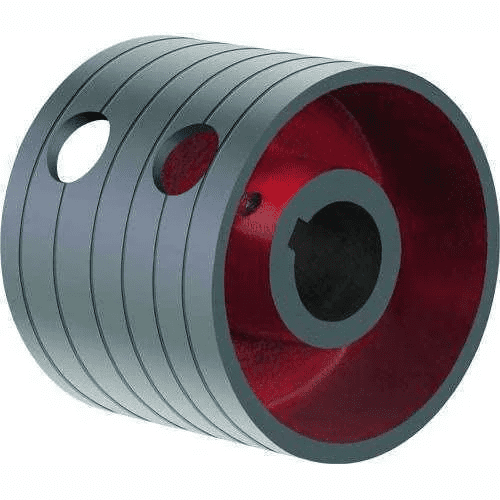
A complicated part may need an extra hole in it solely for someone to pass a screwdriver or wrench through, in order to tighten a fastener. For example, this pulley [ external image ] for a flat belt has holes in its face, which don't affect its function, but allow access to the setscrews which attach the pulley to the shaft.
There are a bunch of other design-for-ities. We have an article which lists several. Another example from my field is Design for testability, although this doesn't result in physical features that an end user is likely to notice. And my favorite example, which I've never even seen discussed anywhere, is "Design for Shippability", a term that popped into my head when I figured out why the wheels of this recycling toter (see image to right) toter wheel have offset holes in them. Another manifestation of Design for Shippability is when you buy something that says "some assembly required": they're not making you finish the assembly so that they can cut down on their manufacturing costs; no, they're arranging that the disassembled parts can fit into a smaller box, with less wasted space, for more efficient shipping.
Hello there, while the The Source OC had been proposed before its construction, and this began in August 2012 and was developed by M+D Properties, what was the originality of this shopping mall, and why did it become a home to many Korean-owned businesses, despite its mixed-use development? Did this shopping center originally had American-owned businesses and tenants? And how did you find out? ~2025-35811-87 (talk) 13:35, 23 November 2025 (UTC)[reply]
It looks like M+D Properties itself has a Korean connection:[2]
Chief Executive Officer: Donald Chae
Chief Financial Officer: Donald Chae
Director: Donald Chae
Secretary: Donald Chae
Based on his employment record, interior designer Yoon Chang has been involved with the project.[3]
What with the large influx of Koreans in northern Orange County,[4] the developer (possibly Chae, who is also a real estate agent[5]) must have sensed a business opportunity. ‑‑Lambiam16:35, 23 November 2025 (UTC)[reply]
There are sources for Blumenbach's five-race classification, one of which was the "Ethiopean race". William Henry Flower supported a three-race classification, likewise including an "Ethiopean race". The topic Menschenracen in the ur-edition of Meyers Konversations-Lexikon presented a four-race classification.[7] All were very much 19th-century theoris. None used the term Ethiopid, nor is it clear that the latter term, in theories that use it, means the same as Negroid. ‑‑Lambiam01:06, 27 November 2025 (UTC)[reply]
As of 31 December 2019, Shell had total proved reserves of 11.1 billion barrels (1.76×10⁹ m3) of oil equivalent.
What's a good jurisdiction-independent word for the right to control oil reserves? This sentence's use of "had" is sufficiently vague, but because it's close to "proved", it looks like a misplaced auxiliary verb, and I'd like to change it. But perhaps "owned" is incorrect (can it own reserves if one merely owns the right to extract them from someone else's land?) and perhaps "controlled" is insufficient (perhaps the landowner "controls" oil rights even after selling the rights to Shell?), so I'm not clear on the right terminology. Nyttend (talk) 19:02, 27 November 2025 (UTC)[reply]
The collocation "had proved reserves" is not uncommon: [8], [9], [10], [11], [12]. You can avoid it by using, "Shell's proved resources amounted to 11.1 billion barrels". (The use of "total" is IMO redundant.) ‑‑Lambiam23:44, 27 November 2025 (UTC)[reply]
November 28
History icon
Today I noticed an icon in page histories that looks like a chess pawn and links to info about the username just to the right of it. Is that something new, or has it always been there and I failed to see it until today? ←Baseball BugsWhat's up, Doc?carrots→ 03:34, 28 November 2025 (UTC)[reply]
Culture and cuisine also varies considerably across the contiguous United States, so the main differences are to be expected in what is unique to Alaska. Indigenous culture is more influential in Alaska than in the other continental states. There are (depending on how you count) 22 indigenous languages, 18 of which are official languages of Alaska. There are many indigenous dishes not found in other states; other than these, the cuisine can largely be described as Pacific Northwest cuisine, not unique to Alaska but different from the cuisines of most states. The Iditarod is extremely popular; I can't readily think of a similarly popular state-bound event in any other state. There is probably much more; I've never been to Alaska and don't know any Alaskans personally. Oh, and Alaskans may think they are more rugged than people from other states, but such state-centric chauvinism is not unique to Alaska. ‑‑Lambiam15:11, 29 November 2025 (UTC)[reply]
I don't know about "main difference", but when I think of Alaska, the first things that pop to mind are:
Unlike most other states, Alaska is not subdivided into counties, but rather boroughs. (But it is not quite unique in this regard, as Louisiana is divided into non-county parishes.)
Historically, the finest-scale USGStopographic maps for most of Alaska were 1:63,360 scale, unlike the 1:24,000 and 1:25,000 maps for the other 49 states. (But it looks like, since 2018, they're making 1:25,000 maps for Alaska, also.)




,_oil_on_canvas,_120_x_170_cm,_Kr%C3%B6ller-M%C3%BCller_Museum.jpg?lang=en)


 Resolved