Dieser Artikel oder nachfolgende Abschnitt ist nicht hinreichend mit
Belegen (beispielsweise
Einzelnachweisen ) ausgestattet. Angaben ohne ausreichenden Beleg könnten demnächst entfernt werden. Bitte hilf Wikipedia, indem du die Angaben recherchierst und
gute Belege einfügst.
Sekans hyperbolicus (blau) und Kosekans hyperbolicus (rot) Die Funktionen Kosekans hyperbolicus (csch) und Sekans hyperbolicus (sech) sind Hyperbelfunktionen . Sie ergeben sich als Kehrwert von Sinus hyperbolicus bzw. Kosinus hyperbolicus .
sech
x
=
2
e
x
+
e
−
x
=
1
cosh
x
csch
x
=
2
e
x
−
e
−
x
=
1
sinh
x
{\displaystyle {\begin{aligned}\operatorname {sech} \ x&={\frac {2}{e^{x}+e^{-x}}}={\frac {1}{\cosh x}}\\\operatorname {csch} \ x&={\frac {2}{e^{x}-e^{-x}}}={\frac {1}{\sinh x}}\end{aligned}}}
Sekans hyperbolicus
Kosekans hyperbolicus
Definitionsbereich
−
∞
<
x
<
+
∞
{\displaystyle -\infty <x<+\infty }
−
∞
<
x
<
+
∞
;
x
≠
0
{\displaystyle -\infty <x<+\infty \,;\,x\neq 0}
Wertebereich
0
<
f
(
x
)
≤
1
{\displaystyle 0<f(x)\leq 1}
−
∞
<
f
(
x
)
<
+
∞
;
f
(
x
)
≠
0
{\displaystyle -\infty <f(x)<+\infty \,;\,f(x)\neq 0}
Periodizität
keine
keine
Monotonie
x
<
0
{\displaystyle x<0}
x
>
0
{\displaystyle x>0}
x
>
0
{\displaystyle x>0}
x
<
0
{\displaystyle x<0}
Symmetrien
Spiegelsymmetrie zur y-Achse
Punktsymmetrie zum Koordinatenursprung
Asymptote
f
(
x
)
→
0
{\displaystyle f(x)\to 0}
x
→
±
∞
{\displaystyle x\to \pm \infty }
f
(
x
)
→
0
{\displaystyle f(x)\to 0}
x
→
±
∞
{\displaystyle x\to \pm \infty }
Nullstellen
keine
keine
Sprungstellen
keine
keine
Polstellen
keine
x
=
0
{\displaystyle x=0}
Extrema
Maximum bei
x
=
0
{\displaystyle x=0}
keine
Wendepunkte
x
=
±
ln
(
1
+
2
)
{\displaystyle x=\pm \ln {(1+{\sqrt {2}})}}
keine
Die Umkehrfunktionen sind die entsprechenden Areafunktionen :
x
=
arsech
y
x
=
arcsch
y
{\displaystyle {\begin{aligned}x&=\operatorname {arsech} \ y\\x&=\operatorname {arcsch} \ y\end{aligned}}}
d
d
x
sech
x
=
−
sech
x
⋅
tanh
x
=
−
sinh
x
cosh
2
x
d
d
x
csch
x
=
−
csch
x
⋅
coth
x
=
−
cosh
x
sinh
2
x
=
−
csch
x
⋅
1
+
csch
2
x
{\displaystyle {\begin{aligned}{\frac {\mathrm {d} }{\mathrm {d} x}}\operatorname {sech} \ x&=-\operatorname {sech} \ x\cdot \operatorname {tanh} \ x=-{\frac {\sinh x}{\cosh ^{2}x}}\\{\frac {\mathrm {d} }{\mathrm {d} x}}\operatorname {csch} \ x&=-\operatorname {csch} \ x\cdot \operatorname {coth} \ x=-{\frac {\cosh x}{\sinh ^{2}x}}=-\operatorname {csch} \ x\cdot {\sqrt {1+\operatorname {csch} ^{2}x}}\\\end{aligned}}}
Die Stammfunktionen sind gegeben durch:[ 1] [ 2]
∫
sech
x
d
x
=
2
arctan
(
exp
(
x
)
)
+
C
=
arctan
(
sinh
x
)
+
C
∫
csch
x
d
x
=
ln
|
tanh
x
2
|
+
C
{\displaystyle {\begin{aligned}\int \operatorname {sech} x\ \mathrm {d} x&=2\arctan \left(\exp(x)\right)+C=\arctan \left(\sinh x\right)+C\\\int \operatorname {csch} x\ \mathrm {d} x&=\ln \left|\operatorname {tanh} \,{\frac {x}{2}}\right|+C\end{aligned}}}
Die durch den Koordinatenursprung verlaufende Stammfunktion des Sekans hyperbolicus wird Gudermannfunktion genannt:
gd
(
x
)
=
arctan
[
sinh
(
x
)
]
{\displaystyle \operatorname {gd} (x)=\arctan {\bigl [}\sinh(x){\bigr ]}}
Für folgende Verallgemeinerung ist diese Formel in Bezug auf alle positiven Zahlen w gültig:
∫
0
∞
sech
(
x
)
w
d
x
=
2
w
−
2
β
(
1
2
w
)
{\displaystyle \int _{0}^{\infty }\operatorname {sech} (x)^{w}\,\mathrm {d} x=2^{w-2}\beta ({\tfrac {1}{2}}w)}
Mit dem griechischen Buchstaben β wird die Eulersche Betafunktion bezeichnet.
Wenn der Cosekans hyperbolicus mit ganzrationalen Polynomfunktionen multipliziert wird, dann entstehen meist Funktionen mit polylogarithmischen Integralen:
Für folgende Funktion ist die Ursprungsstammfunktion dilogarithmisch beschaffen:
∫
0
x
y
csch
(
y
)
d
y
=
2
Li
2
[
tanh
(
1
2
x
)
]
−
1
2
Li
2
[
tanh
(
1
2
x
)
2
]
=
2
Li
2
[
1
−
exp
(
−
x
)
]
−
1
2
Li
2
[
1
−
exp
(
−
2
x
)
]
{\displaystyle \int _{0}^{x}y\,\operatorname {csch} (y)\,\mathrm {d} y=2\,\operatorname {Li} _{2}[\tanh({\tfrac {1}{2}}x)]-{\tfrac {1}{2}}\,\operatorname {Li} _{2}[\tanh({\tfrac {1}{2}}x)^{2}]=2\,\operatorname {Li} _{2}[1-\exp(-x)]-{\tfrac {1}{2}}\,\operatorname {Li} _{2}[1-\exp(-2x)]}
Deswegen gilt für folgendes bestimmtes Integral:
3
2
Li
2
(
1
)
=
∫
0
∞
x
csch
(
x
)
d
x
=
∫
0
∞
∫
0
1
cosh
(
x
)
(
1
−
z
2
)
sinh
(
x
)
2
+
1
d
z
d
x
=
{\displaystyle {\frac {3}{2}}\,\operatorname {Li} _{2}(1)=\int _{0}^{\infty }x\,\operatorname {csch} (x)\,\mathrm {d} x=\int _{0}^{\infty }\int _{0}^{1}{\frac {\cosh(x)}{(1-z^{2})\sinh(x)^{2}+1}}\,\mathrm {d} z\,\mathrm {d} x=}
=
∫
0
1
∫
0
∞
cosh
(
x
)
(
1
−
z
2
)
sinh
(
x
)
2
+
1
d
x
d
z
=
∫
0
1
π
2
1
−
z
2
d
z
=
1
4
π
2
{\displaystyle =\int _{0}^{1}\int _{0}^{\infty }{\frac {\cosh(x)}{(1-z^{2})\sinh(x)^{2}+1}}\,\mathrm {d} x\,\mathrm {d} z=\int _{0}^{1}{\frac {\pi }{2{\sqrt {1-z^{2}}}}}\,\mathrm {d} z={\frac {1}{4}}\pi ^{2}}
∑
n
=
1
∞
1
n
2
=
Li
2
(
1
)
=
1
6
π
2
{\displaystyle \sum _{n=1}^{\infty }{\frac {1}{n^{2}}}=\operatorname {Li} _{2}(1)={\frac {1}{6}}\pi ^{2}}
Dies ist somit eine auf dem Satz von Fubini basierende Beweisführung für das sogenannte Basler Problem und findet in der Theorie über die Riemannsche Zeta-Funktion Anwendung.
Wenn das Doppelte der Glockenkurvenfunktion
exp
(
−
x
2
)
{\displaystyle \exp(-x^{2})}
sech
(
x
2
)
{\displaystyle \operatorname {sech} (x^{2})}
∫
0
∞
sech
(
x
2
)
d
x
=
π
β
(
1
2
)
{\displaystyle \int _{0}^{\infty }\operatorname {sech} (x^{2})\,\mathrm {d} x={\sqrt {\pi }}\,\beta \left({\frac {1}{2}}\right)}
Mit dem griechischen Buchstaben β wird an dieser Stelle die Dirichletsche Betafunktion zum Ausdruck gebracht.
Wenn die Produkte von Kardinalhyperbeltangens (Tangens hyperbolicus cardinalis)
tanh
(
x
)
/
x
{\displaystyle \operatorname {tanh} (x)/x}
Sekans hyperbolicus integriert werden, dann können mit diesen Integralen weitere bekannte Namenskonstanten dargestellt werden:
∫
0
∞
1
x
tanh
(
x
)
sech
(
x
)
d
x
=
4
π
G
{\displaystyle \int _{0}^{\infty }{\frac {1}{x}}\operatorname {tanh} (x)\operatorname {sech} (x)\,\mathrm {d} x={\frac {4}{\pi }}\,G}
∫
0
∞
1
x
tanh
(
x
)
sech
(
x
)
2
d
x
=
7
π
2
ζ
(
3
)
{\displaystyle \int _{0}^{\infty }{\frac {1}{x}}\operatorname {tanh} (x)\operatorname {sech} (x)^{2}\,\mathrm {d} x={\frac {7}{\pi ^{2}}}\,\zeta (3)}
∫
0
∞
1
x
tanh
(
x
)
sech
(
x
)
3
d
x
=
2
3
π
G
+
16
π
3
β
(
4
)
{\displaystyle \int _{0}^{\infty }{\frac {1}{x}}\operatorname {tanh} (x)\operatorname {sech} (x)^{3}\,\mathrm {d} x={\frac {2}{3\,\pi }}\,G+{\frac {16}{\pi ^{3}}}\,\beta (4)}
∫
0
∞
1
x
tanh
(
x
)
sech
(
x
)
4
d
x
=
7
3
π
2
ζ
(
3
)
+
31
π
4
ζ
(
5
)
{\displaystyle \int _{0}^{\infty }{\frac {1}{x}}\operatorname {tanh} (x)\operatorname {sech} (x)^{4}\,\mathrm {d} x={\frac {7}{3\,\pi ^{2}}}\,\zeta (3)+{\frac {31}{\pi ^{4}}}\,\zeta (5)}
Der Buchstabe G bezeichnet die Catalansche Konstante , der Ausdruck ζ(3) die Apéry-Konstante . Der Buchstabe β steht auch hier für die Dirichletsche Betafunktion.
Die Gudermannfunktion als Ursprungsstammfunktion des Sekans hyperbolicus ist eine elementare Funktion:
∫
0
x
sech
(
y
)
d
y
=
gd
(
x
)
=
arctan
[
sinh
(
x
)
]
=
arcsin
[
tanh
(
x
)
]
=
2
arctan
[
tanh
(
1
2
x
)
]
=
{\displaystyle \int _{0}^{x}\operatorname {sech} (y)\,\mathrm {d} y=\operatorname {gd} (x)=\arctan[\sinh(x)]=\arcsin[\tanh(x)]=2\arctan[\tanh({\tfrac {1}{2}}x)]=}
=
1
2
π
−
2
arctan
[
exp
(
−
x
)
]
=
2
arctan
[
exp
(
x
)
]
−
1
2
π
{\displaystyle ={\tfrac {1}{2}}\pi -2\arctan[\exp(-x)]=2\arctan[\exp(x)]-{\tfrac {1}{2}}\pi }
Die Ursprungsstammfunktion von der Quadratwurzel des Sekans hyperbolicus ist ein lemniskatisches Integral:
∫
0
x
sech
(
y
)
d
y
=
2
arcsl
[
tanh
(
1
2
x
)
]
{\displaystyle \int _{0}^{x}{\sqrt {\operatorname {sech} (y)}}\,\mathrm {d} y=2\,\operatorname {arcsl} [\tanh({\tfrac {1}{2}}x)]}
Die soeben gezeigte Funktion zählt zu den nicht elementaren Funktionen.
Das Integral von Null bis Unendlich von der Quadratwurzel des Sekans hyperbolicus nimmt exakt den Wert der lemniskatischen Konstante an.
Und die Ursprungsstammfunktion von der Kubikwurzel des Sekans hyperbolicus ist ein äquianharmonisches Integral:
∫
0
x
sech
(
y
)
3
d
y
=
1
2
27
4
F
{
2
arctan
[
tanh
(
x
)
3
4
sech
(
x
)
1
/
3
1
+
sech
(
x
)
2
/
3
+
sech
(
x
)
4
/
3
]
;
sin
(
1
12
π
)
}
{\displaystyle \int _{0}^{x}{\sqrt[{3}]{\operatorname {sech} (y)}}\,\mathrm {d} y={\frac {1}{2}}{\sqrt[{4}]{27}}\,{\text{F}}\left\{2\arctan \left[{\frac {\tanh(x)}{{\sqrt[{4}]{3}}\,\operatorname {sech} (x)^{1/3}{\sqrt {1+\operatorname {sech} (x)^{2/3}+\operatorname {sech} (x)^{4/3}}}}}\right];\sin \left({\frac {1}{12}}\pi \right)\right\}}
Auch die Ursprungsstammfunktion für das Quadrat der Kubikwurzel des Sekans hyperbolicus ist äquianharmonisch:
∫
0
x
sech
(
y
)
2
3
d
y
=
1
2
27
4
F
{
2
arctan
[
tanh
(
x
)
3
4
1
+
sech
(
x
)
2
/
3
+
sech
(
x
)
4
/
3
]
;
cos
(
1
12
π
)
}
{\displaystyle \int _{0}^{x}{\sqrt[{3}]{\operatorname {sech} (y)^{2}}}\,\mathrm {d} y={\frac {1}{2}}{\sqrt[{4}]{27}}\,{\text{F}}\left\{2\arctan \left[{\frac {\tanh(x)}{{\sqrt[{4}]{3}}{\sqrt {1+\operatorname {sech} (x)^{2/3}+\operatorname {sech} (x)^{4/3}}}}}\right];\cos \left({\frac {1}{12}}\pi \right)\right\}}
Sowohl die lemniskatischen als auch die äquianharmonischen Integrale zählen zu den sogenannten elliptischen Integralen.
Die Maclaurin-Reihe der Hyperbelsekans-Funktion (mit Konvergenzradius
π
2
{\displaystyle {\tfrac {\pi }{2}}}
[ 3]
sech
z
=
1
−
1
2
z
2
+
5
24
z
4
−
61
720
z
6
+
1385
40320
z
8
−
⋯
=
∑
n
=
0
∞
E
2
n
(
2
n
)
!
z
2
n
.
{\displaystyle {\begin{aligned}\operatorname {sech} z&=1-{\frac {1}{2}}z^{2}+{\frac {5}{24}}z^{4}-{\frac {61}{720}}z^{6}+{\frac {1385}{40320}}z^{8}-\cdots \\&=\sum _{n=0}^{\infty }{\frac {E_{2n}}{(2n)!}}z^{2n}.\end{aligned}}}
Der Hyperbelkosekans hat folgende Laurent-Entwicklung (für
0
<
|
z
|
<
π
{\displaystyle 0<|z|<\pi }
[ 3]
csch
z
=
1
z
−
1
6
z
+
7
360
z
3
−
31
15120
z
5
+
⋯
=
∑
n
=
0
∞
2
(
1
−
2
2
n
−
1
)
B
2
n
(
2
n
)
!
z
2
n
−
1
{\displaystyle {\begin{aligned}\operatorname {csch} z&={\frac {1}{z}}-{\frac {1}{6}}z+{\frac {7}{360}}z^{3}-{\frac {31}{15120}}z^{5}+\cdots \\&=\sum _{n=0}^{\infty }{\frac {2(1-2^{2n-1})B_{2n}}{(2n)!}}z^{2n-1}\end{aligned}}}
Die Symbole
E
2
n
{\displaystyle E_{2n}}
B
2
n
{\displaystyle B_{2n}}
Euler- bzw. Bernoulli-Zahlen .
Außerdem existieren Partialbruchzerlegungen der beiden Funktionen:
sech
z
=
∑
k
=
0
∞
(
−
1
)
k
(
8
k
+
4
)
π
(
2
k
+
1
)
2
π
2
+
4
z
2
csch
z
=
1
z
+
∑
k
=
1
∞
(
−
1
)
k
2
z
k
2
π
2
+
z
2
{\displaystyle {\begin{aligned}\operatorname {sech} z&=\sum _{k=0}^{\infty }(-1)^{k}{\frac {(8k+4)\pi }{(2k+1)^{2}\pi ^{2}+4z^{2}}}\\\operatorname {csch} z&={\frac {1}{z}}+\sum _{k=1}^{\infty }(-1)^{k}{\frac {2z}{k^{2}\pi ^{2}+z^{2}}}\end{aligned}}}
Für die Gudermannfunktion, also die Ursprungsstammfunktion des Sekans hyperbolicus, gilt somit die Formel
gd
(
z
)
=
∑
k
=
0
∞
2
(
−
1
)
k
arctan
[
2
z
(
2
k
+
1
)
π
]
{\displaystyle \operatorname {gd} (z)=\sum _{k=0}^{\infty }2(-1)^{k}\arctan \left[{\frac {2z}{(2k+1)\pi }}\right]}
Im Komplexen wird der Zusammenhang zwischen den Hyperbelfunktionen
sech
{\displaystyle \operatorname {sech} }
csch
{\displaystyle \operatorname {csch} }
sec
{\displaystyle \sec }
csc
{\displaystyle \csc }
sech
(
i
y
)
=
sec
(
y
)
csch
(
i
y
)
=
−
i
csc
(
y
)
{\displaystyle {\begin{aligned}&\operatorname {sech} (\mathrm {i} y)=\sec(y)\\&\operatorname {csch} (\mathrm {i} y)=-\mathrm {i} \csc(y)\end{aligned}}}
Die komplexen Funktionen lassen sich folgendermaßen auf die reellen Funktionen zurückführen:
sech
(
x
+
i
y
)
=
2
cosh
(
x
)
cos
(
y
)
cosh
(
2
x
)
+
cos
(
2
y
)
+
i
−
2
sinh
(
x
)
sin
(
y
)
cosh
(
2
x
)
+
cos
(
2
y
)
csch
(
x
+
i
y
)
=
2
sinh
(
x
)
cos
(
y
)
cosh
(
2
x
)
−
cos
(
2
y
)
+
i
−
2
cosh
(
x
)
sin
(
y
)
cosh
(
2
x
)
−
cos
(
2
y
)
{\displaystyle {\begin{aligned}\operatorname {sech} (x+\mathrm {i} y)&={\frac {2\cosh(x)\cos(y)}{\cosh(2x)+\cos(2y)}}+\mathrm {i} \,{\frac {-2\sinh(x)\sin(y)}{\cosh(2x)+\cos(2y)}}\\\operatorname {csch} (x+\mathrm {i} y)&={\frac {2\sinh(x)\cos(y)}{\cosh(2x)-\cos(2y)}}+\mathrm {i} \,{\frac {-2\cosh(x)\sin(y)}{\cosh(2x)-\cos(2y)}}\\\end{aligned}}}
Wenn Summenreihen aus dem Sekans hyperbolicus mit linearem Verlauf des inneren Eintrags bezüglich des Summenindex aufgestellt werden, dann entstehen elliptische Werte. Im Folgenden wird eine für alle elliptischen Moduln beziehungsweise numerischen Exzentrizitäten
(
−
1
≤
ε
≤
1
)
∩
ε
∈
R
{\displaystyle (-1\leq \varepsilon \leq 1)\,\cap \,\varepsilon \in \mathbb {R} }
ε
{\displaystyle \varepsilon }
vollständige elliptische Integral erster Art als Resultat ergibt:
1
+
2
{
∑
n
=
1
∞
s
e
c
h
[
π
n
K
′
(
ε
)
K
(
ε
)
]
}
=
1
+
2
[
∑
n
=
1
∞
2
q
(
ε
)
n
1
+
q
(
ε
)
2
n
]
=
ϑ
00
[
q
(
ε
)
]
2
=
2
π
K
(
ε
)
{\displaystyle 1+2{\biggl \{}\sum _{n=1}^{\infty }\mathrm {sech} {\biggl [}\pi \,n\,{\frac {K'(\varepsilon )}{K(\varepsilon )}}{\biggr ]}{\biggr \}}=1+2{\biggl [}\sum _{n=1}^{\infty }{\frac {2\,q(\varepsilon )^{n}}{1+q(\varepsilon )^{2n}}}{\biggr ]}=\vartheta _{00}[q(\varepsilon )]^{2}={\frac {2}{\pi }}\,K(\varepsilon )}
Denn die Jacobische Thetafunktion
ϑ
00
{\displaystyle \vartheta _{00}}
ϑ
00
(
w
)
=
1
+
2
(
∑
n
=
1
∞
w
n
2
)
{\displaystyle \vartheta _{00}(w)=1+2{\biggl (}\sum _{n=1}^{\infty }w^{n^{2}}{\biggr )}}
ϑ
00
(
w
)
2
=
1
+
2
(
∑
n
=
1
∞
2
w
n
1
+
w
2
n
)
{\displaystyle \vartheta _{00}(w)^{2}=1+2{\biggl (}\sum _{n=1}^{\infty }{\frac {2\,w^{n}}{1+w^{2n}}}{\biggr )}}
Die Mathematiker Edmund Taylor Whittaker und George Neville Watson nannten sowohl Summendefinitionen als auch Produktdefinitionen in ihrem gemeinsamen Werk[ 4] [ 5] [ 6] A Course in Modern Analysis nieder. Das elliptische Nomen
q
(
ε
)
{\displaystyle q(\varepsilon )}
q
(
ε
)
=
exp
[
−
π
K
′
(
ε
)
K
(
ε
)
]
{\displaystyle q(\varepsilon )=\exp {\bigl [}-\pi \,{\frac {K'(\varepsilon )}{K(\varepsilon )}}{\bigr ]}}
Diese Formel wurde bei der zuvor genannten Gleichungskette hervorgebracht:
1
+
2
{
∑
n
=
1
∞
s
e
c
h
[
π
n
K
′
(
ε
)
K
(
ε
)
]
}
=
2
π
K
(
ε
)
{\displaystyle 1+2{\biggl \{}\sum _{n=1}^{\infty }\mathrm {sech} {\biggl [}\pi \,n\,{\frac {K'(\varepsilon )}{K(\varepsilon )}}{\biggr ]}{\biggr \}}={\frac {2}{\pi }}\,K(\varepsilon )}
Nun werden einige Werte in diese Gleichungen eingesetzt und die Resultate mit den Eulerschen Betafunktionsidentitäten der K-Integrale versehen:
Modulwerte
ε
{\displaystyle \varepsilon }
Resultierende Sekans-hyperbolicus-Gleichungen
ε
=
1
2
2
{\displaystyle \varepsilon ={\tfrac {1}{2}}{\sqrt {2}}}
1
+
2
[
∑
n
=
1
∞
s
e
c
h
(
π
n
)
]
=
2
π
K
(
1
2
2
)
=
1
2
π
β
(
1
4
)
{\displaystyle 1+2{\biggl [}\sum _{n=1}^{\infty }\mathrm {sech} (\pi \,n){\biggr ]}={\frac {2}{\pi }}\,K{\bigl (}{\tfrac {1}{2}}{\sqrt {2}}\,{\bigr )}={\frac {1}{2\,\pi }}\,\beta ({\tfrac {1}{4}})}
ε
=
2
−
1
{\displaystyle \varepsilon ={\sqrt {2}}-1}
1
+
2
[
∑
n
=
1
∞
s
e
c
h
(
2
π
n
)
]
=
2
π
K
(
2
−
1
)
=
1
4
π
2
4
(
2
+
1
)
β
(
3
8
)
{\displaystyle 1+2{\biggl [}\sum _{n=1}^{\infty }\mathrm {sech} ({\sqrt {2}}\,\pi \,n){\biggr ]}={\frac {2}{\pi }}\,K({\sqrt {2}}-1)={\frac {1}{4\,\pi }}{\sqrt[{4}]{2}}\,({\sqrt {2}}+1)\,\beta ({\tfrac {3}{8}})}
ε
=
sin
(
1
12
π
)
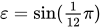
{\displaystyle \varepsilon =\sin({\tfrac {1}{12}}\pi )}
1
+
2
[
∑
n
=
1
∞
s
e
c
h
(
3
π
n
)
]
=
2
π
K
[
sin
(
1
12
π
)
]
=
1
6
π
4
3
27
4
β
(
1
3
)
{\displaystyle 1+2{\biggl [}\sum _{n=1}^{\infty }\mathrm {sech} ({\sqrt {3}}\,\pi \,n){\biggr ]}={\frac {2}{\pi }}\,K{\bigl [}\sin({\tfrac {1}{12}}\pi ){\bigr ]}={\frac {1}{6\,\pi }}{\sqrt[{3}]{4}}\,{\sqrt[{4}]{27}}\,\beta ({\tfrac {1}{3}})}
Im Gegensatz zu den nun gezeigten Integralen können jedoch nicht alle vollständigen elliptischen Integrale erster Art mit Hilfe der reduzierten Eulerschen Betafunktion als einzigen nicht-elementaren Funktionsausdruck dargestellt werden!
↑ Ilʹja N. Bronštejn: Taschenbuch der Mathematik . 11., aktualisierte Auflage. Haan-Gruiten 2020, ISBN 978-3-8085-5792-1 , S. 1111 (Formel 433).
↑ Ilʹja N. Bronštejn: Taschenbuch der Mathematik . 11., aktualisierte Auflage. Haan-Gruiten 2020, ISBN 978-3-8085-5792-1 , S. 1111 (Formel 432).
↑ a b Ilʹja N. Bronštejn: Taschenbuch der Mathematik . 11., aktualisierte Auflage. Haan-Gruiten 2020, ISBN 978-3-8085-5792-1 , S. 1080 (Abweichende Definition der Euler- bzw. Bernoulli-Zahlen).
↑ Eric W. Weisstein : Jacobi Theta Functions .MathWorld ↑ http://wayback.cecm.sfu.ca/~pborwein/TEMP_PROTECTED/pi-agm.pdf ↑ DLMF: 20.5 Infinite Products and Related Results. Abgerufen am 13. August 2022 .







![{\displaystyle \operatorname {gd} (x)=\arctan {\bigl [}\sinh(x){\bigr ]}}](/media/api/rest_v1/media/math/render/svg/bf151b0da37f0636e4b2fa97e87ab18f30e1c3d8)

![{\displaystyle \int _{0}^{x}y\,\operatorname {csch} (y)\,\mathrm {d} y=2\,\operatorname {Li} _{2}[\tanh({\tfrac {1}{2}}x)]-{\tfrac {1}{2}}\,\operatorname {Li} _{2}[\tanh({\tfrac {1}{2}}x)^{2}]=2\,\operatorname {Li} _{2}[1-\exp(-x)]-{\tfrac {1}{2}}\,\operatorname {Li} _{2}[1-\exp(-2x)]}](/media/api/rest_v1/media/math/render/svg/46a6d0e272a5d4b61405318ffb12cd53e7a1160c)


![{\displaystyle \int _{0}^{x}\operatorname {sech} (y)\,\mathrm {d} y=\operatorname {gd} (x)=\arctan[\sinh(x)]=\arcsin[\tanh(x)]=2\arctan[\tanh({\tfrac {1}{2}}x)]=}](/media/api/rest_v1/media/math/render/svg/6ec65c2a7137fe2892c2aad91763b992ec1ea65d)
![{\displaystyle ={\tfrac {1}{2}}\pi -2\arctan[\exp(-x)]=2\arctan[\exp(x)]-{\tfrac {1}{2}}\pi }](/media/api/rest_v1/media/math/render/svg/0c71f0694e643386bff33620ab5889734a1d2a58)
![{\displaystyle \int _{0}^{x}{\sqrt {\operatorname {sech} (y)}}\,\mathrm {d} y=2\,\operatorname {arcsl} [\tanh({\tfrac {1}{2}}x)]}](/media/api/rest_v1/media/math/render/svg/bcba5f0447b30ce51fa62cf1d5c3b23e4b356f2b)
![{\displaystyle \int _{0}^{x}{\sqrt[{3}]{\operatorname {sech} (y)}}\,\mathrm {d} y={\frac {1}{2}}{\sqrt[{4}]{27}}\,{\text{F}}\left\{2\arctan \left[{\frac {\tanh(x)}{{\sqrt[{4}]{3}}\,\operatorname {sech} (x)^{1/3}{\sqrt {1+\operatorname {sech} (x)^{2/3}+\operatorname {sech} (x)^{4/3}}}}}\right];\sin \left({\frac {1}{12}}\pi \right)\right\}}](/media/api/rest_v1/media/math/render/svg/e2efe47a0cacf7ab1b9f67663c63609d9d3a4925)
![{\displaystyle \int _{0}^{x}{\sqrt[{3}]{\operatorname {sech} (y)^{2}}}\,\mathrm {d} y={\frac {1}{2}}{\sqrt[{4}]{27}}\,{\text{F}}\left\{2\arctan \left[{\frac {\tanh(x)}{{\sqrt[{4}]{3}}{\sqrt {1+\operatorname {sech} (x)^{2/3}+\operatorname {sech} (x)^{4/3}}}}}\right];\cos \left({\frac {1}{12}}\pi \right)\right\}}](/media/api/rest_v1/media/math/render/svg/5f9f87387bd9a55fe6da0526e313e5a7f2d6a5ec)


![{\displaystyle \operatorname {gd} (z)=\sum _{k=0}^{\infty }2(-1)^{k}\arctan \left[{\frac {2z}{(2k+1)\pi }}\right]}](/media/api/rest_v1/media/math/render/svg/06526672b7a6ae9ca4182fb6940b094f3063a180)




![{\displaystyle 1+2{\biggl \{}\sum _{n=1}^{\infty }\mathrm {sech} {\biggl [}\pi \,n\,{\frac {K'(\varepsilon )}{K(\varepsilon )}}{\biggr ]}{\biggr \}}=1+2{\biggl [}\sum _{n=1}^{\infty }{\frac {2\,q(\varepsilon )^{n}}{1+q(\varepsilon )^{2n}}}{\biggr ]}=\vartheta _{00}[q(\varepsilon )]^{2}={\frac {2}{\pi }}\,K(\varepsilon )}](/media/api/rest_v1/media/math/render/svg/825cd022ea758af5544bb7b6d5e1ad6155977a08)


![{\displaystyle q(\varepsilon )=\exp {\bigl [}-\pi \,{\frac {K'(\varepsilon )}{K(\varepsilon )}}{\bigr ]}}](/media/api/rest_v1/media/math/render/svg/3672e5c0ad54377625bda0af96b57d3018e3093f)
![{\displaystyle 1+2{\biggl \{}\sum _{n=1}^{\infty }\mathrm {sech} {\biggl [}\pi \,n\,{\frac {K'(\varepsilon )}{K(\varepsilon )}}{\biggr ]}{\biggr \}}={\frac {2}{\pi }}\,K(\varepsilon )}](/media/api/rest_v1/media/math/render/svg/f7ad852bb5f3ca99cdc62d6076c0047698dd0ec6)

![{\displaystyle 1+2{\biggl [}\sum _{n=1}^{\infty }\mathrm {sech} (\pi \,n){\biggr ]}={\frac {2}{\pi }}\,K{\bigl (}{\tfrac {1}{2}}{\sqrt {2}}\,{\bigr )}={\frac {1}{2\,\pi }}\,\beta ({\tfrac {1}{4}})}](/media/api/rest_v1/media/math/render/svg/bf93b8cb578f33511e1c5e3e61ddd04b11c58078)

![{\displaystyle 1+2{\biggl [}\sum _{n=1}^{\infty }\mathrm {sech} ({\sqrt {2}}\,\pi \,n){\biggr ]}={\frac {2}{\pi }}\,K({\sqrt {2}}-1)={\frac {1}{4\,\pi }}{\sqrt[{4}]{2}}\,({\sqrt {2}}+1)\,\beta ({\tfrac {3}{8}})}](/media/api/rest_v1/media/math/render/svg/26e4615a529fbba890c7f4d2893a797d756eecca)
![{\displaystyle 1+2{\biggl [}\sum _{n=1}^{\infty }\mathrm {sech} ({\sqrt {3}}\,\pi \,n){\biggr ]}={\frac {2}{\pi }}\,K{\bigl [}\sin({\tfrac {1}{12}}\pi ){\bigr ]}={\frac {1}{6\,\pi }}{\sqrt[{3}]{4}}\,{\sqrt[{4}]{27}}\,\beta ({\tfrac {1}{3}})}](/media/api/rest_v1/media/math/render/svg/fce7739c8f7f6387b0079cc1e9cacd62eafff1f0)