


Absolutely and completely monotonic functions and sequences
In mathematics, the notions of an absolutely monotonic function and a completely monotonic function are two very closely related concepts. Both imply very strong monotonicity properties. Both types of functions have derivatives of all orders. In the case of an absolutely monotonic function, the function as well as its derivatives of all orders must be non-negative in its domain of definition which would imply that the function as well as its derivatives of all orders are monotonically increasing functions in the domain of definition. In the case of a completely monotonic function, the function and its derivatives must be alternately non-negative and non-positive in its domain of definition which would imply that function and its derivatives are alternately monotonically increasing and monotonically decreasing functions.
Such functions were first studied by S. Bernstein in 1914 and the terminology is also due to him.[1][2][3] There are several other related notions like the concepts of almost completely monotonic function, logarithmically completely monotonic function, strongly logarithmically completely monotonic function, strongly completely monotonic function and almost strongly completely monotonic function.[4][5] Another related concept is that of a completely/absolutely monotonic sequence. This notion was introduced by Hausdorff in 1921.
The notions of completely and absolutely monotonic function/sequence play an important role in several areas of mathematics. For example, in classical analysis they occur in the proof of the positivity of integrals involving Bessel functions or the positivity of Cesàro means of certain Jacobi series.[6] Such functions occur in other areas of mathematics such as probability theory, numerical analysis, and elasticity.[7]
Absolutely and completely monotonic functions
[edit]Definitions
[edit]A real valued function defined over an interval in the real line is called an absolutely monotonic function if it has derivatives of all orders and for all in .[1] The function is called a completely monotonic function if for all in .[1]






The two notions are mutually related. The function is completely monotonic if and only if is absolutely monotonic on where the interval obtained by reflecting with respect to the origin. (Thus, if is the interval then is the interval .)


In applications, the interval on the real line that is usually considered is the closed-open right half of the real line, that is, the interval .

Sometimes, especially when defining completely monotonic functions on semigroups,[8][9][10] they are defined as functions such that for all sequences for all where is the finite difference operator defined by .


Examples
[edit]The following functions are absolutely monotonic in the specified regions.[11]: 142–143
- , where a non-negative constant, in the region
- , where for all , in the region
- in the region
- in the region
- in the region



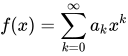


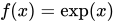


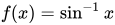

The following functions are completely monotonic on [0,∞)
- for
- for
- for
- because it is the Laplace transform of


The following combinations of completely and absolutely monotonic functions are completely monotonic[12]:
- non-negative linear combination of completely monotonic functions
- product of completely monotonic functions
- where is absolutely monotonic and is completely monotonic
- where is completely monotonic and is a Bernstein function ( and its derivative is completely monotonic)


The forward difference for of a completely monotonic function is completely monotonic (since is a decreasing function for all ).


Upper bound on derivatives
[edit]If is completely monotonic, we can use Taylor's theorem with the Lagrange remainder

where and we have used that for all and is decreasing. From this we get the upper bound


Compactness
[edit]The set of completely monotonic functions on such that is a compact subset of for the usual Fréchet topology.


Bernstein's little theorem
[edit]Bernstein's little theorem states that a function that is absolutely monotonic on the open interval can be extended to an analytic function on the open disk in the complex plane defined by and this function will be absolutely monotonic on the interval .[11][13] It follows that if a function is absolutely monotonic on then it can be extended to an analytic function on the complex half-plane and if it is absolutely monotonic on then it can be extended to a function that is analytic in the whole complex plane.


A function that is completely monotonic on the open interval can be extended to an analytic function on the open disk in the complex plane defined by and this function will be completely monotonic on the interval . It follows that if a function is completely monotonic on then it can be extended to an analytic function on the complex half-plane and if it is completely monotonic on then it can be extended to a function that is analytic in the whole complex plane.

![{\displaystyle (a,b]}](/media/api/rest_v1/media/math/render/svg/6a6969e731af335df071e247ee7fb331cd1a57ae)

Representation
[edit]Bernstein's theorem on monotone functions: A function that is completely monotonic on can be represented there as a Laplace integral in the form

where is non-decreasing and bounded on .

Log-convexity
[edit]From the Laplace transform representation we get

and then we can use the Cauchy–Schwarz inequality applied to the functions and with weight to get


This means that for every the sequence for is log-convex. It also means that for every the function is log-convex because .


More general inequalities can be found based on the notion of Schur-convexity.[14][15]
Bernstein functions
[edit]Definition
[edit]Related to the above, Bernstein functions are defined as those that are non-negative and whose derivative is completely monotonic.
Examples
[edit]The following functions are Bernstein functions
- for
- for

![{\displaystyle \beta \in [0,1]}](/media/api/rest_v1/media/math/render/svg/ee888ffc8e3e1b7496794b19b3ca0b653b6544ba)


Representation
[edit]Every Bernstein function has the representation:

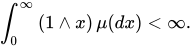
where and is a measure on the positive real half-line such that


Absolutely and completely monotonic sequences
[edit]Definition
[edit]A sequence is called an absolutely monotonic sequence if its elements are non-negative and its successive differences are all non-negative, that is, if


where .
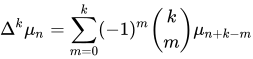
A sequence is called a completely monotonic sequence if its elements are non-negative and its successive differences are alternately non-positive and non-negative,[11]: 101 that is, if

Examples
[edit]The sequences and for are completely monotonic sequences.


Representation
[edit]A sequence is completely monotonic if and only if there exists an increasing function on such that


![{\displaystyle [0,1]}](/media/api/rest_v1/media/math/render/svg/738f7d23bb2d9642bab520020873cccbef49768d)

The determination of this function from the sequence is referred to as the Hausdorff moment problem.
Logarithmically completely monotonic functions
[edit]A positive function is said to be logarithmically completely monotonic if is completely monotonic.

Every logarithmically completely monotonic function is completely monotonic.[16][17] Writing with , Faà di Bruno’s formula expresses the -th derivative of as


where denotes the -th Bell polynomial. Each Bell polynomial is a finite sum of monomials of the form with the exponents satisfying and all coefficients strictly positive. Since logarithmic complete monotonicity implies , we get


so that .

As , it follows that . As this true for all , we get that is completely monotonic.

Note that this is a special case of being completely monotonic when is absolutely monotonic and is completely monotonic, for the case of being the exponential function. This can be proved as above with the more general version of Faà di Bruno’s formula.


The converse implication is false in general, and logarithmically completely monotonic functions form a proper subclass of completely monotonic functions.
Further reading
[edit]The following is a selection from the large body of literature on absolutely/completely monotonic functions/sequences.
- René L. Schilling, Renming Song and Zoran Vondraček (2010). Bernstein Functions Theory and Applications. De Gruyter. pp. 1–10. ISBN 978-3-11-021530-4. (Chapter 1 Laplace transforms and completely monotone functions)
- D. V. Widder (1946). The Laplace Transform. Princeton University Press. See Chapter III The Moment Problem (pp. 100 - 143) and Chapter IV Absolutely and Completely Monotonic Functions (pp. 144 - 179).
- Milan Merkle (2014). Analytic Number Theory, Approximation Theory, and Special Functions. Springer. pp. 347–364. arXiv:1211.0900. (Chapter: "Completely Monotone Functions: A Digest")
- Arvind Mahajan and Dieter K Ross (1982). "A note on completely and absolutely monotonic functions" (PDF). Canadian Mathematical Bulletin. 25 (2): 143–148. doi:10.4153/CMB-1982-020-x. Retrieved 28 December 2023.
- Senlin Guo, Hari M Srivastava and Necdet Batir (2013). "A certain class of completely monotonic sequences" (PDF). Advances in Difference Equations. 294: 1–9. doi:10.1186/1687-1847-2013-294. Retrieved 29 December 2023.
- Yajima, S.; Ibaraki, T. (March 1968). "A Theory of Completely Monotonic Functions and its Applications to Threshold Logic". IEEE Transactions on Computers. C-17 (3): 214–229. doi:10.1109/tc.1968.229094.
See also
[edit]- Bernstein's theorem on monotone functions
- Hausdorff moment problem
- Monotonic function
- Cyclical monotonicity
References
[edit]- ^ a b c "Absolutely monotonic function". encyclopediaofmath.org. Encyclopedia of Mathematics. Retrieved 28 December 2023.
- ^ S. Bernstein (1914). "Sur la définition et les propriétés des fonctions analytique d'une variable réelle". Mathematische Annalen. 75 (4): 449–468. doi:10.1007/BF01563654.
- ^ S. Bernstein (1928). "Sur les fonctions absolument monotones". Acta Mathematica. 52: 1–66. doi:10.1007/BF02592679.
- ^ Guo, Senlin (2017). "Some Properties of Functions Related to Completely Monotonic Functions" (PDF). Filomat. 31 (2): 247–254. doi:10.2298/FIL1702247G. Retrieved 29 December 2023.
- ^ Guo, Senlin; Laforgia, Andrea; Batir, Necdet; Luo, Qiu-Ming (2014). "Completely Monotonic and Related Functions: Their Applications" (PDF). Journal of Applied Mathematics. 2014: 1–3. doi:10.1155/2014/768516. Retrieved 28 December 2023.
- ^ R. Askey (1973). "Summability of Jacobi series". Transactions of the American Mathematical Society. 179: 71–84. doi:10.1090/S0002-9947-1973-0315351-7.
- ^ William Feller (1971). An Introduction to Probability Theory and Its Applications, Vol. 2 (3 ed.). New York: Wiley. ISBN 9780471257097. OCLC 279852.
- ^ Choquet, Gustave (1954). "Theory of capacities". Annales de l'Institut Fourier. 5: 131–295. doi:10.5802/aif.53. ISSN 1777-5310.
- ^ Berg, Christian; Christensen, Jens Peter Reus; Ressel, Paul (1984). Harmonic Analysis on Semigroups. Graduate Texts in Mathematics. Vol. 100. New York, NY: Springer New York. doi:10.1007/978-1-4612-1128-0. ISBN 978-1-4612-7017-1.
- ^ Aguech, Rafik; Jedidi, Wissem (2019). "New characterizations of completely monotone functions and Bernstein functions, a converse to Hausdorff's moment characterization theorem". Arab Journal of Mathematical Sciences. 25 (1): 57–82. doi:10.1016/j.ajmsc.2018.03.001.
- ^ a b c Widder, David Vernon (1946). The Laplace Transform. Princeton University Press. ISBN 9780486477558. OCLC 630478002.
{{cite book}}: ISBN / Date incompatibility (help) - ^ Fasshauer, Greg (2010). "Chapter 5: Completely Monotone and Multiply Monotone Functions" (PDF). MATH 590: Meshfree Methods.
- ^ Szabó, V.E.S. (2026). "Completely monotone functions in general and some applications". Journal of Mathematical Analysis and Applications. 554 (2): 129984. doi:10.1016/j.jmaa.2025.129984.
{{cite journal}}: CS1 maint: article number as page number (link) - ^ Fink, A.M (1982). "Kolmogorov-Landau inequalities for monotone functions". Journal of Mathematical Analysis and Applications. 90 (1): 251–258. doi:10.1016/0022-247X(82)90057-9.
- ^ Merkle, Milan (2014), Milovanović, Gradimir V.; Rassias, Michael Th. (eds.), "Completely Monotone Functions: A Digest", Analytic Number Theory, Approximation Theory, and Special Functions, New York, NY: Springer New York, pp. 347–364, doi:10.1007/978-1-4939-0258-3_12, ISBN 978-1-4939-0257-6, retrieved 2026-02-06
{{citation}}: CS1 maint: work parameter with ISBN (link) - ^ Horn, Roger A. (1967). "On infinitely divisible matrices, kernels, and functions". Zeitschrift für Wahrscheinlichkeitstheorie und Verwandte Gebiete. 8 (3): 219–230. doi:10.1007/BF00531524. ISSN 0044-3719.
- ^ Guo, Bai-Ni; Qi, Feng (2010). "A property of logarithmically absolutely monotonic functions and the logarithmically complete monotonicity of a power-exponential function" (PDF). U.P.B. Sci. Bull., Series A, Applied Mathematics and Physics. 72 (2): 21–30. ISSN 1223-7027.