aus Wikipedia, der freien Enzyklopädie
Dieser Artikel oder nachfolgende Abschnitt ist nicht hinreichend mit
Belegen (beispielsweise
Einzelnachweisen ) ausgestattet. Angaben ohne ausreichenden Beleg könnten demnächst entfernt werden. Bitte hilf Wikipedia, indem du die Angaben recherchierst und
gute Belege einfügst.
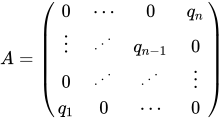
Als Antidiagonalmatrix bezeichnet man im mathematischen Teilgebiet der linearen Algebra eine quadratische Matrix , bei der alle Elemente außerhalb der Gegendiagonale Null sind. Sie ist also von der Form
A
=
(
0
⋯
0
q
n
⋮
⋅
⋅
⋅
q
n
−
1
0
0
⋅
⋅
⋅
⋅
⋅
⋅
⋮
q
1
0
⋯
0
)
{\displaystyle A={\begin{pmatrix}0&\cdots &0&q_{n}\\\vdots &\scriptstyle \cdot ^{\,\scriptstyle \cdot ^{\,\scriptstyle \cdot }}&q_{n-1}&0\\0&\scriptstyle \cdot ^{\,\scriptstyle \cdot ^{\,\scriptstyle \cdot }}&\scriptstyle \cdot ^{\,\scriptstyle \cdot ^{\,\scriptstyle \cdot }}&\vdots \\q_{1}&0&\cdots &0\end{pmatrix}}}
Eine
n
×
n
{\displaystyle n\times n}
A
=
(
a
i
j
)
i
,
j
=
1
,
…
,
n
{\displaystyle A=(a_{ij})_{i,j=1,\ldots ,n}}
i
,
j
∈
{
1
,
…
,
n
}
{\displaystyle i,j\in \left\{1,\ldots ,n\right\}}
i
+
j
≠
n
+
1
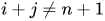
{\displaystyle i+j\not =n+1}
(
i
,
j
)
{\displaystyle (i,j)}
i
+
j
≠
n
+
1
⇒
a
i
j
=
0
{\displaystyle i+j\not =n+1\Rightarrow a_{ij}=0}
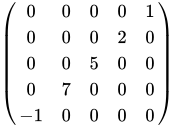
Ein Beispiel einer Antidiagonalmatrix ist
(
0
0
0
0
1
0
0
0
2
0
0
0
5
0
0
0
7
0
0
0
−
1
0
0
0
0
)
{\displaystyle {\begin{pmatrix}0&0&0&0&1\\0&0&0&2&0\\0&0&5&0&0\\0&7&0&0&0\\-1&0&0&0&0\end{pmatrix}}}
Die Determinante von
A
=
(
0
⋯
0
q
n
⋮
⋅
⋅
⋅
q
n
−
1
0
0
⋅
⋅
⋅
⋅
⋅
⋅
⋮
q
1
0
⋯
0
)
{\displaystyle A={\begin{pmatrix}0&\cdots &0&q_{n}\\\vdots &\scriptstyle \cdot ^{\,\scriptstyle \cdot ^{\,\scriptstyle \cdot }}&q_{n-1}&0\\0&\scriptstyle \cdot ^{\,\scriptstyle \cdot ^{\,\scriptstyle \cdot }}&\scriptstyle \cdot ^{\,\scriptstyle \cdot ^{\,\scriptstyle \cdot }}&\vdots \\q_{1}&0&\cdots &0\end{pmatrix}}}
ist
det
(
A
)
=
(
−
1
)
(
n
2
)
q
1
q
2
…
q
n
.
{\displaystyle \det(A)=(-1)^{n \choose 2}q_{1}q_{2}\ldots q_{n}.}
Falls alle
q
i
{\displaystyle q_{i}}
A
{\displaystyle A}
invertierbar und die zu
A
{\displaystyle A}
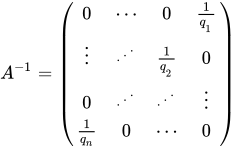
inverse Matrix ist
A
−
1
=
(
0
⋯
0
1
q
1
⋮
⋅
⋅
⋅
1
q
2
0
0
⋅
⋅
⋅
⋅
⋅
⋅
⋮
1
q
n
0
⋯
0
)
{\displaystyle A^{-1}={\begin{pmatrix}0&\cdots &0&{\frac {1}{q_{_{1}}}}\\\vdots &\scriptstyle \cdot ^{\,\scriptstyle \cdot ^{\,\scriptstyle \cdot }}&{\frac {1}{q_{_{2}}}}&0\\0&\scriptstyle \cdot ^{\,\scriptstyle \cdot ^{\,\scriptstyle \cdot }}&\scriptstyle \cdot ^{\,\scriptstyle \cdot ^{\,\scriptstyle \cdot }}&\vdots \\{\frac {1}{q_{n}}}&0&\cdots &0\end{pmatrix}}}
Das Produkt zweier Antidiagonalmatrizen ist eine Diagonalmatrix . Das Produkt einer Antidiagonalmatrix mit einer Diagonalmatrix (oder umgekehrt) ist eine Antidiagonalmatrix.
Antidiagonalmatrizen sind persymmetrisch .