


Grover's algorithm
Grover's algorithm is a quantum algorithm for searching an unsorted database with N entries in O(N1/2) time and using O(log N) storage space (see big O notation). It was invented by Lov Grover in 1996.
In models of classical computation, searching an unsorted database cannot be done in less than linear time (so merely searching through every item is optimal). Grover's algorithm illustrates that in the quantum model searching can be done faster than this; in fact its time complexity O(N1/2) is asymptotically the fastest possible for searching an unsorted database in the quantum model.[1] It provides a quadratic speedup, unlike other quantum algorithms, which may provide exponential speedup over their classical counterparts. However, even quadratic speedup is considerable when N is large.
Like many quantum algorithms, Grover's algorithm is probabilistic in the sense that it gives the correct answer with high probability. The probability of failure can be decreased by repeating the algorithm. (An example of a deterministic quantum algorithm is the Deutsch-Jozsa algorithm, which always produces the correct answer.)
Applications
Although the purpose of Grover's algorithm is usually described as "searching a database", it may be more accurate to describe it as "inverting a function". Roughly speaking, if we have a function y=f(x) that can be evaluated on a quantum computer, this algorithm allows us to calculate x when given y. Inverting a function is related to the searching of a database because we could come up with a function that produces a particular value of y if x matches a desired entry in a database, and another value of y for other values of x.
Grover's algorithm can also be used for estimating the mean and median of a set of numbers, and for solving the Collision problem. The algorithm can be further optimized if there is more than one matching entry and the number of matches is known beforehand.
Setup
Consider an unsorted database with N entries. The algorithm requires an N-dimensional state space H, which can be supplied by n=log2 N qubits.
Let us denote the database entries by 1, 2,... , N. Choose an observable, Ω, acting on H, with N distinct eigenvalues whose values are all known. Each of the eigenstates of Ω encode one of the entries in the database, in a manner that we will describe. Denote the eigenstates (using bra-ket notation) as

and the corresponding eigenvalues by

We are provided with a unitary operator, Uω, which acts as a subroutine (or quantum black box) that compares database entries according to some search criterion. The algorithm does not specify how this subroutine works, but it must be a quantum subroutine that works with superpositions of states. Furthermore, it must act specially on one of the eigenstates, , which corresponds to the database entry matching the search criterion. To be precise, we require Uω to have the following effects:

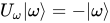

Our goal is to identify this eigenstate , or equivalently the eigenvalue ω, that Uω acts specially upon. (Although this model may look arbitrary, it is the natural quantum model of a black box function with a domain of N inputs that returns true for exactly one output and false for all others.)
Algorithm steps

The steps of Grover's algorithm are given as follows. Let denotes the uniform distribution over all states

- .

Then the operator

is known as the Grover diffusion operator.
Here is the algorithm:
- Initialize the system to the state
- Perform the following "Grover iteration" r(N) times. The function r(N), which is asymptotically O(N½), is described below.
- Apply the operator .
- Apply the operator .
- Perform the measurement Ω. The measurement result will be λω with probability approaching 1 for N≫1. From λω, ω may be obtained.


The first iteration
A preliminary observation, in parallel with our definition
- ,
is that Uω can be expressed in an alternate way:
- .

To prove this it suffices to check how Uω acts on basis states:
- .
- for all .


The following computations show what happens in the first iteration:
- .
- .
- .
- .

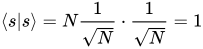



After application of the two operators ( and ), the amplitude of the searched-for element has increased from to .


Geometric proof of correctness
Consider the plane spanned by |s> and |ω>. Let |ω×> be a ket in this plane perpendicular to |ω>. Since |ω> is one of the basis vectors, the overlap is
In geometric terms, the angle θ between |ω> and |s> is given by:

The operator Uω is a reflection at the hyperplane orthogonal to |ω>; for vectors in the plane spanned by |s> and |ω>, it acts as a reflection at the line through |ω×>. The operator Us is a reflection at the line through |s>. Therefore, the state vector remains in the plane spanned by |s> and |ω> after each application of Us and after each application of Uω, and it is straightforward to check that the operator UsUω of each Grover iteration step rotates the state vector by an angle of .

We need to stop when the state vector passes close to |ω>; after this, subsequent iterations rotate the state vector away from |ω>, reducing the probability of obtaining the correct answer. The exact probability of measuring the correct answer is:

where r is the (integer) number of Grover iterations. The earliest time that we get a near-optimal measurement is therefore .

Algebraic proof of correctness
To complete the algebraic analysis we need to find out what happens when we repeatedly apply . A natural way to do this is by eigenvalue analysis of a matrix. Notice that during the entire computation, the state of the algorithm is a linear combination of and . We can write the action of and in the space spanned by as:


So in the basis (which is neither orthogonal nor a basis of the whole space) the action of applying followed by is given by the matrix


This matrix happens to have a very convenient Jordan form. If we define , it is

- where

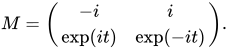
It follows that rth power of the matrix (corresponding to r iterations) is

Using this form we can use trigonometric identities to compute the probability of observing ω after r iterations mentioned in the previous section,
- .

Alternatively, one might reasonably imagine that a near-optimal time to distinguish would be when the angles 2rt and -2rt are as far apart as possible, which corresponds to or . Then the system is in state



A short calculation now shows that the observation yields the correct answer ω with error O(1/N).
Extensions
If, instead of 1 matching entry, there are k matching entries, the same algorithm works but the number of iterations must be π(N/k)1/2/4 instead of πN1/2/4. There are several ways to handle the case if k is unknown. For example, one could run Grover's algorithm several times, with

iterations. For any k, one of iterations will find a matching entry with a sufficiently high probability. The total number of iterations is at most

which is still O(N1/2).
It can be shown that this could be improved. If the number of marked items is k, where k is unknown, there is an algorithm that finds the solution in queries. This fact is used in order to solve the collision problem.

Optimality
It is known that Grover's algorithm is optimal. That is, any algorithm that accesses the database only by using the operator Uω must apply Uω at least as many times as Grover's algorithm.[1] This result is important in understanding the limits of quantum computation. If the Grover's search problem was solvable with logc N applications of Uω, that would imply that NP is contained in BQP, by transforming problems in NP into Grover-type search problems. The optimality of Grover's algorithm suggests (but does not prove) that NP is not contained in BQP.
The number of iterations for k matching entries, π(N/k)1/2/4, is also optimal.[2]
See also
References
- Grover L.K.: A fast quantum mechanical algorithm for database search, Proceedings, 28th Annual ACM Symposium on the Theory of Computing, (May 1996) p. 212
- Grover L.K.: From Schrödinger's equation to quantum search algorithm, American Journal of Physics, 69(7): 769-777, 2001. Pedagogical review of the algorithm and its history.
- What's a Quantum Phone Book?, Lov Grover, Lucent Technologies
- Grover's Algorithm: Quantum Database Search, C. Lavor, L.R.U. Manssur, R. Portugal
- Grover's algorithm on arxiv.org
Notes
- ^ a b Bennett C.H., Bernstein E., Brassard G., Vazirani U., The strengths and weaknesses of quantum computation. SIAM Journal on Computing 26(5): 1510–1523 (1997). Shows the optimality of Grover's algorithm.
- ^ Michel Boyer; Gilles Brassard; Peter Hoeyer; Alain Tapp (1996). "Tight bounds on quantum searching". arXiv:quant-ph/9605034v1.
{{cite arXiv}}:|class=ignored (help)
| General | |||||||||
|---|---|---|---|---|---|---|---|---|---|
| Theorems | |||||||||
| Quantum communication |
| ||||||||
| Quantum algorithms | |||||||||
| Quantum complexity theory | |||||||||
| Quantum processor benchmarks | |||||||||
| Quantum computing models | |||||||||
| Quantum error correction | |||||||||
| Physical implementations |
| ||||||||
| Quantum programming | |||||||||

